Categories
Fuzhou people
 From Wikipedia - Reading time: 13 min
| |
|---|---|
 Hockchew women in Bible Women's Training School during a women's class in Fuzhou, 1873. | |
| Total population | |
| 10,000,000 | |
| Regions with significant populations | |
| |
| Languages | |
Standard Chinese, Fuzhou dialect (prestige), Gutian dialect, Ningde dialect, Fuqing dialect
| |
| Religion | |
| Atheism, Chinese folk religions (including Taoism, Confucianism, ancestral worship and others), Chinese Buddhism, Christianity and non-religious | |
| Related ethnic groups | |
| Fuzhou Americans, Minbei people, Putian people, Fuzhou Tanka, other Chinese people |


Fuzhou people (Chinese: 福州人; Foochow Romanized: Hók-ciŭ-nè̤ng), also known as Foochowese, Hokchew, Hokchia, Hokchiu, Fuzhou Shiyi people (福州十邑人), Eastern Min or Mindong are a subgroup of Han Chinese of either Fuzhou and Mindong regions and the Gutian and Pingnan counties of Fujian province and Matsu Islands in Taiwan. Fuzhou people are a part of the Min Chinese-speaking group that speaks Eastern Min or specifically Fuzhou dialect. There is also a significant overseas Fuzhou population, particularly distributed in Japan, United States (Fuzhou Americans), Canada, Australia, New Zealand, Malaysia, Indonesia, Singapore and the United Kingdom.[1]
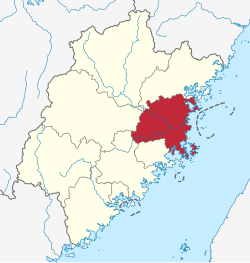
Language
[edit]Fuzhou dialect is a tonal language that has extensive sandhi rules in the initials, rimes, and tones. These complicated rules make Fuzhou dialect one of the most difficult Chinese varieties.[2]
Dialects
[edit]List of dialects of the Fuzhou language (福州話的方言):
- Min county dialect (prestige) – Fuzhou and Minhou county
- Gutian dialect
- Ningde dialect
- Changle dialect
- Fuqing dialect, includes Pingtan Island and parts of Changle
- Matsu dialect
- Minqing dialect 福州閩清話 - Minqing county
City history
[edit]Fuzhou throughout the 1800s had many missionaries from the West coming in and out of the city.[3] The lack of communication between government officials and local town people led to uproar among local residence regarding missionaries.[3] Although around 1850 five major ports were allowing foreigners to reside temporarily for missionary work, Fuzhounese people believed only their city was allowing this.[3] Fuzhou natives were against missionaries as well as confronting Europeans in regards to business arrangements. At the same time Fuzhou had missionaries present, other cities such as Guangzhou started rebelling against foreigners. While Daoist people as well as monks showed hospitality towards missionaries unlike most other residents. Following the lead of Guangzhou people, Fuzhounese natives soon also rebelled. Miscommunication was a large part of misunderstanding by Fuzhounese people. During the 1800s there were five port cities that were of interest of Europeans. Shanghai and Ningbo in addition of Fuzhou, were also allowing residency for missionaries during this time. The western powers felt similar resentment towards China as China did on the West.[4]
Education and technology
[edit]Throughout the Ming and Qing dynasties, local lineages were of high importance. The success rate regarding education throughout Fuzhou was often linked to the lineage members. As part of a lineage, it was the responsibility of a community to ensure successful education occurred. Education began as a private matter and not regulated throughout different lineages. The ability for a lineage to teach the fundamentals would determine people's later success with imperial examinations given throughout much of China. Shu-yuan were considered highly educated people who succeeded on given examinations. Many of these shu-yuan, around eighteen, were associated with Fuzhou fu throughout Ming and Qing dynasty. Some of the eighteen may have been from Song dynasty. However, there is less evidence to back up those claims.[5]
Although over time southeastern Fujian Province is more developed in terms of technology and resources, Fujian decided on the capital Fuzhou which is in North Fujian.[4] Fujian has had a lower rate of urbanization in comparison to China as a whole. As a result, in provinces such as Fuzhou, the locals tend to be behind on methods in regards to agriculture and technological advancements. Fujian is rich in their ability to fish due to their location along the coastline. Fuzhou can not only participate in fishing itself but also the transporting of goods along the sea. Due to the richness of resources, the desire for migration to Fuzhou is high. As a result, people desiring to move to Fuzhou must have high education levels as well as skills necessary to contribute to the society.[4]
Emigration and diaspora
[edit]
History
[edit]Fuzhou's history of emigration began since the Ming dynasty with Zheng He's voyages overseas. As the result of immigration of Fuzhounese to Southeast Asia, Fuzhou dialect is found in Malaysia and Indonesia. The city of Sibu of Malaysia is called "New Fuzhou" due to a significant wave of Fuzhounese immigration in the early 1900s. They are referred to as "Hockchiu" or "Hokchew" in Malaysia and Singapore and "Hokchia" in Indonesia.[6]
Japan
[edit]Some Fuzhou people have moved to Japan. Conversely, many Japanese have historically been interested in Fuzhou language. During the Second World War, some Japanese scholars became passionate about studying Fuzhou dialect, believing that it could be beneficial to the rule of the Greater East Asia Co-Prosperity Sphere. One of their most famous works was the Japanese-Chinese Translation: Fuzhou Dialect (日華對譯: 福州語) published in 1940 in Taipei, in which katakana was used to represent Fuzhou pronunciation.[citation needed]
Southeast Asia
[edit]The Hockchius and Hockchias migrated to Nanyang (South-East Asia) in much smaller numbers compared to the Hokkien, Cantonese, Hakkas and Hainanese peoples, but achieved remarkable success. Amongst others, Robert Kuok (Hockchiu) rose to become the "Sugar King" of Malaysia and is currently ranked the richest man in South-East Asia[7] whereas Liem Sioe Liong (Sudono Salim) who was of Hockchia origin, was once the richest man in Indonesia, controlling a vast empire in the industry of flour, cement and food manufacturing.[8]
United States
[edit]Fuzhounese people first started immigrating to America during the late Qing dynasty. Some of these immigrants were students who, after completing their studies returned to back to their fatherland (Fuzhou).
However, after the US passed the 1882 Chinese Exclusion Act, immigration from China to the USA stopped for nearly a century. Only in 1980s with the China-USA détente and subsequent reform and opening, a wave of Fuzhounese settled in America. These new Fuzhounese immigrants set up their own separated communities such as "Little Fuzhou" in Manhattan.
Notable Fuzhou people
[edit] | This section needs additional citations for verification. (March 2024) |
Scientists, mathematicians and inventors
[edit]- Chen Jingrun, mathematician
- Yan Fu, scholar and translator
- Chih-Tang Sah, professor
- Hou Debang, chemical engineer
- Hsien Wu, protein scientist
- Ray Wu, geneticist
- Zhang Yuzhe, astronomer
- Chia-Chiao Lin, mathematician and professor[9]
- Tung-Yen Lin, structural engineer
- Deng Xuquan, microbiologist[10]
- Wang Shizhen, physician
- Wu Mengchao, surgeon
- Guo Kexin, physicist, metallurgist and crystallographer
- Liu Yingming, mathematician and academician
- Sun Shensu, geochemist
- Chen Zhangliang, biologist, elected as vice-governor of Guangxi in 2007
- Min Zhuo, neuroscientist
-
 Yan Fu, a scientist who translated many of Charles Darwin's works and ideas into Chinese.
 -
 A famous protein scientist, Hsien Wu was the first to propose that protein denaturation was a purely conformational change.
 -
![Mathematics genius, Chen Jingrun invented the Chen's theorem and Chen prime, he also stunned famous mathematicians by providing better solutions to their works.[11]](https://upload.wikimedia.org/wikipedia/commons/thumb/e/e4/Chen_Jingrun.jpg/120px-Chen_Jingrun.jpg) Mathematics genius, Chen Jingrun invented the Chen's theorem and Chen prime, he also stunned famous mathematicians by providing better solutions to their works.[11]
Mathematics genius, Chen Jingrun invented the Chen's theorem and Chen prime, he also stunned famous mathematicians by providing better solutions to their works.[11] -
![Tung-Yen Lin, a Chinese-American structural engineer who was the pioneer of standardizing the use of prestressed concrete.[12]](https://upload.wikimedia.org/wikipedia/commons/thumb/4/47/%E6%9E%97%E5%90%8C%E7%82%8E%E5%85%88%E7%94%9F%E7%BA%AA%E5%BF%B5%E5%83%8F_2025-01-14_01.jpg/120px-%E6%9E%97%E5%90%8C%E7%82%8E%E5%85%88%E7%94%9F%E7%BA%AA%E5%BF%B5%E5%83%8F_2025-01-14_01.jpg) Tung-Yen Lin, a Chinese-American structural engineer who was the pioneer of standardizing the use of prestressed concrete.[12]
Tung-Yen Lin, a Chinese-American structural engineer who was the pioneer of standardizing the use of prestressed concrete.[12] -
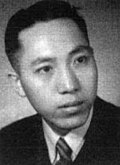 Wu Mengchao, a medical scientist who specialized in hepatobiliary surgery. He was also known as the "Father of Chinese Hepatobiliary Surgery".
 -
![Xiao Guangyan, a petrochemist known for his research on catalysts used in petroleum processing.[13][14]](https://upload.wikimedia.org/wikipedia/commons/thumb/c/c9/Xiao_Guangyan_%281920-1968%29_portrait.jpg/120px-Xiao_Guangyan_%281920-1968%29_portrait.jpg)
-
 Shu Chun Teng, a famous mycologist.
 -
 Chen Daisun (zh:陳岱孫), a finance scientist who is prominent in the history of economics research and education in China.
 -
 Zhang Yuzhe, an astronomer and director of the Purple Mountain Observatory who is widely regarded as the "Father of modern Chinese astronomy".
 -
 Min Zhuo, being an accomplished pain neuroscientist, he has won many honours and awards.
Politicians and revolutionaries
[edit]- Shen Song, a chancellor of the state Wuyue during the Five Dynasties and Ten Kingdoms Period
- Chen Youding, a warlord who quelled various uprisings at the end of Yuan dynasty in Fujian
- Zhang Jing, a prominent Ming dynasty general
- Chen Di, Ming-era philologist, strategist and traveler
- Gan Guobao, a Qing dynasty military leader
- Lin Zexu, a famous Qing dynasty scholar and official
- Shen Baozhen, Viceroy of Liangjiang from 1875 to 1879
- Chen Baochen, Chinese scholar and loyalist to the Qing dynasty
- Wong Nai Siong, a Chinese revolutionary leader and Christian scholar
- Chen Jitong, Chinese diplomat, general and scholar during the late Qing dynasty
- Lin Shu, Chinese scholar and translator, noted for his translation of Alexandre Dumas and La Dame aux Camélias
- Liu Buchan, naval officer of the Beiyang Fleet, the most prominent of China's naval units in the late Qing dynasty
- Lin Yongsheng, naval officer of the Beiyang Fleet, the most prominent of China's naval units in the late Qing dynasty
- Sa Zhenbing, naval officer of Mongolian origin
- Zheng Xiaoxu, Chinese statesman, diplomat and calligrapher
- Liu Guanxiong, Chinese Admiral who was Navy Minister of China, from 1912 to 1916 and 1917–1919
- Lin Sen, President of the Republic of China from 1931 to 1943
- Chin Peng, former leader of the Malayan Communist Party
- Lin Xu, Chinese politician, scholar, songwriter and poet who lived in the late Qing dynasty
- Du Xigui, Chinese admiral during the warlord era
- Liang Hongzhi, a leading politician in the collaborationist Reformed Government of the Republic of China during World War II
- Yin Ju-keng, a political leader in the early Republic of China
- Zhu Shaoliang, a general in the National Revolutionary Army of the Republic of China
- Xiao Shuxuan, a general in the Reorganized National Government of China
- Lin Juemin, Chinese revolutionary
- Fang Shengdong, Chinese revolutionary
- Fang Junying, Chinese revolutionary
- Chen Shaokuan, fleet admiral who served as the senior commander of naval forces of the National Revolutionary Army
-
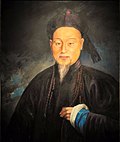 Lin Zexu, national hero of China.
 -
 Shen Baozhen, Viceroy of Liangjiang from 1875 to 1879.
 -
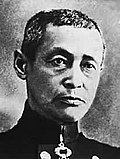 Sa Zhenbing, high-ranking naval officer of Mongolian origin who lived through four governments in China.
 -
 Lin Changmin (zh:林長民), high-ranking governor in the Beiyang Government.
 -
 Lin Juemin, one of 72 Revolutionary Martyrs at Huanghuagang.
 -
 Chen Baochen, imperial tutor of Puyi (the last emperor of China).
 -
 Zheng Xiaoxu, statesman, diplomat and calligrapher.
 -
 Wong Nai Siong, prominent Qing era revolutionary leader.
 -
 Chen Shaokuan, high-ranking military commander of Republic of China Navy.
 -
 Zou Taofen, journalist, media entrepreneur, and political activist.
Writers and poets
[edit]- Ingen, Ming-era Buddhist monk, poet, and calligrapher
- Lin Huiyin, female architect and poet
- Zou Taofen, Chinese patriot, journalist, media entrepreneur, and political activist
- Zheng Zhenduo, a Chinese journalist and literary scholar
- Zhu Qianzhi, intellectual, translator and historian
- Bing Xin, a female Chinese writer
- Hu Yepin, leftist writer
- Zheng Min, Chinese scholar and poet
- Wang Wen-hsing, Chinese-American writer
- Watchman Nee, a Chinese Christian author and church leader
-
 Ingen, Ming era Buddhist Monk.
 -
 Lin Huiyin, a female architect and poet.
 -
 Zheng Zhenduo, master of literature.
Businesspeople
[edit]- Tong Jixu, a Manchukuo official, and the founder of Yanguangshi
- Liem Sioe Liong, a Chinese Indonesian billionaire and founder of Salim Group
- Robert Kuok, a Malaysian billionaire and chairman of Shangri-La Hotels and Resorts
- Surya Wonowidjojo, the founder of Gudang Garam, the largest cigarette producer in Indonesia
- Rachman Halim, executive of Gudang Garam
- Tiong Hiew King, executive
- Tiong Thai King, Malaysian politician and businessman, Member of the Malaysian Parliament for Lanang, Sibu, Sarawak from 1995 to 2013
- Wei Chenghui, a Chinese Singaporean tycoon who is also known as Singapore's "Popiah King"
- Cao Dewang, the chairman of Fuyao Group, one of the largest glass manufacturers in the world
- Gary Wang, the founder of video sharing company Tudou.com
- Joey Wat, the chief executive officer of Yum China
Others
[edit]- Baizhang Huaihai, influential master of Zen Buddhism
- Huangbo Xiyun, influential master of Zen Buddhism
- Sokuhi Nyoitsu, influential Buddhist monk of the Ōbaku Zen sect
- Go Seigen, professional Go player
- Zhan Shi Chai, famous entertainer known as "Chang the Chinese Giant"
- Jahja Ling, orchestra conductor
- Lin Yaohua, sociologist and anthropologist
- Nicholas Kao Se Tseien, Catholic priest
- Cheng Nan-jung, Taiwanese publisher and activist
- Xiao Qiang, Taiwanese model, actress, singer and writer
- Lin Hsi-Lei, Taiwanese actress and model
- Lin Chi-ling, Taiwanese model, actress, singer and television host
- Lin Zhiying, Taiwanese singer, actor, and race car driver
- Chen Haomin, Hong Kong actor and singer
- Ludi Lin, Canadian actor and model
- Daniel Bambang Dwi Byantoro, an Indonesian Greek Old Calendarist archimandrite and founder of the decanate Indonesia Orthodox Church
-
 Baizhang Huaihai, influential master of Zen Buddhism during the Tang dynasty.
 -
 Huangbo Xiyun, influential master of Zen Buddhism during the Tang dynasty.
 -
 Sokuhi Nyoitsu, influential Buddhist master of the Ōbaku Zen sect.
 -
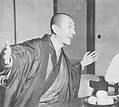 Go Seigen, Weiqi/Go player, considered by many players to be the greatest player of the game in the 20th century and one of the greatest of all time.
 -
 Zhan Shichai, Entertainer toured the world as "Chang the Chinese Giant" in the 19th century.
 -
 Xiao Qiang, Taiwanese model, actress, singer, and writer.
 -
 Lin Zhiying, Taiwanese singer, actor, and race car driver.
 -
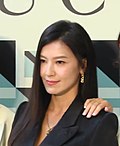 Lin Xilei, Taiwanese actress and model.
 -
 Lin Chi-ling, Taiwanese model, actress, singer, and television host.
 -
 Ludi Lin, Chinese-Canadian actor and model.
References
[edit]- ^ 福州市志(第八册). 方志出版社. 2000. ISBN 978-7-80122-605-1.
- ^ Khoon Choy Lee (2005). Pioneers of Modern China: Understanding the Inscrutable Chinese. World Scientific. p. 20. ISBN 978-98-127-0090-2.
- ^ a b c Chin-keong, Ng (2017). Boundaries and Beyond. Singapore: NUS Press. pp. 147–174.
- ^ a b c Chen, Aimin (January 2006). "Urbanization in China and the Case of Fujian Province". Modern China. 32: 99–130. doi:10.1177/0097700405283503. S2CID 145056213.
- ^ Zurndorfer, Harriet (1992). "Learning, Lineages, and Locality in Late Imperial China. A Comparative Study of Education in Huichow (Anhwei) and Foochow (Fukien) 1600–1800. Part II". Journal of the Economic and Social History of the Orient. 35 (3): 209–238. doi:10.2307/3632732. JSTOR 3632732.
- ^ Chinese Overseas: Comparative Cultural Issues. Hong Kong University Press. p. 92.
- ^ Leo Suryadinata (2006). Southeast Asia's Chinese Businesses in an Era of Globalization: Coping with the Rise of China. Institute of Southeast Asian Studies. p. 184. ISBN 978-98-123-0401-8.
- ^ Timothy Brook & Hy V. Luong (1999). Culture and Economy: The Shaping of Capitalism in Eastern Asia. University of Michigan Press. p. 163. ISBN 978-04-720-8598-9.
- ^ "林家翘纪念馆-林家翘-网上纪念". Archived from the original on 2017-03-15. Retrieved 2019-12-22.
- ^ 邓叔群. dangan.njau.cn.
- ^ Roberts, Siobhan (2015-07-14). Genius At Play: The Curious Mind of John Horton Conway. Bloomsbury. p. 62. ISBN 9781620405949.
- ^ Weingardt, R.G.; Petroski, H. (2005). Engineering Legends: Great American Civil Engineers. American Society of Civil Engineers. ISBN 9780784471210. Retrieved September 13, 2015.
- ^ 吴思主编; 吴思 (2010). Qin li ji (in Chinese) (1st ed.). Taiyuan Shi: Shanxi ren min chu ban she. ISBN 978-7-203-06998-0. OCLC 748308939.
- ^ Xu, Zhigao (16 May 2016). Wen ge shi gao (in Chinese) (1st ed.). 世界華語出版社. ISBN 978-1-940266-15-2. OCLC 980879225.
Original source: https://en.wikipedia.org/wiki/Fuzhou people
Status: article is cached
 EncycloReader
is supported by the
EncycloReader
is supported by the  KSF
KSF