Categories
GE boxcab
 From Wikipedia - Reading time: 9 min
An editor has nominated this article for deletion. You are welcome to participate in the deletion discussion, which will decide whether or not to retain it. |
 | This article includes a list of general references, but it lacks sufficient corresponding inline citations. (January 2017) |
| GE boxcab | |||||||||||||||||||||||||||||||
|---|---|---|---|---|---|---|---|---|---|---|---|---|---|---|---|---|---|---|---|---|---|---|---|---|---|---|---|---|---|---|---|
 Chicago and Northwestern #1200 | |||||||||||||||||||||||||||||||
| |||||||||||||||||||||||||||||||
| |||||||||||||||||||||||||||||||
| |||||||||||||||||||||||||||||||
| |||||||||||||||||||||||||||||||
The GE boxcabs, sometimes also GE IR boxcabs, were diesel-electric switcher locomotives succeeding the ALCO boxcabs. The locomotives were built by General Electric and Ingersoll Rand without ALCO. Production lasted from 1928 to 1930. These boxcabs were often termed oil-electrics to avoid the use of the German name Diesel, unpopular after World War I.
History[edit]
In 1913, GE combined an internal combustion engine with electric traction motors in the GE 57-ton gas-electric boxcab. Impetus for wider adoption of this technology was provided by improved control systems introduced around 1920 and the State of New York's 1926 Kaufman Act, which banned the use of steam locomotives within the New York metropolitan area.[1][2] A consortium consisting of ALCO, GE and Ingersoll Rand started series production of the ALCO Boxcabs in 1925, also called AEGIR Boxcabs according to the initials of the company names.[3] The consortium's boxcabs were pioneering examples of diesel-electric locomotives, and the first to prove commercially successful.[4] Till 1928 the consortium built 26 locomotives of the 60-Ton model and 7 of the 100-ton model.[5] ALCO dropped out of the arrangement in 1928, after acquiring their own diesel engine manufacturer in McIntosh & Seymour and went on to start its own line of diesel switchers.[4] GE and Ingersoll Rand went on with the production of the former ALCO boxcabs, but without ALCO. The locomotives were built in the GE plant in Erie, Pennsylvania, except the unit for Canadian National Railway (CN), which was built by the railroad itself in their workshop. Fourteen units were built after ALCO's withdrawal: two 50-ton units, 11 100-ton units and one 120-ton unit. The 120-ton unit was an experimental unit with one larger 6 cylinder engine. The last 100-ton unit was produced in 1930 on stock and sold in 1935 to the Belt Railway of Chicago, where it was given the road number 301.[5]
Models[edit]

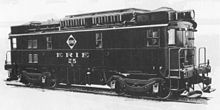
All models have chassis and running gear, generator, traction motors and controls from GE, and Ingersoll Rand provided its 10 × 12 diesel engine.[6] The principle of operation was the same as modern locomotives,[7] the diesel engine driving a main generator of 600 volts DC with four axle-hung traction motors.[8] In contrast to the ALCO boxcabs having a design with side doors and ladders the GE boxcabs have front doors and end platforms with steps. The underframe was cast steel. The radiator system was sitting on the roof of the locomotive. At each locomotive end a GE Model CD65 motor with a Sturtevant multivane fan[9] was pressing air through the radiators.
Two models were in series production and two versions were only produced once:
- a 60-Ton locomotive with a six-cylinder four-stroke in-line engine of 300 hp.[10]
- a 100-Ton locomotive with two of the same engines as the 60-Ton model[10]
- a 120-Ton locomotive with a single six-cylinder 800 hp unit (1 prototype built for Erie Railroad)
Surviving examples[edit]
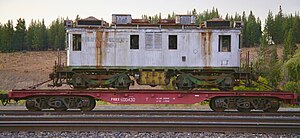
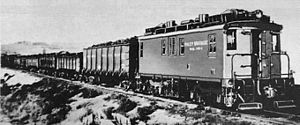
The only surviving GE boxcab is the 100-ton unit built in December 1929 and delivered to the contractor Foley Brothers in January 1930. It was used with the road number 110-1 for pulling coal trains in a Northern Pacific Railway owned mine in Coalstrip, Montana until it was withdrawn somewhere in the 1960s and later ended up in the Western Pacific Railroad Museum in Portola, CA. In December 2011 it was moved to the California State Railroad Museum in Sacramento CA.[11][12]
References[edit]
- ^ "Harkness fights 5-year delay in electrifying R.R's". Brooklyn Daily Eagle. March 12, 1925. Retrieved April 21, 2024.
- ^ Staten Island Rapid Transit Ry. Co. v. Public Service Com'n, 16 F.2d 313 (S.D.N.Y. 1926).
- ^ "Alco: AEGIR Boxcabs". The Reading Modeler.
- ^ a b Solomon, Brian (1998). Vintage Diesel Locomotives. Osceola, Wisconsin: MBI Publishing Company. p. 13. ISBN 0-7603-0507-2.
- ^ a b Vicknair 2000, p. 8.
- ^ Pinkepank, Jerry A. (1973). The Second Diesel Spotter's Guide. Milwaukee, WI: Kalmbach Publishing Company. p. 142. ISBN 0-89024-026-4.
- ^ Vicknair 2000, p. 9.
- ^ Vicknair 2000, p. 7.
- ^ "Sturtevant Multivane Fan". Sturtevant Fan Company. Archived from the original on June 24, 2016. Retrieved June 9, 2016.
- ^ a b Solomon, Brian (2014). GE and EMD Locomotives. Voyageur Press. p. 47. ISBN 9781627883979.
- ^ "C&NW Box Cab Diesel Locomotives". Chicago & North Western Historical Society. Retrieved April 21, 2024.
- ^ Berliner. "GE-IR Foley Bros. #110-1 Boxcab Page". Archived from the original on June 17, 2016.
Bibliography[edit]
- Vicknair, Eugene John (2000). "The little engines that did" (PDF). The Train Sheet (99): 7–10.
External links[edit]

- "Foley Bros Box Cab". Docent Roundhouse. California State Railroad Museum. Archived from the original on August 10, 2016. Retrieved June 9, 2016.[failed verification]
Original source: https://en.wikipedia.org/wiki/GE boxcab
Status: article is cached
 EncycloReader
is supported by the
EncycloReader
is supported by the  KSF
KSF