Categories
Germany–South Korea relations
 From Wikipedia - Reading time: 9 min
 | |
 Germany |
 South Korea |
|---|---|
| Diplomatic mission | |
| Embassy of Germany, Seoul | Embassy of South Korea, Berlin |
| Envoy | |
| Ambassador Georg Wilfried Schmidt | Ambassador Lim Sang-beom |
Germany–South Korea relations (German: Deutsch-Südkorea Beziehungen; Korean: 한독관계, romanized: Handok-gwangye) were established in the 1950s and play a vital role in the foreign policy of both countries today.
Today, Germany and South Korea are the world's third- and 12th-largest economies, respectively, and are bonded through strong economic, cultural, and political cooperation.
Historical background
[edit]The Korean state of Joseon first established diplomatic relations with the German Empire under the Germany–Korea Treaty of 1883 which remained in effect even after in 1905.[1]
In 1955, West Germany officially recognized South Korea as a sovereign state.[2]
Present situation
[edit]Since the German reunification of 1990, much effort has been undertaken by both countries to improve diplomatic relations with each other. In the mid-2000s, the Germany–Korea Treaty of 1883 was renewed by both countries and was officially put into effect on December 19, 2008, as a form of commemoration of the 125th anniversary of the original treaty.[3]
On December 20, 2012, the German chancellor Angela Merkel congratulated Park Geun-hye on her appointment as President of South Korea and invited her to make an official visit to Germany. Both politicians stressed the importance of furthering and strengthening the "traditionally very good ties" between the two countries.[4] Merkel has also vowed to assist in the potential challenges of any future Korean reunification, since Germany underwent a reunification itself.
On March 7, 2016, the Ministry of National Defense of South Korea and Germany signed a Memorandum of Understanding with the German Ministry of National Defense to discuss ways to strengthen military cooperation, including regularization of military cooperation meetings between the two countries. According to the memorandum of understanding, the two countries agreed to hold regular military cooperation meetings and deepen and develop friendly cooperation relations and share their experience in military innovation.[5]
In 2023, Germany and South Korea marked 140 years of diplomatic relations. As of 2022, the volume of trade between the two countries was about $33.6 billion, an increase of 34% from 2011.[6]
"There has been a tremendously growing economic interconnection over the past decades, promoted in particular by the EU-Korea Free Trade Agreement.... German investments in South Korea have amounted to a cumulative $13.7 billion over the past 60 years. South Korea has now become Germany's third-largest trading partner in Asia. And bilateral trade volume in 2022 reached an impressive $33.7 billion, the highest ever."
— Martin Henkelmann, head of the Korean-German Chamber of Commerce and Industry
Education
[edit]Some high schools in Germany adopt Korean language as a formal elective.[7] As of 2022, South Korea was the fourth most popular destination for German students.[6]
High-level visits
[edit]
High-level visit from Germany to South Korea[8][9][10][11][12][13][14][15]
- Chancellor Helmut Kohl (1993)
- President Roman Herzog (1998)
- Chancellor Gerhard Schröder (2000)
- Chancellor Johannes Rau (2002)
- President Horst Köhler (2010)
- Chancellor Angela Merkel (2010 & 2021)
- President Joachim Gauck (2015)
- President Frank-Walter Steinmeier (2018 & 2022)
- Chancellor Olaf Scholz (2023)
High-level visit from South Korea to Germany [16][17][18][19][20]
- President Park Jeong-hee (1964)
- President Chun Doo-hwan (1986)
- President Kim Young-sam (1995)
- President Kim Dae-Jung (2000)
- President Roh Moo-Hyun (2005)
- President Park Geun-Hye (2014)
- President Moon Jae-in (2017)
Resident diplomatic missions
[edit]- Germany has an embassy in Seoul.
- South Korea has an embassy in Berlin and an embassy office in Bonn and a consulates-general in Frankfurt and Hamburg.
-
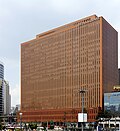 Embassy of Germany in Seoul
 -
 Embassy of South Korea in Berlin
See also
[edit]- Foreign relations of Germany
- Foreign relations of South Korea
- Indo-Pacific Strategy of South Korea
- Germany–North Korea relations
References
[edit]- ^ Korean Mission p. 36., p. 36, at Google Books; excerpt, ", November 22, 1905, declares: 'In bringing this agreement to the notice of the powers having treaties with Korea, the Imperial Government declares that * * * they will see that these treaties are maintained and respected, and they also engage not to prejudice In any way the legitimate commercial and industrial interests of those powers in Korea'."
- ^ Ministry of Foreign Affairs and Trade, Republic of Korea: Germany Archived 2013-07-03 at archive.today
- ^ Beziehungen zwischen der Republik Korea und Deutschland, Foreign Office (Germany) (in German)
- ^ Presse- und Informationsamt der Bundesregierung Archived 2013-01-22 at the Wayback Machine, Foreign Office (Germany) (in German)
- ^ "S. Korea, Germany Sign MOU on Military Supply". KBS WORLD. March 7, 2016.
- ^ a b "Korea, Germany mark 140 years of diplomatic ties". The Korea Times. September 25, 2023.
- ^ "German high school offers Korean as language elective". Korea.net. September 14, 2021.
- ^ The Chancellor's [Helmut Kohl's] Meeting with Korean President Kim Young-Sam on Tuesday, 2 March 1993 in Seoul - Wilson Center
- ^ German President Roman Herzog And South Korean President Kim In Seoul, 1998-09-15 (photo) - Bridgeman Images
- ^ Gerhard Gerhard Schroder to wed Korean - Korea JoonAng Daily
- ^ German President Rau And South Korean Foreign Minister Choi Reveiw [sic] Honour Guard In Seoul, 2002-06-27 (photo) - Bridgeman Images
- ^ German Chancellor Scholz to visit Seoul on May 21 - Yonhap News Agency
- ^ German president arrives in South Korea - DW News
- ^ German president to pay respect to victims of Itaewon crush during S. Korean visit - Yonhap News Agency Culture
- ^ South Korea, Germany to sign information pact to boost defence cooperation - Reuters
- ^ When Park spoke, everybody cried' - The Korea Times
- ^ S. Korea tried to have nuclear bombs in 1980s: declassified papers - The Korea Times
- ^ Address by President Kim Dae-jung of the Republic of Korea, Lessons of German Reunification and the Korean Peninsula - Le Monde
- ^ Evaluating President Park Geun-Hye’s Foreign Policy in its 1st Year - The Asian Institute for Policy Studies
- ^ Full text of Moon's speech at the Korber Foundation - The Korea Herald
 Foreign relations of Germany Foreign relations of Germany | ||
|---|---|---|
| Africa |
|  |
| Americas |
| |
| Asia |
| |
| Europe |
| |
| Oceania |
| |
| Historical |
| |
| Other |
| |
 Foreign relations of South Korea Foreign relations of South Korea | ||
|---|---|---|
| Africa |
|  |
| Americas |
| |
| Asia |
| |
| Europe |
| |
| Oceania |
| |
| Multilateral relations |
| |
| ||

Original source: https://en.wikipedia.org/wiki/Germany–South Korea relations
Status: article is cached
 EncycloReader
is supported by the
EncycloReader
is supported by the  KSF
KSF