Categories
Great Himalayas
 From Wikipedia - Reading time: 7 min
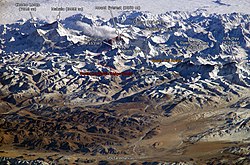
The Great Himalayas (also known as Greater Himalayas, Inner Himalayas, or Himadri) is one of the four parallel sub-ranges of the Himalayas.[1][2] It is the highest in altitude and extends for about 2,300 km (1,400 mi) from northern Pakistan to the Indian state of Arunachal Pradesh, passing through China, India, Nepal, and Bhutan. The sub-range has an average elevation of 6,100 m (20,000 ft) and contains many of the world's tallest peaks, including the eight-thousanders and Mount Everest, the highest peak on Earth.[3][4] The range is mainly composed of granite rocks with permafrost, and consists of many glaciers, including the Gangotri, Khumbu, and Satopanth Glaciers.[5][6]
See also
[edit]- Geology of the Himalaya
- Mountain ranges of the Himalayas
References
[edit]- ^ S. Sathyakumar; Mansi Mungee; Ranjana Pal (2020). "Biogeography of the Mountain Ranges of South Asia". Encyclopedia of the World's Biomes. Elsevier. pp. 543–554. ISBN 978-0-124-09548-9.
- ^ "Physiography of Himalayas". Britannica. Retrieved 1 June 2024.
- ^ Nag, Prithvish; Sengupta, Smita (1992). Geography of India. Concept Publishing. p. 40. ISBN 978-8-170-22384-9.
- ^ "Great Himalayas". Britannica. Retrieved 10 November 2024.
- ^ Potocki, Mariusz; Mayewski, Paul Andrew; Matthews, Tom; Perry, L. Baker; Schwikowski, Margit; Tait, Alexander M.; Korotkikh, Elena; Clifford, Heather; Kang, Shichang; Sherpa, Tenzing Chogyal; Singh, Praveen Kumar; Koch, Inka; Birkel, Sean (2022). "Mt. Everest's highest glacier is a sentinel for accelerating ice loss". Nature. 5 (1): 1–8. doi:10.1038/s41612-022-00230-0. Retrieved 1 June 2024.
- ^ "Himalayas, Drainage". Britannica. Retrieved 1 June 2024.
 | This article related to a mountain or hill in Nepal is a stub. You can help Wikipedia by expanding it. |
 | This Nepalese location article is a stub. You can help Wikipedia by expanding it. |
 | This Indian location article is a stub. You can help Wikipedia by expanding it. |
 | This Chinese location article is a stub. You can help Wikipedia by expanding it. |
Original source: https://en.wikipedia.org/wiki/Great Himalayas
Status: article is cached
 EncycloReader
is supported by the
EncycloReader
is supported by the  KSF
KSF