Islamic schools and branches
 From Wikipedia - Reading time: 62 min
| Part of a series on |
| Islam |
|---|
 |
|
| Islam by country |
|---|
 |
 Islam portal Islam portal |
Islamic schools and branches have different understandings of Islam. There are many different sects or denominations, schools of Islamic jurisprudence, and schools of Islamic theology, or ʿaqīdah (creed). Within Sunnī Islam, there may be differences, such as different orders (tariqa) within Sufism, different schools of theology (Atharī, Ashʿarī, Māturīdī) and jurisprudence (Ḥanafī, Mālikī, Shāfiʿī, Ḥanbalī).[1] Groups in Islam may be numerous (Sunnīs make up 87-90% of all Muslims), or relatively small in size (Ibadis, Ismāʿīlīs, Zaydīs).[2]
Differences between the groups may not be well known to Muslims outside of scholarly circles, or may have induced enough passion to have resulted in political and religious violence (Barelvism, Deobandism, Salafism, Wahhabism).[3][4][5][6] There are informal movements driven by ideas (such as Islamic modernism and Islamism), as well as organized groups with governing bodies (such as Nation of Islam). Some of the Islamic sects and groups regard certain others as deviant or not being truly Muslim (for example, Sunnīs frequently discriminate against Ahmadiyya, Alawites, Quranists, and sometimes Shīʿas).[3][4][5][6] Some Islamic sects and groups date back to the early history of Islam between the 7th and 9th centuries CE (Kharijites, Mu'tazila, Sunnīs, Shīʿas), whereas others have arisen much more recently (Islamic neo-traditionalism, liberalism and progressivism, Islamic modernism, Salafism and Wahhabism), or even in the 20th century (Nation of Islam). Still others were influential historically, but are no longer in existence (non-Ibadi Kharijites and Murji'ah).
Muslims who do not belong to, do not self-identify with, or cannot be readily classified under one of the identifiable Islamic schools and branches are known as non-denominational Muslims.
Overview
[edit]
The original schism between Kharijites, Sunnīs, and Shīʿas among Muslims was disputed over the political and religious succession to the guidance of the Muslim community (Ummah) after the death of the Islamic prophet Muhammad.[7] From their essentially political position, the Kharijites developed extreme doctrines that set them apart from both mainstream Sunnī and Shīʿa Muslims.[7] Shīʿas believe ʿAlī ibn Abī Ṭālib is the true successor to Muhammad, while Sunnīs consider Abu Bakr to hold that position. The Kharijites broke away from both the Shīʿas and the Sunnīs during the First Fitna (the first Islamic Civil War);[7] they were particularly noted for adopting a radical approach to takfīr (excommunication), whereby they declared both Sunnī and Shīʿa Muslims to be either infidels (kuffār) or false Muslims (munafiqun), and therefore deemed them worthy of death for their perceived apostasy (ridda).[7]
In addition, there are several differences within Sunnī and Shīʿa Islam: Sunnī Islam is separated into four main schools of jurisprudence, namely Mālikī, Ḥanafī, Shāfiʿī, and Ḥanbalī; these schools are named after their founders Mālik ibn Anas, Abū Ḥanīfa al-Nuʿmān, Muḥammad ibn Idrīs al-Shāfiʿī, and Aḥmad ibn Ḥanbal, respectively.[1] Shīʿa Islam, on the other hand, is separated into three major sects: Twelvers, Ismāʿīlīs, and Zaydīs. The vast majority of Shīʿa Muslims are Twelvers (a 2012 estimate puts the figure as 85%),[8] to the extent that the term "Shīʿa" frequently refers to Twelvers by default. All mainstream Twelver and Ismāʿīlī Shīʿa Muslims follow the same school of thought, the Jaʽfari jurisprudence, named after Jaʿfar al-Ṣādiq, the sixth Shīʿīte Imam.
Zaydīs, also known as Fivers, follow the Zaydī school of thought (named after Zayd ibn ʿAlī). Ismāʿīlīsm is another offshoot of Shīʿa Islam that later split into Nizārī and Musta'lī, and the Musta'lī further divided into Ḥāfiẓi and Ṭayyibi.[9] Ṭayyibi Ismāʿīlīs, also known as "Bohras", are split between Dawudi Bohras, Sulaymani Bohras, and Alavi Bohras.[10]
Similarly, Kharijites were initially divided into five major branches: Sufris, Azariqa, Najdat, Adjarites, and Ibadis. Of these, Ibadi Muslims are the only surviving branch of Kharijites. In addition to the aforementioned groups, new schools of thought and movements like Ahmadi Muslims, Quranist Muslims, and African-American Muslims later emerged independently.
Muslims who do not belong to, do not self-identify with, or cannot be readily classified under one of the identifiable Islamic schools and branches are known as non-denominational Muslims.
Main branches or denominations
[edit]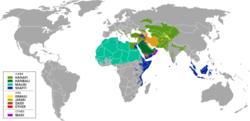
- Sunnīsm (85%)
- Shīʿīsm[11] (15%)
- Ibadism and others (0.5%)
Sunnī Islam
[edit]| Part of a series on Sunni Islam |
|---|
 |
|
Islam portal |
Sunnī Islam, also known as Ahl as-Sunnah waʾl Jamāʾah or simply Ahl as-Sunnah, is by far the largest denomination of Islam, comprising around 87-90% of the Muslim population in the world. The term Sunnī comes from the word sunnah, which means the teachings, actions, and examples of the Islamic prophet Muhammad and his companions (ṣaḥāba).
Sunnīs believe that Muhammad did not specifically appoint a successor to lead the Muslim community (Ummah) before his death in 632 CE, however they approve of the private election of the first companion, Abū Bakr.[12][13] Sunnī Muslims regard the first four caliphs—Abū Bakr (632–634), ʿUmar ibn al-Khaṭṭāb (Umar І, 634–644), ʿUthmān ibn ʿAffān (644–656), and ʿAlī ibn Abī Ṭālib (656–661)—as al-Khulafāʾ ur-Rāshidūn ("the Rightly-Guided Caliphs"). Sunnīs also believe that the position of caliph may be attained democratically, on gaining a majority of the votes, but after the Rashidun, the position turned into a hereditary dynastic rule because of the divisions started by the Umayyads and others. After the fall of the Ottoman Empire in 1923, there has never been another caliph as widely recognized in the Muslim world.
Followers of the classical Sunnī schools of jurisprudence and kalām (rationalistic theology) on one hand, and Islamists and Salafists such as Wahhabis and Ahle Hadith, who follow a literalist reading of early Islamic sources, on the other, have laid competing claims to represent the "orthodox" Sunnī Islam.[14] Anglophone Islamic currents of the former type are sometimes referred to as "traditional Islam".[15] Islamic modernism is an offshoot of the Salafi movement that tried to integrate modernism into Islam by being partially influenced by modern-day attempts to revive the ideas of the Muʿtazila school by Islamic scholars such as Muhammad Abduh.
Shīʿa Islam
[edit]| Part of a series on Shia Islam |
|---|
 |
 Shia Islam portal Shia Islam portal |
Shīʿa Islam is the second-largest denomination of Islam, comprising around 10–13%[16] of the total Muslim population.[17] Although a minority in the Muslim world, Shīʿa Muslims constitute the majority of the Muslim populations in Iran, Iraq and Azerbaijan, as well as significant minorities in Syria, Turkey, South Asia, Yemen, Bahrain, Saudi Arabia, Lebanon, as well as in other parts of the Persian Gulf.[18]
In addition to believing in the supreme authority of the Quran and teachings of Muhammad, Shīʿa Muslims believe that Muhammad's family, the Ahl al-Bayt ("People of the Household"), including his descendants known as Imams, have distinguished spiritual and political authority over the community,[19] and believe that ʿAlī ibn Abī Ṭālib, Muhammad's cousin and son-in-law, was the first of these Imams and the rightful successor to Muhammad, and thus reject the legitimacy of the first three Rāshidūn caliphs.[20][full citation needed]
Major sub-denominations
[edit]- The Twelvers believe in the Twelve Shīʿīte Imams and are the only school to comply with the Hadith of the Twelve Successors, where Muhammad stated that he would have twelve successors. This sometimes includes the Alevi and Bektashi schools.
- The Isma'ili are an esoteric Shīʿīte branch that accept Isma'il ibn Jafar as the sixth Imam. Their thought is heavily influenced by philosophy of Neoplatonism.[21] Isma'ilism includes the Nizārī, Sevener, Musta‘lī, Dawudi Bohra, Hebtiahs Bohra, Sulaymani Bohra, and Alavi Bohra sub-denominations.
- The Zaydīs historically derive from the followers of Zayd ibn ʿAlī. In the modern era, they "survive only in northern Yemen".[22] Although they are a Shīʿa sect, "in modern times" they have "shown a strong tendency to move towards the Sunni mainstream".[22]
Ghulat movements
[edit]Shīʿīte groups and movements who either ascribe divine characteristics to some important figures in the history of Islam (usually members of Muhammad's family, the Ahl al-Bayt) or hold beliefs deemed deviant by mainstream Shīʿa Muslims were designated as Ghulat.[23]
- The Alawites—a distinct Arab ethno-religious group—is the only ghulat sect still in existence today.[24] Their movement was developed between the 9th and 10th centuries CE. Historically, Twelver Shīʿīte scholars such as Shaykh Tusi didn't consider Alawites as Shīʿa Muslims while condemning their beliefs, perceived as heretical.[25] The medieval Sunnī Muslim scholar Ibn Taymiyyah also pointed out that the Alawites were not Shīʿītes.[26] However, the Sunni Grand Mufti of Jerusalem, Haj Amin al-Husseini, issued a fatwa recognizing them as part of the Muslim community in the interest of Arab nationalism.[27][28] And during the Syrian regime Hafez al-Assad and his son and successor Bashar al-Assad, Alawites have shown a tendency to move towards the regular Twelver Shīʿa Islam.[29]
Offshoots of Shīʿa Islam
[edit]- The Ali-Illahis are a distinct syncretic religious movement which has been practiced in parts of the Luristan region in Iran which combines elements of Shīʿa Islam with older religions. It centers on the belief that there have been successive incarnations of the Deity throughout history, and Ali-Illahis reserve particular reverence for ʿAlī who is considered one such incarnation.[30]
- The Druze are a distinct monotheistic Abrahamic religion and ethno-religious group that developed in the 11th century CE, originally as an offshoot of Ismāʿīlīsm.[31] The Druze faith further split from Ismāʿīlīsm as it developed its own unique doctrines, and finally separated from both Ismāʿīlīsm and Islam altogether;[31] these include the belief that the Imam Al-Ḥākim bi-Amr Allāh was God incarnate.[32] Thus, the Druze don't identify themselves as Muslims,[31][33][34][35][36] and aren't considered as such by Muslims either (See: Islam and Druze).[31][37][38][39] According to the medieval Sunnī Muslim scholar Ibn Taymiyyah, the Druze were not Muslims, neither ′Ahl al-Kitāb (People of the Book), nor mushrikin (polytheists); rather, he labeled them as kuffār (infidels).[40][41][42][43]
- The Baháʼí Faith is a distinct monotheistic universal Abrahamic religion that developed in 19th-century Persia, originally derived as a splinter group from Bábism, another distinct monotheistic Abrahamic religion, itself derived from Twelver Shīʿīsm.[44][45] Baháʼís believe in an utterly transcendent and inaccessible Supreme Creator of the universe,[44] nevertheless seen as conscious of the creation,[44] with a will and purpose that is expressed through messengers recognized in the Baháʼí Faith as the Manifestations of God (all the Jewish prophets, Zoroaster, Krishna, Gautama Buddha, Jesus, Muhammad, the Báb, and ultimately Baháʼu'lláh).[44] Baháʼís believe that God communicates his will and purpose to humanity through his intermediaries, the prophets and messengers who have founded various world religions from the beginning of humankind up to the present day, and will continue to do so in the future.[44] Baháʼís and Bábis don't consider themselves as Muslims, since both of their religions have superseded Islam, and aren't considered as such by Muslims either; rather, they are seen as apostates from Islam.[44][45] Since both Baháʼís and Bábis reject the Islamic dogma that Muhammad is the last prophet, they have suffered religious discrimination and persecution both in Iran and elsewhere in the Muslim world due to their beliefs.[45] (See: Persecution of Baháʼís).
Kharijites
[edit]| Part of a series on Muhakkima |
|---|
|
Islam portal |
The Kharijites (literally, "those who seceded") are a branch who originated during the First Fitna, the struggle for political leadership over the Muslim community, following the assassination in 656 of the third caliph Uthman.[7][46] It is an extinct sect, except the Ibadis, whose roots go back to them.[47] Kharijites originally supported the caliphate of Ali, but then later on fought against him and eventually succeeded in his martyrdom while he was praying in the mosque of Kufa. While there are few remaining Kharijite or Kharijite-related groups, the term is sometimes used to denote Muslims who refuse to compromise with those with whom they disagree.
Sufris were a major sub-sect of Kharijite in the 7th and 8th centuries, and a part of the Kharijites. Nukkari was a sub-sect of Sufris. Harūrīs were an early Muslim sect from the period of the Four Rightly-Guided Caliphs (632–661 CE), named for their first leader, Habīb ibn-Yazīd al-Harūrī. Azariqa, Najdat, and Adjarites were minor sub-sects.
Ibadism
[edit]The only Khariji Islam sub-sect extant today is Ibadism, which developed out of the 7th century CE. There are currently two geographically separated Ibadi groups—in Oman, where they constitute the majority of the Muslim population in the country, and in North Africa where they constitute significant minorities in Algeria, Tunisia, and Libya.[47] Similarly to another Muslim minority, the Zaydīs, "in modern times" they have "shown a strong tendency" to move towards the Sunnī branch of Islam.[22]
Schools of Islamic jurisprudence
[edit]| Part of a series on |
| Islamic jurisprudence (fiqh) |
|---|
 |
| Islamic studies |
Islamic schools of jurisprudence, known as madhhab, differ in the methodology they use to derive their rulings from the Quran, ḥadīth literature, the sunnah (accounts of the sayings and living habits attributed to the Islamic prophet Muhammad during his lifetime), and the tafsīr literature (exegetical commentaries on the Quran).
Sunnī
[edit]
Sunnī Islam contains numerous schools of Islamic jurisprudence (fiqh) and schools of Islamic theology (ʿaqīdah).[1] In terms of religious jurisprudence (fiqh), Sunnism contains several schools of thought (madhhab):[1]
- the Ḥanafī school, named after Abū Ḥanīfa al-Nuʿmān (8th century CE);
- the Mālikī school, named after Mālik ibn Anas (8th century CE);
- the Shāfiʿī school, named after Muḥammad ibn Idrīs al-Shāfiʿī (8th century CE);
- the Ḥanbalī school, named after Aḥmad ibn Ḥanbal (8th century CE);
- the Ẓāhirī school, founded by Dāwūd al-Ẓāhirī (9th century CE).[48]
In terms of religious creed (ʿaqīdah), Sunnism contains several schools of theology:[1]
- the Atharī school, a scholarly movement that emerged in the late 8th century CE;
- the Ashʿarī school, founded by Abū al-Ḥasan al-Ashʿarī (10th century CE);
- the Māturīdī school, founded by Abū Manṣūr al-Māturīdī (10th century CE).
The Salafi movement is a conservative reform branch and/or revivalist movement within Sunnī Islam whose followers do not believe in strictly following one particular madhhab. They include the Wahhabi movement, an Islamic doctrine and religious movement founded by Muhammad ibn ʿAbd al-Wahhab, and the modern Ahle Hadith movement, whose followers call themselves Ahl al-Ḥadīth.
Shīʿa
[edit]In Shīʿa Islam, the major Shīʿīte school of jurisprudence is the Jaʿfari or Imāmī school,[49] named after Jaʿfar al-Ṣādiq, the sixth Shīʿīte Imam. The Jaʿfari jurisprudence is further divided into two branches: the Usuli school, which favors the exercise of ijtihad,[50] and the Akhbari school, which holds the traditions (aḵbār) of the Shīʿīte Imams to be the main source of religious knowledge.[51] Minor Shīʿa schools of jurisprudence include the Ismāʿīlī school (Mustaʿlī-Fāṭimid Ṭayyibi Ismāʿīlīs) and the Zaydī school, both of which have closer affinity to Sunnī jurisprudence.[49][52][53] Shīʿīte clergymen and jurists usually carry the title of mujtahid (i.e., someone authorized to issue legal opinions in Shīʿa Islam).
Ibadism
[edit]The fiqh or jurisprudence of Ibadis is relatively simple. Absolute authority is given to the Quran and ḥadīth literature; new innovations accepted on the basis of qiyas (analogical reasoning) were rejected as bid'ah (heresy) by the Ibadis. That differs from the majority of Sunnīs,[54] but agrees with most Shīʿa schools[55] and with the Ẓāhirī and early Ḥanbalī schools of Sunnism.[56][57][58]
Schools of Islamic theology
[edit]Aqidah is an Islamic term meaning "creed", doctrine, or article of faith.[59][60] There have existed many schools of Islamic theology, not all of which survive to the present day. Major themes of theological controversies in Islam have included predestination and free will, the nature of the Quran, the nature of the divine attributes, apparent and esoteric meaning of scripture, and the role of dialectical reasoning in the Islamic doctrine.
| Part of a series on Aqidah |
|---|
|
Including:
Islam portal |
Sunnism
[edit]Classical
[edit]Kalām is the Islamic philosophy of seeking theological principles through dialectic. In Arabic, the word literally means "speech/words". A scholar of kalām is referred to as a mutakallim (Muslim theologian; plural mutakallimūn). There are many schools of Kalam, the main ones being the Ashʿarī and Māturīdī schools in Sunni Islam.[61]
Ashʿarī
[edit]Ashʿarīsm is a school of theology founded by Abū al-Ḥasan al-Ashʿarī in the 10th century. The Ashʿarīte view was that comprehension of the unique nature and characteristics of God were beyond human capability. Ashʿarī theology is considered one of the orthodox creeds of Sunni Islam alongside the Māturīdī theology.[61] Historically, the Ashʿarī theology prevails in Sufism.[61]
Māturīdīsm
[edit]Māturīdism is a school of theology founded by Abū Manṣūr al-Māturīdī in the 10th century, which is a close variant of the Ashʿarī school. Māturīdī theology is considered one of the orthodox creeds of Sunni Islam alongside the Ashʿarī theology,[61] and prevails in the Ḥanafī school of Islamic jurisprudence.[61] Points which differ are the nature of belief and the place of human reason. The Māturīdites state that imān (faith) does not increase nor decrease but remains static; rather it's taqwā (piety) which increases and decreases. The Ashʿarītes affirm that belief does in fact increase and decrease. The Māturīdites affirm that the unaided human mind is able to find out that some of the more major sins such as alcohol or murder are evil without the help of revelation. The Ashʿarītes affirm that the unaided human mind is unable to know if something is good or evil, lawful or unlawful, without divine revelation.
Atharism
[edit]The Atharī school derives its name from the word "tradition" as a translation of the Arabic word hadith or from the Arabic word athar, meaning "narrations". The traditionalist creed is to avoid delving into extensive theological speculation. They rely on the Qur'an, the Sunnah, and sayings of the Sahaba, seeing this as the middle path where the attributes of Allah are accepted without questioning their nature (bi-la kayf). Ahmad ibn Hanbal is regarded as the leader of the traditionalist school of creed. Western scholars of Islamic studies remark that it would be incorrect to consider Atharism and Hanbalism as synonymous, since there have been Hanbali scholars who have explicitly rejected and opposed the Athari theology.[62][63] The modern Salafi movement associates itself with the Atharī creed.[64][65][66][67]
Muʿtazilism
[edit]Muʿtazilite theology originated in the 8th century in Basra when Wasil ibn Ata left the teaching lessons of Hasan al-Basri after a theological dispute. He and his followers expanded on the logic and rationalism of Greek philosophy, seeking to combine them with Islamic doctrines and show that the two were inherently compatible. The Mu'tazilite resolved many theological and philosophical discourse issues such as whether the Qur'an was created or eternal with God, whether evil was created by God or existed by itself, the problem of destiny versus free will, whether the Qur'an should be interpreted allegorically or literally. In this regard, Mu'tazila places more emphasis on rationality in answering Islamic theological and philosophical questions.[68][69]
Murji'ah
[edit]Murji'ah was a name for an early politico-religious movement which came to refer to all those who identified faith (iman) with belief to the exclusion of acts.[70] Originating during the caliphates of Uthman and Ali, Murijites opposed the Kharijites, holding that only God has the authority to judge who is a true Muslim and who is not, and that Muslims should consider all other Muslims as part of the community.[71] Two major Murijite sub-sects were the Karamiya and Sawbaniyya.[72]
Qadariyyah
[edit]Qadariyya is an originally derogatory term designating early Islamic theologians who asserted that humans possess free will, whose exercise makes them responsible for their actions, justifying divine punishment and absolving God of responsibility for evil in the world.[73][74] Some of their doctrines were later adopted by the Mu'tazilis and rejected by the Ash'aris.[73]
Jabriyah
[edit]In direct contrast to the Qadariyyah, Jabriyah was an early Islamic philosophical school based on the belief that humans are controlled by predestination, without having choice or free will. The Jabriya school originated during the Umayyad dynasty in Basra. The first representative of this school was Al-Ja'd ibn Dirham who was executed in 724.[75] The term is derived from the Arabic root j-b-r, in the sense which gives the meaning of someone who is forced or coerced by destiny.[75] The term Jabriyah was also a derogatory term used by different Islamic groups that they considered wrong,[76] The Ash'ariyah used the term Jabriyah in the first place to describe the followers of, Jahm ibn Safwan who died in 746, in that they regarded their faith as a middle position between Qadariyah and Jabriya. On the other hand, the Mu'tazilah considered the Ash'ariyah as Jabriyah because, in their opinion, they rejected the orthodox doctrine of free will.[77] The Shiites used the term Jabriyah to describe the Ash'ariyah and Hanbalis.[78]
Jahmiyya
[edit]Jahmis were the alleged followers of the early Islamic theologian Jahm bin Safwan who associated himself with Al-Harith ibn Surayj. He was an exponent of extreme determinism according to which a man acts only metaphorically in the same way in which the sun acts or does something when it sets.[79]
Batiniyyah
[edit]Bāṭiniyyah is a name given to an allegoristic type of scriptural interpretation developed among some Shia groups, stressing the bāṭin (inward, esoteric) meaning of texts. It has been retained by all branches of Isma'ilism and its Druze offshoot. Alevism, Bektashism and folk religion, Hurufis and Alawites practice a similar system of interpretation.[80]
Sufism
[edit]| Part of a series on Islam Sufism |
|---|
 Islam portal Islam portal |
Sufism is Islam's mystical-ascetic dimension and is represented by schools or orders known as Tasawwufī-Ṭarīqah. It is seen as that aspect of Islamic teaching that deals with the purification of inner self. By focusing on the more spiritual aspects of religion, Sufis strive to obtain direct experience of God by making use of "intuitive and emotional faculties" that one must be trained to use.[81][full citation needed]
The following list contains some notable Sufi orders:
- The Azeemiyya order was founded in 1960 by Qalandar Baba Auliya, also known as Syed Muhammad Azeem Barkhia.
- The Bektashi order was founded in the 13th century by the Islamic saint Haji Bektash Veli, and greatly influenced during its formulative period by the Hurufi Ali al-'Ala in the 15th century and reorganized by Balım Sultan in the 16th century. Because of its adherence to the Twelve Imams it is classified under Twelver Shia Islam.[citation needed]
- The Chishti order (Persian: چشتیہ) was founded by (Khawaja) Abu Ishaq Shami ("the Syrian"; died 941) who brought Sufism to the town of Chisht, some 95 miles east of Herat in present-day Afghanistan. Before returning to the Levant, Shami initiated, trained and deputized the son of the local Emir (Khwaja) Abu Ahmad Abdal (died 966). Under the leadership of Abu Ahmad's descendants, the Chishtiyya as they are also known, flourished as a regional mystical order. The founder of the Chishti Order in South Asia was Moinuddin Chishti.
- The Kubrawiya order was founded in the 13th century by Najmuddin Kubra in Bukhara in modern-day Uzbekistan.[82]
- The Mevlevi order is better known in the West as the "whirling dervishes".
- Mouride is most prominent in Senegal and The Gambia, with headquarters in the holy city of Touba, Senegal.[83]
- The Naqshbandi order was founded in 1380 by Baha-ud-Din Naqshband Bukhari. It is considered by some to be a "sober" order known for its silent dhikr (remembrance of God) rather than the vocalized forms of dhikr common in other orders. The Süleymani and Khalidiyya orders are offshoots of the Naqshbandi order.
- The Ni'matullahi order is the most widespread Sufi order of Persia today. It was founded by Shah Ni'matullah Wali (d. 1367), established and transformed from his inheritance of the Ma'rufiyyah circle.[84] There are several suborders in existence today, the most known and influential in the West following the lineage of Javad Nurbakhsh, who brought the order to the West following the 1979 Iranian Revolution.
- The Noorbakshia order,[85] also called Nurbakshia,[86][87] claims to trace its direct spiritual lineage and chain (silsilah) to the Islamic prophet Muhammad, through Ali, by way of Ali Al-Ridha. This order became known as Nurbakshi after Shah Syed Muhammad Nurbakhsh Qahistani, who was aligned to the Kubrawiya order.
- The Oveysi (or Uwaiysi) order claims to have been founded 1,400 years ago by Uwais al-Qarni from Yemen.
- The Qadiri order is one of the oldest Sufi Orders. It derives its name from Abdul-Qadir Gilani (1077–1166), a native of the Iranian province of Gīlān. The order is one of the most widespread of the Sufi orders in the Islamic world, and can be found in Central Asia, Turkey, Balkans and much of East and West Africa. The Qadiriyyah have not developed any distinctive doctrines or teachings outside of mainstream Islam. They believe in the fundamental principles of Islam, but interpreted through mystical experience. The Ba'Alawi order is an offshoot of Qadiriyyah.
- Senussi is a religious-political Sufi order established by Muhammad ibn Ali as-Senussi. As-Senussi founded this movement due to his criticism of the Egyptian ulema.[88]
- The Shadhili order was founded by Abu-l-Hassan ash-Shadhili. Followers (murids Arabic: seekers) of the Shadhiliyya are often known as Shadhilis.[89][90]
- The Suhrawardiyya order (Arabic: سهروردية) is a Sufi order founded by Abu al-Najib al-Suhrawardi (1097–1168).
- The Tijaniyyah order attach a large importance to culture and education, and emphasize the individual adhesion of the disciple (murid).
Later movements
[edit]African-American movements
[edit]Many slaves brought from Africa to the Western Hemisphere were Muslims,[91] and the early 20th century saw the rise of distinct Islamic religious and political movements within the African-American community in the United States,[92] such as Darul Islam,[91] the Islamic Party of North America,[91] the Mosque of Islamic Brotherhood (MIB),[91] the Muslim Alliance in North America,[91] the Moorish Science Temple of America,[92] the Nation of Islam (NOI),[92][93][94][95] and the Ansaaru Allah Community.[96] They sought to ascribe Islamic heritage to African-Americans, thereby giving much emphasis on racial and ethnic aspects[93][92][94][95][97] (see black nationalism and black separatism).[91][96][98] These black Muslim movements often differ greatly in matters of doctrine from mainstream Islam.[92][94][96][98] They include:
- Moorish Science Temple of America, founded in 1913 by Noble Drew Ali (born Timothy Drew).[95] The Moorish Science Temple of America is characterized by a strong African-American ethnic and religious identity.[92][95][99]
- Moorish Orthodox Church of America
- Nation of Islam, founded by Wallace Fard Muhammad in Detroit in 1930,[100] with a declared aim of "resurrecting" the spiritual, mental, social, and economic condition of the black man and woman of America and the world.[92][93][94] The Nation of Islam believes that Wallace Fard Muhammad was God on earth.[98][100][101] The Nation of Islam doesn't consider the Arabian Muhammad as the final prophet and instead regards Elijah Muhammad, successor of Wallace Fard Muhammad, as the true Messenger of Allah.[92][93][94]
- American Society of Muslims: Warith Deen Mohammed established the American Society of Muslims in 1975.[91] This offshoot of the Nation of Islam wanted to bring its teachings more in line with mainstream Sunni Islam, establishing mosques instead of temples, and promoting the Five pillars of Islam.[102][103]
- Five-Percent Nation[91]
- United Nation of Islam
Ahmadiyya Movement in Islam
[edit]| Part of a series on
Ahmadiyya |
|---|
 |
The Ahmadiyya Movement in Islam was founded in British India in 1889 by Mirza Ghulam Ahmad of Qadian, who claimed to be the promised Messiah ("Second Coming of Christ"), the Mahdi awaited by the Muslims as well as a "subordinate" prophet to the Islamic prophet Muhammad.[104][105][106][107] Ahmadis claim to practice the pristine form of Islam as followed by Muhammad and his earliest followers.[108][109] They believe that it was Mirza Ghulam Ahmad's task to restore the original sharia given to Muhammad by guiding the Ummah back to the "true" Islam and defeat the attacks on Islam by other religions.[104][105][106][107][110]
There are a wide variety of distinct beliefs and teachings of Ahmadis compared to those of most other Muslims,[104][105][106][107] which include the interpretation of the Quranic title Khatam an-Nabiyyin,[111] interpretation of the Messiah's Second Coming,[105][112] complete rejection of the abrogation/cancellation of Quranic verses,[113] belief that Jesus survived the crucifixion and died of old age in India,[105][106][114] conditions of the "Jihad of the Sword" are no longer met,[105][115] belief that divine revelation (as long as no new sharia is given) will never end,[116] belief in cyclical nature of history until Muhammad,[116] and belief in the implausibility of a contradiction between Islam and science.[110] These perceived deviations from normative Islamic thought have resulted in severe persecution of Ahmadis in various Muslim-majority countries,[105] particularly Pakistan,[105][117] where they have been branded as Non-Muslims and their Islamic religious practices are punishable by the Ahmadi-Specific laws in the penal code.[118]
The followers of the Ahmadiyya Movement in Islam are divided into two groups: the first being the Ahmadiyya Muslim Community, currently the dominant group, and the Lahore Ahmadiyya Movement for the Propagation of Islam.[105] The larger group takes a literalist view believing that Mirza Ghulam Ahmad was the promised Mahdi and a Ummati Nabi subservient to Muhammad, while the latter believing that he was only a religious reformer and a prophet only in an allegorical sense.[105] Both Ahmadi groups are active in dawah or Islamic missionary work, and have produced vasts amounts of Islamic literature, including numerous translations of the Quran, translations of the Hadith, Quranic tafsirs, a multitude of sirahs of Muhammad, and works on the subject of comparative religion among others.[105][107] As such, their international influence far exceeds their number of adherents.[105][107][119] Muslims from more Orthodox sects of Islam have adopted many Ahmadi polemics and understandings of other religions,[120] along with the Ahmadi approach to reconcile Islamic and Western education as well as to establish Islamic school systems, particularly in Africa.[121]
Barelvi / Deobandi split
[edit]Sunni Muslims of the Indian subcontinent comprising present day India, Pakistan and Bangladesh who are overwhelmingly Hanafi by fiqh have split into two schools or movements, the Barelvi and the Deobandi. While the Deobandi is revivalist in nature, the Barelvi are more traditional and inclined towards Sufism.
Gülen / Hizmet movement
[edit]The Gülen movement, usually referred to as the Hizmet movement,[122] established in the 1970s as an offshoot of the Nur Movement[123] and led by the Turkish Islamic scholar and preacher Fethullah Gülen in Turkey, Central Asia, and in other parts of the world, is active in education, with private schools and universities in over 180 countries as well as with many American charter schools operated by followers. It has initiated forums for interfaith dialogue.[124][125] The Cemaat movement's structure has been described as a flexible organizational network.[126] Movement schools and businesses organize locally and link themselves into informal networks.[127] Estimates of the number of schools and educational institutions vary widely; it appears there are about 300 Gülen movement schools in Turkey and over 1,000 schools worldwide.[128][129]
Islamic modernism
[edit]Islamic modernism, also sometimes referred to as "modernist Salafism",[130][131][132][133][134] is a movement that has been described as "the first Muslim ideological response"[135] attempting to reconcile Islamic faith with modern Western values such as nationalism, democracy, and science.[136]
Islamism
[edit]| Part of a series on |
| Islamism |
|---|
 |
|

Islamism is a set of political ideologies, derived from various fundamentalist views, which hold that Islam is not only a religion but a political system that should govern the legal, economic and social imperatives of the state. Many Islamists do not refer to themselves as such and it is not a single particular movement. Religious views and ideologies of its adherents vary, and they may be Sunni Islamists or Shia Islamists depending upon their beliefs. Islamist groups include groups such as Al-Qaeda, the organizer of the September 11, 2001 attacks and perhaps the most prominent; and the Muslim Brotherhood, the largest and perhaps the oldest. Although violence is often employed by some organizations, most Islamist movements are nonviolent.
Muslim Brotherhood
[edit]The Al-Ikhwan Al-Muslimun (with Ikhwan الإخوان brethren) or Muslim Brotherhood, is an organisation that was founded by Egyptian scholar Hassan al-Banna, a graduate of Dar al-Ulum. With its various branches, it is the largest Sunni movement in the Arab world, and an affiliate is often the largest opposition party in many Arab nations. The Muslim Brotherhood is not concerned with theological differences, accepting both, Muslims of any of the four Sunni schools of thought, and Shi'a Muslims. It is the world's oldest and largest Islamist group. Its aims are to re-establish the Caliphate and in the meantime, push for more Islamisation of society. The Brotherhood's stated goal is to instill the Qur'an and sunnah as the "sole reference point for... ordering the life of the Muslim family, individual, community... and state".[citation needed]
Jamaat-e-Islami
[edit]The Jamaat-e-Islami (or JI) is an Islamist political party in the Indian subcontinent. It was founded in Lahore, British India, by Sayyid Abul Ala Maududi (with alternative spellings of last name Maudoodi) in 1941 and is the oldest religious party in Pakistan. Today, sister organizations with similar objectives and ideological approaches exist in India (Jamaat-e-Islami Hind), Bangladesh (Jamaat-e-Islami Bangladesh), Kashmir (Jamaat-e-Islami Kashmir), and Sri Lanka, and there are "close brotherly relations" with the Islamist movements and missions "working in different continents and countries", particularly those affiliated with the Muslim Brotherhood (Akhwan-al-Muslimeen). The JI envisions an Islamic government in Pakistan and Bangladesh governing by Islamic law. It opposes Westernization—including secularization, capitalism, socialism, or such practices as interest based banking, and favours an Islamic economic order and Caliphate. [citation needed]
Hizb ut-Tahrir
[edit]Hizb ut-Tahrir (Arabic: حزب التحرير) (Translation: Party of Liberation) is an international, pan-Islamist political organization which describes its ideology as Islam, and its aim the re-establishment of the Islamic Khilafah (Caliphate) to resume Islamic ways of life in the Muslim world. The caliphate would unite the Muslim community (Ummah)[137] upon their Islamic creed and implement the Shariah, so as to then carry the proselytizing of Islam to the rest of the world.[138]
Quranism
[edit]Quranism[139] or Quraniyya (Arabic: القرآنية; al-Qur'āniyya) is a quran only[140][clarification needed] branch of Islam. It holds the belief that Islamic guidance and law should only be based on the Quran, thus opposing the religious authority and authenticity of the hadith literature.[141][142] Quranists believe that God's message is already clear and complete in the Quran and it can therefore be fully understood without referencing outside texts.[143] Quranists claim that the vast majority of hadith literature are forged lies and believe that the Quran itself criticizes the hadith both in the technical sense and the general sense.[144][141][145][146][147][148][excessive citations]
Liberal and progressive Islam
[edit]Liberal Islam originally emerged from the Islamic revivalist movement of the 18th–19th centuries.[149] Liberal and progressive Islamic organizations and movements are primarily based in the Western world, and have in common a religious outlook which depends mainly on ijtihad or re-interpretation of the sacred scriptures of Islam.[149] Liberal and progressive Muslims are characterized by a rationalistic, critical examination and re-interpretation of the sacred scriptures of Islam;[149] affirmation and promotion of democracy, gender equality, human rights, LGBT rights, women's rights, religious pluralism, interfaith marriage,[150][151] freedom of expression, freedom of thought, and freedom of religion;[149] opposition to theocracy and total rejection of Islamism and Islamic fundamentalism;[149] and a modern view of Islamic theology, ethics, sharia, culture, tradition, and other ritualistic practices in Islam.[149]
Mahdavia
[edit]Mahdavia, or Mahdavism, is a Mahdiist sect founded in late 15th century India by Syed Muhammad Jaunpuri, who declared himself to be the Hidden Twelfth Imam of the Twelver Shia tradition.[152] They follow many aspects of the Sunni doctrine. Zikri Mahdavis, or Zikris, are an offshoot of the Mahdavi movement.[153]
Non-denominational Muslims
[edit]"Non-denominational Muslims" (Arabic: مسلمون بلا طائفة, romanized: Muslimūn bi-la ṭā’ifa) is an umbrella term that has been used for and by Muslims who do not belong to a specific Islamic denomination, do not self-identify with any specific Islamic denomination, or cannot be readily classified under one of the identifiable Islamic schools and branches.[154][155][156] A quarter of the world's Muslim population see themselves as "just a Muslim".[157]
Non-denominational Muslims constitute the majority of the Muslim population in seven countries, and a plurality in three others: Albania (65%), Kyrgyzstan (64%), Kosovo (58%), Indonesia (56%), Mali (55%), Bosnia and Herzegovina (54%), Uzbekistan (54%), Azerbaijan (45%), Russia (45%), and Nigeria (42%).[157] They are found primarily in Central Asia.[157] Kazakhstan has the largest number of non-denominational Muslims, who constitute about 74% of the population.[157] While the majority of the population in the Middle East identify as either Sunni or Shi'a, a significant number of Muslims identify as non-denominational.[158] Southeastern Europe also has a large number of non-denominational Muslims.[159]
In 1947, the non-sectarian movement Jama'ah al-Taqrib bayna al-Madhahib al-Islamiyyah was founded in Cairo, Egypt.[160] Several of its supporters were high-ranking scholars of Al-Ahzar University.[161] The movement sought to bridge the gap between Sunnis and Shi'is.[161] At the end of the 1950s, the movement reached a wider public, as the Egyptian president Gamal Abdel Nasser discovered the usefulness of pan-Islamism for his foreign policy.[161]
Salafism and Wahhabism
[edit]Ahle Hadith
[edit]Ahl-i Hadith (Persian: اهل حدیث, Urdu: اہل حدیث: transl. People of the traditions of the Prophet) is a movement which emerged in the Indian subcontinent in the mid-19th century. Its followers call themselves Ahl al-Hadith and are considered to be a branch of the Salafiyya school. Ahl-i Hadith is antithetical to various beliefs and mystical practices associated with folk Sufism. Ahl-i Hadith shares many doctrinal similarities with the Wahhabi movement and hence often classified as being synonymous with the "Wahhabis" by its adversaries. However, its followers reject this designation, preferring to identify themselves as "Salafis".[162][163][164][165]
Salafiyya movement
[edit]| Part of a series on:
Salafi movement |
|---|
 |
|
Islam portal |
The Salafiyya movement is a conservative,[166] Islahi (reform)[167] movement within Sunni Islam that emerged in the second half of the 19th century and advocate a return to the traditions of the "devout ancestors" (Salaf al-Salih). It has been described as the "fastest-growing Islamic movement"; with each scholar expressing diverse views across social, theological, and political spectrum. Salafis follow a doctrine that can be summed up as taking "a fundamentalist approach to Islam, emulating the Prophet Muhammad and his earliest followers—al-salaf al-salih, the 'pious forefathers'....They reject religious innovation, or bidʻah, and support the implementation of Sharia (Islamic law)."[168] The Salafi movement is often divided into three categories: the largest group are the purists (or quietists), who avoid politics; the second largest group are the militant activists, who get involved in politics; the third and last group are the jihadists, who constitute a minority.[168] Most of the violent Islamist groups come from the Salafi-Jihadist movement and their subgroups.[169] In recent years, Jihadi-Salafist doctrines have often been associated with the armed insurgencies of Islamic extremist movements and terrorist organizations targeting innocent civilians, both Muslims and Non-Muslims, such as al-Qaeda, ISIL/ISIS/IS/Daesh, Boko Haram, etc.[170][171][168][169] The second largest group are the Salafi activists who have a long tradition of political activism, such as those that operate in organizations like the Muslim Brotherhood, the Arab world's major Islamist movement. In the aftermath of widescale repressions after the Arab Spring, accompanied by their political failures, the activist-Salafi movements have undergone a decline. The most numerous are the quietists, who believe in disengagement from politics and accept allegiance to Muslim governments, no matter how tyrannical, to avoid fitna (chaos).[168]
Wahhabism
[edit]The Wahhabi movement was founded and spearheaded by the Ḥanbalī scholar and theologian Muhammad ibn ʿAbd al-Wahhab,[172][173][174] a religious preacher from the Najd region in central Arabia,[175][176][177][178][179] and was instrumental in the rise of the House of Saud to power in the Arabian peninsula.[172] Ibn ʿAbd al-Wahhab sought to revive and purify Islam from what he perceived as non-Islamic popular religious beliefs and practices by returning to what, he believed, were the fundamental principles of the Islamic religion.[176][177][178][179] His works were generally short, full of quotations from the Quran and Hadith literature, such as his main and foremost theological treatise, Kitāb at-Tawḥīd (Arabic: كتاب التوحيد; "The Book of Oneness").[176][177][178][179] He taught that the primary doctrine of Islam was the uniqueness and oneness of God (tawḥīd), and denounced what he held to be popular religious beliefs and practices among Muslims that he considered to be akin to heretical innovation (bidʿah) and polytheism (shirk).[176][177][178][179]
Wahhabism has been described as a conservative, strict, and fundamentalist branch of Sunnī Islam,[180] with puritan views,[180] believing in a literal interpretation of the Quran.[172] The terms "Wahhabism" and "Salafism" are sometimes evoked interchangeably, although the designation "Wahhabi" is specifically applied to the followers of Muhammad ibn ʿAbd al-Wahhab and his reformist doctrines.[172] The label "Wahhabi" was not claimed by his followers, who usually refer themselves as al-Muwaḥḥidūn ("affirmers of the singularity of God"), but is rather employed by Western scholars as well as his critics.[172][173][177] Starting in the mid-1970s and 1980s, the international propagation of Salafism and Wahhabism within Sunnī Islam[180] favored by the Kingdom of Saudi Arabia[175][181][182] and other Arab states of the Persian Gulf has achieved what the French political scientist Gilles Kepel defined as a "preeminent position of strength in the global expression of Islam."[183]
22 months after the September 11 attacks, when the FBI considered al-Qaeda as "the number one terrorist threat to the United States", journalist Stephen Schwartz and U.S. Senator Jon Kyl have explicitly stated during a hearing that occurred in June 2003 before the Subcommittee on Terrorism, Technology, and Homeland Security of the U.S. Senate that "Wahhabism is the source of the overwhelming majority of terrorist atrocities in today's world".[184] As part of the global "War on terror", Wahhabism has been accused by the European Parliament, various Western security analysts, and think tanks like the RAND Corporation, as being "a source of global terrorism".[184][185] Furthermore, Wahhabism has been accused of causing disunity in the Muslim community (Ummah) and criticized for its followers' destruction of many Islamic, cultural, and historical sites associated with the early history of Islam and the first generation of Muslims (Muhammad's family and his companions) in Saudi Arabia.[186][187][188][189]
Population of the branches
[edit]| Denomination | Population |
|---|---|
| Sunni | Varies: 87% – 90%[190][191] |
| Non-denominational Muslim | 25%[192] |
| Shia | Varies: 10% – 13%[193] |
| Ibadi | 2.7 million[194] |
| Quranism | n/a |
See also
[edit]- Amman Message
- Aqidah
- Glossary of Islam
- Index of Islam-related articles
- International Islamic Unity Conference (Iran)
- Islamic eschatology
- Islamic studies
- Madhhab
- Outline of Islam
- Schools of Islamic theology
- Shia crescent
- Shia–Sunni relations
- Succession to Muhammad
References
[edit]- ^ a b c d e Geaves, Ronald (2021). "Part 1: Sunnī Traditions – Sectarianism in Sunnī Islam". In Cusack, Carole M.; Upal, M. Afzal (eds.). Handbook of Islamic Sects and Movements. Brill Handbooks on Contemporary Religion. Vol. 21. Leiden and Boston: Brill Publishers. pp. 25–48. doi:10.1163/9789004435544_004. ISBN 978-90-04-43554-4. ISSN 1874-6691.
- ^ Sebastian Kusserow, Patryk Pawlak (2015). Understanding the branches of Islam (PDF). European parliamentary research service.
- ^ a b Poljarevic, Emin (2021). "Theology of Violence-oriented Takfirism as a Political Theory: The Case of the Islamic State in Iraq and Syria (ISIS)". In Cusack, Carole M.; Upal, M. Afzal (eds.). Handbook of Islamic Sects and Movements. Brill Handbooks on Contemporary Religion. Vol. 21. Leiden and Boston: Brill Publishers. pp. 485–512. doi:10.1163/9789004435544_026. ISBN 978-90-04-43554-4. ISSN 1874-6691.
- ^ a b Baele, Stephane J. (October 2019). Giles, Howard (ed.). "Conspiratorial Narratives in Violent Political Actors' Language" (PDF). Journal of Language and Social Psychology. 38 (5–6). Sage Publications: 706–734. doi:10.1177/0261927X19868494. hdl:10871/37355. ISSN 1552-6526. S2CID 195448888. Retrieved January 3, 2022.
- ^ a b Rickenbacher, Daniel (August 2019). Jikeli, Gunther (ed.). "The Centrality of Anti-Semitism in the Islamic State's Ideology and Its Connection to Anti-Shiism". Religions. 10 (8: The Return of Religious Antisemitism?). Basel: MDPI: 483. doi:10.3390/rel10080483. ISSN 2077-1444.
- ^ a b Badara, Mohamed; Nagata, Masaki; Tueni, Tiphanie (June 2017). "The Radical Application of the Islamist Concept of Takfir" (PDF). Arab Law Quarterly. 31 (2). Leiden: Brill Publishers: 134–162. doi:10.1163/15730255-31020044. ISSN 1573-0255. Archived (PDF) from the original on July 11, 2019. Retrieved October 25, 2021.
- ^ a b c d e Izutsu, Toshihiko (2006) [1965]. "The Infidel (Kāfir): The Khārijites and the origin of the problem". The Concept of Belief in Islamic Theology: A Semantic Analysis of Imān and Islām. Tokyo: Keio Institute of Cultural and Linguistic Studies at Keio University. pp. 1–20. ISBN 983-9154-70-2 – via Google Books.
- ^ Guidère, Mathieu (2012). Historical Dictionary of Islamic Fundamentalism. Scarecrow Press. p. 319. ISBN 978-0-8108-7965-2 – via Google Books.
- ^ Öz, Mustafa (2011). Mezhepler Tarihi ve Terimleri Sözlüğü [The History of madh'habs and its terminology dictionary] (in Turkish). Istanbul: Ensar Publications.
- ^ "Branches of Shia Islam: Ismailis, Twelvers, and Bohras". Ismailimail. August 23, 2017. Retrieved November 28, 2018.
- ^ "Mapping the Global Muslim Population". October 7, 2009. Archived from the original on December 14, 2015. Retrieved December 10, 2014.
The Pew Forum's estimate of the Shia population (10–13%) is in keeping with previous estimates, which generally have been in the range of 10–15%.
- ^ Razwy, Sayed Ali Asgher. A Restatement of the History of Islam & Muslims. pp. 331–335.
- ^ History of the Islamic Caliphate (in Urdu). Lahore.
In pre-Islamic times, the custom of the Arabs was to elect their chiefs by a majority vote...the same principle was adopted in the election of Abu Bakr.
- ^ Brown, Jonathan A.C. (2009). Hadith: Muhammad's Legacy in the Medieval and Modern World. Oneworld Publications (Kindle edition). p. 180.
- ^ Mathiesen, Kasper (2013). "Anglo-American 'Traditional Islam' and Its Discourse of Orthodoxy" (PDF). Journal of Arabic and Islamic Studies. 13: 191–219. doi:10.5617/jais.4633.
- ^ See:
- "Mapping the Global Muslim Population: A Report on the Size and Distribution of the World's Muslim Population". Pew Research Center. October 7, 2009. Retrieved September 24, 2013.
The Pew Forum's estimate of the Shia population (10–13%) is in keeping with previous estimates, which generally have been in the range of 10–15%. Some previous estimates, however, have placed the number of Shias at nearly 20% of the world's Muslim population.
- "Shia". Berkley Center for Religion, Peace, and World Affairs. Archived from the original on December 15, 2012. Retrieved December 5, 2011.
Shi'a Islam is the second largest branch of the tradition, with up to 200 million followers who comprise around 15% of all Muslims worldwide...
- "Religions". The World Factbook. Central Intelligence Agency. Archived from the original on December 20, 2018. Retrieved August 25, 2010.
Shia Islam represents 10–20% of Muslims worldwide...
- "Mapping the Global Muslim Population: A Report on the Size and Distribution of the World's Muslim Population". Pew Research Center. October 7, 2009. Retrieved September 24, 2013.
- ^ Miller, Tracy, ed. (October 2009). Mapping the Global Muslim Population: A Report on the Size and Distribution of the World's Muslim Population (PDF). Pew Research Center. Archived from the original (PDF) on October 10, 2009. Retrieved October 8, 2009.
- ^ "Shi'i | History & Beliefs | Britannica". www.britannica.com. January 11, 2024.
- ^ Corbin (1993), pp. 45–51
- ^ Tabatabaei (1979), pp. 41–44
- ^ "Early Philosophical Shiism". Cambridge University Press. Retrieved April 1, 2016.
- ^ a b c Cook, Michael (2003). Forbidding Wrong in Islam, an Introduction. Cambridge University Press.
- ^ Hodgson, M. G. S. (1965). "GHULĀT". Encyclopaedia of Islam. Vol. 2 (2nd ed.). Brill Academic Pub. pp. 1093–1095.
- ^ Cosman, Madeleine Pelner; Jones, Linda Gale (2009). "The Nusayriyya Alawis". Handbook to Life in the Medieval World, 3-Volume Set. Infobase Pub. pp. 406–407. ISBN 978-1-4381-0907-7.
The Alawis are a sect of extremist (ghuluw) Shiism, so called because of their doctrine of the deification of Ali ibn Abi Talib, the nephew of the prophet Muhammad. The movement was founded in the mid-ninth century by Muhammad ibn Nusayr al-Namiri, who also proclaimed that the 10th of the 12 Shiite imams, Ali ibn Hadi, possessed a divine nature. Alawi doctrine is secret, esoteric, and Gnostic in nature.
- ^ Barfi, Barak (January 24, 2016). "The Real Reason Why Iran Backs Syria".
- ^ Pipes, Daniel (1992). Greater Syria. Oxford University Press. p. 163. ISBN 9780195363043.
"The Nusayris are more infidel than Jews or Christians, even more infidel than many polytheists. They have done greater harm to the community of Muhammad than have the warring infidels such as the Franks, the Turks, and others. To ignorant Muslims they pretend to be Shi'is, though in reality they do not believe in God or His prophet or His book ... Whenever possible, they spill the blood of Muslims ... They are always the worst enemies of the Muslims ... war and punishment in accordance with Islamic law against them are among the greatest of pious deeds and the most important obligations." – Ibn Taymiyyah
- ^ Me'ir Mikha'el Bar-Asher; Gauke de Kootstra; Arieh Kofsky (2002). The Nuṣayr−i-ʻalaw−i Religion: An Enquiry into Its Theology and Liturgy. Brill Pub. p. 1. ISBN 978-90-04-12552-0.
- ^ Talhamy, Y. (2010). "The Fatwas and the Nusayri/Alawis of Syria". Middle Eastern Studies. 46 (2): 175–194. doi:10.1080/00263200902940251. S2CID 144709130.
- ^ Rubin, Barry (2007). The Truth about Syria. New York: Palgrave Macmillan. p. 49. ISBN 978-1-4039-8273-5.
- ^ Layard, Austen Henry (2010). Discoveries in the Ruins of Nineveh and Babylon: With Travels in Armenia, Kurdistan and the Desert: Being the Result of a Second Expedition Undertaken for the Trustees of the British Museum. Cambridge University Press. p. 216. ISBN 9781108016773.
- ^ a b c d Timani, Hussam S. (2021). "Part 5: In Between and on the Fringes of Islam – The Druze". In Cusack, Carole M.; Upal, M. Afzal (eds.). Handbook of Islamic Sects and Movements. Brill Handbooks on Contemporary Religion. Vol. 21. Leiden; Boston: Brill Pub. pp. 724–742. doi:10.1163/9789004435544_038. ISBN 978-90-04-43554-4. ISSN 1874-6691.
- ^ Poonawala, Ismail K. (July–September 1999). "Review: The Fatimids and Their Traditions of Learning by Heinz Halm". Journal of the American Oriental Society. 119 (3). American Oriental Society: 542. doi:10.2307/605981. ISSN 0003-0279. JSTOR 605981. LCCN 12032032. OCLC 47785421.
- ^ "Are the Druze People Arabs or Muslims? Deciphering Who They Are". Arab America. August 8, 2018. Retrieved April 13, 2020.
- ^ J. Stewart, Dona (2008). The Middle East Today: Political, Geographical and Cultural Perspectives. Routledge. p. 33. ISBN 9781135980795.
Most Druze do not consider themselves Muslim. Historically they faced much persecution and keep their religious beliefs secrets.
- ^ Lewis, James (2002). The Encyclopedia of Cults, Sects, and New Religions. Prometheus Books – via Google Books.
- ^ De McLaurin, Ronald (1979). The Political Role of Minority Groups in the Middle East. Michigan University Press. p. 114. ISBN 9780030525964.
Theologically, one would have to conclude that the Druze are not Muslims. They do not accept the five pillars of Islam. In place of these principles the Druze have instituted the seven precepts noted above.
- ^ Hunter, Shireen (2010). The Politics of Islamic Revivalism: Diversity and Unity: Center for Strategic and International Studies (Washington, D.C.), Georgetown University. Center for Strategic and International Studies. University of Michigan Press. p. 33. ISBN 9780253345493.
Druze - An offshoot of Shi'ism; its members are not considered Muslims by orthodox Muslims.
- ^ D. Grafton, David (2009). Piety, Politics, and Power: Lutherans Encountering Islam in the Middle East. Wipf and Stock Publishers. p. 14. ISBN 9781630877187.
In addition, there are several quasi-Muslim sects, in that, although they follow many of the beliefs and practices of orthodox Islam, the majority of Sunnis consider them heretical. These would be the Ahmadiyya, Druze, Ibadi, and the Yazidis.
- ^ R. Williams, Victoria (2020). Indigenous Peoples: An Encyclopedia of Culture, History, and Threats to Survival [4 volumes]. Santa Barbara, Ca: ABC-Clio. p. 318. ISBN 9781440861185.
As Druze is a nonritualistic religion without requirements to pray, fast, make pilgrimages, or observe days of rest, the Druze are not considered an Islamic people by Sunni Muslims.
- ^ Roald, Anne Sofie (2011). Religious Minorities in the Middle East: Domination, Self-Empowerment, Accommodation. Brill Pub. p. 255. ISBN 9789004207424.
Therefore, many of these scholars follow Ibn Taymiyya'sfatwa from the beginning of the fourteenth century that declared the Druzes and the Alawis as heretics outside Islam ...
- ^ Zabad, Ibrahim (2017). Middle Eastern Minorities: The Impact of the Arab Spring. Taylor & Francis. p. 126. ISBN 9781317096733.
- ^ Knight, Michael (2009). Journey to the End of Islam. Soft Skull Press. p. 129. ISBN 9781593765521.
- ^ S. Swayd, Samy (2009). The A to Z of the Druzes. Rowman & Littlefield. p. 37. ISBN 9780810868366.
Subsequently, Muslim opponents of the Druzes have often relied on Ibn Taymiyya's religious ruling to justify their attitudes and actions against Druzes...
- ^ a b c d e f Cole, Juan (December 30, 2012) [December 15, 1988]. "BAHAISM i. The Faith". Encyclopædia Iranica. Vol. III/4. New York: Columbia University. pp. 438–446. doi:10.1163/2330-4804_EIRO_COM_6391. ISSN 2330-4804. Archived from the original on January 23, 2013. Retrieved December 11, 2020.
- ^ a b c Osborn, Lil (2021). "Part 5: In Between and on the Fringes of Islam – The Bahāʾī Faith". In Cusack, Carole M.; Upal, M. Afzal (eds.). Handbook of Islamic Sects and Movements. Brill Handbooks on Contemporary Religion. Vol. 21. Leiden; Boston: Brill Pub. pp. 761–773. doi:10.1163/9789004435544_040. ISBN 978-90-04-43554-4. ISSN 1874-6691.
- ^ "Sunan Ibn Majah 176 – The Book of the Sunnah – كتاب المقدمة – Sunnah.com – Sayings and Teachings of Prophet Muhammad (صلى الله عليه و سلم)". sunnah.com. Retrieved March 30, 2022.
- ^ a b John L. Esposito, ed. (2014). "Ibadis". The Oxford Dictionary of Islam. Oxford: Oxford University Press. Archived from the original on August 20, 2017.
Ibadis [:] subsect of Khariji Islam founded in the eighth century. Has its strongest presence in Oman, but is also found in North Africa and various communities on the Swahili Coast.
- ^ Osman, Amr (2014). "Dāwūd al-Ẓāhirī and the Beginnings of the Ẓāhirī Madhhab". The Ẓāhirī Madhhab (3rd/9th-10th/16th Century): A Textualist Theory of Islamic Law. Studies in Islamic Law and Society. Vol. 38. Leiden and Boston: Brill Publishers. pp. 9–47. doi:10.1163/9789004279650_003. ISBN 978-90-04-27965-0. ISSN 1384-1130.
- ^ a b Sachedina, Abdulaziz (2009). "Law: Shīʿī Schools of Law". The Oxford Encyclopedia of the Islamic World. Oxford: Oxford University Press. Archived from the original on November 21, 2008.
- ^ Esposito, John L. (2014). "Usulis". The Oxford Dictionary of Islam. Oxford: Oxford University Press. ISBN 978-0-19-512558-0.
- ^ Kohlberg, E. "AḴBĀRĪYA". Encyclopædia Iranica.
- ^ Hussin, Iza; Gleave, Robert; Haykel, Bernard (2014). "Schools of Jurisprudence". The Oxford Encyclopedia of Islam and Politics. Oxford: Oxford University Press. ISBN 978-0-19-973935-6.
- ^ Morgan, Diane (2010). Essential Islam: A Comprehensive Guide to Belief and Practice. ABC-CLIO. p. 182. ISBN 9780313360251.
- ^ Rabi, Uzi. The Emergence of States. p. 21.
- ^ Mansoor Moaddel, Islamic Modernism, Nationalism, and Fundamentalism: Episode and Discourse, p. 32. Chicago: University of Chicago Press, 2005.
- ^ Adang, Camilla (2006). "This Day I have Perfected Your Religion For You: A Zahiri Conception of Religious Authority". In Krämer, Hudrun; Schmidtke, Sabine (eds.). Speaking for Islam: Religious Authorities in Muslim Societies. Leiden: Brill Publishers. p. 15. ISBN 9789004149496.
- ^ Christopher Melchert, The Formation of the Sunni Schools of Law: 9th–10th Centuries C.E., p. 185. Leiden: Brill Publishers, 1997.
- ^ Ali, Chiragh (2002). "The Proposed Political, Legal and Social Reforms". In Kurzman, Charles (ed.). Modernist Islam 1840–1940: A Sourcebook. New York City: Oxford University Press. p. 281.
- ^ J. Hell. Encyclopedia of Islam, 2nd ed, Brill. "'Aḳīda", vol. 1, p. 332.
- ^ John L. Esposito, ed. (2014). "Aqidah". The Oxford Dictionary of Islam. Oxford: Oxford University Press. ISBN 978-0-19-512558-0.
- ^ a b c d e Henderson, John B. (1998). "The Making of Orthodoxies". The Construction of Orthodoxy and Heresy: Neo-Confucian, Islamic, Jewish, and Early Christian Patterns. Albany, New York: SUNY Press. pp. 55–58. ISBN 978-0-7914-3760-5 – via Google Books.
- ^ Halverson, Jeffry R. (2010). Theology and Creed in Sunni Islam: The Muslim Brotherhood, Ash'arism, and Political Sunnism. Palgrave Macmillan. pp. 34–35. ISBN 9781137473578.
- ^ Laoust, Henri (1986). "Hanabila". In P. Bearman; Th. Bianquis; C.E. Bosworth; E. van Donzel; W.P. Heinrichs (eds.). Encyclopaedia of Islam. Vol. 3 (Second ed.). Brill. p. 158.
- ^ Ibn Qayyim al-Jawziyah, Muhammad ibn Abi Bakr Ibn Qayyim al-Jawziyah (1991). Tariq al-hijratayn wa-bab al-sa'adatayn. Dar al-Hadith (1991). p. 30.
- ^ al-Hanafi, Imam Ibn Abil-'Izz. Sharh At Tahawiyya. p. 76.
- ^ al-Safarayni, Muhamad bin Ahmad. Lawami' al-anwar al-Bahiyah. Dar al-Kutub al-Ilmiyah. p. 1/128.
- ^ Abd al-Wahhab, Ibn; ibn Abd Allah, Sulayman (1999). Taysir al-'Aziz al-Hamid fi sharh kitab al-Tawhid. 'Alam al-Kutub. pp. 17–19.
- ^ Martin, Richard C.; Woodward, Mark; Atmaja, Dwi Surya; Atmaja, Dwi S. Defenders of Reason in Islam: Mu'tazililism from Medieval School to Modern Symbol. Oneworld Publications. ISBN 978-1-85168-147-1.
- ^ Campanini, Massimo (2012). "The Mu'tazila in Islamic History and Thought". Religion Compass. 6 (1): 41–50. doi:10.1111/j.1749-8171.2011.00273.x. ISSN 1749-8171.
- ^ W. Madelung. Encyclopedia of Islam, 2nd ed, Brill. "Murdji'a", vol. 7, p. 605.
- ^ Isutzu, Concept of Belief, p. 55-56.
- ^ "KERRÂMİYYE". TDV İslâm Ansiklopedisi.
- ^ a b Esposito, John L., ed. (2014). "Qadariyyah". The Oxford Dictionary of Islam. Oxford: Oxford University Press. ISBN 978-0-19-512558-0.
- ^ J. van Ess. Encyclopedia of Islam, 2nd ed, Brill. "Ķadariyya", vol.4, p. 368.
- ^ a b Ибрагим, Т. К. и Сагадеев А. В. ал-Джабрийа // Ислам: энциклопедический словарь / отв. ред. С. М. Прозоров. — М. : Наука, ГРВЛ, 1991. — С. 57–58.
- ^ Josef van (January 17, 2011). Der Eine und das Andere. Berlin, New York: DE GRUYTER. ISBN 9783110215786
- ^ William Montgomery Watt: "Djabriyya" in The Encyclopaedia of Islam. New Edition Bd. II, S. 365a
- ^ M. Heidari-Abkenar: Die ideologische und politische Konfrontation Schia-Sunna am Beispiel der Stadt Rey des 10.-12. Jh. n. Chr. Inaugural-Dissertation, Universität Köln, 1992
- ^ Watt, W. Montgomery (May 1970). Pestman, P. W. (ed.). "The study of the development of the Islamic sects". Acta Orientalia Neerlandica: Proceedings of the Congress of the Dutch Oriental Society Held in Leiden on the Occasion of Its 50th Anniversary: 85.
- ^ M.G.S. Hodgson. Encyclopedia of Islam, 2nd ed, Brill. "Bāṭiniyya", vol. 1, p. 1098.
- ^ Trimingham (1998), p. 1
- ^ "Saif ed-Din Bokharzi & Bayan-Quli Khan Mausoleums". Retrieved February 15, 2015.
- ^ "Mourides Celebrate 19 Years in North America" Archived October 13, 2008, at the Wayback Machine by Ayesha Attah. The African magazine. (n.d.) Retrieved November 13, 2007.
- ^ Nasr, Seyyed Hossein (2007). The Garden of Truth. New York, NY: HarperCollins. pp. 195. ISBN 978-0-06-162599-2.
- ^ "Sufia Noorbakhshia". Archived from the original on December 18, 2014. Retrieved February 15, 2015.
- ^ Aggarwal, Ravina (November 30, 2004). Beyond Lines of Control: Performance and Politics on the Disputed. Duke University Press. ISBN 0822334143 – via Google Books.
- ^ Kumar, Raj (2008). Encyclopaedia Of Untouchables: Ancient Medieval And Modern. Gyan Publishing House. p. 345. ISBN 9788178356648 – via Google Books.
- ^ Metz, Helen Chapin. "The Sanusi Order". Libya: A Country Study. GPO for the Library of Congress. Retrieved February 28, 2011.
- ^ "Hazrat Sultan Bahu". Archived from the original on March 27, 2015. Retrieved April 22, 2015.
- ^ "Home – ZIKR". Retrieved April 22, 2015.
- ^ a b c d e f g h Turner, Richard Brent (2013). "African Muslim Slaves and Islam in Antebellum America". In Hammer, Juliane; Safi, Omid (eds.). The Cambridge Companion to American Islam. Cambridge and New York City: Cambridge University Press. pp. 28–44. doi:10.1017/CCO9781139026161.005. ISBN 9781139026161. LCCN 2012046780.
- ^ a b c d e f g h Walker, Dennis (2012) [1990]. "The Black Muslims in American Society: From Millenarian Protest to Trans-Continental Relationships". In Trompf, G. W. (ed.). Cargo Cults and Millenarian Movements: Transoceanic Comparisons of New Religious Movements. Religion and Society. Vol. 29. Berlin and Boston: De Gruyter. pp. 343–390. doi:10.1515/9783110874419.343. ISBN 9783110874419.
- ^ a b c d Curtis IV, Edward E. (August 2016). Wessinger, Catherine (ed.). "Science and Technology in Elijah Muhammad's Nation of Islam: Astrophysical Disaster, Genetic Engineering, UFOs, White Apocalypse, and Black Resurrection". Nova Religio: The Journal of Alternative and Emergent Religions. 20 (1). Berkeley: University of California Press: 5–31. doi:10.1525/novo.2016.20.1.5. hdl:1805/14819. ISSN 1541-8480. S2CID 151927666.
- ^ a b c d e Berg, Herbert (2011). "Elijah Muhammad's Redeployment of Muḥammad: Racialist and Prophetic Interpretations of the Qurʾān". In Boekhoff-van der Voort, Nicolet; Versteegh, Kees; Wagemakers, Joas (eds.). The Transmission and Dynamics of the Textual Sources of Islam: Essays in Honour of Harald Motzki. Islamic History and Civilization. Vol. 89. Leiden: Brill Publishers. pp. 329–353. doi:10.1163/9789004206786_017. ISBN 978-90-04-20678-6. ISSN 0929-2403.
- ^ a b c d Melton, J. Gordon; Murphy, Larry G.; Ward, Gary L., eds. (2011) [1993]. Encyclopedia of African American Religions. Religious Information Systems. New York City and London: Routledge. pp. 506–507. ISBN 9780815305002. OCLC 897454070.
- ^ a b c Palmer, Susan J. (2021). "The Ansaaru Allah Community". In Cusack, Carole M.; Upal, M. Afzal (eds.). Handbook of Islamic Sects and Movements. Brill Handbooks on Contemporary Religion. Vol. 21. Leiden and Boston: Brill Publishers. pp. 694–723. doi:10.1163/9789004435544_037. ISBN 978-90-04-43554-4. ISSN 1874-6691.
- ^ Berg, Herbert (2005). "Mythmaking in the African American Muslim Context: The Moorish Science Temple, the Nation of Islam, and the American Society of Muslims" (PDF). Journal of the American Academy of Religion. 73 (3): 685–703. doi:10.1093/jaarel/lfi075. Archived from the original (PDF) on October 22, 2016. Retrieved July 16, 2016.
- ^ a b c Corbman, Marjorie (June 2020). Fletcher, Jeannine H. (ed.). "The Creation of the Devil and the End of the White Man's Rule: The Theological Influence of the Nation of Islam on Early Black Theology". Religions. 11 (6: Racism and Religious Diversity in the United States). Basel: MDPI: 305. doi:10.3390/rel11060305. eISSN 2077-1444.
- ^ "The Aging of the Moors". Chicago Reader. November 15, 2007. Retrieved February 15, 2015.
- ^ a b Milton C. Sernett (1999). African American religious history: a documentary witness. Duke University Press. pp. 499–501.
- ^ Elijah Muhammad. History of the Nation of Islam. BooksGuide (2008). pp. 10.
- ^ Evolution of a Community, WDM Publications, 1995.
- ^ Lincoln, C. Eric. (1994) The Black Muslims in America, Third Edition, (Grand Rapids, Michigan: William B. Eerdmans Publishing Company) page 265.
- ^ a b c Upal, M. Afzal (2021). "The Cultural Genetics of the Aḥmadiyya Muslim Jamāʿat". In Cusack, Carole M.; Upal, M. Afzal (eds.). Handbook of Islamic Sects and Movements. Brill Handbooks on Contemporary Religion. Vol. 21. Leiden and Boston: Brill Publishers. pp. 637–657. doi:10.1163/9789004435544_034. ISBN 978-90-04-43554-4. ISSN 1874-6691.
- ^ a b c d e f g h i j k l Drover, Lauren (2020). "The Ahmadiyya Muslim Jamaat: A New Religious Movement Derived from Islam?". In Kim, David W. (ed.). New Religious Movements in Modern Asian History: Socio-Cultural Alternatives. Ethnographies of Religion. Lanham, Maryland: Rowman & Littlefield. pp. 21–36. ISBN 978-1-7936-3403-0. OCLC 1220880253.
- ^ a b c d Korbel, Jonathan; Preckel, Claudia (2016). "Ghulām Aḥmad al-Qādiyānī: The Messiah of the Christians—Peace upon Him—in India (India, 1908)". In Bentlage, Björn; Eggert, Marion; Krämer, Hans-Martin; Reichmuth, Stefan (eds.). Religious Dynamics under the Impact of Imperialism and Colonialism. Numen Book Series. Vol. 154. Leiden: Brill Publishers. pp. 426–442. doi:10.1163/9789004329003_034. ISBN 978-90-04-32511-1.
- ^ a b c d e Turner, Richard Brent (2003) [1997]. "The Ahmadiyya Mission to America: A Multi-Racial Model for American Islam". Islam in the African-American Experience (2nd ed.). Bloomington, Indiana and Indianapolis: Indiana University Press. pp. 109–146. ISBN 9780253216304. LCCN 2003009791.
- ^ Khan, Adil Hussain (2015). From Sufism to Ahmadiyya: a Muslim minority movement in South Asia. Bloomington, Indiana and Indianapolis: Indiana University Press. pp. 68–69. ISBN 978-0-253-01529-7. OCLC 907336796.
- ^ Murphy, Eamon. Islam and Sectarian Violence in Pakistan: The Terror Within. London. pp. 4. Sectarian Conflict in Pakistan. ISBN 978-1-315-17719-9. OCLC 1053981563.
- ^ a b Duffey, John M. (2013). Science and Religion: A Contemporary Perspective. Eugene, Oregon: Resource Publications. p. 51. ISBN 978-1-61097-728-9. OCLC 853497666.
- ^ Balzani, Marzia. Ahmadiyya Islam and the Muslim Diaspora: Living at the End of Days. Abingdon, Oxon. pp. 6–8. ISBN 978-1-315-19728-9. OCLC 1137739779.
- ^ "What are the Signs of the Second Coming of the Messiah?". Review of Religions. March 23, 2016. Retrieved June 23, 2020.
- ^ Leaman, Oliver (2006). The Qurʼan: An Encyclopedia. London: Routledge. p. 6. ISBN 0-203-17644-8. OCLC 68963889.
- ^ "The Death of Jesus (AS)". Review of Religions. July 18, 2019. Retrieved June 23, 2020.
- ^ Khan, Adil Hussain (2015). From Sufism to Ahmadiyya: a Muslim minority movement in South Asia. Bloomington: Indiana University Press. p. 119. ISBN 978-0-253-01529-7. OCLC 907336796.
Jama ̔at-i Ahmadiyya also asserts that the conditions of the world will not revert back to a situation that warrants violent jihad
- ^ a b Ya'Ocov, Yehoiakin Ben (2012). Concepts of messiah: a study of the messianic concepts of Islam, Judaism, Messianic Judaism and Christianity. Bloomington, IN: West Bow Press. pp. 20–21. ISBN 978-1-4497-5745-8. OCLC 825564208.
- ^ Uddin, Asma T. (2014). "A Legal Analysis of Ahmadi Persecution in Pakistan". In Kirkham, David M. (ed.). State Responses to Minority Religions. Ashgate Inform Series on Minority Religions and Spiritual Movements. Farnham, U.K. and Burlington, Vermont: Ashgate Publishing/Routledge. pp. 81–98. ISBN 978-1-4724-1647-6. LCCN 2013019344 – via Google Books.
- ^ "Who are the Ahmadi?". BBC. May 28, 2010. Retrieved May 28, 2020.
- ^ "Ahmadi Muslims Have a Storied American History—And a Legacy That Is Often Overlooked | Religion & Politics". November 20, 2018. Retrieved May 28, 2020.
- ^ Burhani, Ahmad Najib (April 3, 2014). "The Ahmadiyya and the Study of Comparative Religion in Indonesia: Controversies and Influences". Islam and Christian–Muslim Relations. 25 (2): 141–158. doi:10.1080/09596410.2013.864191. ISSN 0959-6410. S2CID 145427321.
- ^ Holt, Peter Malcolm; Lambton, Ann K. S.; Lewis, Bernard (1970). The Cambridge history of Islam. Cambridge [England]: Cambridge University Press. pp. 400–404. ISBN 0-521-07567-X. OCLC 107078.
- ^ "Profile: Fethullah Gulen's Hizmet movement". BBC. December 18, 2013.
- ^ Christopher L. Miller (January 3, 2013). The Gülen Hizmet Movement: Circumspect Activism in Faith-Based Reform. Cambridge Scholars Publishing. pp. 2–. ISBN 978-1-4438-4507-6.
- ^ "The Turkish exception: Gallipoli, Gülen, and capitalism". Australia's ABC. Radio National. August 31, 2013. Retrieved September 3, 2013.
- ^ White, Jenny Barbara (August 13, 2017). Islamist Mobilization in Turkey: A Study in Vernacular Politics. University of Washington Press. ISBN 9780295982236 – via Google Books.
- ^ Portrait of Fethullah Gülen, A Modern Turkish-Islamic Reformist
- ^ "Islam in Kazakhstan". Archived from the original on February 13, 2015.
- ^ "Reuters | Breaking International News & Views". Reuters.
- ^ "Turkish Schools". Archived from the original on October 6, 2014. Retrieved September 29, 2015.
- ^ "SE Asian Muslims caught between iPad and Salafism – The Nation". Archived from the original on October 31, 2017. Retrieved July 8, 2016.
- ^ Salafism Modernist Salafism from the 20th Century to the Present
- ^ Kjeilen, Tore (December 30, 2020). "Salafism – LookLex Encyclopaedia". i-cias.com.
- ^ Salafism Archived March 11, 2015, at the Wayback Machine Tony Blair Faith Foundation
- ^ "The split between Qatar and the GCC won't be permanent". Archived from the original on November 17, 2016. Retrieved July 8, 2016.
- ^ Mansoor Moaddel (May 16, 2005). Islamic Modernism, Nationalism, and Fundamentalism: Episode and Discourse. University of Chicago Press. p. 2. ISBN 9780226533339.
Islamic modernism was the first Muslim ideological response to the Western cultural challenge. Started in India and Egypt in the second part of the 19th century ... reflected in the work of a group of like-minded Muslim scholars, featuring a critical reexamination of the classical conceptions and methods of jurisprudence and a formulation of a new approach to Islamic theology and Quranic exegesis. This new approach, which was nothing short of an outright rebellion against Islamic orthodoxy, displayed astonishing compatibility with the ideas of the Enlightenment.
- ^ Encyclopedia of Islam and the Muslim World, Thomson Gale (2004)
- ^ "Can the Muslim world really unite?". hizb.org.uk. March 4, 2010. Retrieved January 15, 2016.
- ^ Commins, David (1991). "Taqi al-Din al-Nabhani and the Islamic Liberation Party" (PDF). The Muslim World. 81 (3–4): 194–211. doi:10.1111/j.1478-1913.1991.tb03525.x. Retrieved March 6, 2016.
- ^ Brown, Rethinking tradition in modern Islamic thought, 1996: p.38-42
- ^ Yüksel, Edip (2008). İslami Reform İçin Manifesto. Ozan Yayıncılık. ISBN 9789944143202.
- ^ a b Musa, Aisha Y. (2010). "The Qur'anists". Religion Compass. 4 (1). John Wiley & Sons: 12–21. doi:10.1111/j.1749-8171.2009.00189.x.
- ^ Mansour, Ahmed Subhy (March 2, 2018). Refaat, Amin (ed.). How to Understand the Holy Quran. Translated by Fathy, Ahmed. Amin Refaat.
- ^ Yuksel, Edip (February 20, 2012). Running Like Zebras. Brainbow Press. ISBN 978-0982586730.
- ^ al-Manar 12(1911): 693-99; cited in Juynboll, Authenticity, 30; cited in D.W. Brown, Rethinking tradition in modern Islamic thought, 1996: p.120
- ^ Voss, Richard Stephen (April 1996). "Identifying Assumptions in the Hadith/Sunnah Debate". Monthly Bulletin of the International Community of Submitters. 12 (4). Archived from the original on July 29, 2016. Retrieved December 5, 2013.
- ^ admin. "19.org". 19.org. Retrieved February 6, 2021.
- ^ "KUR'ANİ-BİLİMSEL-TEOLOJİ, BİLİMSEL-KUR'ANİ-TEOLOJİ VE KUR'ANİ-AHENKSEL-TEOLOJİ – Caner Taslaman" (in Turkish). Retrieved February 6, 2021.
- ^ "Hadis & Sünnet: Şeytani Bidatler". Teslimolanlar. Archived from the original on November 5, 2021. Retrieved May 25, 2021.
- ^ a b c d e f Kurzman, Charles (1998). "Liberal Islam and Its Islamic Context". In Kurzman, Charles (ed.). Liberal Islam: A Sourcebook. Oxford and New York City: Oxford University Press. pp. 1–26. ISBN 9780195116229. OCLC 37368975.
- ^ Leeman, A. B. (Spring 2009). "Interfaith Marriage in Islam: An Examination of the Legal Theory Behind the Traditional and Reformist Positions" (PDF). Indiana Law Journal. 84 (2). Bloomington, Indiana: Indiana University Maurer School of Law: 743–772. ISSN 0019-6665. S2CID 52224503. Archived (PDF) from the original on November 23, 2018. Retrieved October 24, 2021.
- ^ Jahangir, Junaid (March 21, 2017). "Muslim Women Can Marry Outside The Faith". The Huffington Post. Archived from the original on March 25, 2017. Retrieved October 24, 2021.
- ^ Balyuzi, H.M. (1973). The Báb: The Herald of the Day of Days. Oxford, UK: George Ronald. pp. 71–72. ISBN 0-85398-048-9.
- ^ "Zikris (pronounced 'Zigris' in Baluchi) are estimated to number over 750,000 people. They live mostly in Makran and Las Bela in southern Pakistan, and are followers of a 15th-century mahdi, an Islamic messiah, called Nur Pak ('Pure Light'). Zikri practices and rituals differ from those of orthodox Islam... " Gall, Timothy L. (ed). Worldmark Encyclopedia of Culture & Daily Life: Vol. 3 – Asia & Oceania. Cleveland, OH: Eastword Publications Development (1998); p. 85 cited after adherents.com[usurped].
- ^ Benakis, Theodoros (January 13, 2014). "Islamophoobia in Europe!". New Europe. Brussels. Archived from the original on January 31, 2016. Retrieved October 20, 2015.
Anyone who has travelled to Central Asia knows of the non-denominational Muslims – those who are neither Shiites nor Sounites, but who accept Islam as a religion generally.
- ^ Longton, Gary G. (2014). "Isis Jihadist group made me wonder about non-denominational Muslims". The Sentinel. Stoke-on-Trent. Archived from the original on March 26, 2017. Retrieved October 21, 2015.
The appalling and catastrophic pictures of the so-called new extremist Isis Jihadist group made me think about someone who can say I am a Muslim of a non-denominational standpoint, and to my surprise/ignorance, such people exist. Online, I found something called the people's mosque, which makes itself clear that it's 100 per cent non-denominational and most importantly, 100 per cent non-judgmental.
- ^ Pollack, Kenneth (2014). Unthinkable: Iran, the Bomb, and American Strategy. New York City: Simon & Schuster. p. 29. ISBN 9781476733937.
Although many Iranian hardliners are Shi'a chauvinists, Khomeini's ideology saw the revolution as pan-Islamist, and therefore embracing Sunni, Shi'a, Sufi, and other, more nondenominational Muslims.
- ^ a b c d "Chapter 1: Religious Affiliation". The World's Muslims: Unity and Diversity. Religion & Public Life Project. Washington, D.C.: Pew Research Center. August 9, 2012. Archived from the original on January 30, 2023. Retrieved February 18, 2023.
- ^ Seyfi, Siamak; Michael Hall, C. (September 28, 2020). Cultural and Heritage Tourism in the Middle East and North Africa: Complexities, Management and Practices. Routledge. ISBN 9781000177169 – via Google Books.
- ^ "Chapter 1: Religious Affiliation". The World's Muslims: Unity and Diversity. Pew Research Center's Religion & Public Life Project. August 9, 2012. Retrieved September 4, 2013.
- ^ Ismail, Raihan (2021). Rethinking Salafism: The Transnational Networks of Salafi 'Ulama in Egypt, Kuwait, and Saudi Arabia. Oxford University Press. ISBN 978-0-19-094895-5 – via Google Books.
- ^ a b c Abdelnour, Mohammed Gamal (May 25, 2021). A Comparative History of Catholic and Aš'arī Theologies of Truth and Salvation: Inclusive Minorities, Exclusive Majorities. BRILL. ISBN 9789004461765 – via Google Books.
- ^ Alex Strick Van Linschoten and Felix Kuehn, An Enemy We Created: The Myth of the Taliban-Al Qaeda Merger in Afghanistan, p. 427. New York City: Oxford University Press, 2012. ISBN 9780199927319 "Ahl-e Hadith: Literally translates as 'People of the traditions of the Prophet,' and refers to a branch of Salafi Muslims who seek to emulate the traditions practiced by the Prophet (rather than the various actions referred to as accretions that had been added since). The Ahl-e Hadith tradition is antithetical, for instance, to the ideas and practice of Sufism."
- ^ Lieven, Anatol (2011). Pakistan: A Hard Country. New York: PublicAffairs. p. 128. ISBN 978-1-61039-023-1.
Ahl-e-Hadith ... a branch of the international Salafi ... tradition, heavily influenced by Wahabism.
- ^ Rabasa, Angel M. The Muslim World After 9/11 By Angel M. Rabasa, p. 275, 256 "Ahl-e-Hadith is heavily influenced by Wahhabism"
- ^ Ahl-i Hadith, a movement founded in the nineteenth century and classified as "Wahhabi" by the British, wrongly so at the time.... For example, the Ahl-i Hadith which "have been active since the nineteenth century on the border between Pakistan and Afghanistan ... though designated as Wahhabis by their adversaries, they prefer to call themselves 'Salafis.'" (from The Failure of Political Islam, by Olivier Roy, translated by Carol Volk, Harvard University Press, 1994, pp. 118–9, ISBN 0-674-29140-9)
- ^ Naylor, Phillip (January 15, 2015). North Africa Revised. University of Texas Press. ISBN 9780292761926. Retrieved December 5, 2015.
- ^ Esposito, John (2004). The Oxford Dictionary of Islam. Oxford University Press. p. 275. ISBN 9780195125597. Retrieved December 5, 2015.
- ^ a b c d "Salafism: Politics and the puritanical". The Economist. June 27, 2015. Retrieved June 29, 2015.
- ^ a b Meleagrou-Hitchens, Alexander; Hughes, Seamus; Clifford, Bennett (2021). "The Ideologues". Homegrown: ISIS in America (1st ed.). London and New York City: I.B. Tauris. pp. 111–148. ISBN 978-1-7883-1485-5.
- ^ Marc Sageman (September 21, 2011). Understanding Terror Networks. University of Pennsylvania Press. pp. 61–. ISBN 978-0-8122-0679-1.
- ^ Vincenzo Oliveti (January 2002). Terror's Source: The Ideology of Wahhabi-Salafism and Its Consequences. Amadeus Books. ISBN 978-0-9543729-0-3.
- ^ a b c d e Peskes, Esther (2012) [1993]. "Wahhabis". In Bearman, P. J.; Bianquis, Th.; Bosworth, C. E.; van Donzel, E. J.; Heinrichs, W. P. (eds.). Encyclopaedia of Islam, Second Edition. Leiden: Brill Publishers. doi:10.1163/1877-5888_rpp_SIM_224015. ISBN 978-9004161214.
- ^ a b Bokhari, Kamran; Senzai, Farid, eds. (2013). "Conditionalist Islamists: The Case of the Salafis". Political Islam in the Age of Democratization. New York City: Palgrave Macmillan. pp. 81–100. doi:10.1057/9781137313492_5. ISBN 978-1-137-31349-2.
- ^ Ágoston, Gábor; Masters, Bruce, eds. (2009). "Ibn Abd al-Wahhab, Muhammad". Encyclopedia of the Ottoman Empire. New York City: Facts On File. pp. 260–261. ISBN 978-0816062591. LCCN 2008020716.
- ^ a b Wagemakers, Joas (2021). "Part 3: Fundamentalisms and Extremists – The Citadel of Salafism". In Cusack, Carole M.; Upal, M. Afzal (eds.). Handbook of Islamic Sects and Movements. Brill Handbooks on Contemporary Religion. Vol. 21. Leiden and Boston: Brill Publishers. pp. 333–347. doi:10.1163/9789004435544_019. ISBN 978-90-04-43554-4. ISSN 1874-6691.
- ^ a b c d Laoust, H. (2012) [1993]. "Ibn ʿAbd al-Wahhāb". In Bearman, P. J.; Bianquis, Th.; Bosworth, C. E.; van Donzel, E. J.; Heinrichs, W. P. (eds.). Encyclopaedia of Islam (2nd ed.). Leiden: Brill Publishers. doi:10.1163/1573-3912_islam_SIM_3033. ISBN 978-90-04-16121-4.
- ^ a b c d e Haykel, Bernard (2013). "Ibn ‛Abd al-Wahhab, Muhammad (1703-92)". In Böwering, Gerhard; Crone, Patricia; Kadi, Wadad; Mirza, Mahan; Stewart, Devin J.; Zaman, Muhammad Qasim (eds.). The Princeton Encyclopedia of Islamic Political Thought. Princeton, NJ: Princeton University Press. pp. 231–232. ISBN 978-0-691-13484-0. Retrieved July 15, 2020.
- ^ a b c d Esposito, John L., ed. (2004). "Ibn Abd al-Wahhab, Muhammad (d. 1791)". The Oxford Dictionary of Islam. New York City: Oxford University Press. p. 123. ISBN 0-19-512559-2. Retrieved October 1, 2020.
- ^ a b c d "Ibn Abd al-Wahhab, Muhammad – Oxford Islamic Studies Online". www.oxfordislamicstudies.com. Oxford University Press. 2020. Archived from the original on July 12, 2016. Retrieved July 15, 2020.
- ^ a b c Musa, Mohd Faizal (2018). "The Riyal and Ringgit of Petro-Islam: Investing Salafism in Education". In Saat, Norshahril (ed.). Islam in Southeast Asia: Negotiating Modernity. Singapore: ISEAS Publishing. pp. 63–88. doi:10.1355/9789814818001-006. ISBN 9789814818001. S2CID 159438333.
- ^ Hasan, Noorhaidi (2010). "The Failure of the Wahhabi Campaign: Transnational Islam and the Salafi madrasa in post-9/11 Indonesia". South East Asia Research. 18 (4). Taylor & Francis on behalf of the SOAS University of London: 675–705. doi:10.5367/sear.2010.0015. ISSN 2043-6874. JSTOR 23750964. S2CID 147114018.
- ^ "6 common misconceptions about Salafi Muslims in the West". OUPblog. October 5, 2016. Retrieved August 20, 2021.
- ^ Kepel, Gilles (2003). Jihad: The Trail of Political Islam. New York City: I.B. Tauris. pp. 61–62. ISBN 9781845112578.
- ^ a b "Terrorism: Growing Wahhabi Influence in the United States". www.govinfo.gov. Washington, D.C.: United States Government Publishing Office. June 26, 2003. Archived from the original on December 15, 2018. Retrieved June 26, 2021.
Nearly 22 months have passed since the atrocity of September 11. Since then, many questions have been asked about the role in that day's terrible events and in other challenges we face in the war against terror of Saudi Arabia and its official sect, a separatist, exclusionary and violent form of Islam known as Wahhabism. It is widely recognized that all of the 19 suicide pilots were Wahhabi followers. In addition, 15 of the 19 were Saudi subjects. Journalists and experts, as well as spokespeople of the world, have said that Wahhabism is the source of the overwhelming majority of terrorist atrocities in today's world, from Morocco to Indonesia, via Israel, Saudi Arabia, Chechnya. In addition, Saudi media sources have identified Wahhabi agents from Saudi Arabia as being responsible for terrorist attacks on U.S. troops in Iraq. The Washington Post has confirmed Wahhabi involvement in attacks against U.S. forces in Fallujah. To examine the role of Wahhabism and terrorism is not to label all Muslims as extremists. Indeed, I want to make this point very, very clear. It is the exact opposite. Analyzing Wahhabism means identifying the extreme element that, although enjoying immense political and financial resources, thanks to support by a sector of the Saudi state, seeks to globally hijack Islam [...] The problem we are looking at today is the State-sponsored doctrine and funding of an extremist ideology that provides the recruiting grounds, support infrastructure and monetary life blood of today's international terrorists. The extremist ideology is Wahhabism, a major force behind terrorist groups, like al Qaeda, a group that, according to the FBI, and I am quoting, is the "number one terrorist threat to the U.S. today".
- ^ Haider, Murtaza (July 22, 2013). "European Parliament identifies Wahabi and Salafi roots of global terrorism". Dawn. Pakistan. Retrieved August 3, 2014.
- ^ "Wahhābī (Islamic movement)". Encyclopædia Britannica. Edinburgh: Encyclopædia Britannica, Inc. June 9, 2020. Archived from the original on June 26, 2020. Retrieved July 1, 2020.
Because Wahhābism prohibits the veneration of shrines, tombs, and sacred objects, many sites associated with the early history of Islam, such as the homes and graves of companions of Muhammad, were demolished under Saudi rule. Preservationists have estimated that as many as 95 percent of the historic sites around Mecca and Medina have been razed.
- ^ Rabasa, Angel; Benard, Cheryl (2004). "The Middle East: Cradle of the Muslim World". The Muslim World After 9/11. Rand Corporation. p. 103, note 60. ISBN 0-8330-3712-9.
- ^ Howden, Daniel (August 6, 2005). "The destruction of Mecca: Saudi hardliners are wiping out their own heritage". The Independent. Archived from the original on October 20, 2011. Retrieved December 21, 2009.
- ^ Finn, Helena Kane (October 8, 2002). "Cultural Terrorism and Wahhabi Islam". Council on Foreign Relations. Archived from the original on September 4, 2014. Retrieved August 5, 2014.
It is the undisputed case that the Taliban justification for this travesty [the destruction of the Buddha statues at Bamiyan] can be traced to the Wahhabi indoctrination program prevalent in the Afghan refugee camps and Saudi-funded Islamic schools (madrasas) in Pakistan that produced the Taliban. ...In Saudi Arabia itself, the destruction has focused on the architectural heritage of Islam's two holiest cities, Mecca and Medina, where Wahhabi religious foundations, with state support, have systematically demolished centuries-old mosques and mausolea, as well as hundreds of traditional Hijazi mansions and palaces.
- ^ "Field Listing :: Religions — The World Factbook – Central Intelligence Agency". Central Intelligence Agency. Archived from the original on March 7, 2020. Retrieved June 12, 2020.
- ^ "Mapping the Global Muslim Population". Pew Research Center. October 7, 2009.
- ^ "Preface". Pew Research Center's Religion & Public Life Project. August 9, 2012. Retrieved June 12, 2020.
- ^ "Mapping the Global Muslim Population". Pew Research Center. October 7, 2009.
- ^ Brenton Betts, Robert (July 31, 2013). The Sunni-Shi'a Divide: Islam's Internal Divisions and Their Global Consequences. Potomac Books. pp. 14–15. ISBN 9781612345222. Retrieved August 7, 2015 – via Google Books.
External links
[edit]

Authority control databases | |
|---|---|
| National | |
| Other | |

Original source: https://en.wikipedia.org/wiki/Islamic schools and branches
Status: article is cached
 EncycloReader
is supported by the
EncycloReader
is supported by the  KSF
KSF