Categories
K2-25
 From Wikipedia - Reading time: 7 min
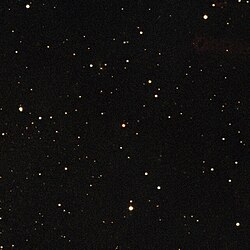 K2-25 is the star at the center of this image. | |
| Observation data Epoch J2000 Equinox J2000 | |
|---|---|
| Constellation | Taurus[1] |
| Right ascension | 04h 13m 05.6131s[2] |
| Declination | +15° 14′ 52.018″[2] |
| Apparent magnitude (V) | 15.881[3] |
| Characteristics | |
| Spectral type | M4.5 V[4] |
| Apparent magnitude (J) | 11.303(21)[5] |
| Apparent magnitude (H) | 10.732(20)[5] |
| Apparent magnitude (K) | 10.444(19)[5] |
| Variable type | Planetary transit[4] |
| Astrometry | |
| Radial velocity (Rv) | 38.64(15)[4] km/s |
| Proper motion (μ) | RA: 122.450(38) mas/yr[2] Dec.: −18.603(26) mas/yr[2] |
| Parallax (π) | 22.3572 ± 0.0308 mas[2] |
| Distance | 145.9 ± 0.2 ly (44.73 ± 0.06 pc) |
| Details[6] | |
| Mass | 0.2634(77) M☉ |
| Radius | 0.2932(93) R☉ |
| Luminosity | 0.00816(29) L☉ |
| Temperature | 3207(58) K |
| Metallicity [Fe/H] | 0.15(3)[4] dex |
| Rotation | 1.87708(66) d[7] |
| Rotational velocity (v sin i) | 7.71(29)[8] km/s |
| Age | 650(70)[8][9] Myr |
| Other designations | |
| Database references | |
| SIMBAD | data |
K2-25 is a young red dwarf star located in the Hyades cluster. There is a single known Neptune-sized planet in a 3.5 day orbit.
Hyades cluster[edit]
Using proper motion measurements in a search for low-luminosity members of the Hyades cluster, William van Altena first identified the star vA 50 (later known as K2-25) as a probable cluster member.[12] Membership in the Hyades cluster was later confirmed.[13][14][4]
Properties[edit]
K2-25 is a red dwarf that is only 26% the mass of the Sun and less than 1% of the luminosity.[6] As a member of the Hyades cluster, it is only 650 million years old as compared to the Sun's 4.5 billion.[8]
There is clear evidence for starspot activity in both the Kepler data and radial velocities as well as the associated activity indicators.[15]
Planetary system[edit]
The star has one known planet, K2-25b, with searches of the Kepler space telescope data for transits of additional planets being negative.[4] Analysis of transit-timing variations from the Spitzer Space Telescope as well as the MEarth Project also found no evidence of additional planets.[16]
Discovery[edit]
Brightness measurements of K2-25 taken by the Kepler space telescope during its extended K2 mission led to the discovery of the transiting planet K2-25b.[4][10]
Characteristics[edit]
K2-25b is a Hot Neptune type planet in an eccentric 3.48 day orbit.[15]
Due to its proximity and the activity levels of its host star, K2-25b should be losing some of its atmosphere to space; however, observations of two transits by the Hubble Space Telescope to search for escaping neutral hydrogen were negative.[17]
| Companion (in order from star) |
Mass | Semimajor axis (AU) |
Orbital period (days) |
Eccentricity | Inclination | Radius |
|---|---|---|---|---|---|---|
| K2-25b | 24.5+5.7 −5.2 M🜨 |
0.0287(12) | 3.48456408+0.0000006 −0.0000005 |
0.428+0.050 −0.049 |
88.16+0.18 −0.21° |
3.44(12) R🜨 |
Gallery[edit]

References[edit]
- ^ Roman, Nancy G. (1987). "Identification of a Constellation From a Position". Publications of the Astronomical Society of the Pacific. 99 (617): 695–699. Bibcode:1987PASP...99..695R. doi:10.1086/132034. Vizier query form
- ^ a b c d Vallenari, A.; et al. (Gaia collaboration) (2023). "Gaia Data Release 3. Summary of the content and survey properties". Astronomy and Astrophysics. 674: A1. arXiv:2208.00211. Bibcode:2023A&A...674A...1G. doi:10.1051/0004-6361/202243940. S2CID 244398875. Gaia DR3 record for this source at VizieR.
- ^ Henden, A. A.; et al. (2016). "VizieR Online Data Catalog: AAVSO Photometric All Sky Survey (APASS) DR9 (Henden+, 2016)". VizieR On-line Data Catalog: II/336. Originally Published in: 2015AAS...22533616H. 2336. Bibcode:2016yCat.2336....0H. Vizier catalog entry
- ^ a b c d e f g Mann, Andrew W.; et al. (2016). "Zodiacal Exoplanets in Time (ZEIT). I. A Neptune-sized Planet Orbiting an M4.5 Dwarf in the Hyades Star Cluster". The Astrophysical Journal. 818 (1) 46. arXiv:1512.00483. Bibcode:2016ApJ...818...46M. doi:10.3847/0004-637X/818/1/46.
- ^ a b c Skrutskie, M. F.; et al. (2006). "The Two Micron All Sky Survey (2MASS)". The Astronomical Journal. 131 (2): 1163–1183. Bibcode:2006AJ....131.1163S. doi:10.1086/498708. Vizier catalog entry
- ^ a b Thao, Pa Chia; et al. (2020). "Zodiacal Exoplanets in Time (ZEIT). IX. A Flat Transmission Spectrum and a Highly Eccentric Orbit for the Young Neptune K2-25b as Revealed by Spitzer". The Astronomical Journal. 159 (1) 32. arXiv:1911.05744. Bibcode:2020AJ....159...32T. doi:10.3847/1538-3881/ab579b. S2CID 208006920.
- ^ Mori, Mayuko; et al. (2024-04-05). "Characterization of starspots on a young M-dwarf K2-25: multi-band observations of stellar photometric variability and planetary transits". Monthly Notices of the Royal Astronomical Society. 530 (1): 167–189. arXiv:2403.13946. Bibcode:2024MNRAS.530..167M. doi:10.1093/mnras/stae841.
- ^ a b c Gaidos, E.; et al. (2020). "Zodiacal Exoplanets in Time. XI. The Orbit and Radiation Environment of the Young M Dwarf-Hosted Planet K2-25b". Monthly Notices of the Royal Astronomical Society: Letters. 498 (1). arXiv:2007.12701. Bibcode:2020MNRAS.498L.119G. doi:10.1093/mnrasl/slaa136.
- ^ Martín, Eduardo L.; et al. (2018). "The Lithium Depletion Boundary and the Age of the Hyades Cluster". The Astrophysical Journal. 856 (1) 40. arXiv:1802.07155. Bibcode:2018ApJ...856...40M. doi:10.3847/1538-4357/aaaeb8.
- ^ a b David, Trevor J.; et al. (2016). "New Pleiades Eclipsing Binaries and a Hyades Transiting System Identified by K2". The Astronomical Journal. 151 (5) 112. arXiv:1602.01901. Bibcode:2016AJ....151..112D. doi:10.3847/0004-6256/151/5/112.
- ^ "K2-25". SIMBAD. Centre de données astronomiques de Strasbourg. Retrieved 2020-08-17.
- ^ van Altena, W. F. (1966). "Low-luminosity members of the Hyades cluster". The Astronomical Journal. 71: 482–512. Bibcode:1966AJ.....71..482V. doi:10.1086/109952.
- ^ Röser, S.; et al. (2011). "A deep all-sky census of the Hyades". Astronomy & Astrophysics. 531: A92. arXiv:1105.6093. Bibcode:2011A&A...531A..92R. doi:10.1051/0004-6361/201116948. Vizier catalog entry
- ^ Douglas, S. T.; et al. (2014). "The Factory and the Beehive. II. Activity and Rotation in Praesepe and the Hyades". The Astrophysical Journal. 795 (2) 161. arXiv:1409.7603. Bibcode:2014ApJ...795..161D. doi:10.1088/0004-637X/795/2/161.
- ^ a b c Stefansson, Gudmundur; et al. (2020-09-30). "The Habitable Zone Planet Finder Reveals a High Mass and Low Obliquity for the Young Neptune K2-25b". The Astronomical Journal. 160 (4) 192. arXiv:2007.12766. Bibcode:2020AJ....160..192S. doi:10.3847/1538-3881/abb13a.
- ^ Kain, Isabel J.; et al. (2020-03-01). "The Young Planetary System K2-25: Constraints on Companions and Starspots". The Astronomical Journal. 159 (3) 83. arXiv:1912.05552. Bibcode:2020AJ....159...83K. doi:10.3847/1538-3881/ab655b.
- ^ Rockcliffe, Keighley E.; et al. (2021-09-01). "A Lyα Transit Left Undetected: the Environment and Atmospheric Behavior of K2-25b". The Astronomical Journal. 162 (3) 116. arXiv:2109.04376. Bibcode:2021AJ....162..116R. doi:10.3847/1538-3881/ac126f.
External links[edit]
Constellation of Taurus | |||||||||||||
|---|---|---|---|---|---|---|---|---|---|---|---|---|---|
| |||||||||||||
| Stars |
| ||||||||||||
| |||||||||||||
 Category Category | |||||||||||||
Original source: https://en.wikipedia.org/wiki/K2-25
Status: article is cached
 EncycloReader
is supported by the
EncycloReader
is supported by the  KSF
KSF