Karcag
 From Wikipedia - Reading time: 8 min
 | This article relies largely or entirely on a single source. (March 2018) |
Karcag | |
|---|---|
Town | |
 City Hall in Karcag | |
 Flag 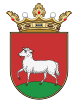 Coat of arms | |
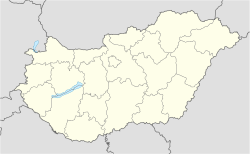  Karcag Location of Karcag | |
| Coordinates: 47°18′40″N 20°54′58″E / 47.31111°N 20.91611°E | |
| Country | Hungary |
| Region | Northern Great Plain |
| County | Jász-Nagykun-Szolnok |
| District | Karcag |
| Area | |
| • Total | 368.63 km2 (142.33 sq mi) |
| Population (2018) | |
| • Total | 19,732 |
| • Density | 61.25/km2 (158.6/sq mi) |
| Time zone | UTC+1 (CET) |
| • Summer (DST) | UTC+2 (CEST) |
| Postal code | 5300 |
| Area code | (+36) 59 |
| Website | karcag |
Karcag (Hungarian pronunciation: [ˈkɒrt͡sɒg]) is a large town in Jász-Nagykun-Szolnok county, in the Northern Great Plain region of central Hungary.
Geography[edit]
Karcag covers an area of 368.63 km2 (142 sq mi) and has a population of 20,632 people (2011).
Transport[edit]

Karcag has its own railway station, but InterCity trains do not stop here.
| Significant minority groups | |
| Nationality | Population (2011) |
|---|---|
| German | 48 |
| Romanian | 20 |
| Russian | 8 |
| Slovakian | 8 |
| Serbian | 6 |
Politics[edit]
The current mayor of Karcag is László Dobos (Fidesz-KDNP).
The local Municipal Assembly, elected at the 2019 local government elections, is made up of 12 members (1 Mayor, 8 Individual constituencies MEPs and 3 Compensation List MEPs) divided into this political parties and alliances:[1]
| Party | Seats | Current Municipal Assembly | |||||||||
|---|---|---|---|---|---|---|---|---|---|---|---|
| Fidesz-KDNP | 9 | M | |||||||||
| Jobbik | 2 | ||||||||||
| Momentum Movement | 1 | ||||||||||
Twin towns – sister cities[edit]
Karcag is twinned with:
- Cristuru Secuiesc, Romania (1990)
- Kunszentmiklós, Hungary (2009)
- Lazdijai, Lithuania (2004)
- Lednice, Czech Republic (2006)
- Merki District, Kazakhstan (1998)
- Moldava nad Bodvou, Slovakia (1998)
- Schwarzheide, Germany (2004)
- Stara Moravica (Bačka Topola), Serbia (1994)
Notable people[edit]
- István Varró (died in 1770), the last speaker of the Cuman language
- Colonel Michael de Kovats (1724–1779), the father of the US cavalry, a Hungarian hussar was born in Karcag
- Avram Hershko (born 1937), Israeli biochemist and Nobel laureate in Chemistry
- Margit Sebők (1939–2000), painter and educator
- Kevin Varga (born 1996), footballer
- Mihály Varga (born 1965), politician, since 2013 Minister of National Economy
- Suzi Diamond, Holocaust survivor.[2]
References[edit]
External links[edit]

Wikimedia Commons has media related to Karcag.
- Official website in Hungarian, English, German and Italian
Towns and villages of Karcag District | ||
|---|---|---|
| Towns (3) |
|  |
| Large village (1) |
| |
| Village (1) |
| |
Jász-Nagykun-Szolnok County | ||
|---|---|---|
| City with county rights |
| 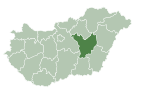  |
| Towns |
| |
| Large villages |
| |
| Villages |
| |
| Other topics |
| |
Authority control databases | |
|---|---|
| International | |
| National | |
| Geographic | |

 | This Jász-Nagykun-Szolnok location article is a stub. You can help Wikipedia by expanding it. |
This article is licensed under CC BY-SA 3.0.
Original source: https://en.wikipedia.org/wiki/Karcag
Status: article is cached
Original source: https://en.wikipedia.org/wiki/Karcag
Status: article is cached
 EncycloReader
is supported by the
EncycloReader
is supported by the  KSF
KSF