Categories
Kingdom of Montenegro
 From Wikipedia - Reading time: 13 min
Kingdom of Montenegro Краљевина Црна Горa Kraljevina Crna Gora | |||||||||||
|---|---|---|---|---|---|---|---|---|---|---|---|
| 1910–1918[a] | |||||||||||
 Flag
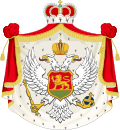 Coat of arms
| |||||||||||
| Anthem: Убавој нам Црној Гори Ubavoj nam Crnoj Gori ("To Our Beautiful Montenegro") | |||||||||||
 The Kingdom of Montenegro in 1914 | |||||||||||
 Kingdom of Montenegro in 1914 zoomed in the map with some cities | |||||||||||
| Capital | Cetinje | ||||||||||
| Capital-in-exile | Bordeaux Neuilly-sur-Seine | ||||||||||
| Common languages | Serbian | ||||||||||
| Religion | Serbian Orthodox (official)[1] | ||||||||||
| Demonym(s) | Montenegrin | ||||||||||
| Government | Constitutional monarchy | ||||||||||
| King | |||||||||||
• 1910–1918 | Nicholas I | ||||||||||
| Prime Minister | |||||||||||
• 1910–1912 (first) | Lazar Tomanović | ||||||||||
• 1917–1918 (last) | Evgenije Popović | ||||||||||
| Legislature | Popular Assembly | ||||||||||
| History | |||||||||||
• Elevation from principality | 28 August 1910 | ||||||||||
• Balkan Wars | 1912–1913 | ||||||||||
• Treaty of London | 30 May 1913 | ||||||||||
• Balkans theatre | 1914–1918 | ||||||||||
• Corfu Declaration | 20 July 1917 | ||||||||||
• Unification with Serbia | 28 November 1918[a] | ||||||||||
| Area | |||||||||||
• Total | 14.000 km2 (5.405 sq mi) | ||||||||||
| Currency | Montenegrin perper | ||||||||||
| |||||||||||
| Today part of |
| ||||||||||


| History of Montenegro |
|---|
 |
| Prehistory |
|
| Middle Ages and early modern |
|
| Modern and contemporary |
|
| Topics |
|
The Kingdom of Montenegro[b] was a monarchy in southeastern Europe, present-day Montenegro, during the tumultuous period of time on the Balkan Peninsula leading up to and during World War I. Officially it was a constitutional monarchy, but absolutist in practice. On 28 November 1918, following the end of World War I, with the Montenegrin government still in exile, the Podgorica Assembly proclaimed unification with the Kingdom of Serbia, which itself was merged into the Kingdom of Serbs, Croats and Slovenes three days later, on 1 December 1918. This unification with Serbia lasted, through various successor states, for almost 88 years, ending in 2006.
During this period, Montenegro remained largely rural and traditional. The constitution, adopted in 1905, provided a basic framework for governance and recognized some civil rights, such as freedom of religion and the press, but the political system remained heavily centered on the king. King Nikola maintained tight control over political life, and the state operated with only limited parliamentary influence. The society was patriarchal and conservative, with significant influence from the church and tribal customs, and few advancements in terms of modernization or civil institutions.
Internationally, Montenegro aligned itself with Serbia and other Balkan states during the Balkan Wars (1912–1913), aiming to expand its territory at the expense of the weakening Ottoman Empire. These efforts brought some gains but also deeper entanglement with Serbian political ambitions. When World War I broke out in 1914, Montenegro joined the Allied Powers, but by 1916 it had been overrun by Austro-Hungarian forces. King Nikola and his government went into exile, and the monarchy never returned to power.
The kingdom’s end came in 1918, when the Podgorica Assembly, under heavy influence from pro-Serbian forces, declared the unification of Montenegro with Serbia, effectively dissolving Montenegrin independence without a popular referendum. King Nikola was deposed in absentia. Many Montenegrins saw this act as illegitimate, leading to the Christmas Uprising in 1919 by royalist forces, which was quickly suppressed. Despite this resistance, Montenegro was absorbed into the newly formed Kingdom of Serbs, Croats and Slovenes (later Yugoslavia), and it ceased to exist as a sovereign kingdom.
History
[edit]
Prince Nicholas of Montenegro proclaimed the Kingdom of Montenegro in Cetinje on 28 August 1910, elevating the country from the rank of Principality. King Nicholas I had ruled the country as prince since 1860, and had initiated several modernising reforms at the beginning of the 20th century, such as introducing a constitution and a new currency, the Montenegrin perper. Although independent, Montenegro was nationally and culturally close to Serbia.[2]
Montenegro joined the First Balkan War in 1912, hoping to win a share in the last Ottoman-controlled areas of Rumelia. Montenegro did make further territorial gains by splitting Sandžak with Serbia on 30 May 1913. But the Montenegrins had to abandon the newly captured city of İşkodra (Skadar in Serbian, modern-day Shkodër) to the new state of Albania in May 1913, at the insistence of the Great Powers. Esad Pasha made a deal to surrender the town to the Montenegrins in exchange for Montenegro supporting his claims in Central Albania. However, as Shkodër and the surroundings had a large ethnic Albanian majority, the area went to the state of Albania instead. When the Second Balkan War broke out in June 1913, Serbia fought against Bulgaria, and King Nicholas sided with Serbia.
During World War I (1914–1918) Montenegro allied itself with the Triple Entente, in line with King Nicholas' pro-Serbian policy. Accordingly, Austria-Hungary occupied Montenegro from 15 January 1916 to October 1918. In 1918, coastal areas were occupied by the French and the Italian troops within the framework of the occupation of the eastern Adriatic.
On 20 July 1917, the signing of the Corfu Declaration foreshadowed the unification of Montenegro with Serbia. On 26 November 1918, the Podgorica Assembly, an elected body claiming to represent the Montenegrin people, unanimously adopted a resolution deposing king Nicholas I (who was still in exile) and unifying Montenegro with Serbia. Upon this event Nicholas I, who had previously supported unification with Serbia into a greater state with his dynasty playing the pivotal role, switched to promoting Montenegrin nationalism and opposing the union with Serbia, a position he maintained until his death in France in 1921.
On 1 December 1918, Serbia and Montenegro together formed a major part of the new Kingdom of Serbs, Croats and Slovenes (Yugoslavia).
During World War II, the occupying forces in Yugoslavia considered turning the Italian governorate of Montenegro into a puppet kingdom, but nothing came of these plans.[citation needed]
Rulers
[edit]King of Montenegro (1910–1918)
[edit]- Nicholas I of Montenegro (1910–1918)
Prime Ministers (1910–1916)
[edit]- Lazar Tomanović (1910–1912)
- Mitar Martinović (1912–1913)
- Janko Vukotić (1913–1915)
- Milo Matanović (1915–1916)
- Lazar Mijušković (1916)
Prime Ministers in-exile (1916–1922)
[edit]- Lazar Mijušković (1916)
- Andrija Radović (1916–1917)
- Milo Matanović (1917)
- Evgenije Popović (1917–1919)
- Jovan Plamenac (1919–1921)
- Anto Gvozdenović (1921–1922)
- Milutin Vučinić (1922)
- Anto Gvozdenović (1922)
See also
[edit]- History of Montenegro
- Principality of Montenegro
Notes
[edit]References
[edit]- ^ Constitution of the Principality of Montenegro, 1905, Article 40, "Paragraph 1: State religion in Montenegro is Eastern-Orthodox. Paragraph 2: Montenegrin Church is Autocephalous. It is independent from any other Church, but maintains dogmatic unity with Eastern-Orthodox Ecumenical Church. Paragraph 3: All other recognized religions are free in Montenegro.[1]
- ^ Ivetić, Eđidio (2015). GRANICA NA MEDITERANU. ISTOČNI JADRAN IZMEĐU ITALIJE I JUŽNOSLOVENSKOG SVETA OD XIII DO XX VEKA. Arhipelag. p. 72.
Further reading
[edit]- Živojinović Dragoljub R. (2014). "King Nikola and the territorial expansion of Montenegro, 1914–1920". Balcanica (45).
External links
[edit] Media related to Kingdom of Montenegro at Wikimedia Commons
- Kingdom of Montenegro in 1918 Archived 2012-12-05 at archive.today
- Montenegro – World Statesmen
Timeline of Yugoslav statehood | ||||||||||||||||||||||||||||||||||||||||||||||||||||||||||||||||||||||||||||||
|---|---|---|---|---|---|---|---|---|---|---|---|---|---|---|---|---|---|---|---|---|---|---|---|---|---|---|---|---|---|---|---|---|---|---|---|---|---|---|---|---|---|---|---|---|---|---|---|---|---|---|---|---|---|---|---|---|---|---|---|---|---|---|---|---|---|---|---|---|---|---|---|---|---|---|---|---|---|---|
| ||||||||||||||||||||||||||||||||||||||||||||||||||||||||||||||||||||||||||||||


Original source: https://en.wikipedia.org/wiki/Kingdom of Montenegro
Status: article is cached
 EncycloReader
is supported by the
EncycloReader
is supported by the  KSF
KSF