Categories
Kosovo Serbs
 From Wikipedia - Reading time: 40 min
Serbët në Kosovë (Albanian) косовски Срби (Serbian) kosovski Srbi (Serbian) | |
|---|---|
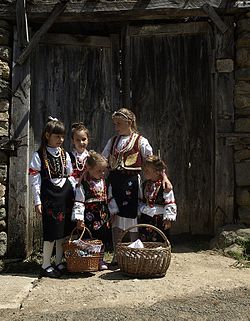 Girls from Štrpce in Serbian traditional clothing | |
| Regions with significant populations | |
 Kosovo Kosovo
| ca. 95,000[1][2][3] |
 Serbia Serbia | 68,514[4] |
| Languages | |
| Serbian | |
| Religion | |
| Serbian Orthodox Church | |
| Related ethnic groups | |
| Other South Slavs, especially other Serbs. | |
| Part of a series on |
| Serbs |
|---|
 |
Kosovo Serbs form the largest ethnic minority group in Kosovo (5–6%).[1][2][5][6][7][8] The precise number of Kosovo Serbs is difficult to determine as they have boycotted national censuses. However, it is estimated that there are about 95,000 of them, nearly half of whom live in North Kosovo.[3][9] Other Kosovo Serb communities live in the Southern municipalities of Kosovo.[6][10]
The medieval Kingdom of Serbia (1217–1346) and the Serbian Empire (1346–1371) included parts of the territory of Kosovo until its annexation by the Ottomans following the Battle of Kosovo (1389), considered one of the most notable events of Serbian history.[11][12] Afterwards, it was a part of the Serbian Despotate. Modern Serbian historiography considers Kosovo in this period to be the political, religious and cultural core of the medieval Serbian state.[13]
In the Ottoman period (1455–1913), the situation of the Serb population in Kosovo went through different phases. In the 16th century, the Serbian Patriarchate of Peć was re-established and its status strengthened even more. At the end of 18th century, the support of the Patriarchate to the Habsburgs during the Great Turkish War of 1683–1699 triggered a wave of Serb migrations to locations under the control of the Habsburg monarchy.[14] After the independence of the Principality of Serbia to its north, Kosovo came increasingly to be seen by the mid-19th century as the "cradle of Serb civilization" and called the "Serbian Jerusalem". In the area of Kosovo, Serbs have built and renovated approximately 1,300 monasteries, churches and churchyards since the 12th century, in at least 1,000 settlements.[15] Kosovo was annexed by the Kingdom of Serbia in 1912, following the First Balkan War.
As a region of the Kingdom of Yugoslavia, Kosovo was divided in several banovinas. In the pre-World War II period, the Yugoslav colonisation of Kosovo took place which aimed to increase the number of Serbs in Kosovo with colonists from Central Serbia and Montenegro. After World War II, Kosovo's districts were reunited. They were referred to as the Socialist Autonomous Province of Kosovo. Serbs were one of the people of the province within the Socialist Republic of Serbia (1944–1992). As a result of the Kosovo War and following by its declaration of independence, in 2008 it is partially recognized by the international community. Serbs are the second largest community in Kosovo.[6][10]
More than half of Kosovo's pre-1999 Serb population (226,000),[16] including 37,000 Romani, 15,000 Balkan Muslims (including Ashkali, Bosniaks, and Gorani), and 7,000 other non-Albanian civilians were expelled to central Serbia and Montenegro, following the Kosovo War.[17] According to the 2013 Brussels Agreement the establishment of a Community of Serb Municipalities, a self-governing association of municipalities with a majority Serb population in Kosovo is proposed.
Terminology
[edit]The formal names for the Serb community in Kosovo is "Serbs of Kosovo and Metohija" (Srbi na Kosovu i Metohiji) or "Serbs of Kosmet" (Kosmetski Srbi), in use by the community itself and the Serbian government. They are also referred to as Serbs of Kosovo (Serbian: Косовски Срби/Kosovski Srbi) or Serbs in Kosovo (Serbian: Срби на Косову/Srbi na Kosovu, Albanian: Serbët në Kosovë). The term "Kosovo Serbs" is predominantly used in English. They are known by the demonym Kosovari,[18] though this is properly used for inhabitants of the region of Kosovo (in the narrow sense – centred around the Kosovo Field), along with Metohijci (of Metohija).[19]
History
[edit]Medieval period
[edit]

Right: Main Gate of the Fortress in Prizren, which Stefan Dušan used as capital of Serbian Empire
Sclaveni raided and settled the western Balkans in the 6th and 7th century.[20] The White Serbs are mentioned in De Administrando Imperio as having settled the Balkans during the reign of Byzantine Emperor Heraclius (r. 610–641), however, research does not support that the White Serbian tribe was part of this later migration (as held by historiography) rather than migrating with the rest of Early Slavs.[21] Serbian linguistical studies concluded that the Early South Slavs were made up of a western and eastern branch, of parallel streams, roughly divided in the Timok–Osogovo–Šar line.[22] However, per Ivo Banac in the early Middle Ages Eastern Herzegovinian dialects were Eastern South Slavic, but since the 12th century, the Shtokavian dialects, including Eastern Herzegovinian, began to separate themselves from the rest of the Eastern South Slavic dialects.[23]
Starting from the first half of the 9th century, and up to the second half of the 10th century, several Byzantine–Bulgarian and Bulgarian–Serbian wars were fought in various regions, including Kosovo, that came under Bulgarian control. During the reign of Byzantine emperor John I Tzimiskes (969-976), Byzantine control was established throughout the region, including Kosovo and up to the Catepanate of Ras.[24][25][26]
Byzantine rule in the region was supressed by Samuel of Bulgaria (976-1014), but later restored by emperor Basil II in 1018. Under Byantine rule, local Eastern Orthodox eparchies of Lipljan and Prizren were placed under the jurisdiction of the Archbishopric of Ohrid (1019).[27][28]
In 1040–1041 a massive Bulgarian rebellion against Byzantine rule broke out, which included Kosovo. Another rebellion broke out in 1072, in which Serbian prince Constantine Bodin was crowned Emperor of Bulgaria at Prizren, however, despite some initial success, he was eventually captured and the rebellion was suppressed.[29][30][31] Vukan I, the new independent Serbian Grand Prince, began raiding Byzantine territories during the early 1090s, first in Kosovo,[32] capturing Lipjan,[33][34] and advancing further towards Skoplje and Vranje.[35] He broke several peace treaties which he personally negotiated with the Byzantine Emperor at Zvečan and Lipjan, until finally submitting in 1106.


In 1166, a Serbian prince, Stefan Nemanja, the founder of the Nemanjić dynasty, asserted independence after an uprising against the Byzantine Emperor Manuel I Comnenus.[36] Nemanja defeated his brother, Tihomir, at Pantino near Pauni, and drowned him in the Sitnica river. Nemanja was eventually defeated and had to return some of his conquests, and vouched to the Emperor that he would not raise his hand against him. In 1183, Stefan Nemanja embarked on a new offensive allied with the Kingdom of Hungary after the death of Manuel I Komnenos in 1180, which marked the end of Byzantine domination over the region of Kosovo. Nemanja's son, Stefan, ruled a realm reaching the river of Lab in the south. Stefan conquered all of Kosovo by 1208, by which time he had conquered Prizren and Lipjan, and moved the border of his realm to the Šar mountain. In 1217, Stefan was crowned King of Serbs, due to which he is known in historiography as Stefan "the First-Crowned".[37]
In 1219, the Serbian Church was given autocephaly, with Hvosno, Prizren and Lipljan being the Orthodox Christian eparchies with territory in modern-day Kosovo. By the end of the 13th century, the centre of the Serbian Church was moved to Peja from Žiča.
Prizren serving as the capital of Serbia during the 14th century, and was a centre of trade.[38] King Stefan Dušan founded the great Monastery of the Holy Archangel near Prizren in 1342–1352. During those periods, several major monasteries were endowed with vast possessions in the regions of Kosovo and Metohija.[39] The Serbian Kingdom was elevated into an Empire in 1345–46. Stefan Dušan received John VI Kantakuzenos in 1342 at Pauni to discuss an alliance against the Byzantine Emperor. In 1346, the Serbian Archbishopric at Peja was upgraded into a Patriarchate, but it was not recognized before 1375. After the death of Dušan in 1355, the fall of the Serbian Empire began, with feudal disintegration during the reign of his successor, Stefan Uroš V (r. 1355–1371).[40][41]
Parts of Kosovo became domains of Vukašin Mrnjavčević, but Vojislav Vojinović expanded his demesne further onto Kosovo. The armies of Vukašin from Pristina and his allies defeated Vojislav's forces in 1369, putting a halt to his advances. After the Battle of Maritsa on 26 September 1371 in which the Mrnjavčević brothers lost their lives, Đurađ I Balšić of Zeta took Prizren and Peja in 1372. A part of Kosovo became the demesne of the Lazar of Serbia.[42][43]

The Ottoman Empire invaded the realm of Prince Lazar on 28 June 1389, at the Battle of Kosovo near Pristina, at Gazimestan. The Serbian army was led by Prince Lazar who led 12,000–30,000 men against the Ottoman army of 27,000–40,000 men. Lazar was killed in battle, while Sultan Murad also lost his life, believed to have been assassinated by Serbian knight Miloš Obilić. The outcome of the battle is deemed inconclusive, with the new Sultan Bayezid having to retreat to consolidate his power. Vuk Branković came to prominence as the local lord of Kosovo, though he was an Ottoman vassal at times, between 1392 and 1395.[44][45]
Another battle occurred in Kosovo 1448 between the Hungarian troops supported by the Albanian ruler Gjergj Kastrioti Skanderbeg on one side, and Ottoman troops supported by the Branković dynasty in 1448. Skanderbeg's troops, who were en route to help John Hunyadi, were stopped by Branković's troops, as he was more or less an Ottoman vassal. Hungarian regent John Hunyadi lost the battle after a 2-day fight, but essentially stopped the Ottoman advance northwards.[46] In 1455, southern regions of the Serbian Despotate were invaded again, and the region of Kosovo was finally conquered by the Ottoman Empire and incorporated into the Ottoman administrative system.[47]
In 1455, new castles rose to prominence in Pristina and Vushtrri, centres of Branković District.
Early Modern period
[edit]The Ottomans brought Islamization with them, particularly in towns, and later also created the Kosovo Vilayet as one of the Ottoman territorial entities. During the Islamisation many Churches and Holy Orthodox Christian places were razed to the ground or turned into mosques. The big Monastery of Saint Archangels near Prizren was torn down at the end of the 16th century and the material used to build the Mosque of Sinan-pasha, an Islamized Albanian, in Prizren. Although the Serbian Orthodox Church was officially abolished in 1532, an Islamized Serb from Bosnia, Grand Vizier Mehmed-pasha Sokolović influenced the restoration of the Serbian Patriarchate of Peć in 1557. Special privileges were provided, which helped the survival of Serbs and other Christians on Kosovo.[48]

Kosovo was taken by the Austrian forces during the War of the Holy League (1683–1698). In 1690, the Serbian Patriarch of Peć Arsenije III, who previously escaped a certain death, led 37,000 families from Kosovo, to evade Ottoman wrath since Kosovo had just been retaken by the Ottomans.[49] In 1766, the Ottomans abolished the Serbian Patriarchate of Peć.
By the end of the 19th century, Albanians became the dominating nation of Kosovo.[50]
During the First Serbian Uprising, Serbs from the northern parts of Kosovo prepared to join the uprising, but an Ottoman army arrived to suppress their efforts before they could partake in the uprising. Ottoman violence resulted in a number of Serbs migrating to central Serbia in order to join rebels led by Karađorđe.[51][52] The Kelmendi were the only Albanian tribe to fully support Serb rebels.[53] [54] After the independence of the Principality of Serbia to its north, Kosovo came increasingly to be seen by the mid-19th century as the “cradle of Serb civilization” and called the "Serbian Jerusalem".[55][56][57][58][59]
The term Arnauti or Arnautaši was coined by 19th and early 20th century Serbian ethnographers to refer to the Albanians in Kosovo, which they perceived as Albanised Serbs; Serbs who had converted to Islam and went through a process of Albanisation.[60][61] In modern anthropology, the historical validity of the term has been criticized as well as use as a tool of nation-building and homogenization policies of the Serbian state.[62][63][64][65]
In the aftermath of the expulsion of the Albanians (1877–1878) in the newly annexed territories of southern Serbia and the resettlements of tens of thousands of Albanians mostly in eastern Kosovo, attacks against Serbs took place, during and after the Serbian–Ottoman War. In 1901, massacres against Serbs were carried out by Albanians in North Kosovo and Pristina.[66] Jovan Cvijić claimed that the Albanians were responsible for forcing an estimated 150,000 Serbs out of Kosovo from 1876 until 1912.[67][68] Albanians were also accused of conducting a campaign of terror against the Serbian population who remained.[69][67]
Modern period
[edit]

The arising Kingdom of Serbia planned a restoration of its rule in Kosovo as Ottoman might crumbled on the Balkan peninsula. The period witnessed a rise of Serbian nationalism. Some historians suggest that Austro-Hungarian emissaries were active in areas where Serbs and Albanians coexisted, deliberately stirring conflicts and divisions between the two nations to advance their state's political interests and influence.[70] During the First Balkan War, the Kingdom of Serbia and the Kingdom of Montenegro fought alongside the Kingdoms of Greece and Bulgaria as part of the Balkan League to drive the Ottoman forces out of Europe and to incorporate the spoils into their respective states. Serbia, Montenegro and Greece had acquired the entire Western Balkan (Albanian-inhabited territories) with the exception of Vlora in the hope of achieving recognition with their new borders. Resistance from the Albanians across their entire region in favour of their own proposed independent nation state led to fighting between the Balkan League armies (less geographically uninvolved Bulgaria) and Albanian forces. To end the conflict, the Treaty of London decreed an independent Principality of Albania (close to its present borders), with most of the Vilayet of Kosovo awarded to Serbia and the Metohija region awarded to Montenegro.[71][72]
World War I and First Yugoslavia
[edit]During the First World War, in the winter of 1915–1916, the Serbian army withdrew through Kosovo in a bid to evade the forces of the Central Powers. Thousands died of starvation and exposure.[73] In 1918, the Serbian army pushed the Central Powers out of Kosovo, and the region was unified as Montenegro subsequently joined the Kingdom of Serbia. The monarchy was then transformed into the Kingdom of Serbs, Croats and Slovenes.[74]
The 1918–1929 period of the Kingdom of Serbs, Croats and Slovenes witnessed a decrease in the Serbian population of the region and an increase in the number of Albanians. In 1929, the state was renamed the Kingdom of Yugoslavia. The territories of Kosovo were split among the Zeta Banovina, the Banate of Morava and the Banate of Vardar. The state lasted until the World War II invasion and Axis occupation of Yugoslavia.
World War II
[edit]
After the invasion of Yugoslavia (6–18 April 1941), the Axis powers divided territory among themselves. Kosovo and Metohija was divided between Italian, German and Bulgarian occupation. The largest part of what is today Kosovo was under Italian occupation and was annexed into an axis Greater Albania, the Albanian Kingdom through a decree on 12 August 1941, while northern parts were included in German-occupied Serbia, and southeastern parts into the Bulgarian occupational zone.[75] Parts of eastern Montenegro and western Macedonia were also annexed to Albania.
During the occupation, the population was subject to expulsion, internment, forced labour, torture, destruction of private property, confiscation of land and livestock, destruction and damaging of monasteries, churches, cultural-historical monuments and graveyards.[75] There were waves of violence against Serbs in some periods, such as April 1941, June 1942, September 1943, and continuous pressure in various ways.[76] Civilians were sent to camps and prisons established by the Italian, German and Bulgarian occupation, and the Albanian community.[77] The expulsion of Serbs proved problematic, as they had performed important functions in the region, and been running most of the businesses, mills, tanneries, and public utilities, and been responsible for most of the useful agricultural production.[78] Most of the war crimes were perpetrated by the Vulnetari ("volunteers"),[79] Balli Kombëtar and the SS Skanderbeg Division.[80] The Skanderbeg Division was better known for murdering, raping, and looting in predominantly Serbian areas than for participating in combat operations on behalf of the German war effort.[81] The most harsh position of Serbs was in the Italian (Albanian) zone.[82] A large part of the Serb population was expelled or forced to flee in order to survive.[82] Serbian estimations put the number of expelled at around 100,000; an estimated 40,000 from the Italian-occupation zone, 30,000 from the German zone, and 25,000 from the Bulgarian zone.[83] It is estimated that 10,000 Serbs and Montenegrins were killed in Kosovo during WWII.[84]
Second Yugoslavia
[edit]The Province of Kosovo was formed in 1946 as an autonomous region to protect its regional Albanian majority within the People's Republic of Serbia as a member of the Federal People's Republic of Yugoslavia under the leadership of the former Partisan leader, Josip Broz Tito, with limited self-government.[85] After Yugoslavia's name changed to the Socialist Federal Republic of Yugoslavia and Serbia's to the Socialist Republic of Serbia in 1963, the now-termed Autonomous Region of Kosovo and Metohija's status was equalized with that of Vojvodina;[85] further constitutional amendments in 1968 elevated the autonomous provinces to constitutional elements of the federation while the term socialist was added and the term Metohija was removed from Kosovo.[86] In the 1974 constitution, the Socialist Autonomous Province of Kosovo received higher powers, allowing it to have its own administration, assembly, and judiciary. It also received membership in the collective presidency and the federal parliament, in which it held veto power, though remaining as a Socialist Autonomous Region within the Socialist Republic of Serbia.[87][88]

In the 1970s, an Albanian nationalist movement pursued full recognition of the province of Kosovo as another republic within the federation, while the most extreme elements aimed for full-scale independence. Tito's government dealt with the situation swiftly, but only gave it a temporary solution. In 1981, Kosovar Albanian students organized protests demanding more autonomy for Kosovo. During this period, the ethnic balance of Kosovo witnessed disproportional increase as the number of Albanians rose dramatically due to higher birth rates.[90] Serbs barely increased and dropped in the full share of the total population down to 10% due to higher demographic raise of the Albanian population.
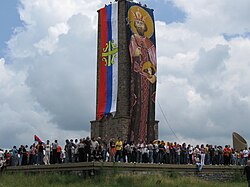
In 1986, the Serbian Academy of Sciences and Arts (SANU) was working on a document, which later would be known as the SANU Memorandum. An unfinished edition was filtered to the press. In the essay, SANU explained the Serbian peoples history as victims of a 500-year and more genocide from Kosovo, and therefore called for the revival of Serb nationalism. During this time, Slobodan Milošević's rise to power started in the League of the Socialists of Serbia. Milošević used the discontent reflected in the SANU memorandum for his political goals. One of the events that contributed to Milošević's rise of power was the Gazimestan speech, delivered in front of 1,000,000 Serbs at the central celebration marking the 600th anniversary of the Battle of Kosovo, held at Gazimestan on 28 June 1989.
Soon afterwards, as approved by the Assembly in 1990, the autonomy of Kosovo was revoked back to the old status (1971). Milošević, however, did not remove Kosovo's seat from the Federal Presidency. After Slovenia's secession from Yugoslavia in 1991, Milošević used the seat to attain dominance over the Federal government, outvoting his opponents.


Right: Ruins of a Serb part of Prizren destroyed during 2004 unrest in Kosovo.
Breakup of Yugoslavia and Kosovo War
[edit]After the Dayton Agreement of 1995, the Kosovo Liberation Army, ethnic-Albanian paramilitary organisation that sought the separation of Kosovo and the eventual creation of a Greater Albania,[91][92][93][94][95] began attacking Serbian civilians and Yugoslav army and police, bombing police stations and government buildings, killing Yugoslav police and innocent people of all nationalities, even Albanians who were not on their side.[96] As of 2014[update], mass graves of Kosovar Albanian victims are still being found.[97] There have been many reports of abuses and war crimes committed by the KLA during and after the conflict, including the massacres of civilians in (Lake Radonjić, Klečka, Staro Gracko, and Gnjilane, along with prison camps (such as Lapušnik), organ theft and destruction of medieval churches and monuments.[98][99]
The war ended on 10 June 1999, after a 78-day bombing campaign by NATO against Yugoslavia, resulting in the withdrawal of Yugoslav troops. Kosovo was placed under U.N. administration and Kosovo Force (KFOR), a NATO-led peacekeeping force was deployed to the province.[100] According to the 1991 Yugoslavia census, there were 194,190 Serbs in Kosovo.[101] Following the Kosovo War, a large number of Serbs fled or were expelled and many of the remaining civilians were subjected to abuse.[102][103][104][105][106] After Kosovo and other Yugoslav Wars, Serbia became home to highest number of refugees and IDPs (including Kosovo Serbs) in Europe.[107][108][109] During unrest in Kosovo in March 2004, 35 churches and monasteries were destroyed or seriously damaged.
In total, 156 Serbian Orthodox churches and monasteries have been destroyed since June 1999, including during March 2004. Many of the churches and monasteries dated back to the 12th, 13th and 14th centuries.[110] KLA fighters are accused of vandalizing Devič monastery and terrorizing the staff. KFOR troops said KLA rebels vandalized centuries-old murals and paintings in the chapel and stole two cars and all the monastery's food.[111]
21st century
[edit]The interim Kosovo government unilaterally declared independence from Serbia on Sunday, 17 February 2008.[112] Serbia refuses to recognise this declaration of independence. Kosovo's self-proclaimed independence has been recognised by 98 UN countries, and one non-UN country, the Republic of China (Taiwan). The remaining Kosovo Serbs (mostly in North Kosovo) want to remain part of Serbia, but Serbian majority towns are now rare in Kosovo.
After the declaration of Independence, some officials[who?] in the Serbian government have proposed a partition of Kosovo, with North Kosovo and Štrpce becoming part of Serbia or given autonomy. The United States opposes the partition of Kosovo, stressing that the "great majority of countries around the world are not going to stand for that."[113] In response to the seizure of railways in Northern Kosovo and formation of Serbian offices to serve as part of a parallel government, the-then Prime Minister of Kosovo Hashim Thaci stated that they would "not tolerate any parallel institution on Kosovo's territory" and would assert their authority over all of Kosovo.[114] The UN's Special Representative in Kosovo said the "international community has made it very clear that no partition of Kosovo will be acceptable."[115] Ivan Eland, a Senior Fellow at the Independent Institute, suggested such "a partition within a partition" would prevent a "Serbia-Kosovo War" and provides the "best chance" of Kosovo having a long-term stable relationship with Serbia.[116] Pieter Feith, the European Union's special representative in Kosovo, and the International Civilian Representative for Kosovo said no plans were under discussion to carve out a canton or grant any other autonomy to Serbs living in the north of Kosovo.[117]

On 19 April 2013, Kosovo and Serbia signed the Brussels Agreement. The deal established the proposal of the Community of Serb Municipalities that included Serb-majority municipalities.[118] It envisaged the withdrawal of Serbian presence in the north, in exchange for the expansion of self-governance for Kosovo Serbs. The agreement also defined the structure of the police and local elections, called for integration of Serbian institutions into the Kosovo police and judicial authorities within Kosovo's legal framework. Belgrade did not recognize Kosovo's independence but both sides agreed to not prevent the other in its EU integration.[119]
During the COVID-19 pandemic, Kosovo Serbs found themselves in a limbo, stuck between different orders issued by Serbia and Kosovo.[120] In November 2020, during the COVID pandemics, Kosovo policemen and inspectors stormed and temporarily closed several Serb-owned pharmacies in North Kosovo, attempting to confiscate medicine supplies, because the items were allegedly not registered within the central system in Pristina. The act was met with citizen protest which were on the verge of escalation.[121][122] In December 2020, the vaccines for COVID-19 were sent to North Kosovo by Serbia without any consultation with Kosovan authorities. Kosovo opposed the arrival of those vaccines, claiming that they were illegally distributed by Serbia.[123][124] Only few people were vaccinated and the remaining vaccines were sent back after an investigation was launched.[125] In 2021 health workers from North Kosovo protested against arrests of their colleagues who are employed in the hospitals which take care of patients with COVID-19. They described the actions as "inhumane" and sent protesting letters to various international institutions and organisations.[126]
In September 2021, Serbs in North Kosovo protested following the government's reciprocal decision to ban Serbian license plates entering Kosovo. The ensuing crisis was temporarily eased when Kosovo and Serbia reached an agreement to end the standoff, with stickers being placed over each country’s insignia on number plates at border crossings.[127] In late July 2022 tensions flared up again when the Kosovo government declared that Serb-issued identity documents and vehicle licence plates would be invalid, prompting Serbs in North Kosovo to protest again by blocking roads. On 27 August, it was announced that Serbia agreed to abolish entry and exit documents for Kosovo ID holders while Kosovo committed to refrain from implementing such measures for Serbian ID holders.[128] In November, ethnic Serbs resigned en masse from Kosovo state institutions in protest.[129]
In April 2023, local elections were held, boycotted by ethnic Serbs. As a result, ethnic Albanian mayors were elected in the Serb-majority municipalities of Zvečan, Leposavić, Zubin Potok and North Mitrovica.[130] When Kosovo police took control of the municipal buildings in Zvečan, Zubin Potok and Leposavić to allow the newly elected mayors to assume office, protesters gathered in front of the municipal buildings and tried stop the police from escorting the mayor inside, resulting in multiple injuries.[131] On 24 September 2023, a group of Serb militants ambushed Kosovo Police units in the village of Banjska in North Kosovo, resulting in one policeman being killed and two others wounded, and three of the gunmen being killed.[132] In February 2024, the Kosovar government banned the use of the Serbian dinar as a payment in Kosovo and North Kosovo.[133] The move was criticized by the U.S. and E.U. since the Serb minority relies on financial assistance and social benefit payments from the government of Serbia.[134]
Kosovo's Serb minority is often the target of demonstrations of hostility and attacks.[135] In addition to that, members of the Kosovo Serbs community face mistreatment and prejudice in Serbia too.[136]
Demographics
[edit]| Year | Albanians | Serbs | Others |
|---|---|---|---|
| 1921 | 65 % | 26 % | 9 % |
| 1931 | 60 % | 33 % | 7 % |
| 1948[137] | 68 % | 24 % | 8 % |
| 1953 | 65 % | 23 % | 11 % |
| 1961 | 67 % | 23 % | 9 % |
| 1971 | 73 % | 18 % | 8 % |
| 1981 | 77 % | 13 % | 9 % |
| 1991[101] | 82 % | 10 % | 8 % |
| 2000[138] | 88 % | 7 % | 5 % |
| 2007[138] | 92 % | 5 % | 3 % |
During the 20th century, the Serb population of Kosovo constantly decreased. Today, Serbs mostly populate the enclaves across Kosovo, as well as North Kosovo, which comprises 11% of Kosovo's territory and where they comprise 95% of population. 1,200 km2 (463 sq mi). Diplomats from the United Nations have voiced concern over slow progress on minority rights.[139] Human Rights Watch pointed out discrimination against Serbs and Roma in Kosovo immediately after the war.[102]
ECMI calculated, based on 2010 and 2013 estimations, that ca. 146,128 Serbs resided in Kosovo, that is, ca. 7.8% of the total population.[8] In 2012, the Helsinki Committee for Human Rights in Serbia estimated that the number was 90–120,000.[140] The Republic of Kosovo-organized 2011 census did not take place in North Kosovo, and was boycotted by a considerable number of Serbs in southern Kosovo.[8] The ECMI did call "for caution when referring to the 2011 Census in Kosovo".[141] There are ten municipalities constituted by a Serb numerical majority.[8] These are the four northern municipalities of North Mitrovica, Leposavić, Zvečan, Zubin Potok, and the six southern (enclave) municipalities of Gračanica, Štrpce, Novo Brdo, Ranilug, Parteš and Klokot.[8] As of 2014, the OSCE estimates that around 96,000 Serbs live in Kosovo.[9]
The UNHCR estimated in 2019 that the total number of IDPs (Serbs and non-Serbs) from Kosovo in Serbia are 68,514.[4] Serbia has claimed (2018) that a total 199,584 IDPs from Kosovo (Serbs and non-Serbs) origin have settled and live in Serbia after the war based on the original data it gathered in 2000.[142][143] The UNHCR reported in 2009, based on the official figures by the government of Serbia, that around 205,835 IDPs who fled from Kosovo lived in Serbia.[144] These included Serbs, Roma, Ashkali and Egyptians.[145] The registration data in 2000 are the only official data which have been generated and there has been no re-registration of IDPs in Serbia since 2000. The same figure has been used in all official reports since then with some statistical reconfigurations. As such, the reliability of the registration of IDPs living in Serbia has been questioned.[142][143][146]
In 2003, the number of Kosovo Serb IDPs in Montenegro was c. 12,000.[147] The numbers do not include those that have received Montenegrin citizenship. As of 2015, there were at least 6,600 Kosovo Serb refugees in Montenegro.[148] By 2019, there were 135 IDPs in total in Montenegro from Kosovo.[4]
In 2017, per the Serbian President Aleksandar Vučić, there were 94,998 Serbs in Kosovo. In the north, there were 47.1 percent of them and south of the Ibar lived 52.8 percent of the Serbs.[149] The think-tank European Stability Initiative estimated that there were around 95,000 Serbs in Kosovo in 2023, based on primary school pupil data.[3]


| Municipality | Percentage | Number |
|---|---|---|
| North Mitrovica | 76.48% | 22,530 |
| Leposavić | 96% | 18,000 |
| Zvečan | 96.1% | 16,000 |
| Zubin Potok | 93.29% | 13,900 |
| Štrpce | 70.58% | 9,100 |
| Gračanica | 82.15% | 7,209 |
| Novo Brdo | 61.46% | 5,802 |
| Ranilug | 97.15% | 5,718 |
| Parteš | 99.96% | 5,300 |
| Gjilan | 5.29% | 5,000 |
| Klokot | 71.23% | 3,500 |
| Vushtrri | 4.79% | 3,500 |
| Kamenica | 8.01% | 3,019 |
| Obiliq | 12.37% | 3,000 |
| Lipjan | 3.37% | 2,000 |
| Pristina | 1% | 2,000 |
| Istog | 4.16% | 1,700 |
| Rahovec | 1.76% | 1,000 |
| Peja | 1.03% | 1,000 |
| Kosovo Polje | 2.51% | 900 |
| Klina | 1.53% | 600 |
| Skenderaj | 0.59% | 300 |
| Viti, Kosovo | 0.59% | 280 |
| Prizren | 0.13% | 237 |
| Ferizaj | 0.06% | 60 |
| Shtime | 0.18% | 49 |
| Deçan | 0.11% | 46 |
| Gjakova | 0.02% | 17 |
| Mitrovica | 0.02% | 14 |
| Podujevo | 0.01% | 12 |
| Dragash | 0.02% | 7 |
| Suva Reka | <0.01% | 2 |
| Kaçanik | <0.01% | 1 |
Culture
[edit]

Right: Gračanica monastery painting by Nadežda Petrović.

The Battle of Kosovo is particularly important to Serbian history, tradition, and national identity.[150]
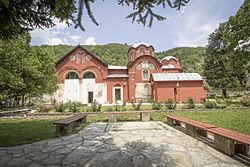
Eparchy of Raška and Prizren of Serbian orthodox church take care of Serbian people and Orthodox heritage in Kosovo. Numerous Serbian Orthodox monasteries and churches are spread around Kosovo. Some of them include: Banjska monastery, Devič monastery, Gračanica monastery, Patriarchal Monastery of Peć, Visoki Dečani monastery and Our Lady of Ljeviš. The last four make up the Medieval Monuments in Kosovo, founded by the Nemanjić dynasty, is a combined World Heritage Site.[151]
Medieval fortifications built by Serbian rulers and lords present important cultural heritage.
In connection with social gatherings among the Serbs around the churches and monasteries called Sabori during the Slava and Hram (Patron of the monastery) there was a belief that everyone must dance (to instrumental accompaniments) in order to gain and secure good health.[152] In upper Prizren the Sabor was held on 21 November by the ruins of the monastery of the Holy archangel founded by the Serbian Emperor Stefan Dušan the Mighty in the 14th century. There were also great social gatherings at the Kaljaja fortress.[153]
Serbian folk music is rich in a large number of songs from Kosovo, which were especially preserved in the performances of Jordan Nikolić and Mara Đorđević.[154]
The Serbs in Kosovo speak the dialects of Zeta-South Raška, Kosovo-Resava, and Prizren-South Morava.[155]
UNESCO World Heritage Sites
[edit]


Prominent people
[edit]Monarchs
[edit]
- Lazar of Serbia, Serbian ruler who led the army in the Battle of Kosovo, born in Prilepac fortress in Boževce village near Kamenica.
- Dragana of Serbia, Bulgarian empress consort
- Musić noble family
- Jelena Balšić, Serbian noblewoman
- Jovan Dragoslav, Serbian nobleman
- Mladen, magnate and vojvoda
- Vuk Branković, lord of District of Branković
- Đurađ Branković, lord of District of Branković
- Mara Branković
- Kantakuzina Katarina Branković
- Mahmud Pasha Angelović, Grand Vizier of the Ottoman Empire
Politicians
[edit]- Radivoje Milojković, prime minister of Principality of Serbia
- Dušan Mugoša, Presidents of the Assembly of SAP Kosovo
- Ilija Vakić, Chairman of the Executive Council of SAP Kosovo
- Bogoljub Nedeljković, Chairman of the Executive Council of SAP Kosovo
- Dragan Tomić, acting President of Serbia
- Aleksandar Tijanić, Minister of Information of Serbia and director of the Radio Television of Serbia
- Ivica Dačić, Prime Minister of Serbia
- Jorgovanka Tabaković, Governor of the National Bank of Serbia
- Slobodan Petrović, Deputy Prime Minister of Republic of Kosovo
- Aleksandar Jablanović, Minister of Communities and Returns of Republic of Kosovo[156]
- Branislav Grbić, Minister of Communities and Returns of Republic of Kosovo
- Dalibor Jevtić, Minister of Communities and Returns of Republic of Kosovo
- Oliver Ivanović, State Secretary of the Ministry for Kosovo and Metohija[157]
- Bogoljub Karić, businessman and politician
- Vladimir Dobričanin, doctor and politician, Member of the Parliament of Montenegro
- Dragan Velić, Chairman of the Serbian National Council for Central Kosovo[158]
- Radovan Ničić, first President of the Assembly of the Community and Municipalities of AP Kosovo
- Slaviša Ristić, former mayor of Zubin Potok[159]
Religious people
[edit]
- Joanikije II, Archbishop of Peć and first Serbian Patriarch
- Pajsije, Archbishop of Peć and Serbian Patriarch
- Vikentije Popović-Hadžilavić, the first metropolitan of Metropolitanate of Karlovci
- Arsenije IV Jovanović Šakabenta, Archbishop of Peć and Serbian Patriarch
- Lazar the Serb, monk and horologist who invented and built the first known mechanical public clock in Russia
- Martin Segon, Catholic Bishop of Ulcinj
Military people
[edit]
- Miloš Obilić, knight during the invasion of the Ottoman Empire
- Vuk Isaković, military commander in Austrian service during the Austrian-Ottoman Wars
- Čolak-Anta, military commander and one of the most important figures of the First Serbian Uprising
- Vukajlo Božović, Serbian Orthodox priest and revolutionary who participated in the Balkan Wars as a commander of a detachment in Ibarski Kolašin
- Jake Allex, Serbian American soldier who received the Medal of Honor for his service in the U.S. Army during World War I
- Boro Vukmirović, one of the organizers of the anti-fascist uprising in Kosovo
- Živko Gvozdić, commander in the Balkan Wars and World War I
- Kosta Pećanac, Chetnik commander
- Lazar Kujundžić, Chetnik commander
- Sava Petrović-Grmija, Chetnik soldier
- Božidar Delić, general of the Army of Yugoslavia
- Veljko Radenović, Serbian police general
- Zoran Radosavljević, pilot
- Milan Mojsilović, Chief of General Staff of the Serbian Armed Forces
Writers
[edit]- Elder Grigorije, Serbian Orthodox clergyman and writer
- Marko Pećki, writer and poet
- Konstantin Mihailović, author of a memoir of his time as a Janissary in the army of the Ottoman Empire.
- Dimitrije Kantakuzin, writer who lived in the 15th century
- Vladislav the Grammarian, an Orthodox Christian monk, scribe, historian and theologian
- Grigorije Božović, writer
- Lazar Vučković, poet
- David Albahari, Serbian Jewish writer
- Darinka Jevrić, poet
- Dejan Stojanović, poet, writer and essayist
- Novica Petković, writer, professor and member of ANURS
- Mošo Odalović, poet
Science and education
[edit]- Gligorije Elezović, historian and member of the Serbian Academy of Science and Arts
- Atanasije Urošević, geographer and ethnologist
- Radivoje Papović, Rector of the University of Pristina
- Nebojša Radunović, professor of Obstetrics and Gynecology at University of Belgrade's School of Medicine and a corresponding member of the Serbian Academy of Sciences and Arts
- Marko Savić, pianist and professor at the University of Pristina Faculty of Arts
- Anđelko Karaferić, musician, Professor of Counterpoint and Associate Dean at the University of Pristina Faculty of Arts
- Andrijana Videnović, actress and associate professor of Diction at the University of Pristina Faculty of Arts
- Jasmina Novokmet, conductor, professor and former Associate Dean at the University of Pristina
- Aleksandra Trajković, pianist, assistant professor of Piano and Chief of the Piano Department at the University of Pristina
- Tomislav Trifić, graphic artist and Dean of the University of Pristina Faculty of Arts
- Branibor Debeljković, artist, historian and professor
- Slađana Đurić, professor of philosophy and sociology
Art
[edit]Visual art
[edit]- Svetomir Arsić-Basara, sculptor
- Branibor Debeljković, photographer
- Aleksandar Joksimović, fashion designer
- Trajko Stojanović Kosovac, graphic artist, painter, scenographer
- Slobodan Trajković, painter
Cinema and theatre
[edit]
- Ljuba Tadić, Dobričin prsten and four-time Golden Arena for Best Actor winner
- Mira Stupica, Dobričin prsten and Golden Arena for Best Actress winner
- Dragoslav Ilić
- Dragan Maksimović
- Miodrag Krivokapić
- Saša Pantić
- Milan Vasić
- Predrag Vasić
Music
[edit]

- Jordan Nikolić, folk singer who interpreted traditional songs from Kosovo[160]
- Milica Milisavljević Dugalić, performer of traditional songs from Kosovo
- Bora Spužić Kvaka, folk singer
- Dragica Radosavljević Cakana, folk singer
- Viktorija, rock artist who represented Yugoslavia in the Eurovision Song Contest 1982 as part of Aska
- Đani, folk singer
- Jana, folk singer
- Tina Ivanović, folk singer
- Slađa Delibašić, pop singer and dancer
- Peđa Medenica, pop-folk singer
- Stefan Đurić Rasta, popular musician
- Nevena Božović, pop singer who represented Serbia in the Junior Eurovision Song Contest 2007, with band Moje 3 in the Eurovision Song Contest 2013 and solo in the Eurovision Song Contest 2019
Sport
[edit]


- Milutin Šoškić, football player and Olympic champion
- Vladimir Durković, football player and Olympic champion
- Stevan Stojanović, football goalkeeper and European Cup champion
- Goran Đorović, football player
- Ranko Popović, football player and coach
- Mladen Dodić, football player and coach
- Dragoljub Bekvalac, football player and coach
- Darko Spalević, football player
- Nenad Stojković, football player
- Nikola Lazetić, football player
- Miloš Krasić, football player and 2009 Serbian Footballer of the Year
- Milan Biševac, football player
- Miodrag Anđelković, football player
- Aleksandar Čanović, football player
- Miroslav Vulićević, football player
- Miloš Ostojić, football player
- Milan Milanović, football player
- Aleksandar Paločević, football player
- Đorđe Jovanović, football player
- Sreten Mirković, boxer and European Amateur Championships silver medalist
- Marko Simonović, basketball player, Olympic and World Cup silver medalist
- Miloš Bojović, basketball player
- Miljana Bojović, basketball player
- Bojan Krstović, basketball player
- Dejan Musli, basketball player
- Milena Rašić, volleyball player, World and European champion, Olympic silver medalist
- Vaso Komnenić, high jumper
- Darko Radomirović, middle distance and long-distance runner
- Sonja Stolić, middle distance and long-distance runner
- Novak Djokovic, tennis player, World No.1 and 17-time Grand Slam champion[162]
- Danijela Rundqvist, Swedish ice hockey player and two-time Olympic medalist[163]
- Luka Dončić, Slovenian basketball player, European and EuroLeague champion
Other
[edit]- Sima Igumanov, merchant who made a fortune through tobacco trade and invested his fortune in building educational facilities
- Bogdan Radenković, an organizer of the Serbian Chetnik Organization and one of the founders of the Black Hand
- Đorđe Martinović, farmer from who was at the centre of a notorious incident in May 1985
- Zvezdan Jovanović, former paramilitary, JSO Commander and convicted criminal
- Anđelka Tomašević, Miss Earth Serbia 2013 and Miss Universe Serbia 2014
- Katarina Šulkić, Miss Serbia 2015
See also
[edit]- Community of Serb Municipalities
- Serbian enclaves in Kosovo
- Enclave (film), a 2015 Serbian film
- Gorani people
- Janjevci
Annotations
[edit]References
[edit]- ^ a b Cocozelli 2016, p. 267
- ^ a b Judah, Tim (7 November 2019). "Kosovo's demographic destiny looks eerily familiar". Balkan Insight.
- ^ a b c "Statistics, lies and confusion in Kosovo" (PDF). esiweb.org. European Stability Initiative. 19 February 2024.
- ^ a b c "UNHCR - Kosovo Fact Sheet 2019" (PDF). UNHCR.
- ^ "Kosovo Population 2019". 28 July 2019. Archived from the original on 28 July 2019. Retrieved 11 July 2021.
- ^ a b c Khakee, Anna; Florquin, Nicolas (1 June 2003). "Kosovo: Difficult Past, Unclear Future" (PDF). Kosovo and the Gun: A Baseline Assessment of Small Arms and Light Weapons in Kosovo. 10. Small Arms Survey: 4–6. JSTOR resrep10739.9. Archived from the original (PDF) on 30 June 2022. Retrieved 3 March 2023.
Kosovo—while still formally part of the so-called State Union of Serbia and Montenegro dominated by Serbia—has, since the war, been a United Nations protectorate under the United Nations Interim Administration Mission in Kosovo (UNMIK). [...] However, members of the Kosovo Serb minority of the territory (circa 6–7 per cent in 2000) have, for the most part, not been able to return to their homes. For security reasons, the remaining Serb enclaves are, in part, isolated from the rest of Kosovo and protected by the multinational NATO-led Kosovo Force (KFOR).
- ^ "Kosovo Demographics". CIA Factbook. 28 December 2021.
- ^ a b c d e "Community Profile: Serb Community" (PDF). ECMI Kosovo. 2013. Archived from the original (PDF) on 16 January 2017. Retrieved 29 January 2017.
- ^ a b Cocozelli 2016, p. 267.
- ^ a b Keil, Soeren (December 2017). "The Serbs in Bosnia and Herzegovina, Croatia, and Kosovo" (PDF). European Review of International Studies. 4 (2–3). Brill Nijhoff: 39–58. doi:10.3224/eris.v4i2-3.03. ISSN 2196-7415. JSTOR 26593793. Archived from the original (PDF) on 21 July 2018. Retrieved 26 August 2023.
- ^ Cox 2002, p. 29.
- ^ Šuica 2011, p. 152-174.
- ^ Ivić 1995.
- ^ Casiday, Augustine (2012), The Orthodox Christian World (PDF), Routledge, p. 135
- ^ Samardžić et al. 2022, p. 47.
- ^ "Интерно расељена и прогнана лица са Косова и Метохије".
- ^ • Vladisavljević, Nebojša (2012). "Kosovo and Two Dimensions of the Contemporary Serb-Albanian Conflict". In Hudson, Robert; Bowman, Glenn (eds.). After Yugoslavia: Identities and Politics Within the Successor States. Palgrave Macmillan. pp. 29–30. doi:10.1057/9780230305137_3. ISBN 9780230201316. Retrieved 12 December 2022.
• Wills, Siobhán (2009). Protecting Civilians: The Obligations of Peacekeepers. Oxford University Press. p. 219. ISBN 978-0-19-953387-9. Retrieved 12 December 2022.
• "Abuses against Serbs and Roma in the new Kosovo". Human Rights Watch. August 1999. Archived from the original on 13 November 2022. Retrieved 12 December 2022.
• "The Violence: Ethnic Albanian Attacks on Serbs and Roma". Human Rights Watch. July 2004. Archived from the original on 12 July 2022. Retrieved 12 December 2022.
• "Kosovo Crisis Update". UNHCR. 4 August 1999. Archived from the original on 2 July 2022. Retrieved 12 December 2022.
• "Forced Expulsion of Kosovo Roma, Ashkali and Egyptians from OSCE Participated state to Kosovo". OSCE. 6 October 2006. Archived from the original on 28 May 2022. Retrieved 12 December 2022. - ^ Petar Vlahović (2004). Serbia: the country, people, life, customs. Ethnographic Museum. p. 392. ISBN 978-86-7891-031-9.
- ^ Pižurica, Mato; Pešikan, Mitar; Jerković, Jovan (2010). Pravopis srpskoga jezika (4th ed.). Matica Srpska. ISBN 978-86-7946-105-6.
- ^ Bogdanović 1986, ch. II, para. 2.
- ^ Bogdanović 1986, ch. II, para. 3.
- ^ Bogdanović 1986, ch. II, para. 4.
- ^ Ivo Banac, The National Question in Yugoslavia: Origins, History, Politics, Cornell University Press, 1988, ISBN 0801494931, p. 47.
- ^ Stephenson 2003, p. 42.
- ^ Krsmanović 2008, p. 189.
- ^ Živković 2008, p. 247.
- ^ Stephenson 2000, pp. 74–75.
- ^ Bulić 2013, pp. 221–222.
- ^ Fine 1991, p. 214.
- ^ Stephenson 2000, p. 142.
- ^ Ćirković 2004, p. 26.
- ^ Fine 1991, p. 225.
- ^ Ćirković 2004, pp. 23.
- ^ Curta 2006, pp. 272.
- ^ Fine 1991, p. 226.
- ^ Yuri Stoyanov (1994). The hidden tradition in Europe. Arkana1.
- ^ Stephanos Efthymiadis (1 April 2016). The Ashgate Research Companion to Byzantine Hagiography: Volume II: Genres and Contexts. Routledge. p. 375. ISBN 9781317043966.
- ^ "Prizren | History, Geography, & Points of Interest". Encyclopedia Britannica. Retrieved 4 August 2021.
- ^ Živković, Bojanin & Petrović 2000.
- ^ Fine 1994, p. 345-366, 373-382.
- ^ Ćirković 2004, p. 75-80.
- ^ Fine 1994, p. 373-382.
- ^ Ćirković 2004, p. 77-80.
- ^ Fine 1994, p. 382-389, 408-414.
- ^ Ćirković 2004, p. 82-85.
- ^ Ćirković 2004, p. 106.
- ^ Ćirković 2004, p. 107, 111.
- ^ Mario Katic; Tomislav Klarin; Mike McDonald (2014). Pilgrimage and Sacred Places in Southeast Europe: History, Religious Tourism and Contemporary Trends. LIT Verlag Münster. p. 204. ISBN 9783643905048.
- ^ Plamen Mitev (2010). Empires and Peninsulas: Southeastern Europe Between Karlowitz and the Peace of Adrianople, 1699–1829. LIT Verlag Münster. p. 172. ISBN 9783643106117.
- ^ Robert Elsie (15 November 2015). Historical Dictionary of Kosovo. Scarecrow Press. p. 256. ISBN 9780810874831.
- ^ Tričković, Radmila (February 1965). "Pismo travničkog vezira iz 1806". Politika.
- ^ Hrabak, Bogumil (1996). "Kosovo i Metohija prema Prvom srpskom ustanku". Baština. 6.
- ^ Dj. Mikic drustveno politicki razvoj kosovskih Srba u XIX veku, Glasnik muzeja Kosova XIII-XIV, Pristina 1984
- ^ I. Dermaku, Neki aspekti saradnje Srbije i Arbanasa u borbi protiv turskog feudalizma 1804-1868. godine, Glasnik Muzeja Kosova XI, Pristina, 1972, page 238
- ^ Omer, Atalia; Springs, Jason (2013). Religious Nationalism:A Reference Handbook. ABC-CLIO. p. 1999. ISBN 978-1598844405. Retrieved 25 April 2020.
- ^ Stavrianakis, Anna (October 2002). "A Tale of Two Ethnicities? An Analysis of Approaches to 'Ethnic Conflict': The Case of Kosovo" (PDF). Global Politics Network. 16 (4): 13.
- ^ Dobbs, Michael (March 1999). "Serbian Nationalism Lifts Milosevic". The Washington Post.
- ^ Kuljanin, Vedran (May 2016). "Why Kosovo Matters: What the West Doesn't Understand About the Balkans- Part III". NATO Association of Canada.
- ^ "Kosovo: The Jerusalem of Serbia". The Washington Post. July 1999.
- ^ Dietmar Müller, Staatsbürger aus Widerruf: Juden und Muslime als Alteritätspartner im rumänischen und serbischen Nationscode: ethnonationale Staatsbürgerschaftskonzepte 1878–1941, p. 183-208. ISBN 3-447-05248-1, ISBN 978-3-447-05248-1
- ^ Religion and the politics of identity in Kosovo, p. 73: see footnotes
- ^ Roudometof, Victor (2001). Nationalism, Globalization, and Orthodoxy: The Social Origins of Ethnic Conflict in the Balkans. Greenwood Publishing Group. p. 198. ISBN 0313319499. Retrieved 25 April 2020.
- ^ Anna Di Lellio (2006). The Case for Kosova: Passage to Independence. Anthem Press. p. 20.
What is most problematic about the arnautas thesis, though, is not its historical claims, which can be tested against the evidence, but its political or ideological implications.
- ^ Ivo Banac. The National Question in Yugoslavia: Origins, History, Politics. p. 295.
- ^ Steven Béla Várdy (2003). Ethnic Cleansing in Twentieth-century Europe. Social Science Monographs. p. 226.
Simultaneously, they developed the thesis many of them were initially Serbs who had been converted to Islam. They spoke of arnautasi ( Albanized Serbs ) in order to " reclassify " the Albanians as Serbs.
- ^ Skendi, Stavro (2015). The Albanian National Awakening. Cornell University Press. pp. 201, 293. ISBN 978-1-4008-4776-1. Archived from the original on 28 July 2021. Retrieved 28 July 2021.
- ^ a b Lampe, J.R.; Lampe, P.J.R. (2000). Yugoslavia as History: Twice There Was a Country. Cambridge University Press. p. 97. ISBN 978-0-521-77401-7.
The Albanians were accused of having forced some 150,000 Serbs out of Kosovo since the mid-1870s and of conducting a campaign of local terror against the Serbs who remained.
- ^ Dragnich, A.N.; Todorovich, S. (1984). The Saga of Kosovo: Focus on Serbian-Albanian Relations. East European Monographs. p. 95. ISBN 978-0-88033-062-6.
- ^ Dragnich, A.N.; Todorovich, S. (1984). The Saga of Kosovo: Focus on Serbian-Albanian Relations. East European Monographs. p. 121. ISBN 978-0-88033-062-6.
- ^ Stojančević, Vladimir (1998). Srpski narod u Staroj Srbiji u Velikoj istočnoj krizi 1876-1878. Balkanološki institut SANU, Službeni list SRJ.
- ^ Anderson, Frank Marby; Amos Shartle Hershey (1918). "The Treaty of London, 1913". Handbook for the Diplomatic History of Europe, Asia, and Africa 1870–1914. National Board for Historical Service, Government Printing Office.
- ^ Malcolm, Noel (2002). Kosovo. Pan. p. 253. ISBN 0-330-41224-8.
- ^ Jordan, David (2014). The Balkans, Italy & Africa 1914–1918: From Sarajevo to the Piave and Lake Tanganyika. Amber Books Ltd. p. 58. ISBN 9781908273086.
- ^ Oesterreichische Leo-Gesellschaft; Görres-Gesellschaft (2009). "Kosovo's Masters and Their Influence on the Local Population throughout History". Anthropos. 104. Zaunrith'sche Buch-, Kunst- und Steindruckerei: 507.
- ^ a b Антонијевић 2009, p. 9.
- ^ Антонијевић 2009, p. 10.
- ^ Антонијевић 2009, p. 24.
- ^ Fischer 1999, p. 238.
- ^ Božović 1991, p. 85.
- ^ Mojzes 2011, p. 95.
- ^ Mojzes 2011, pp. 94–95.
- ^ a b Антонијевић 2009, p. 27.
- ^ Антонијевић 2009, pp. 26–27.
- ^ Ramet, Sabrina P. (2006). The Three Yugoslavias: State-building and Legitimation, 1918-2005. Indiana University Press. p. 141. ISBN 9780253346568.
- ^ a b Krieger, Heike (2001). The Kosovo Conflict and International Law: An Analytical Documentation 1974-1999. Cambridge University Press. p. XX. ISBN 9780521800716.
- ^ Haug, Hilde Katrine (2012). Creating a Socialist Yugoslavia: Tito, Communist Leadership and the National Question. Bloomsbury Publishing. p. 230. ISBN 9780857721211.
- ^ Independent International Commission on Kosovo (2000). The Kosovo Report: Conflict, International Response, Lessons Learned. Oxford University Press. pp. 35–36. ISBN 9780199243082.
- ^ Hayden, Robert M. (2000). Blueprints for a House Divided: The Constitutional Logic of the Yugoslav Conflicts. University of Michigan Press. p. 169. ISBN 9780472087563.
- ^ "Prishtine – mon amour". bturn.com. 7 September 2012.
- ^ IBP USA (3 March 2012). Kosovo Country Study Guide Strategic Information and Developments9. Lulu.com. p. 28. ISBN 9783643106117.
- ^ State-building in Kosovo. A plural policing perspective. Maklu. 5 February 2015. p. 53. ISBN 9789046607497.
- ^ Liberating Kosovo: Coercive Diplomacy and U. S. Intervention. Belfer Center for Science and International Affairs. 2012. p. 69. ISBN 9780262305129.
- ^ Dictionary of Genocide. Greenwood Publishing Group. 2008. p. 249. ISBN 9780313346422.
- ^ "Kosovo Liberation Army (KLA)". Encyclopædia Britannica. 14 September 2014.
- ^ "Albanian Insurgents Keep NATO Forces Busy". Time. 6 March 2001.
- ^ "KLA Ran Torture Camps in Albania". 29 April 2009. Retrieved 14 September 2016.
- ^ "Remains of Kosovo Albanian war victims found in Serbia". 27 May 2014. Retrieved 29 June 2014.
- ^ Ristic, Marija (4 September 2015). "Kosovo Organ-Trafficking: How the Claims were Exposed". Balkan Insight.
- ^ "Abuses After June 12, 1999". hrw.org. Human Rights Watch. 2001.
- ^ U.S. Participation in the UN: Report by the President to the Congress. Bureau of International Organization Affairs. 2000. pp. 38–39. ISBN 9780160509476.
- ^ a b Bugajski, Janusz (2002). Political Parties of Eastern Europe: A Guide to Politics in the Post-Communist Era. New York: The Center for Strategic and International Studies. p. 479. ISBN 1563246767.
- ^ a b "Abuses against Serbs and Roma in the new Kosovo". Human Rights Watch. August 1999.
- ^ Hudson, Robert; Bowman, Glenn (2012). After Yugoslavia: Identities and Politics Within the Successor States. Palgrave Macmillan. p. 30. ISBN 9780230201316.
- ^ "Kosovo Crisis Update". UNHCR. 4 August 1999.
- ^ "Forced Expulsion of Kosovo Roma, Ashkali and Egyptians from OSCE Participated state to Kosovo". OSCE. 6 October 2006.
- ^ Siobhán Wills (26 February 2009). Protecting Civilians: The Obligations of Peacekeepers. Oxford University Press. p. 219. ISBN 978-0-19-953387-9. Retrieved 24 February 2013.
- ^ "Serbia home to highest number of refugees and IDPs in Europe". B92. 20 June 2010.
- ^ "Serbia: Europe's largest proctracted refugee situation". OSCE. 2008.
- ^ S. Cross; S. Kentera; R. Vukadinovic; R. Nation (7 May 2013). Shaping South East Europe's Security Community for the Twenty-First Century: Trust, Partnership, Integration. Springer. p. 169. ISBN 9781137010209. Retrieved 31 January 2017.
- ^ Ted Olsen (1 March 2004). "Dozens of Churches Destroyed in Kosovo". Christianity Today. Retrieved 14 March 2013.
- ^ "KLA rebels accused of vandalizing Serb monastery". New York: CNN. 17 June 1999. Archived from the original on 8 August 2003.
- ^ "Kosovo Declares Independence From Serbia". Geography.about.com. Archived from the original on 7 August 2011. Retrieved 18 October 2011.
- ^ "US 'absolutely' opposed to Kosovo partition". Agence France Presse. 28 February 2008. Archived from the original on 5 October 2012. Retrieved 9 March 2008.
- ^ "Kosovo PM: End to Parallel Structures". Balkan Insight. 7 March 2008. Archived from the original on 14 April 2009. Retrieved 9 March 2008.
- ^ "UN: Kosovo Partition 'Not An Option'". Balkan Insight. 5 March 2008. Archived from the original on 24 September 2015. Retrieved 9 March 2008.
- ^ Eland, Ivan (20 February 2008). "Prevent trouble with partition of Kosovo". The Detroit News. Retrieved 9 March 2008.
- ^ "EU dismisses Serb autonomy in Kosovo". United Press International. 3 March 2008. Archived from the original on 4 June 2011. Retrieved 9 March 2008.
- ^ "Kosovo and Serbia Reach Historic Deal in Brussels". Balkan Insight. 19 April 2013. Archived from the original on 20 April 2013. Retrieved 19 April 2013.
- ^ Freedom House (2014). Nations in Transit 2014: Democratization from Central Europe to Eurasia. Bloomsbury Publishing. p. 319. ISBN 9781442242319.
- ^ "COVID-19 Exacerbates Ethnic Serb Limbo in Kosovo". Balkan Insight. 30 September 2020. Retrieved 6 December 2020.
- ^ "Kosovo health officials inspect pharmacy in North Mitrovica amidst the pandemic - assisted by the ECI police unit, citizens protest". KoSSev (in Serbian). 19 November 2020. Retrieved 6 December 2020.
- ^ "Građani sprečili zaplenu lekova na Kosovu". Dnevni list Danas (in Serbian). 19 November 2020. Retrieved 6 December 2020.
- ^ "Kosovo Protests 'Illegal' Arrival of COVID-19 Vaccines in North". Balkan Insight. 28 December 2020. Retrieved 5 January 2021.
- ^ Bislimi, Bekim; Heil, Andy (30 December 2020). "'Illegal' Vaccines In Northern Kosovo Provide A Heavy Dose Of Cross-Border Politics". Radio Free Europe/Radio Liberty. Retrieved 5 January 2021.
- ^ "Serbia Accused of Playing Politics by Sending Vaccines to Kosovo". Balkan Insight. 29 December 2020. Retrieved 5 January 2021.
- ^ Serbia. "Protest zdravstvenih radnika u Kosovskoj Mitrovici". www.rts.rs. Retrieved 25 January 2021.
- ^ "Kosovo, Serbia Agree to End Border Blockade Without Solution to Licence Plate Dispute". BalkanInsight. 30 September 2021.
- ^ "Serbia-Kosovo ID document row settled, says EU". BBC News. 27 August 2022. Archived from the original on 30 August 2022. Retrieved 12 December 2022.
- ^ Bahri, Cani; Rujevic, Nemanja (27 December 2022). "What's behind the tensions between Kosovo and ethnic Serbs?". Deutsche Welle.
- ^ Taylor-Braçe, Alice (23 April 2024). "EU, US diverge over outcome of north Kosovo electoral referendum". euractiv.com.
- ^ Bytyci, Fatos (26 May 2023). "US rebukes Kosovo for escalating tensions, Serbia puts army on alert". Reuters. Retrieved 27 May 2023.
- ^ Moloney, Marita (24 September 2023). "Kosovo police surround 30 gunmen in monastery after officer shot". BBC News. Retrieved 24 September 2023.
- ^ BOUISSOU, Camille. "Kosovo Says Dinar 'Not Banned' Amid New Row With Serbia". www.barrons.com. Retrieved 8 February 2024.
- ^ "Kosovo's block on the Serbian currency raises alarm in the EU and US". Associated Press. 4 February 2024.
- ^ Andrea Lorenzo Capussela (28 September 2020). "Are 'Serb' churches Serb? Critique of an unwise choice". European Western Balkans. Retrieved 7 July 2021.
- ^ "Return to Kosovo: The Serbs Who Re-Embraced Their Hometown". Balkan Insight. 14 January 2020. Retrieved 12 July 2021.
- ^ "Report on the size and ethnic composition of the population of Kosovo" (PDF). ICTY. 14 August 2002.
- ^ a b Statistics Office of Kosovo, World Bank (2000), OSCE (2007)
- ^ "UN rights chief urges broad cooperation to achieve comprehensive settlement in Kosovo". UN News Center. Retrieved 18 June 2013.
- ^ "Srpska zajednica na Kosovu" (PDF). helsinki.org.rs (in Serbian). Helsinki Committee for Human Rights in Serbia. 2012. Retrieved 11 June 2015.
Prema ocenama...broj Srba na Kosovu je između 90.000 i 120.000. [According to the estimates, the number of Serbs in Kosovo is between 90.000 to 120.000]
- ^ "ECMI: Minority figures in Kosovo census to be used with reservations". ECMI. Archived from the original on 28 May 2017. Retrieved 22 June 2015.
- ^ a b U Srbiji živi skoro 200.000 interno raseljenih lica sa Kosova i Metohije, Radio-televizija Vojvodine, 1 October 2018: Prema najnovijim podacima, u Srbiji, ne računajući teritoriju Kosova i Metohije, živi 199.584 interno raseljenih lica sa KiM od čega su 68.514 lica, odnosno 16.644 porodice, u stanju potrebe - nemaju odgovarajuće stambeno rešenje i adekvatne prihode kojim bi mogli sebi takvo rešenje da obezbede.
- ^ a b "U Srbiji živi skoro 200.000 interno raseljenih lica sa KiM". Politika Online. Retrieved 18 February 2021.
- ^ "UNHCR: Returns to Kosovo halted". B92. 5 April 2010. Archived from the original on 31 December 2014.
1 August 2009 UNHCR
- ^ Cvejic, Slobodan; Babovic, Marija. "IDPs FROM AND WITHIN KOSOVO: Vulnerabilities and Resources June 2009" (PDF). SeConS – Development Initiative Group and Danish Refugee Council, prepared under the UNHCR and UNDP Joint Programming Framework. p. 4. Archived from the original (PDF) on 7 July 2020. Retrieved 7 July 2020.
- ^ Allen, Richard. "Support for IDPs in Serbia Summary Report and Proposals" (PDF). UNHCR.
Officially, there are 203,140 persons displaced from Kosovo and still living in Serbia. This data comes from the registration of IDPs in 2000 and following subsequent movements of people out of Kosovo. There has been no re-registration exercise, but the total number of registered people is adjusted annually to reflect population movements and demographic changes. While the reliability of registration data can be questioned, it remains the sole source of official data.
- ^ a b Radević, Dragana (2005). "Izbjeglice i interno raseljene osobe u Crnoj Gori–trajna rješenja". Migracijske I Etničke Teme.
Crna Gora je pružila (ili pruža) utočište za 18.047 interno raseljenih osoba s Kosova od kojih je većina izbjegla 1999., a manji broj njih 2000. (Izvještaj o registracijiraseljenih lica..., 2003). Među interno raseljenima trećina su Romi, a najviše ih je smješteno u romskim naseljima, gdje su izmiješani s lokalnim sunarodnjacima ... Ukupan broj raseljenih u Crnoj Gori je približno 26.500
- ^ a b "Izbeglice sa Kosova protiv Tačijeve posete". 12 January 2015.
Estimates suggest that over 6,600 Kosovo Serbs still live in Montenegro, over 15 years after the conflict ended. The majority of them still live in temporary refugee settlements without personal identity documents.
- ^ "(MAPA) SRBI NA KOSOVU U sastav ZSO ulazi 10 opština sa srpskom većinom: Najviše ih je u Severnoj Mitrovici, a najveća enklava i povratničko mesto su JUŽNO OD IBRA". Blic.rs. 22 March 2023. Retrieved 19 November 2023.
- ^ Isabelle Dierauer (16 May 2013). Disequilibrium, Polarization, and Crisis Model: An International Relations Theory Explaining Conflict. University Press of America. p. 88. ISBN 978-0-7618-6106-5.
- ^ Centre, UNESCO World Heritage. "World Heritage Committee puts Medieval Monuments in Kosovo on Danger List and extends site in Andorra, ending this year's inscriptions". UNESCO World Heritage Centre. Retrieved 4 August 2021.
- ^ "Kolo". www.crkvenikalendar.com. Retrieved 8 April 2024.
- ^ Serbian Folk Dance Tradition in Prizren Ethnomusicology, Vol. 6, No. 2 (May 1962)
- ^ "Национална Ревија - National Review". www.nacionalnarevija.com. Retrieved 8 April 2024.
- ^ "Thaj Enterprises - Foreign Recruitment Agency". thajenterprises.com. Retrieved 8 April 2024.
- ^ "Aleksandar Jablanovic says resignations unilateral move of Serbian List (Voice of America)". UNMIK Media Observer. 15 August 2024.
- ^ "Oliver Ivanović". belgradeforum.org. Belgrade Security Forum.
- ^ "Kosovo Russians?". Deutsche Welle. 21 November 2011.
- ^ "Slaviša Ristić". fakeobservers.org. European Platform for Democratic Elections.
- ^ "Косовo у гласу Јордана Николића". www.rts.rs. RTS, Radio televizija Srbije, Radio Television of Serbia. Retrieved 8 February 2021.
- ^ "Djokovic doesn't regret Kosovo comments". TENNIS.com. 7 October 2011.
- ^ Đoković to visit northern Kosovo Thursday Accessed 10 April 2015. "Đoković, whose family is originally from Kosovo, will be in the province to support the Serbs there..."
- ^ "Danijela Rundqvist blog". Retrieved 14 February 2010.
Sources
[edit]- Антонијевић, Ненад (2009). Албански злочини над Србима на Косову и Метохији у Другом светском рату: Документа (PDF) (2nd ed.). Музеј жртава геноцида.
- Bogdanović, Dimitrije (1986) [25 December 1984]. The Kosovo Question Past and Present. Serbian Academy Of Sciences And Arts Monographs. Vol. DLXVI.
- Božović, Branislav (1991). Surova vremena na Kosovu i Metohiji: kvislinzi i kolaboracija u drugom svetskom ratu. Institut za savremenu istoriju. ISBN 9788674030400.
- Bulić, Dejan (2013). "The Fortifications of the Late Antiquity and the Early Byzantine Period on the Later Territory of the South-Slavic Principalities, and their re-occupation". The World of the Slavs: Studies of the East, West and South Slavs: Civitas, Oppidas, Villas and Archeological Evidence (7th to 11th Centuries AD). Belgrade: The Institute for History. pp. 137–234. ISBN 978-86-7743-104-4.
- Ćirković, Sima (2004). The Serbs. Blackwell Publishing. ISBN 9781405142915.
- Cocozelli, Fred (2016). "The Serbs of Kosovo". In Ramet, Sabrina (ed.). Ethnic Minorities and Politics in Post-Socialist Southeastern Europe. Cambridge University Press. ISBN 978-1-316982778.
- Cox, John K. (2002). The History of Serbia. Greenwood Press. ISBN 9780313312908.
- Curta, Florin (2006). Southeastern Europe in the Middle Ages, 500–1250. Cambridge: Cambridge University Press. ISBN 978-0-521-81539-0.
- Fine, John Van Antwerp Jr. (1991) [1983]. The Early Medieval Balkans: A Critical Survey from the Sixth to the Late Twelfth Century. Ann Arbor, Michigan: University of Michigan Press. ISBN 0-472-08149-7.
- Fine, John Van Antwerp Jr. (1994) [1987]. The Late Medieval Balkans: A Critical Survey from the Late Twelfth Century to the Ottoman Conquest. Ann Arbor, Michigan: University of Michigan Press. ISBN 0472082604.
- Fischer, Bernd J. (1999). Albania at War, 1939-1945. C. Hurst & Co. Publishers. ISBN 978-1-85065-531-2.
- Ivić, Pavle, ed. (1995). The History of Serbian Culture. Porthill Publishers. ISBN 9781870732314.
- Krsmanović, Bojana (2008). The Byzantine Province in Change: On the Threshold Between the 10th and the 11th Century. Belgrade: Institute for Byzantine Studies.
- Mojzes, Paul (2011). Balkan Genocides: Holocaust and Ethnic Cleansing in the 20th Century. Rowman & Littlefield. ISBN 9781442206632.
- Samardžić, Renata; Nešić, Danijela; Simeunović, Dragan; Zirojević, Mina (2022). Uništavanje i prisvajanje kulturnog nasleđa: Od Luvra do Kosova i Palmire. Belgrade: Službeni glasnik. ISBN 978-86-519-2761-7.
- Stephenson, Paul (2000). Byzantium's Balkan Frontier: A Political Study of the Northern Balkans, 900-1204. Cambridge University Press. ISBN 9780521770170.
- Stephenson, Paul (2003). The Legend of Basil the Bulgar-Slayer. Cambridge: Cambridge University Press.
- Šuica, Marko (2011). "The Image of the Battle of Kosovo (1389) Today: a Historic Event, a Moral Pattern, or the Tool of Political Manipulation". The Uses of the Middle Ages in Modern European States: History, Nationhood and the Search for Origins. New York: Palgrave Macmillan. pp. 152–174. ISBN 9780230283107.
- Živković, Tibor (2008). Forging unity: The South Slavs between East and West 550-1150. Belgrade: The Institute of History; Čigoja štampa.
- Živković, Tibor; Bojanin, Stanoje; Petrović, Vladeta, eds. (2000). Selected Charters of Serbian Rulers (XII-XV Century): Relating to the Territory of Kosovo and Metohia. Center for Studies of Byzantine Civilisation.
- Le Kosovo-Metohija dans l'histoire serbe (in French). L'AGE D'HOMME. 1990. ISBN 978-2-8251-0139-1.
Further reading
[edit]- Books
- Bataković, Dušan T. (1992). The Kosovo Chronicles. Plato.
- Bataković, Dušan T. (1998). Kosovo, la spirale de la haine: Les faits, les acteurs, l'histoire (2nd ed.). L'Age d'Homme. ISBN 9782825111321.
- Bataković, Dušan T., ed. (2007). Kosovo and Metohija: Living in the Enclave (PDF). Institute for Balkan Studies.
- Bataković, Dušan T. (2014). A Turbulent Decade: The Serbs in Post-1999 Kosovo: Destruction of Cultural Heritage, Ethnic Cleansing, and Marginalization (1999-2009). Paris: Dialogue. ISBN 9782911527128.
- Bataković, Dušan T. (2015). "Kosovo and Metohija: History, Memory and Identity". The Christian Heritage of Kosovo and Metohija: the Historical and Spiritual Heartland of the Serbian People. Los Angeles: Sebastian Press. pp. 569–608. ISBN 9788682685395.
- Bataković, Dušan T. (2015). "The Serbs of Kosovo and Metohija 1999-2007: Surviving in Ghetto-like Enclaves". The Christian Heritage of Kosovo and Metohija: the Historical and Spiritual Heartland of the Serbian People. Los Angeles: Sebastian Press. pp. 935–945. ISBN 9788682685395.
- Благојевић, Милош (2006). Поседи манастира Хиландара на Косову и Метохији (XII-XV век): The Estates of Chilandar Monastery in Kosovo and Metohija (12th-15th centuries). Завод за уџбенике и наставна средства. ISBN 9788617134943.
- Bogdanović, Dimitrije (1985). Књига о Косову [The Book on Kosovo]. SANU.
- Ćurčić, Slobodan (1979). Gračanica: King Milutin's Church and Its Place in Late Byzantine Architecture. Pennsylvania State University Press. ISBN 9780271002187.
- Dželetović, Pavle Ivanov (2004). Злочини Арбанаса над Србима. Геополитика.
- Đorđević, Života; Pejić, Svetlana, eds. (1999). Cultural Heritage of Kosovo and Metohija. Belgrade: Institute for the Protection of Cultural Monuments of the Republic of Serbia. ISBN 9788680879161.
- Karapandžić, Bor. M. (1986). Srpsko Kosovo i Metohija: zločini Arnauta nad srpskim narodom. sn.n.
- Krstić, Branislav (2003). Saving the Cultural Heritage of Serbia and Europe in Kosovo and Metohia. Coordination Center of the Federal Government and the Government of the Republic of Serbia for Kosovo and Metohia. ISBN 9788675560173.
- Krstić, Branislav (2004). Kosovo: Facing the Court of History. Humanity Books. ISBN 978-1-59102-207-7.
- Marković, Miodrag; Vojvodić, Dragan, eds. (2017). Serbian Artistic Heritage in Kosovo and Metohija: Identity, Significance, Vulnerability. Serbian Academy of Sciences and Arts.
- Mikić, Đorđe (1988). Društvene i ekonomske prilike kosovskih srba u XIX i početkom XX veka. SANU. ISBN 9788670250772.
- Mitrović, Dragan M., ed. (2010). The Predicament of Serbian Orthodox Holy Places in Kosovo and Metohia : elements for a historical, legal and conservational understanding (PDF) (1st ed.). Faculty of Law.
- Nušić, Branislav Đ. (1986). Kosovo: opis zemlje i naroda (in Serbian). (Public Domain)
- Ocić, Časlav (2006). "Kosovo and Metohia: Ethnodemographic Changes from the End of World War II to 1991" (PDF). Срби на Косову и у Метохији: Зборник радова са научног скупа. Српска академија наука и уметности. pp. 441–460. Archived from the original (PDF) on 19 January 2019. Retrieved 18 January 2019.
- Petrović, Ruža; Blagojević, Marina (1992). The Migration of Serbs and the Montenegrins from Kosovo and Metohija: Results of the Survey Conducted in 1985-1986. Serbian Academy of Sciences and Arts.
- Popović, Zarija R. (1900). Pred Kosovom: beleške iz doba 1874-1878 godine. Drž. štamp. Kralj. Srbije.
- Stojančević, Vladimir (1998). Srpski narod u Staroj Srbiji u Velikoj istočnoj krizi 1876-1878. Službeni list SRJ. ISBN 9788635503905.
- Subotić, Gojko (1998). Art of Kosovo: The Sacred Land. New York: The Monacelli Press. ISBN 9781580930062.
- Journals
- Antonijević, Nenad (2009). "Kidnapped Serbs and Other Non-Albanians in the Territory of the Autonomous Province of Kosovo and the Metohija from 1998/89 to 2002 and Their Fate: Information" (PDF). Istorija 20. Veka: Časopis Instituta Za Savremenu Istoriju. 27 (1): 201–204.
- Zdravković-Zonta, Helena (2011). "Serbs as threat the extreme negative portrayal of the Serb "minority" in Albanian-language newspapers in Kosovo" (PDF). Balcanica (42): 165–215. doi:10.2298/BALC1142165Z.
- Conference papers
- Pejin, Jovan (2006). "The Extermination of the Serbs in Metohia, 1941-1944" (PDF). Срби на Косову и у Метохији: Зборник радова са научног скупа. Српска академија наука и уметности. pp. 189–207.
External links
[edit]- Filling the Vacuum: Ensuring Protection and Legal Remedies for Minorities in Kosovo by Minority Rights Group International (May 2009)
- Groups working with all demographics in Kosovo
Ethnic groups in Kosovo | ||
|---|---|---|
|  | |
Original source: https://en.wikipedia.org/wiki/Kosovo Serbs
Status: article is cached
 EncycloReader
is supported by the
EncycloReader
is supported by the  KSF
KSF