Categories
Krylov subspace
 From Wikipedia - Reading time: 7 min
In linear algebra, the order-r Krylov subspace generated by an n-by-n matrix A and a vector b of dimension n is the linear subspace spanned by the images of b under the first r powers of A (starting from ), that is,[1][2]


Background
[edit]The concept is named after Russian applied mathematician and naval engineer Alexei Krylov, who published a paper about the concept in 1931.[3]
Properties
[edit]- .
- Let . Then are linearly independent unless , for all , and . So is the maximal dimension of the Krylov subspaces .
- The maximal dimension satisfies and .
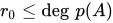
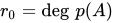
- Consider , where is the minimal polynomial of . We have . Moreover, for any , there exists a for which this bound is tight, i.e. .
- is a cyclic submodule generated by of the torsion -module , where is the linear space on .
- can be decomposed as the direct sum of Krylov subspaces.[clarification needed]















![{\displaystyle k[x]}](https://wikimedia.org/api/rest_v1/media/math/render/svg/4915a37b1a02daf6efc009d5e99b8a911483bab0)


Use
[edit]Krylov subspaces are used in algorithms for finding approximate solutions to high-dimensional linear algebra problems.[2] Many linear dynamical system tests in control theory, especially those related to controllability and observability, involve checking the rank of the Krylov subspace. These tests are equivalent to finding the span of the Gramians associated with the system/output maps so the uncontrollable and unobservable subspaces are simply the orthogonal complement to the Krylov subspace.[4]
Modern iterative methods such as Arnoldi iteration can be used for finding one (or a few) eigenvalues of large sparse matrices or solving large systems of linear equations. They try to avoid matrix-matrix operations, but rather multiply vectors by the matrix and work with the resulting vectors. Starting with a vector , one computes , then one multiplies that vector by to find and so on. All algorithms that work this way are referred to as Krylov subspace methods; they are among the most successful methods currently available in numerical linear algebra. These methods can be used in situations where there is an algorithm to compute the matrix-vector multiplication without there being an explicit representation of , giving rise to Matrix-free methods.


Issues
[edit]Because the vectors usually soon become almost linearly dependent due to the properties of power iteration, methods relying on Krylov subspace frequently involve some orthogonalization scheme, such as Lanczos iteration for Hermitian matrices or Arnoldi iteration for more general matrices.
Existing methods
[edit]The best known Krylov subspace methods are the Conjugate gradient, IDR(s) (Induced dimension reduction), GMRES (generalized minimum residual), BiCGSTAB (biconjugate gradient stabilized), QMR (quasi minimal residual), TFQMR (transpose-free QMR) and MINRES (minimal residual method).
See also
[edit]- Iterative method, which has a section on Krylov subspace methods
References
[edit]- ^ Nocedal, Jorge; Wright, Stephen J. (2006). Numerical optimization. Springer series in operation research and financial engineering (2nd ed.). New York, NY: Springer. p. 108. ISBN 978-0-387-30303-1.
- ^ a b Simoncini, Valeria (2015), "Krylov Subspaces", in Nicholas J. Higham; et al. (eds.), The Princeton Companion to Applied Mathematics, Princeton University Press, pp. 113–114
- ^ Krylov, A. N. (1931). "О численном решении уравнения, которым в технических вопросах определяются частоты малых колебаний материальных систем" [On the Numerical Solution of Equation by Which are Determined in Technical Problems the Frequencies of Small Vibrations of Material Systems]. Izvestiia Akademii Nauk SSSR (in Russian). 7 (4): 491–539.
- ^ Hespanha, Joao (2017), Linear Systems Theory, Princeton University Press
Further reading
[edit]- Nevanlinna, Olavi (1993). Convergence of iterations for linear equations. Lectures in Mathematics ETH Zürich. Basel: Birkhäuser Verlag. pp. viii+177 pp. ISBN 3-7643-2865-7. MR 1217705.
- Saad, Yousef (2003). Iterative methods for sparse linear systems (2nd ed.). SIAM. ISBN 0-89871-534-2. OCLC 51266114.
- Charles George Broyden and Maria Teresa Vespucci(2004): Krylov Solvers for Linear Algebraic Systems, Elsevier(Studies in Computational Mathematics 11), ISBN 0-444-51474-0.
- Meurant, Gérard; Duintjer Tebbens, Jurjen (2020). Krylov Methods for Nonsymmetric Linear Systems: From Theory to Computations. Vol. 57. Cham: Springer International Publishing. doi:10.1007/978-3-030-55251-0. ISBN 978-3-030-55250-3.
- Iman Farahbakhsh: Krylov Subspace Methods with Application in Incompressible Fluid Flow Solvers, Wiley, ISBN 978-1119618683 (Sep., 2020).
Original source: https://en.wikipedia.org/wiki/Krylov subspace
Status: article is cached
 EncycloReader
is supported by the
EncycloReader
is supported by the  KSF
KSF