Categories
Lemna minuta
 From Wikipedia - Reading time: 5 min
| Lemna minuta | |
|---|---|
| |
Conservation status
| |
 Apparently Secure (NatureServe) | |
Scientific classification 
| |
| Kingdom: | Plantae |
| Clade: | Tracheophytes |
| Clade: | Angiosperms |
| Clade: | Monocots |
| Order: | Alismatales |
| Family: | Araceae |
| Genus: | Lemna |
| Species: | L. minuta
|
| Binomial name | |
| Lemna minuta Kunth
| |
| Synonyms | |
|
Lemna minuscula | |
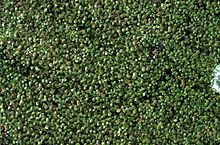
Lemna minuta is a species of duckweed known by the common name least duckweed.[2][3] It is the smallest Lemna species.[4] It is native to parts of the Americas, and naturalized in others; the exact native range is not known. It is found on other continents as a non-native introduction as well. The plant's distribution is ever-expanding; it has been spreading in Europe and it was described from Poland for the first time in 2007.[5] In many areas it is a noxious weed, such as in Belgium.[6]
This tiny plant varies in shape depending on growth conditions. In the shade it is a single green translucent oval body no more than 2.5 millimeters long, and in full sunlight it generally grows in pairs. There is a central vein usually visible under magnification and microscopy. The plant produces an ephemeral membrane-bound flower.
This duckweed grows in slow-moving, calm, and stagnant freshwater habitats. It affects the ecology of its habitat by forming mats on the water surface, reducing sunlight penetration and oxygen exchange.[6]
References
[edit]- ^ Maiz-Tome, L. (2016). "Lemna minuta". IUCN Red List of Threatened Species. 2016: e.T64316939A67729952. doi:10.2305/IUCN.UK.2016-1.RLTS.T64316939A67729952.en. Retrieved 17 January 2024.
- ^ BSBI List 2007 (xls). Botanical Society of Britain and Ireland. Archived from the original (xls) on 2015-06-26. Retrieved 2014-10-17.
- ^ USDA, NRCS (n.d.). "Lemna minuta". The PLANTS Database (plants.usda.gov). Greensboro, North Carolina: National Plant Data Team. Retrieved 24 January 2016.
- ^ Flora of Northern Ireland
- ^ Banaszek, A. and K. Musiał. (2009). The new kenophyte in Poland - Lemna minuta Humb., Bonpl., & Kunth Archived 2011-10-04 at the Wayback Machine. Acta Societatis Botanicorum Poloniae 78:1 69-72
- ^ a b Invasive Alien Species in Belgium: Lemna minuta
External links
[edit]- Jepson Manual Treatment
- Lemna Comparisons and L. minuta Species Description Archived 2002-02-10 at the Wayback Machine
- Flora of North America
 | This Araceae-related article is a stub. You can help Wikipedia by expanding it. |
Original source: https://en.wikipedia.org/wiki/Lemna minuta
Status: article is cached
 EncycloReader
is supported by the
EncycloReader
is supported by the  KSF
KSF