Categories
Libya–European Union relations
 From Wikipedia - Reading time: 8 min
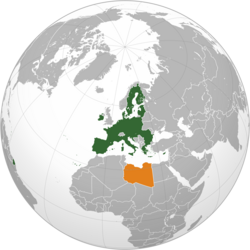 | |
 Libya |
 European Union |
|---|---|
Libya–European Union relations are the foreign relations between the country of Libya and the European Union.[1]
Prior to the 2011 Libyan civil war, the EU and Libya were negotiating a cooperation agreement which has now been frozen.[2] The EU worked to apply sanctions over the Libyan conflict, provide aid and some members participated in military action.[3]
History of European-Libyan Affairs
[edit]Libya has had a long and tumultuous relationship with mainland Europe.
The Greek, Persian, Carthaginian, and Roman Empires
[edit]In 630 BCE, the Ancient Greeks colonized Eastern Libya and founded the city of Cyrene.[4] Within 200 years, four more important Greek cities were established in the area that became known as Cyrenaica. The Greeks of the Pentapolis resisted encroachments by the Ancient Egyptians from the East, as well as by the Carthaginians from the West, but in 525 BCE the Persian army of Cambyses II overran Cyrenaica, which for the next two centuries remained under Persian or Egyptian rule. Alexander was greeted by the Greeks when he entered Cyrenaica in 331 BCE, and Eastern Libya again fell under the control of the Greeks, this time as part of the Ptolemaic Kingdom. The Carthaginian Empire rose to power to hold sway over the coast of much of modern-day Libya, but was later enveloped into the Roman Empire after the Punic Wars.
The Ottoman Empire and Fascist Italy
[edit]Libya was part of the Ottoman Empire, which fell apart following the events of WWI. From 1912 to 1943, Libya was controlled by Italy. Italy lost the land during the North African Campaign of WWII. The United Kingdom and France administered the region until on 24 December 1951, Libya declared its independence as the United Kingdom of Libya.
The Second Libyan Civil War and the European Migrant Crisis
[edit]Prior to the 2011 Libyan civil war, the EU and Libya were negotiating a cooperation agreement which has now been frozen.[5] The EU worked to apply sanctions over the Libyan conflict, provide aid and some members participated in military action.[6] The ongoing Second Libyan Civil War and European Migrant Crisis are causing tensions on both sides of the Mediterranean.
In July 2025, the EU's Commissioner for Migration was denied entry to Libya.[7]
The Malta Declaration
[edit]The Malta Declaration (EU) is a declaration made on 3 February 2017 during the European migrant crisis by leaders of the European Union in Malta, which held the presidency at the time, that focuses on measures to stem the flow of immigration from Libya to Italy and the EU.[8][9]
The EU is closely working with Libya on the safety of migrants with such actions as Operation Sophia and the training of Libyan Coast Guards.[10]
References
[edit]- ^ Although there has been a large degree of integration between European Union member states, foreign relations is still a largely intergovernmental matter, with the 28 members controlling their own relations to a large degree.[citation needed] However, with the Union holding more weight as a single bloc, there are at times[vague] attempts to speak with one voice, notably on trade and energy matters. The High Representative of the Union for Foreign Affairs and Security Policy personifies this role.
- ^ Libya, European Commission
- ^ Developments in Libya: an overview of the EU's response, European Commission
- ^ Federal Research Division of the Library of Congress, (1987), "Cyrenaica and the Greeks", U.S. Library of Congress. Retrieved 11 July 2006.
- ^ Libya, European Commission
- ^ Developments in Libya: an overview of the EU's response, European Commission
- ^ "EU migration commissioner denied entry to Libya over 'protocol issue'". Al Arabiya English. 2025-07-09. Retrieved 2025-07-18.
- ^ "Informal meeting of EU heads of state or government, 03/02/2017 - Consilium". www.consilium.europa.eu. Retrieved 4 February 2017.
- ^ Kanter, James (3 February 2017). "E.U. Vows to Slow Migration on Sea Route That Claimed Thousands of Lives". The New York Times. Retrieved 4 February 2017.
- ^ "Migration: Mogherini pushes Valletta Action Plan forward and concludes first training of Libyan coastguards | EU Neighbours". www.euneighbours.eu. Retrieved 2017-02-17.
 Foreign relations of Libya Foreign relations of Libya | ||
|---|---|---|
| Africa |
|  |
| Americas |
| |
| Asia |
| |
| Europe |
| |
| Oceania |
| |
| Former |
| |
| Missions |
| |
| Related articles |
| |
 Foreign relations of the European Union Foreign relations of the European Union | |||||||||||||||||||||||||||
|---|---|---|---|---|---|---|---|---|---|---|---|---|---|---|---|---|---|---|---|---|---|---|---|---|---|---|---|
| |||||||||||||||||||||||||||
| |||||||||||||||||||||||||||
| |||||||||||||||||||||||||||
| |||||||||||||||||||||||||||
Original source: https://en.wikipedia.org/wiki/Libya–European Union relations
Status: article is cached
 EncycloReader
is supported by the
EncycloReader
is supported by the  KSF
KSF