Categories
Lilith (computer)
 From Wikipedia - Reading time: 8 min
 | |
| Developer | ETH Zurich |
|---|---|
| Manufacturer | Modula Computer Systems |
| Product family | Wirth |
| Type | workstation |
| Release date | 1980 |
| Introductory price | $8000 |
| Discontinued | Yes |
| Units sold | 120[1] |
| Units shipped | 120 |
| Media | Floppy disk 5.25 in (13.3 cm) 140 K |
| Operating system | Medos-2 (Modula-2) |
| CPU | AMD 2901 |
| Memory | 256 K (131,072 16-bit words) |
| Storage | 15 MB hard disk |
| Display | 12 in (30 cm) monochrome bitmapped |
| Dimensions | 15.5 in × 15 in × 14.5 in (39 cm × 38 cm × 37 cm) |
| Marketing target | Research |
| Successor | Ceres |
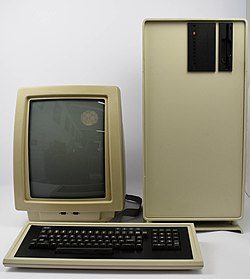
The DISER Lilith is a custom built workstation computer based on the Advanced Micro Devices (AMD) 2901 bit slicing processor, created by a group led by Niklaus Wirth at ETH Zurich.[2][3] The project began in 1977, and by 1984 several hundred workstations were in use. It has a high resolution full page portrait oriented cathode-ray tube display, a mouse, a laser printer interface, and a computer networking interface. Its software is written fully in Modula-2 and includes a relational database program named Lidas.
The Lilith processor architecture is a stack machine.[2] Citing from Sven Erik Knudsen's contribution to "The Art of Simplicity": "Lilith's clock speed was around 7 MHz and enabled Lilith to execute between 1 and 2 million instructions (called M-code) per second. (...) Initially, the main memory was planned to have 65,536 16-bit words memory, but soon after its first version, it was enlarged to twice that capacity. For regular Modula-2 programs however, only the initial 65,536 words were usable for storage of variables."[4]
History
[edit]The development of Lilith was influenced by the Xerox Alto from the Xerox PARC (1973) where Niklaus Wirth spent a sabbatical from 1976 to 1977. Unable to bring back one of the Alto systems to Europe, Wirth decided to build a new system from scratch between 1978 and 1980, selling it under the company name DISER (Data Image Sound Processor and Emitter Receiver System).[5] In 1985, he had a second sabbatical leave to PARC, which led to the design of the Oberon System. Ceres, the follow-up to Lilith, was released in 1987.
Operating system
[edit]| Medos-2 | |
|---|---|
| Developer | Svend Erik Knudsen |
| Written in | Modula-2 |
| OS family | Wirth |
| Working state | Discontinued |
| Initial release | 1983 |
| Marketing target | Research |
| Available in | English |
| Update method | Compile from source code |
| Package manager | Modula-2 modules |
| Supported platforms | Lilith (AMD 2901) |
| Kernel type | Modular, object-oriented |
| Succeeded by | Oberon |
The Lilith operating system (OS), named Medos-2, was developed at ETH Zurich, by Svend Erik Knudsen with advice from Wirth. It is a single user, object-oriented operating system built from modules of Modula-2.[3][6][7]
Its design influenced the design of the OS Excelsior, developed for the Soviet Kronos workstation (see below), by the Kronos Research Group (KRG).[8]
Soviet variants
[edit]From 1986 into the early 1990s, Soviet Union technologists created and produced a line of printed circuit board systems, and workstations based on them, all named Kronos. The workstations were based on Lilith, and made in small numbers.[9]
Mouse
[edit]The computer mouse of the Lilith was custom-designed, and later used with the Smaky computers. It then inspired the first mice produced by Logitech.
Gallery
[edit]-
 The vertical screen, keyboard and mouse of the Diser Lilith
 -
 Vertical tower central unit
 -
 Internal view of the Lilith, showcasing the CPU boards
 -
 Front view of the Lilith workstation
References
[edit]- ^ ETH Zurich: Ready. YouTube (video). Zürich, Switzerland: ETH Zurich. 15 June 2017. Event occurs at 1:25–1:35. Archived from the original on 21 December 2021. Retrieved 21 March 2021.
- ^ a b Ohran, Richard (August 1984). "Lilith and Modula-2: A case study of high-level-language processor design". Byte. pp. 181–192. Retrieved 6 March 2021. Reprint.
- ^ a b Sand, Paul A. (September 1984). "The Lilith Personal Computer". Byte. pp. 300–311. Retrieved 6 March 2021. Reprint.
- ^ Böszörményi, László; Gutknecht, Jürg; Pomberger, Gustav, eds. (25 October 2000). The School of Niklaus Wirth: The Art of Simplicity. Morgan Kaufmann. ISBN 978-1558607231. ISBN 1-55860-723-4 & dpunkt, ISBN 3-932588-85-1.
- ^ Wirth, Niklaus (January 1995). "A Brief History of Modula and Lilith". The ModulaTor. 0.
- ^ Knudsen, Svend Erik (1983). Medos-2: A Modula-2 Oriented Operating System for the Personal Computer Lilith (PhD). ETH Zurich. doi:10.3929/ethz-a-000300091. hdl:20.500.11850/137906.
- ^ Knudsen, Svend Erik (25 October 2000). "Medos in Retrospect". In Böszörményi, László; Gutknecht, Jürg; Pomberger, Gustav (eds.). The School of Niklaus Wirth: The Art of Simplicity. Morgan Kaufmann. pp. 69–86. ISBN 978-1558607231. ISBN 1-55860-723-4 & dpunkt, ISBN 3-932588-85-1.
- ^ Kuznetsov, D.N.; Nedorya, A.E.; Tarasov, E.V.; Filippov, V.E. "Kronos: a family of processors for high-level languages". Kronos: History of a Project (in Russian). xTech. Retrieved 13 April 2021.
- ^ "Kronos: History of a Project" (in Russian). xTech. Retrieved 8 April 2021.
External links
[edit]
Wikimedia Commons has media related to Diser Lilith.
- Documentation on BitSavers
- Geissman, L et al. (August 1982) Lilith Handbook
- Wirth, N (1981) The Personal Computer Lilith
- Emulith emulator for the Lilith, homepage and documentation
- Lilith and Modula-2
- "ETHistory - Lilith Workstation". Retrieved 26 April 2025.
- AMD AM2901DC entry on CPU World
Modula, Oberon | |||||||||||||||||
|---|---|---|---|---|---|---|---|---|---|---|---|---|---|---|---|---|---|
| Modula |
| ||||||||||||||||
| Oberon |
| ||||||||||||||||
| |||||||||||||||||

Niklaus Wirth | |||||||||
|---|---|---|---|---|---|---|---|---|---|
| Software |
| ||||||||
| Workstations | Lilith (1977) → Ceres (1985) | ||||||||
| Workplaces |
| ||||||||
| Collaborators |
| ||||||||
| Awards |
| ||||||||
| |||||||||
This article is licensed under CC BY-SA 3.0.
Original source: https://en.wikipedia.org/wiki/Lilith (computer)
Status: article is cached
Original source: https://en.wikipedia.org/wiki/Lilith (computer)
Status: article is cached
 EncycloReader
is supported by the
EncycloReader
is supported by the  KSF
KSF