Linguine
 From Wikipedia - Reading time: 9 min
 | |
| Type | Pasta |
|---|---|
| Place of origin | Italy |
| Region or state | Liguria |
| Main ingredients | Flour, egg |
| Variations | Linguettine |
Food energy (per serving) | Depends on serving kcal |
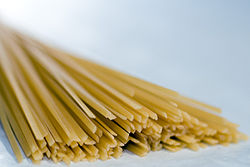
Linguine (Italian: [liŋˈɡwiːne]; sometimes anglicized as linguini,[1][2] English: /lɪŋˈɡwiːni/; lit. 'little tongues'[3]) is a type of Italian pasta similar to fettuccine and trenette, but elliptical in section rather than flat. It is about 4 millimetres (5⁄32 in) in width, which is wider than spaghetti, but not as wide as fettuccine.[4][5] Linguine was traditionally served with sauces such as pesto, but others such as tomato or fish based sauces are popular as well.[6] Linguine originated in Italy and is based on more traditional pastas.[7] It is a type of pasta that finds its origin in Genoa.[8] Linguine is typically available in both white flour and whole-wheat versions, but was originally made with durum wheat.[9] In the United States, National Linguine Day occurs on September 15 every year.[10]
Etymology[edit]
Linguine comes from the Latin word lingua, meaning 'tongue'. The modern language closest to Latin is Italian, and the Italian word linguine, plural of the feminine linguina, meaning 'little tongues'. A thinner version of linguine is called linguettine.[11] Linguine is one of the types of pasta whose name describes its shape (narrow flat pasta).[3]
History[edit]
Linguine, a type of flattened spaghetti, was initially documented in the 1700s in Genoa, Italy, by Giulio Giacchero, an economist writer; Giacchero, author of a book on the economy of Genoa in the 1700's, writes about linguine served with green beans, potatoes and a Genovese specialty—basil pesto.[12] He claims it was the typical festive dish of Ligurian families of the 1700s.[13]
Liguria is the coastal region in far northwest Italy on the Ligurian Sea, dominated by the ancient port of Genoa. Basil pesto is a traditional dish there, and is often called by its full name pesto alla genovese. That is why pesto dishes are typically served over linguine.[14]
Linguine with clams arrived in New York during the 1800s as Southern Italians migrated to the United States. Referred to as Clam Linguine Pasta or linguine in clam sauce, this dish gained popularity among coastal Italians in Campagna.[15]
Production[edit]
The production of linguine involves mixing semolina flour or durum flour and water to form a dough, which is then rolled out and cut into flat strands. Traditionally, pasta-making was a labor-intensive process carried out by hand, but modern production methods have streamlined the process.[16]
Wheat can also be grounded into whole-wheat flour, then kneaded with water to make whole grain linguine.[17]
Nutrition[edit]
| Nutritional value per 100 g (3.5 oz) | |
|---|---|
| Energy | 433 kcal (1,810 kJ) |
Carbohydrates | 58.9 g |
| Dietary fibre | 2.2 g |
Fat | 17.8 g |
Protein | 8.89 g |
| Minerals | Quantity %DV† |
| Calcium | 13% 167 mg |
| Iron | 9% 1.6 mg |
| Sodium | 55% 1270 mg |
| Other constituents | Quantity |
| Cholesterol | 11 mg |
Source: USDA[18] | |
| †Percentages estimated using US recommendations for adults,[19] except for potassium, which is estimated based on expert recommendation from the National Academies.[20] | |
Linguine provides sources of energy, carbohydrates, fibers, fat, protein, and minerals.[18]
Preparation[edit]
Dry linguine is cooked in a pot of salted, boiling water.
The linguine is stirred gently to prevent sticking together and cooked for 8–10 minutes or until al dente.
While the noodles cook, desired sauce is prepared in a separate pan. Linguine is then drained using a colander. A small cup of pasta water is reserved as it is used to adjust the consistency of sauce later.[21]
Linguine vs. spaghetti[edit]
Linguine and spaghetti are two pasta types in Italian cuisine.[22] These pastas have several similarities and one key difference:
Shape:
- The primary difference between linguine and spaghetti.
- Linguine is a flat noodle.[22]
- Spaghetti is a round noodle.[22]
- Linguine's flat shape provides a surface area for clinging to sauces, making it more common for seafood dishes.[23]
Wheat:
- Linguine and spaghetti are traditionally made with durum or semolina flour. [24]
- These kinds of pasta can technically be made from any type of flour, such as potato or rice, but the traditional forms use wheat.
Long pasta:
- There are many different types of pasta with varying pasta shapes, such as penne, farfalle, rigatoni, macaroni, fusilli, ziti, lasagna, and tagliatelle.[22]
- Linguine and spaghetti belong to the category of pasta known as long pasta.
- Other pastas with long noodles include fettuccine, angel hair, and capellini.
Preparation:
- Many pasta recipes call for noodles to be prepared al dente, meaning they are removed from the hot water while still slightly firm.[25]
- Both spaghetti and linguine dishes are cooked this way.
See also[edit]
 Media related to Linguine at Wikimedia Commons


- List of pasta
- Fettuccine
- Spaghetti
- Trenette
References[edit]
- ^ "linguini". Lexico UK English Dictionary. Oxford University Press.[dead link]
- ^ "linguina in Vocabolario - Treccani". www.treccani.it (in Italian). Retrieved 2022-06-14.
- ^ a b "Definition of LINGUINE". www.merriam-webster.com. Retrieved 2020-02-11.
- ^ "Fresh Pasta widths and serving sizes Lasagne sheets and Asian Noodles". www.cucinafoods.co.nz. Archived from the original on 2019-12-19. Retrieved 2020-02-11.
- ^ "CNN Food Central - Resources: Pasta Shapes and Sizes". www.cnn.com. Retrieved 2020-02-11.
- ^ "Linguine". Pasta Fits. 2018-08-24. Retrieved 2020-02-11.
- ^ "About Linguine". ifood.tv. Retrieved 2020-02-11.
- ^ "Linguine, su barillafoodservice.it. URL consultato l'11 marzo 2019".
- ^ "The Difference Between Linguine, Spaghetti and Fettuccine". Pastamania. 2019-06-01. Retrieved 2020-02-11.[permanent dead link]
- ^ "NATIONAL DAY CALENDAR: National Linguine Day". KX NEWS. 2023-09-15. Retrieved 2024-04-26.
- ^ "Linguine & Linguettine". www.ultimatecookingguide.com. Archived from the original on 2016-10-19. Retrieved 2020-02-11.
- ^ "Spotlight Series: All About Linguine". DeLallo. Retrieved 2024-04-13.
- ^ Tronson, Signe (2021-07-20). "A Little Linguini History". Pastini. Retrieved 2024-04-24.
- ^ Taste Pasta (PDF).
- ^ "The History of Linguine and Clams | Italian American Food". Ultimate Food Tours. Retrieved 2024-04-24.
- ^ "The Glorious Pasta of Italy - The Libraries Consortium - OverDrive". The Libraries Consortium. Retrieved 2024-04-26.
- ^ Clark, Melissa (2010-10-12). "Fiber Meets Flavor in New Whole-Grain Pastas". The New York Times. ISSN 0362-4331. Retrieved 2024-04-24.
- ^ a b "FoodData Central". fdc.nal.usda.gov. Retrieved 2024-04-25.
- ^ United States Food and Drug Administration (2024). "Daily Value on the Nutrition and Supplement Facts Labels". Retrieved 2024-03-28.
- ^ National Academies of Sciences, Engineering, and Medicine; Health and Medicine Division; Food and Nutrition Board; Committee to Review the Dietary Reference Intakes for Sodium and Potassium (2019). Oria, Maria; Harrison, Meghan; Stallings, Virginia A. (eds.). Dietary Reference Intakes for Sodium and Potassium. The National Academies Collection: Reports funded by National Institutes of Health. Washington (DC): National Academies Press (US). ISBN 978-0-309-48834-1. PMID 30844154.
{{cite book}}: CS1 maint: multiple names: authors list (link) - ^ "New Cookbook". Pasta Grannies. Retrieved 2024-04-24.
- ^ a b c d "Popular types of pasta: Why their shape matters". tangent.usatoday.com. 2022-11-16. Retrieved 2024-04-24.
- ^ ThriftBooks. "All Editions of 123 Seafood Linguine Recipes: Discover Seafood Linguine Cookbook NOW!". ThriftBooks. Retrieved 2024-04-26.
- ^ Jenkins, Nancy Harmon (1997-09-17). "From Italy, the Truth About Pasta; The Italians know that less is more: a call for a return to basics". The New York Times. ISSN 0362-4331. Retrieved 2024-04-26.
- ^ Heloise (2023-05-18). "Hints From Heloise: The meaning of 'al dente'". Washington Post. ISSN 0190-8286. Retrieved 2024-04-26.
Pasta | |||||||||||
|---|---|---|---|---|---|---|---|---|---|---|---|
| |||||||||||
| Types |
| ||||||||||
| Cooking |
| ||||||||||
| Producers |
| ||||||||||
| Equipment manufacturers |
| ||||||||||
| See also |
| ||||||||||
| |||||||||||


Original source: https://en.wikipedia.org/wiki/Linguine
Status: article is cached
 EncycloReader
is supported by the
EncycloReader
is supported by the  KSF
KSF