Categories
List of objects at Lagrange points
 From Wikipedia - Reading time: 16 min
This is a list of known objects which occupy, have occupied, or are planned to occupy any of the five Lagrange points of two-body systems in space.
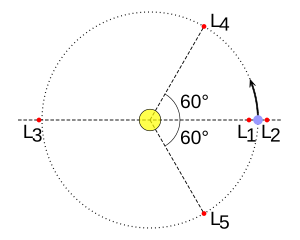
Sun–Earth Lagrange points
[edit]Sun–Earth L1
[edit]L1 is the Lagrange point located approximately 1.5 million kilometers from Earth towards the Sun.
Past probes
[edit]- International Cometary Explorer, formerly the International Sun–Earth Explorer 3 (ISEE-3), diverted out of L1 in 1983 for a comet rendezvous mission. Currently in heliocentric orbit. The Sun–Earth L1 is also the point to which the Reboot ISEE-3 mission was attempting to return the craft as the first phase of a recovery mission (as of September 25, 2014 all efforts have failed and contact was lost).[1]
- NASA's Genesis probe collected solar wind samples at L1 from December 3, 2001, to April 1, 2004, when it returned the sample capsule to Earth. It returned briefly in late 2004 before being pushed into heliocentric orbit in early 2005.
- LISA Pathfinder (LPF) was launched on 3 December 2015, and arrived at L1 on 22 January 2016, where, among other experiments, it tested the technology needed by (e)LISA to detect gravitational waves. LISA Pathfinder used an instrument consisting of two small gold alloy cubes.
- The Chang'e 5 orbiter[2] (during extended mission. After ferrying lunar samples back to Earth in 2020, the transport module was sent to L1 where it is permanently stationed to conduct limited Earth-Sun observations.)
Present probes
[edit]- The Solar and Heliospheric Observatory (SOHO) in a halo orbit around L1
- Mission: Investigation of the outer layer of the Sun, making observations of solar wind and associated phenomena in the vicinity of L1, probing the interior structure of the Sun.
- Launched: 2 December 1995
- Arrival: Operational orbit in May 1996
- Institution:
 ESA
ESA
- The Advanced Composition Explorer (ACE) in a Lissajous orbit
- WIND (At L1 since 2004)
DSCOVR · Earth · Moon
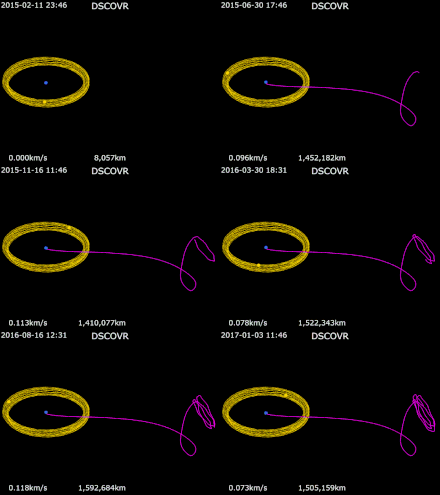
- The Deep Space Climate Observatory (DSCOVR), designed to image the sunlit Earth in 10 wavelengths (EPIC) and monitor total reflected radiation (NISTAR). Launched on 11 February 2015, began orbiting L1 on 8 June 2015 to study the solar wind and its effects on Earth.[3] DSCOVR is unofficially known as GORESAT, because it carries a camera always oriented to Earth and capturing full-frame photos of the planet similar to the Blue Marble. This concept was proposed by then-Vice President of the United States Al Gore in 1998[4] and was a centerpiece in his 2006 film An Inconvenient Truth.[5]
- Aditya-L1 was successfully launched on 2 September 2023 and entered the halo orbit around the lagrange point on 6 January 2024.[6] It's a Solar observation mission by ISRO. It will study solar atmosphere, solar magnetic storms, and their impact on the environment around the Earth.[7]
Planned probes
[edit]- Interstellar Mapping and Acceleration Probe slated for launch in late 2024
- NEO Surveyor
- SWFO-L1
- Vigil (ESA). One spacecraft in L1 and one in L5.
Sun–Earth L2
[edit]L2 is the Lagrange point located approximately 1.5 million kilometers from Earth in the direction opposite the Sun. Spacecraft at the Sun–Earth L2 point are in a Lissajous orbit until decommissioned, when they are sent into a heliocentric graveyard orbit.[citation needed]
Past probes
[edit]
WMAP · Earth
- 2001 – 2010: NASA's Wilkinson Microwave Anisotropy Probe (WMAP)[8] observed the cosmic microwave background. It was moved to a heliocentric orbit to avoid posing a hazard to future missions.
- 2003 – 2004: NASA's WIND. The spacecraft then went to Earth orbit, before heading to L1.[9]
- 2009 – 2013:[10] The ESA Herschel Space Observatory exhausted its supply of liquid helium and was moved from the Lagrangian point in June 2013.
- 2009 – 2013: At the end of its mission ESA's Planck spacecraft was put into a heliocentric orbit and passivated to prevent it from endangering any future missions.
- 2011 – 2012: CNSA's Chang'e 2.[11][12] Chang'e 2 was then placed onto a heliocentric orbit that took it past the near-Earth asteroid 4179 Toutatis.
Present probes
[edit]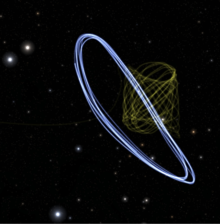
- The ESA Gaia probe
- The joint Russian-German high-energy astrophysics observatory Spektr-RG
- The joint NASA, ESA and CSA James Webb Space Telescope (JWST)
- The ESA Euclid mission
- The CNSA Chang'e 6 orbiter
Planned probes
[edit]- The NASA Nancy Grace Roman Space Telescope (WFIRST)
- The ESA PLATO mission, which will find and characterize rocky exoplanets.
- The JAXA LiteBIRD mission.
- The ESA Advanced Telescope for High ENergy Astrophysics (ATHENA)
- The ESA ARIEL mission, which will observe the atmospheres of exoplanets.
- The joint ESA-JAXA Comet Interceptor
- The NASA Large Ultraviolet Optical Infrared Surveyor (LUVOIR) which would replace the Hubble Space Telescope.
Cancelled probes
[edit]- The ESA Eddington mission
- The NASA Terrestrial Planet Finder mission (may be placed in an Earth-trailing orbit instead)
Sun–Earth L3
[edit]L3 is the Sun–Earth Lagrange point located on the side of the Sun opposite Earth, slightly outside the Earth's orbit. Direct communication with spacecraft in this position is blocked by the Sun.
- There are no known objects in this orbital location. [citation needed]
Sun–Earth L4
[edit]L4 is the Sun–Earth Lagrange point located close to the Earth's orbit 60° ahead of Earth.
- Asteroid (706765) 2010 TK7 is the first discovered tadpole orbit companion to Earth, orbiting L4; like Earth, its mean distance to the Sun is about one astronomical unit.
- Asteroid (614689) 2020 XL5 is the second Earth trojan, confirmed in November 2021, oscillating around L4 in a tadpole orbit and expected to remain there for at least 4000 years, until destabilized by Venus.[13]
- STEREO A (Solar TErrestrial RElations Observatory – Ahead) made its closest pass to L4 in September 2009, on its orbit around the Sun, slightly faster than Earth.[14]
- OSIRIS-REx passed near the L4 point and performed a survey for asteroids between 9 and 20 February 2017.
Sun–Earth L5
[edit]L5 is the Sun–Earth Lagrange point located close to the Earth's orbit 60° behind Earth.
- Asteroid (419624) 2010 SO16, in a horseshoe companion orbit with Earth, is currently proximal to L5 but at a high inclination.
- STEREO B (Solar TErrestrial RElations Observatory – Behind) made its closest pass to L5 in October 2009, on its orbit around the Sun, slightly slower than Earth.[14]
- The Spitzer Space Telescope is in an Earth-trailing heliocentric orbit drifting away c. 0.1 AU per year. In c. 2013–15 it has passed L5 in its orbit.
- Hayabusa2 passed near L5 during the spring of 2017, and imaged the surrounding area to search for Earth trojans on 18 April 2018.[15]
Proposed
[edit]- Vigil (ESA). One spacecraft in L5.
Earth–Moon Lagrange points
[edit]Earth–Moon L2
[edit]- THEMIS
- Chang'e 5-T1
- Queqiao relay satellite
- EQUULEUS nanosat.
Earth–Moon L4 and L5
[edit]- Kordylewski clouds[16]
- Future location of TDRS-style communication satellites to support L2 satellite and further regions on the Moon.[17][18]
Past probes
[edit]- Hiten was the first spacecraft to demonstrate a low energy trajectory, passing by L4 and L5 to achieve lunar orbit at a very low fuel expense, compared to usual orbital techniques. Hiten did not find any conclusive increase in dust density at Lagrange points.[19]
Proposed objects
[edit]- Exploration Gateway Platform
- In his 1976 book The High Frontier: Human Colonies in Space Dr. Gerard O'Neill proposed the establishment of gigantic Space Islands in L5. The inhabitants of the L5 Society should convert lunar material to huge solar power satellites. Many works of fiction, most notably the Gundam series, involve colonies at these locations.
Sun–Venus Lagrange points
[edit]L4
[edit]- 2013 ND15
Sun–Mars Lagrange points
[edit]Asteroids in the L4 and L5 Sun–Mars Lagrangian points are sometimes called Mars trojans, with a lower-case t, as "Trojan asteroid" was originally defined as a term for Lagrangian asteroids of Jupiter. They may also be called Mars Lagrangian asteroids.
L4
[edit]- (121514) 1999 UJ7
L5
[edit]- 5261 Eureka
- (101429) 1998 VF31
- (311999) 2007 NS2
- (385250) 2001 DH47, 2001 FG24, (461377) 2001 FR127 (not confirmed as true Lagrangian asteroids)
Source: Minor Planet Center [1]
Sun–Ceres Lagrange points
[edit]- 1372 Haremari
- (76146) 2000 EU16
- (185105) 2006 SV23
Sun–Jupiter Lagrange points
[edit]Asteroids in the L4 and L5 Sun–Jupiter Lagrangian points are known as Jupiter Trojan asteroids or simply Trojan asteroids.
L4
[edit]- Trojan asteroids, Greek camp
L5
[edit]- Trojan asteroids, Trojan camp
Planned
[edit]- Lucy (spacecraft)
Saturn–Tethys Lagrange points
[edit]L4
[edit]- Telesto
L5
[edit]- Calypso
Saturn–Dione Lagrange points
[edit]L4
[edit]- Helene
L5
[edit]- Polydeuces, follows a "tadpole" orbit around L5
Sun–Uranus Lagrange points
[edit]L3
[edit]- 83982 Crantor, follows a horseshoe orbit around L3
L4
[edit]- (687170) 2011 QF99[20]
- (636872) 2014 YX49
Sun–Neptune Lagrange points
[edit]Minor planets in the L4 and L5 Sun–Neptune Lagrangian points are called Neptune trojans, with a lower-case t, as "Trojan asteroid" was originally defined as a term for Lagrangian asteroids of Jupiter.
Data from: Minor Planet Center [2]
L4
[edit]- 385571 Otrera
- 385695 Clete
- (612243) 2001 QR322
- 2005 TN53
- (613490) 2006 RJ103
- (527604) 2007 VL305
L5
[edit]- 2008 LC18
- 2004 KV18
- 2011 HM102
Tables of missions
[edit]Color key:
Unflown or planned mission
Mission en route or in progress (including mission extensions)
Mission at Lagrangian point completed successfully (or partially successfully)
| Mission | Lagrangian point | Agency | Description |
|---|---|---|---|
| International Sun–Earth Explorer 3 (ISEE-3) | Sun–Earth L1 | NASA | Launched in 1978, it was the first spacecraft to be put into orbit around a libration point, where it operated for four years in a halo orbit about the L1 Sun–Earth point. After the original mission ended, it was commanded to leave L1 in September 1982 in order to investigate comets and the Sun.[21] Now in a heliocentric orbit, an unsuccessful attempt to return to halo orbit was made in 2014 when it made a flyby of the Earth–Moon system.[22][23] |
| Advanced Composition Explorer (ACE) | Sun–Earth L1 | NASA | Launched 1997. Has fuel to orbit near L1 until 2024. Operational as of 2019[update].[24] |
| Deep Space Climate Observatory (DSCOVR) | Sun–Earth L1 | NASA | Launched on 11 February 2015. Planned successor of the Advanced Composition Explorer (ACE) satellite. |
| LISA Pathfinder (LPF) | Sun–Earth L1 | ESA, NASA | Launched one day behind revised schedule (planned for the 100th anniversary of the publication of Einstein's General Theory of Relativity), on 3 December 2015. Arrived at L1 on 22 January 2016.[25] LISA Pathfinder was deactivated on 30 June 2017.[26] |
| Solar and Heliospheric Observatory (SOHO) | Sun–Earth L1 | ESA, NASA | Orbiting near L1 since 1996. Operational as of 2020[update].[27] |
| WIND | Sun–Earth L1 | NASA | Arrived at L1 in 2004 with fuel for 60 years. Operational as of 2019[update].[28] |
| Wilkinson Microwave Anisotropy Probe (WMAP) | Sun–Earth L2 | NASA | Arrived at L2 in 2001. Mission ended 2010,[29] then sent to solar orbit outside L2.[30] |
| Herschel Space Telescope | Sun–Earth L2 | ESA | Arrived at L2 July 2009. Ceased operation on 29 April 2013; will be moved to a heliocentric orbit.[31][32] |
| Planck Space Observatory | Sun–Earth L2 | ESA | Arrived at L2 July 2009. Mission ended on 23 October 2013; Planck has been moved to a heliocentric parking orbit.[33] |
| Chang'e 2 | Sun–Earth L2 | CNSA | Arrived in August 2011 after completing a lunar mission before departing en route to asteroid 4179 Toutatis in April 2012.[12] |
| ARTEMIS mission extension of THEMIS | Earth–Moon L1 and L2 | NASA | Mission consists of two spacecraft, which were the first spacecraft to reach Earth–Moon Lagrangian points. Both moved through Earth–Moon Lagrangian points, and are now in lunar orbit.[34][35] |
| WIND | Sun–Earth L2 | NASA | Arrived at L2 in November 2003 and departed April 2004. |
| Gaia Space Observatory | Sun–Earth L2 | ESA | Launched 19 December 2013.[36] Operational as of 2020[update].[37] |
| Chang'e 5-T1 Service Module | Earth–Moon L2 | CNSA | Launched on 23 October 2014, arrived at L2 halo orbit on 13 January 2015.[2] |
| Queqiao | Earth–Moon L2 | CNSA | Launched on 21 May 2018, arrived at L2 halo orbit on June 14 for Chang'e 4 mission.[38] Queqiao is the first ever communication relay and radio astronomy satellite at operating its location.[39] |
| Spektr-RG | Sun–Earth L2 | IKI RAN DLR |
Launched 13 July 2019. Roentgen and Gamma space observatory. Operational as of June 2020.[40] |
| Chang'e 5 Service Module | Sun–Earth L1 | CNSA | Launched on 23 November 2020, arrived at L1 halo orbit on 15 March 2021. |
| James Webb Space Telescope (JWST) | Sun–Earth L2 | NASA, ESA, CSA | Launched on 25 December 2021, arrived at L2 point on 24 January 2022. Operational as of 2022.[41] |
| Euclid | Sun–Earth L2 | ESA, NASA | Launched on 1 July 2023, arrived at L2 point on 28 July 2023. Currently in testing phase as of September 2023.[42] |
| Aditya-L1 | Sun–Earth L1 | ISRO | Launched on 2 September 2023[43] and was successfully inserted into an orbit about Sun-Earth L1 point on 6 January 2024.[44] |
| Chang'e 6 Service Module | Sun–Earth L2 | CNSA | Launched on 3 May 2024, arrived at L2 halo orbit on 9 September 2024. |
Future and proposed missions
[edit]| Mission | Lagrangian point | Agency | Description |
|---|---|---|---|
| "Lunar Far-Side Communication Satellites" | Earth–Moon L2 | NASA | Proposed in 1968 for communications on the far side of the Moon during the Apollo program, mainly to enable an Apollo landing on the far side—neither the satellites nor the landing were ever realized.[45] |
| Space colonization and manufacturing | Earth–Moon L4 or L5 | — | First proposed in 1974 by Gerard K. O'Neill[46] and subsequently advocated by the L5 Society. |
| EQUULEUS | Earth–Moon L2 | University of Tokyo, JAXA | 6U CubeSat, launch planned in 2021 as a secondary payload onboard SLS Artemis 1.[47] |
| DESTINY+ | Earth–Moon L2 | JAXA | JAXA "Medium-Sized Focused Mission"; launch planned for 2025.[48] |
| Exploration Gateway Platform | Earth–Moon L2[49] | NASA | Proposed in 2011.[50] |
| Nancy Grace Roman Space Telescope (WFIRST) | Sun–Earth L2 | NASA, USDOE | Launch planned for 2026.[51] |
| LiteBIRD | Sun–Earth L2[52] | JAXA, NASA | JAXA's next "Strategic Large Mission"; launch planned for 2032.[53][54] |
| Interstellar Mapping and Acceleration Probe (IMAP) | Sun–Earth L1 | NASA | Planned for launch in early 2025. |
| Space Weather Follow On - Lagrange 1 (SWFO-L1) | Sun–Earth L1 | NOAA | Planned for launch in early 2025 as a rideshare to IMAP. |
| Planetary Transits and Oscillations of stars (PLATO) | Sun–Earth L2 | ESA | Planned for launch in 2026 for an initial six-year mission.[55] |
| Space Infrared Telescope for Cosmology and Astrophysics (SPICA) |
Sun–Earth L2 | JAXA, ESA, SRON | As of 2015[update], awaiting approval from both Japanese and European side, launch proposed for 2032.[56] |
| Advanced Telescope for High Energy Astrophysics (ATHENA) |
Sun–Earth L2 | ESA | Launch planned for 2035.[57] |
| ESA Vigil | Sun–Earth L5 | ESA | Observatory for early warning of increased solar activity. Launch planned for 2029. |
| Sun Chaser[58] | Sun–Earth L4 | — | Observatory for early warning of solar particle events. Early proposal phase. |
| Spektr-M | Sun–Earth L2 | Roscosmos | Possible launch after 2030.[59] |
See also
[edit]- Trojan (celestial body)
- Co-orbital configuration
Footnotes
[edit]- ^ "ISEE-3 is in Safe Mode". Space College. 25 September 2014. "The ground stations listening to ISEE-3 have not been able to obtain a signal since Tuesday the 16th"
- ^ a b "Chang'e 5 Test Mission Updates". Spaceflight 101. Retrieved 14 December 2014.
- ^ US Department of Commerce, NOAA Satellites and Information Service. "NOAA's Satellite and Information Service (NESDIS)". Archived from the original on 2015-06-08.
- ^ "At long last: Al Gore's satellite dream blasts off". USA TODAY. 7 February 2015.
- ^ Mellow, Craig (August 2014). "Al Gore's Satellite". Air & Space/Smithsonian. Retrieved December 12, 2014.
- ^ Kumar, Chethan (6 January 2024). "Aditya reaches halo orbit around L1 point, Sun study to begin soon". The Times of India. Retrieved 6 January 2024.
- ^ "Aditya L1 Mission: Aditya L1 Launch LIVE Updates: Aditya L1 spacecraft successfully separated from PSLV rocket, now en route to Sun-Earth L1 point. ISRO says mission accomplished". The Economic Times. 2 September 2023. Archived from the original on 3 September 2023. Retrieved 2 September 2023.
- ^ "Mission Complete! WMAP Fires Its Thrusters For The Last Time". Archived from the original on 2012-07-14. Retrieved 2022-01-11.
- ^ "WIND Solar-Terrestrial Mission". ESA Earth Observation Portal. Retrieved December 31, 2021.
- ^ Toobin, Adam (2013-06-19). "Herschel Space Telescope Shut Down For Good, ESA Announces". Huffington Post.
- ^ "China's Moon orbiter Chang'e-2 travels 1.5 km into outer space". The Economic Times. 2011-08-30. Retrieved 2011-08-31.
- ^ a b Lakdawalla, Emily (15 June 2012). "Update on yesterday's post about Chang'e 2 going to Toutatis". Planetary Society. Retrieved 26 June 2012.
- ^ Hui, Man-To; Wiegert, Paul A.; Tholen, David J.; Föhring, Dora (November 2021). "The Second Earth Trojan 2020 XL5". The Astrophysical Journal Letters. 922 (2): L25. arXiv:2111.05058. Bibcode:2021ApJ...922L..25H. doi:10.3847/2041-8213/ac37bf. S2CID 243860678.
- ^ a b NASA - Join STEREO and Explore Gravitational "Parking Lots" That May Hold Secret of Moon's Origin
- ^ "太陽−地球系のL5点付近の観測の結果について" (in Japanese). JAXA. 23 August 2017. Retrieved 2018-06-22.
- ^ Slíz-Balogh, Judith; Barta, András; Horváth, Gábor (11 November 2018). "Celestial mechanics and polarization optics of the Kordylewski dust cloud in the Earth–Moon Lagrange point L5 – I. Three-dimensional celestial mechanical modelling of dust cloud formation". Monthly Notices of the Royal Astronomical Society. 480 (4): 5550–5559. arXiv:1910.07466. Bibcode:2018MNRAS.480.5550S. doi:10.1093/mnras/sty2049.
- ^ Hornig, Andreas (2022-05-01). "TYCHO: Supporting Permanently Crewed Lunar Exploration with High-Speed Optical Communication from Everywhere". ESA.
- ^ Hornig, Andreas (2013-10-06). "TYCHO mission to Earth-Moon libration point EML-4 @ IAC 2013". IAC2013.
- ^ "Hiten", NSSDC.GSFC.NASA.gov.
- ^ Alexandersen, Mike; Gladman, Brett; Greenstreet, Sarah; Kavelaars, J. J.; Petit, Jean-Marc; Gwyn, Stephen (2013). "A Uranian Trojan and the Frequency of Temporary Giant-Planet Co-Orbitals". Science. 341 (6149): 994–997. arXiv:1303.5774. Bibcode:2013Sci...341..994A. doi:10.1126/science.1238072. PMID 23990557.
- ^ "Solar System Exploration: ISEE-3/ICE". NASA. Archived from the original on 2011-06-14. Retrieved 2010-09-28.
- ^ Lakdawalla, Emily (October 3, 2008). "It's Alive!". The Planetary Science Weblog. Archived from the original on February 20, 2012. Retrieved January 11, 2022.
- ^ Chang, Kenneth (August 8, 2014). "Rudderless Craft to Get Glimpse of Home Before Sinking Into Space's Depths". The New York Times.
- ^ "ACE MAG Spectrograms: 1 day starting 2019/3/15 (2019 074)". www.srl.caltech.edu. Retrieved 2020-02-12.
- ^ "LISA Pathfinder factsheet". ESA. 11 June 2012. Retrieved 26 June 2012.
- ^ "LISA Pathfinder Will Concludee Trailblazing Mission". ESA Science and Technology. ESA. 20 June 2017. Retrieved 17 August 2017.
- ^ "The Very Latest SOHO Images". sohowww.nascom.nasa.gov. Retrieved 2020-02-12.
- ^ Tran, Lina (2019-10-31). "25 Years of Science in the Solar Wind". NASA. Retrieved 2020-02-12.
- ^ "WMAP Facts". NASA. Retrieved 2013-03-18.
- ^ http://map.gsfc.nasa.gov/news/events.html WMAP Ceases Communications
- ^ "Herschel Factsheet". European Space Agency. 17 April 2009. Retrieved 2009-05-12.
- ^ "Herschel space telescope finishes mission". BBC News. 29 April 2013.
- ^ "Last command sent to ESA's Planck space telescope". European Space Agency. October 23, 2013. Retrieved October 23, 2013.
- ^ Fox, Karen C. (25 March 2015). "First ARTEMIS Spacecraft Successfully Enters Lunar Orbit". The Sun-Earth Connection: Heliophysics. NASA.
- ^ Hendrix, Susan (25 March 2015). "Second ARTEMIS Spacecraft Successfully Enters Lunar Orbit". The Sun-Earth Connection: Heliophysics. NASA.
- ^ "Worldwide launch schedule". Spaceflight Now. 27 November 2013. Archived from the original on 30 May 2010.
- ^ "ESA Science & Technology - Fact Sheet". sci.esa.int. Retrieved 2020-02-12.
- ^ Jones, Andrew (21 May 2018). "China launches Queqiao relay satellite to support Chang'e 4 lunar far side landing mission". GBTimes. Archived from the original on 22 May 2018. Retrieved 22 May 2018.
- ^ Xu, Luyuan (15 June 2018). "How China's lunar relay satellite arrived in its final orbit". The Planetary Society. Archived from the original on 17 October 2018.
- ^ "Illustration of the Spektr-RG spacecraft". 24 June 2020. Retrieved 25 December 2021.
- ^ "James Webb Space Telescope lifts off on historic mission". BBC News. 25 December 2021. Retrieved 2021-12-25.
- ^ "Follow Euclid's first months in space". ESA. 25 August 2023. Retrieved 2 September 2023.
- ^ Graham, William (2 September 2023). "India launches first solar research mission, Aditya-L1, aboard PSLV". NASASpaceFlight. Retrieved 2 September 2023.
- ^ "Halo-Orbit Insertion of Aditya-L1 Successfully Accomplished". www.isro.gov.in. Retrieved 2024-01-06.
- ^ Schmid, P.E. (July 28, 1967). "Lunar far-side communication satellites". NASA Goddard Space Flight Center. Retrieved 2020-09-14.
- ^ O'Neill, Gerard K. (September 1974). "The Colonization of Space". Physics Today. 27 (9): 32–40. Bibcode:1974PhT....27i..32O. doi:10.1063/1.3128863.
- ^ "Extended Tisserand graph and multiple lunar swing-by design with Sun perturbation" (PDF). JAXA. 3 March 2016. Retrieved 2016-06-07.
- ^ "DESTINYについて " (in Japanese). Archived from the original on 2015-10-07. Retrieved 2015-10-23.
- ^ "NASA teams evaluating ISS-built Exploration Platform roadmap". June 15, 2012.
- ^ Bergin, Chris (December 2011). "Exploration Gateway Platform hosting Reusable Lunar Lander proposed". NASA Spaceflight.com. Retrieved 2011-12-05.
- ^ "The Nancy Grace Roman Space Telescope". JPL. NASA. Retrieved 21 August 2021.
- ^ Masahashi, Hazumi (1 September 2015). "LiteBIRD" (PDF). indico.cern. Retrieved 2015-10-23.
- ^ "The origin of the Universe will be unveiled by the LiteBIRD cryogenic satellite". Grenoble Alpes University. 3 July 2023. Retrieved 26 December 2023.
- ^ Montier, L. (10 July 2019). "LiteBIRD Overview" (PDF). IN2P3. Retrieved 21 August 2021.
- ^ "ESA selects planet-hunting PLATO mission". ESA. 19 February 2014. Retrieved 25 April 2016.
- ^ Shibai, Hiroshi (2014-12-31), SPICA (PDF), retrieved 2015-02-24
- ^ "ESA Science & Technology: Athena to study the hot and energetic Universe". ESA. 27 June 2014. Retrieved 23 August 2014.
- ^ "Sun Chaser - A Mission to the Earth-Sun Lagrangian Point 4". NASA. 7 September 2022. Retrieved 20 October 2023.
- ^ "В РАН рассказали, когда состоится запуск космического телескопа "Спектр-М"". РИА Новости. 2019-06-29. Retrieved 2019-07-13.


Original source: https://en.wikipedia.org/wiki/List of objects at Lagrange points
Status: article is cached
 EncycloReader
is supported by the
EncycloReader
is supported by the  KSF
KSF