Table of Contents Categories
List of pharaohs
 From Wikipedia - Reading time: 60 min
 | This article has multiple issues. Please help improve it or discuss these issues on the talk page. (Learn how and when to remove these messages)
|


| Pharaoh of Egypt | |
|---|---|
 The Pschent combined the Red Crown of Lower Egypt and the White Crown of Upper Egypt | |
| Details | |
| Style | Five-name titulary |
| First monarch |
|
| Last monarch | |
| Formation |
|
| Abolition |
|
| Residence | Varies by era |
| Appointer | Hereditary |
The title "pharaoh" is used for those rulers of Ancient Egypt who ruled after the unification of Upper and Lower Egypt by Narmer during the Early Dynastic Period, approximately 3100 BC. However, the specific title was not used to address the kings of Egypt by their contemporaries until the New Kingdom's 18th Dynasty, c. 1400 BC. Along with the title pharaoh for later rulers, there was an Ancient Egyptian royal titulary used by Egyptian kings which remained relatively constant during the course of Ancient Egyptian history, initially featuring a Horus name, a Sedge and Bee (nswt-bjtj) name and a Two Ladies (nbtj) name, with the additional Golden Horus, nomen and prenomen titles being added successively during later dynasties.
Egypt was continually governed, at least in part, by native pharaohs for approximately 2500 years, until it was conquered by the Kingdom of Kush in the late 8th century BC, whose rulers adopted the traditional pharaonic titulature for themselves. Following the Kushite conquest, Egypt experienced another period of independent native rule before being conquered by the Achaemenid Empire, whose rulers also adopted the title of pharaoh. The last native pharaoh of Egypt was Nectanebo II, who was pharaoh before the Achaemenids conquered Egypt for a second time.
Achaemenid rule over Egypt came to an end through the conquests of Alexander the Great in 332 BC, after which it was ruled by Hellenic Pharaohs of the Ptolemaic Dynasty. Their rule, and the independence of Egypt, came to an end when Egypt became a province of Rome in 30 BC. Augustus and subsequent Roman emperors were styled as Pharaoh when in Egypt until the reign of Maximinus Daza in 314 AD.
The dates given in this list of pharaohs are approximate. They are based primarily on the conventional chronology of Ancient Egypt, mostly based on the Digital Egypt for Universities[4] database developed by the Petrie Museum of Egyptian Archaeology, but alternative dates taken from other authorities may be indicated separately.
Ancient Egyptian king lists
[edit]Modern lists of pharaohs are based on historical records and, including Ancient Egyptian king lists and later histories, such as Manetho's Aegyptiaca, as well as archaeological evidence. Concerning ancient sources, Egyptologists and historians alike call for caution in regard to the credibility, exactitude and completeness of these sources, many of which were written long after the reigns they report.[5] An additional problem is that ancient king lists are often damaged, inconsistent with one another and/or selective.
The following ancient king lists are known (along with the dynasty under which they were created):[6]
- Den seal impressions (1st Dynasty); found on a cylinder seal in Den's tomb. It lists all 1st Dynasty kings from Narmer to Den by their Horus names.[7]
- Palermo Stone (5th Dynasty); carved on an olivine-basalt slab. Broken into pieces and thus today incomplete.
- Giza writing board (6th Dynasty); painted with red, green and black ink on gypsum and cedar wood. Very selective.
- South Saqqara Stone (6th Dynasty); carved on a black basalt slab. Very selective.
- Karnak King List (18th Dynasty); carved on limestone. Very selective.
- Abydos King List of Seti I (19th Dynasty); carved on limestone. Very detailed, but omitting some of the Kings from First Intermediate Period and all the kings from Second Intermediate Period of Egypt.
- Abydos King List of Ramesses II (19th Dynasty); carved on limestone. Very selective, today damaged.
- Ramesseum king list (19th Dynasty); carved on limestone. Contains most of the New Kingdom pharaohs up to Ramesses II.
- Saqqara Tablet (19th Dynasty), carved on limestone. Very detailed, but omitting most kings of the 1st Dynasty for unknown reasons.
- Turin King List (19th Dynasty); written with red and black ink on papyrus. Likely the most complete king-list in history, today damaged.
- Medinet Habu king list (20th Dynasty); carved on limestone and very similar to the Ramesseum king list.
- Genealogy of Ankhefensekhmet (22nd Dynasty); carved on limestone, today damaged.
- Manetho's Aegyptiaca (Greek Period); possibly written on papyrus. The original writings are lost today and many anecdotes assigned to certain kings seem fictitious.
Predynastic Period
[edit]The Predynastic Period ends c. 3100 BC when Egypt was first unified as a single kingdom.
Lower Egypt
[edit]Lower Egypt geographically consists of the northern Nile and the Nile delta.
The following list may be incomplete:
| Image | Name | Comments | Reign |
|---|---|---|---|

|
[...]pu[8] | Only known from the Palermo stone[9] | Unknown |
|
|
Hsekiu / Seka | Only known from the Palermo stone[9] | Unknown |
|
|
Khayu | Only known from the Palermo stone[10] | Unknown |
|
|
Tiu / Teyew | Only known from the Palermo stone[11] | Unknown |
|
|
Thesh / Tjesh | Only known from the Palermo stone[12] | Unknown |
|
|
Neheb | Only known from the Palermo stone[13] | Unknown |
|
|
Wazner | Only known from the Palermo stone[14] | c. 3290 BC |
|
|
Mekh | Only known from the Palermo stone[15] | Unknown |
|
|
[...]a[16] | Only known from the Palermo stone[15] | Unknown |

|
Hedju Hor | Only known from two clay jugs from Tura, Egypt | Naqada II c. 3250 BC |
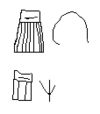
|
Ny-Hor | Only known from clay and stone vessels found in tombs near Tarchan, Tura, Tarjan, and Nagada. Some scholars believe that this serekh is simply a crude attempt at writing the name "Narmer".[17] | Naqada II c. 3240 BC |

|
Ni-Neith | Only known from inscriptions in Helwan. Reading of name is uncertain.[18] | c. 3230 BC |

|
Hat-Hor | Some scholars believe that this serekh is simply a crude attempt at writing the name "Narmer".[19] | c. 3220 BC |

|
[Double Falcon] | May also have ruled in Upper Egypt | c. 3210 BC |
| Wash | Only known from the Narmer Palette[20] | c. 3150 BC |

Upper Egypt
[edit]Upper Egypt refers to the region up-river to the south of Lower Egypt.
Regrouped here are predynastic rulers of Upper Egypt belonging to the late Naqada III period, sometimes informally described as Dynasty 0:
| Image | Name | Comments | Reign |
|---|---|---|---|

|
A (?) | Only known from a graffito discovered in the Western Desert in 2004.[21] This ruler is otherwise unattested. | c. 3180 BC |
| [Finger Snail] | The existence of this king is very doubtful.[22] | Naqada III | |
| — | [Fish][23] | Only known from artifacts that bear his mark. He most likely never existed.[22] | Naqada III |

|
[Elephant][24] | More than likely never existed | Naqada III |
| [Stork][25][26] | [22] | Naqada III | |
| [Bull] | [22] | c. 3280 BC Naqada III | |

|
[Scorpion I] | c. 3255 BC |
Predynastic rulers: Dynasty 0
[edit]Since these kings precede the First Dynasty, they have been informally grouped as "Dynasty 0".[clarification needed]
The following list of predynastic rulers may be incomplete:
| Image | Name | Comments | Reign |
|---|---|---|---|

|
[Crocodile] | Potentially read Shendjw; identity and existence are disputed.[27] | c. 3170 BC
|

|
Iry-Hor | Correct chronological position unclear.[28] | c. 3170 BC
|

|
Ka | Maybe read Sekhen rather than Ka. Correct chronological position unclear.[29] | c. 3170 BC
|
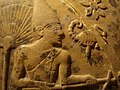
|
[Scorpion II] | Potentially read Serqet; possibly the same person as Narmer.[30] | c. 3170 BC
|
Early Dynastic Period
[edit]The Early Dynastic Period of Egypt stretches from c. 3100 to 2686 BC.[31]
First Dynasty
[edit]The First Dynasty ruled from c. 3100 to c. 2890 BC.[32]
| Image | Name | Personal name | Comments | Reign |
|---|---|---|---|---|

|
Narmer | Menes? | Believed by many scholars to be the same person as Menes, due to the preponderance of evidence indicating this.[33] His name is widely attested across Egypt, and has also been found at Nahal Tillah in Israel, which is much farther afield than his predecessors.[34] | c. 3150 BC[32] |

|
Hor-Aha | Teti | Greek form: Athotís.[35] May also be Menes although Narmer is more likely.[33] Trade was largely replaced by direct exploitation of resources via outposts during his reign.[36] Possibly the son of Narmer. | c. 3050 BC |

|
Djer[37] | Iti | Greek form: Kénkenes. His tomb was later thought to be the legendary tomb of Osiris. First pharaoh with a full Golden Horus name. Interest and trade with Egypt's North Eastern borders appears to have been renewed during Djer's reign.[36] | 41 years, c. 3000 BC[38] |

|
Djet[39] | Ita | Greek form: Ouenephes. Indications show that Djet did not reign for long.[40] | 10 years, c. 2980 BC[41] |
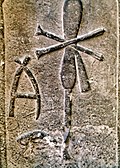
|
Merneith | — | Possibly the first female pharaoh of Egypt. She may have ruled as regent for her son Den. Her tomb is notable for being on the same scale as other tombs of other kings of that period. | c. 2950 BC |

|
Den[42] | Sepati | Greek form: Ousaphaidos. Den was the first pharaoh to have a Nesut-biti (dual king) name, and is the first pharaoh attested wearing the double crown (pschent) of upper and lower Egypt.[43] A second sed festival is attested from his reign, indicating he enjoyed a long time in power.[43] Den focused on the northeastern part of Egypt during his reign, and also led a few small battles in the northeast which are attested on the Palermo stone.[44] | c. 2965 - c. 2923 BC[45] |
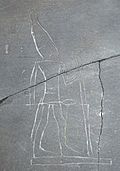
|
Adjib | Merybiap | Greek form: Miebidós.[46]
Known for his ominous nebwy-title.[47] |
9 years, c. 2930 BC |

|
Semerkhet | Semsu | Greek form: Semempsés.[48]
First Egyptian ruler with a fully developed Nebty name. His complete reign is preserved on the Cairo Stone. Many stone vessels of his predecessor were found reinscribed for Semerkhet so he may have been a usurper.[49] |
8.5 years, c. 2920 BC[41] |

|
Qa'a | Qebeh | Greek form: Bienékhes.[50]
Ruled very long, his tomb is the last one with subsidiary tombs. |
34 years, c. 2916 BC |

|
Sneferka | – | Very short reign, correct chronological position unknown. | c. 2900 BC |

|
[Horus Bird] | – | Very short reign, correct chronological position unknown. | c. 2900 BC |
Second Dynasty
[edit]The Second Dynasty ruled from c. 2890 to 2686 BC.[32]
| Image | Throne name | Personal name | Comments | Reign |
|---|---|---|---|---|

|
Hotepsekhemwy[51] | Bedjatau | Manetho names him Boëthos and reports that under this ruler an earthquake killed many people. Hotepsekhemwy broke the tradition of being buried at the Abydos royal cemetery at Umm-el-Qa'ab, where most of the 1st dynasty kings are buried, and chose to be buried at Saqqara instead to be closer to the capital.[52] | 27 years, c. 2890 BC |
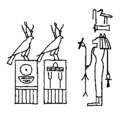
|
Nebra[53] | Kakau | Greek form: Kaíechós (after the Ramesside cartouche name Kakaw).
First ruler who uses the sun-symbol in his royal name, could be identical to king Weneg. |
12 years, c. 2850 BC |

|
Nynetjer[54] | Banetjer | Greek form: Binóthris.
May have divided Egypt between his successors, allegedly allowed women to rule like pharaohs. |
c. 2775 - c. 2730 BC |

|
Ba | – | May have been an independent ruler succeeding Nynetjer. Alternatively, he may have ruled in the 1st or 3rd dynasties or be the same person as Horus Bird. | Unknown |
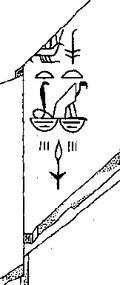
|
Weneg-Nebty[55] | – | Greek form: Ougotlas / Tlás.
Could be an independent ruler succeeding Nynetjer or the same as Peribsen, Sekhemib-Perenmaat, or Raneb. |
c. 2740 BC |

|
Wadjenes | Wadjenes | Greek form: Tlas
May have been a misinterpretation of the hieroglyphic sign of a flower called Weneg. May have been a crown prince or be the same person as Weneg-Nebty. |
c. 2740 BC |

|
Nubnefer | – | May have been the birth name of Nebra. May either be the successor of Wadjenes or Nynetjer. | Unknown |

|
Senedj[56] | Greek form: Sethenes.
Possibly the same person as Peribsen. This, however, is highly disputed.[57] |
47 years (supposedly) | |
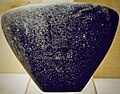
|
Seth-Peribsen | Peribsen | Used a Seth-animal above his serekh rather than a Horus falcon. He promoted the sun-cult in Egypt and reduced the powers of officials, nomarchs and palatines. Some scholars believe that he ruled over a divided Egypt.[58] | c. 2740 BC |

|
Sekhemib | Sekhemib-Perenmaat | Could be the same person as Seth-Peribsen.[59] | c. 2720 BC |

|
Neferkara I | Greek form: Néphercherés.
Known only from Ramesside king lists, not archaeologically attested. |
c. 2740 BC | |

|
Neferkasokar | Greek form: Sesóchris.
Known only from Ramesside king lists, not archaeologically attested. Old Kingdom legends claim that this ruler saved Egypt from a long-lasting drought.[60] |
8 years, c. 2740 BC | |

|
Horus Sa | – | May have been a short form of the Horus-name Sanakht. May have been the Horus-name of Weneg or Senedj, correct chronological position unclear. | Unknown |

|
– ("Hudjefa") | Known only from Ramesside king lists, his "name" is actually a paraphrase pointing out that the original name of the king was already lost in Ramesside times. | 11 years (according to the Turin Canon) | |

|
Khasekhemwy[52] | Beb(e)ty | Greek form: Chenerés.
It is probable that when Khasekhem acceded kingship he was a ruler of upper Egypt, he led campaigns against lower Egypt that ended in his victory, to commemorate his achievement of reunifying Egypt he changed his name to Khasekhemwy.[52] His serekh name is unique for presenting both Horus and Set. He was one of Egypt's first master builders, his funerary enclosure known as Shunet-ez-Zebib is a colossal mudbrick structure.[61] |
c. 2704 - c. 2686 BC |
Old Kingdom
[edit]The Old Kingdom of Egypt is the long period of stability and growth following the Early Dynastic Period and preceding the troubled First Intermediate Period. The kingdom spanned from 2686 to 2181 BC.
Third Dynasty
[edit]The Third Dynasty ruled from 2686 to 2613 BC.[32]
| Image | Throne name | Personal name | Comments | Reign |
|---|---|---|---|---|

|
Netjerikhet | Djoser[62][63] | Hellenized names Sesorthos and Tosórthros.
Commissioned the first Pyramid in Egypt, created by chief architect and scribe Imhotep. |
c. 2670 - c. 2650 BC[64] |

|
Sekhemkhet[65] | (Djoser-)Teti | Greek form: Tyréis (after the Ramesside cartouche name for Sekhemkhet, Teti).
In the necropolis of his unfinished step pyramid, the remains of a 2-year old infant were found.[66] |
c. 2650 - c. 2643 BC |

|
Sanakht | Nebka? | Likely to be identified with the throne name Nebka; Hellenized names Necherôchis and Necherôphes. May have reigned 6 years if identified with the penultimate king of the Dynasty on the Turin canon. | c. 2650 BC |

|
Qahedjet | – | Possibly be the same person as Huni or an archaistic representation of Thutmose III, correct chronological position unknown. | Unknown |

|
Khaba | – | Possibly built an unfinished step pyramid, could be identical with Huni. | 2643–2637 BC |

|
Huni[67] | Greek form: Áches.
Could be the same as Qahedjet or Khaba. Possibly built an unfinished step pyramid and several cultic pyramids throughout Egypt. Huni was for a long time credited with the building of the pyramid of Meidum. This, however, is disproved by New Kingdom graffiti that praise king Sneferu, not Huni. |
2637–2613 BC | |
Fourth Dynasty
[edit]The Fourth Dynasty ruled from c. 2613 to c. 2498 BC.[32]
| Image | Throne name | Personal name | Comments | Reign |
|---|---|---|---|---|
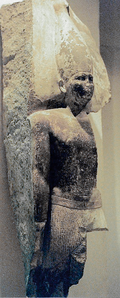
|
Nebmaat | Sneferu | Greek form: Sóris.
Reigned for around 24 years, giving him enough time to build the Meidum Pyramid, the Bent Pyramid and the Red Pyramid. Some scholars believe that he was buried in the Red Pyramid. For a long time it was thought that the Meidum Pyramid was not Sneferu's work, but that of king Huni. Ancient Egyptian documents describe Sneferu as a pious, generous and even accostable ruler.[68] |
c. 2613 – c. 2589 BC[32] |
|
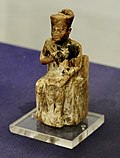
Medjedu | Khufu | Greek form: Cheops and Suphis.
Built the Great Pyramid of Giza. Khufu is depicted as a cruel tyrant by ancient Greek authors; Ancient Egyptian sources however describe him as a generous and pious ruler. He is the main protagonist in the Westcar Papyrus. The first imprinted papyri originate from Khufu's reign, which may have made ancient Greek authors believe that Khufu wrote books in attempt to praise the gods. |
c. 2589 – c. 2566 BC |
|
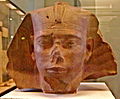
Kheper | Djedefre | Greek form: Rátoises.
Some scholars believe he created the Great Sphinx of Giza as a monument for his deceased father. He also created a pyramid at Abu Rawash. However, this pyramid is no longer extant; it is believed the Romans re-purposed the materials from which it was made. |
c. 2566 – c. 2558 BC |

|
Userib | Khafre | Greek form: Chéphren and Suphis II.
His pyramid is the second largest in Giza. Some scholars prefer him as the creator of the Great Sphinx before Djedefra. His funerary complex was the largest at the Giza plateau. |
c. 2558 – c. 2532 BC |

|
Baka/Bakare | Greek form: Bikheris.
Could be the owner of the Unfinished Northern Pyramid of Zawyet el'Aryan. Possibly fictional. |
c. 2570 BC | |

|
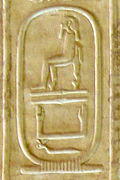
Kakhet | Menkaure | Greek form: Menchéres.
His pyramid is the third and smallest in Giza. A legend claims that his only daughter died due to an illness and Menkaura buried her in a golden coffin in the shape of a cow. |
c. 2532 – c. 2503 BC |
|
Shepeskhet | Shepseskaf | Greek form: Seberchéres.
Owner of the Mastabat al-Fir'aun. |
c. 2503 – c. 2498 BC |
| – | Thamphthis | According to Manetho the last king of the 4th dynasty. He is not archaeologically attested and thus possibly fictional. | c. 2500 BC | |
Fifth Dynasty
[edit]The Fifth Dynasty ruled from c. 2498 to c. 2345 BC.[32]
| Image | Throne name | Personal name | Comments | Reign |
|---|---|---|---|---|

|
Userkaf | Buried in a pyramid in Saqqara. Built the first solar temple at Abusir. | c. 2498 – c. 2491 BC | |

|
Sahure | Moved the royal necropolis to Abusir, where he built his pyramid. | c. 2491 – c. 2477 BC | |

|
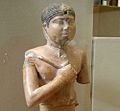
Neferirkare | Kakai | Son of Sahure, born with the name Ranefer | c. 2477 – c. 2460 BC |
|
Neferefre | Isi | Son of Neferirkare | c. 2460 – c. 2458 BC |

|
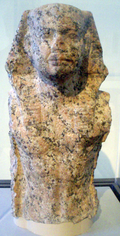
Shepseskare | Netjeruser | Reigned most likely after Neferefre and for only a few months, possibly a son of Sahure.[69] | Around a few months, c. 2458 BC |
|
Nyuserre | Ini | Brother to Neferefre, built extensively in the Abusir necropolis. | c. 2458 - c. 2422 BC |

|
Menkauhor | Kaiu | Last pharaoh to build a sun temple | c. 2422 - c. 2414 BC |

|
Djedkare | Isesi | Effected comprehensive reforms of the Egyptian administration. Enjoyed the longest reign of his dynasty, with likely more than 35 years on the throne. | c. 2414 - c. 2375 BC |

|
Unas | The Pyramid of Unas is inscribed with the earliest instance of the pyramid texts. He also constructed Unas's causeway a 500m long causeway from the bank of the river Nile to his funerary complex, this is where his funerary precession would have taken place. | c. 2375 - c. 2345 BC | |
Sixth Dynasty
[edit]The Sixth Dynasty ruled from c. 2345 to c. 2210 BC.
| Image | Throne name | Personal name | Comments | Reign |
|---|---|---|---|---|

|
Teti | According to Manetho, he was murdered. | c. 2345 – c. 2333 BC | |

|
Userkare | Reigned one to five years, may have usurped the throne at the expense of Teti | c. 2333 – c. 2332 BC | |

|
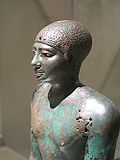
Meryre | Pepi I | Faced conspiracies and political troubles yet became the most prolific builder of his dynasty | c. 2332 – c. 2283 BC |
|
Merenre | Nemtyemsaf I | Reformed the administration of Upper Egypt by decentralization, received the submission of Lower Nubia | c. 2283 – c. 2278 BC |

|
Neferkare | Pepi II | Possibly the longest-reigning monarch in human history, with 94 years on the throne. Alternatively, may have reigned only 64 years. | c. 2278 – c. 2214 BC |
 |
Merenre | Nemtyemsaf II[70] | Short lived pharaoh, possibly an aged son of Pepi II. | c. 2214 – c. 2213 BC |
| — | Neferka | Most likely a writing mistake for "Neferkare" | c. 2200 BC | |

|
Netjerkare
or Nitocris Nitocris |
Neitiqerty Siptah
or Siptah |
This male king gave rise to the legendary queen Nitocris of Herodotus and Manetho.[71] Sometimes classified as the first king of the combined 7th/8th Dynasties. | c. 2213 – c. 2210 BC |
First Intermediate Period
[edit]The First Intermediate Period (2183–2060 BC) is a period of disarray and chaos between the end of the Old Kingdom and the advent of the Middle Kingdom.
The Old Kingdom rapidly collapsed after the death of Pepi II. He had reigned for more than 64 and likely up to 94 years, longer than any monarch in history. The latter years of his reign were marked by inefficiency because of his advanced age. The union of the Two Kingdoms fell apart and regional leaders had to cope with the resulting famine.
The kings of the 7th and 8th Dynasties, who represented the successors of the 6th Dynasty, tried to hold onto some power in Memphis but owed much of it to powerful nomarchs. After 20 to 45 years, they were overthrown by a new line of pharaohs based in Herakleopolis Magna. Some time after these events, a rival line based at Thebes revolted against their nominal Northern overlords and united Upper Egypt. c. 2055 BC, Mentuhotep II, the son and successor of pharaoh Intef III defeated the Herakleopolitan pharaohs and reunited the Two Lands, thereby starting the Middle Kingdom.
Seventh and Eighth Dynasties
[edit]The Seventh and Eighth Dynasties ruled for approximately 20–45 years. They comprise numerous ephemeral kings reigning from Memphis over a possibly divided Egypt and, in any case, holding only limited power owing to the effectively feudal system into which the administration had evolved. The list below is based on the Abydos King List dating to the reign of Seti I and taken from Jürgen von Beckerath's Handbuch der ägyptischen Königsnamen[72] as well as from Kim Ryholt's latest reconstruction of the Turin canon, another king list dating to the Ramesside Era.[73]
| Image | Throne name | Personal name | Comments | Reign |
|---|---|---|---|---|

|
Khui | — | Attested to by a relief fragment with the cartouche of Khui from a mastaba in Dara.[74] | Duration unknown, c. 2150 BC? |

|
Menkare | — | Likely attested by a relief fragment from the tomb of queen Neit.[75][76][77] | Probably short, c. 2181 BC |

|
Neferkare II | — | — | Unknown |

|
Neferkare III | Neby | Attested by inscriptions in the tomb of his mother Ankhesenpepi, started the construction of a pyramid in Saqqara. | Unknown |

|
Djedkare Shemai | – | — | Unknown |

|
Neferkare IV | – | — | Unknown |

|
Merenhor | — | — | Unknown |
|
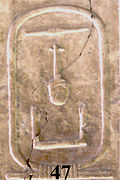
Neferkamin I / Sneferka | — | Unknown | |

|
Nikare | — | Possibly attested by a cylinder-seal. | Unknown |
|
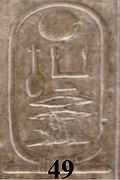
Neferkare V | Tereru | — | Unknown |
|
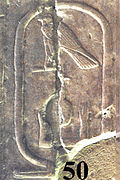
Neferkahor | — | Attested by a cylinder seal. | Unknown |

|
Neferkare VI | Pepiseneb | — | Unknown to 2171 BC |

|
Neferkamin Anu | – | — | c. 2170 BC |
|
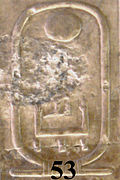
Qakare | Ibi | Built a poorly constructed pyramid at Saqqara inscribed with the last known instance of the Pyramid Texts | 2175–2171 BC |

|
Neferkaure | — | Attested by one to three decrees from the temple of Min at Coptos. | 2167–2163 BC |

|
Neferkauhor | Khuwihapi | Attested by eight decrees from the temple of Min and an inscription in the tomb of Shemay. | 2163–2161 BC |

|
Neferirkare | Pepi | Possibly to be identified with horus Demedjibtawy, in which case he is attested by a decree from the temple of Min. | 2161–2160 BC |
Ninth Dynasty
[edit]The Ninth Dynasty[78] ruled from 2160 to 2130 BC.[32]
The Turin King List has 18 kings reigning in the Ninth and Tenth Dynasties. Of these, twelve names are missing and four are partial.[78]
| Image | Name | Comments | Reign | |
|---|---|---|---|---|

|
Meryibre | Khety I (Acthoes I) | Manetho states that Achthoes founded this dynasty. | 2160 BC–unknown[32] |
| — | — | Name lost | — | Unknown |
| — | Neferkare VII | — | — | Unknown |
|
Nebkaure | Khety II (Acthoes II) | — | Unknown |
| — | Senen[...] or Setut | — | Unknown | |
| — | — | Name lost | — | Unknown |
| — | Mery[...] | — | — | Unknown |
| — | Shed[...] | — | — | Unknown |
| — | H[...] | — | — | Unknown |
| — | — | Name lost | — | Unknown |
| — | — | Name lost | — | Unknown |
| — | — | Name lost | — | Unknown |
| User(?)[...] | — | — | Unknown | |

|
Imhotep | — | Ephemeral ruler of the Ninth Dynasty. Only known from two rock inscriptions in the Wadi Hammamat.[79][80][81][82][83][84] Correct chronological position unknown. | Unknown |
Tenth Dynasty
[edit]The Tenth Dynasty was a local group that held sway over Lower Egypt and ruled from 2130 to 2040 BC.[32]
| Image | Name | Comments | Reign | |
|---|---|---|---|---|

|
Meryhathor | — | — | 2130 BC–unknown |
| — | Neferkare VIII | — | — | Between 2130 and 2040 BC |

|
Wahkare | Khety III (Acthoes III) | — | Unknown |

|
Merykare | — | — | Unknown–2040 BC |
| — | — | Name lost | — | Few months |
Eleventh Dynasty
[edit]The Eleventh Dynasty originated from a group of Theban nomarchs serving kings of the 8th, 9th or 10th dynasty with roots in Upper Egypt that ruled from 2134 to 1991 BC.
| Image | Name | Comments | Reign |
|---|---|---|---|

|
Intef the Elder | Theban nomarch (Iry-pat) serving an unnamed king, later considered a founding figure of the 11th Dynasty. | Unknown |
The successors of Intef the Elder, starting with Mentuhotep I, became independent from their northern overlords and eventually conquered Egypt under Mentuhotep II.
| Image | Throne name | Personal name | Comments | Reign |
|---|---|---|---|---|

|
Tepia | Mentuhotep I | Nominally a Theban nomarch (Tepy-a) but may have ruled independently. | Unknown – 2133 BC |
|
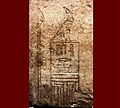
Sehertawy | Intef I | First member of the dynasty to claim a Horus name. | 2133–2117 BC[32] |

|
Wahankh | Intef II | Conquered Abydos and its nome. | 2117–2068 BC[32] |

|
Nakhtnebtepnefer | Intef III | Conquered Asyut and possibly moved further North up to the 17th nome.[85] | 2068–2060 BC[32] |
Middle Kingdom
[edit]The Middle Kingdom of Egypt (2040–1802 BC) is the period from the end of the First Intermediate Period to the beginning of the Second Intermediate Period. In addition to the Twelfth Dynasty, some scholars include the Eleventh, Thirteenth and Fourteenth Dynasties in the Middle Kingdom.
The Middle Kingdom can be noted for the expansion of trade outside of the kingdom that occurred during this time.
Eleventh Dynasty cont.
[edit]The second part of the Eleventh Dynasty is usually considered to be the beginning of the Middle Kingdom of Egypt.
| Image | Throne name | Personal name | Comments | Reign |
|---|---|---|---|---|

|
Nebhepetre | Mentuhotep II[86] | Mentuhotep II regained all Egypt c. 2015 BC, Middle Kingdom begins, becomes first pharaoh of Middle Kingdom. | |

|
Sankhkare | Mentuhotep III[87] | Commanded the first expedition to Punt of the Middle Kingdom | 2009–1997 BC[32] |

|
Nebtawyre | Mentuhotep IV[88] | Obscure pharaoh absent from later king lists; tomb unknown. May have been overthrown by his vizier and successor Amenemhat I. | 1997–1991 BC[32] |
Enigmatic kings, only attested in Lower Nubia:
| Image | Throne name | Personal name | Comments | Reign |
|---|---|---|---|---|

|
Menkhkare | Segerseni[89] | Obscure pharaoh absent from later king lists, tomb unknown. Only attested in Lower Nubia, most likely a usurper at the end of the Eleventh Dynasty or early Twelfth Dynasty. | Early 20th century BC |

|
Qakare | Ini[89] | Obscure pharaoh absent from later king lists, tomb unknown. Only attested in Lower Nubia, most likely a usurper at the end of the Eleventh Dynasty or early Twelfth Dynasty. | Early 20th century BC |

|
Iyibkhentre[89] | Geregtaw(y)ef | Obscure pharaoh absent from later king lists, tomb unknown. Only attested in Lower Nubia, most likely a usurper at the end of the Eleventh Dynasty or early Twelfth Dynasty. | Early 20th century BC |
Twelfth Dynasty
[edit]The Twelfth Dynasty ruled from 1991 to 1802 BC.
| Image | Throne name | Personal name | Comments | Reign |
|---|---|---|---|---|

|
Sehetepibre | Amenemhat I[90][91] (Ammanemes I)[92] | Amenemhat I was not from a royal family, and built the first substantial pyramid since Pepi II at Lisht.[93] He restored order in Egypt, and then built a new capital called Itjtawy. Amenemhat I was probably assassinated.[94] | 1991–1962 BC[32] |

|
Kheperkare | Senusret I[95] (Sesonchosis)[96] | Senusret I built extensively in upper Egypt, including the temple of Amun at Karnak.[93] Senusret I claimed to have sent 17,000 people into the Wadi Hammamat to bring back stone for 150 statues and 60 sphinxes.[97] He also constructed a pyramid at Lisht near his fathers pyramid. | 1971–1926 BC |
|
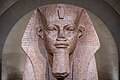
Nubkaure | Amenemhat II[98] (Ammenemes II)[99] | Amenemhat II recorded his reign in now fragmented annals.[93] The Egyptian navy may have attacked Cyprus during his campaigns.[100] Amenemhat II also built a pyramid at Dashur. Ruled for at least 35 years. | 1929–1895 BC[32] |

|
Khakheperre | Senusret II[101] (No name given by Manetho)[102] |
Senusret II developed the Fayyum as a major agricultural resource during his reign.[103] He also built a pyramid at Lahun. | 1897–1878 BC[32] |
|
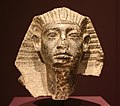
Khakaure | Senusret III[104] (Sesostris)[105] | Senusret III got rid of nomarchs and made 3 administrative districts.[106] He also led campaigns into Lower Nubia in his 8th, 10th, 16th, and 18th regnal years.[100] Senusret III also built his own pyramid at Dashur and was the most powerful and influential pharaoh of the 12th dynasty. | 1878–1839 BC |

|
Nimaatre | Amenemhat III[107] (Lamares)[108] | Amenemhat III further developed the Fayyum as an agricultural region.[93] He also constructed a large mortuary complex at Hawara including his pyramid, the mortuary complex was probably the labyrinth that inspired the ancient Greek authors.[109] | 1860–1814 BC |

|
Maakherure | Amenemhat IV[110] (Ammenemes)[111] | Had a co-regency lasting at least 1 year based on an inscription at Konosso. | 1816–1807 BC |

|
Sobekkare | Sobekneferu[112] (Skemiophris)[113] | The first known archeologically attested female Pharaoh. | 1807–1802 BC |
The position of a possible additional ruler, Seankhibtawy Seankhibra, is uncertain. He may be an ephemeral king, or a name variant of a king of the 12th or 13th Dynasty.
Second Intermediate Period
[edit]The Second Intermediate Period (1802–1550 BC) is a period of disarray between the end of the Middle Kingdom, and the start of the New Kingdom. It is best known as when the Hyksos, whose reign comprised the Fifteenth Dynasty, made their appearance in Egypt.
The Thirteenth Dynasty was much weaker than the Twelfth Dynasty, and was unable to hold onto the two lands of Egypt. Either at the start of the dynasty, c. 1805 BC or toward the middle of it in c. 1710 BC, the provincial ruling family in Xois, located in the marshes of the eastern Delta, broke away from the central authority to form the Canaanite Fourteenth Dynasty.
The Hyksos made their first appearance during the reign of Sobekhotep IV, and c. 1720 BC took control of the town of Avaris (the modern Tell el-Dab'a/Khata'na), conquering the kingdom of the 14th dynasty. Sometime around 1650 BC the Hyksos, perhaps led by Salitis the founder of the Fifteenth Dynasty, conquered Memphis, thereby terminating the 13th dynasty. The power vacuum in Upper Egypt resulting from the collapse of the 13th dynasty allowed the 16th dynasty to declare its independence in Thebes, only to be overrun by the Hyksos kings shortly thereafter.
Subsequently, as the Hyksos withdrew from Upper Egypt, the native Egyptian ruling house in Thebes set itself up as the Seventeenth Dynasty. This dynasty eventually drove the Hyksos back into Asia under Seqenenre Tao, Kamose and finally Ahmose, first pharaoh of the New Kingdom.
Thirteenth Dynasty
[edit]The Thirteenth Dynasty (following the Turin King List) ruled from 1802 to c. 1649 BC and lasted 153 or 154 years according to Manetho.
This table should be contrasted with Known kings of the 13th Dynasty:
| Image | Throne name | Personal name | Comments | Reign |
|---|---|---|---|---|

|
Sekhemre Khutawy | Sobekhotep I | Founded the 13th Dynasty. His reign is well attested. Referred to as Sobekhotep I in dominant hypothesis, known as Sobekhotep II in older studies | 1802–1800 BC[114] |

|
Mehibtawy Sekhemkare | Amenemhat Sonbef | Perhaps a brother of Sekhemre Khutawy Sobekhotep and son of Amenemhat IV[114] | 1800–1796 BC[114] |

|
Nerikare | Sobek[...] | Attested on a Nile record from Semna.[citation needed] | 1796 BC |

|
Sekhemkare | Amenemhat V | Ruled for 3 to 4 years[114] | 1796–1793 BC[114] |

|
— | Ameny Qemau | Buried in his pyramid in south Dashur | 1795–1792 BC |

|
Hotepibre | Qemau Siharnedjheritef | Also called Sehotepibre | 1792–1790 BC |
| — | — | Iufni | Only attested on the Turin canon | Very short reign, possibly c. 1790–1788 BC[114] |
|
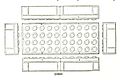
Seankhibre | Amenemhat VI | Attested on the Turin Canon.[citation needed] | 1788–1785 BC |

|
Semenkare | Nebnuni | Attested on the Turin Canon[citation needed] | 1785–1783 BC[114] or 1739 BC[115] |

|
Sehetepibre | Sewesekhtawy | Attested on the Turin Canon.[citation needed] | 1783–1781 BC[114] |
| — | Sewadjkare I | — | Known only from the Turin canon | 1781 BC |
| — | Nedjemibre | — | Known only from the Turin canon | 7 months, 1780 BC[114] or 1736 BC[115] |
|
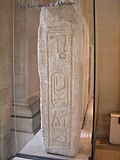
Khaankhre | Sobekhotep | Referred to as Sobekhotep II in dominant hypothesis, known as Sobekhotep I in older studies | Reigned c. 3 years, 1780–1777 BC[114] |
| — | Renseneb | — | 4 months | 1777 BC[114] |

|
Awybre | Hor | Famous for his intact tomb treasure and Ka statue | Reigned 1 year and 6 months, 1777–1775 BC[114] |

|
Sekhemrekhutawy Khabaw | — | Possibly a son of Hor Awibre | Estimated reign 3 years, 1775–1772 BC[114] |

|
Djedkheperew | — | Possibly a son of Hor Awibre and brother of Khabaw, previously identified with Khendjer | Estimated reign 2 years, 1772–1770 BC[114] |

|
— | Sebkay | Possibly two kings, Seb and his son Kay.[114] | |

|
Sedjefakare | Kay Amenemhat | A well known king attested on numerous stelas and other documents. | 5 to 7 years or 3 years, 1769–1766 BC[114] |

|
Khutawyre | Wegaf | Founder of the dynasty in old studies | c. 1767 BC |

|
Userkare | Khendjer | Possibly the first Semitic pharaoh, built a pyramid at Saqqara | Minimum 4 years and 3 months c. 1765 BC |
|
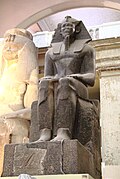
Smenkhkare | Imyremeshaw | Attested by two colossal statues | Reigned less than 10 years, starting 1759 BC[114] or 1711 BC.[116] |

|
Sehetepkare | Intef IV | — | Less than 10 years |

|
Meribre | Seth | — | Reign ended 1749 BC |

|
Sekhemresewadjtawy | Sobekhotep III | 4 years and 2 months | 1755–1751 BC |

|
Khasekhemre | Neferhotep I | 11 years | 1751–1740 BC |
|
Menwadjre | Sihathor | Ephemeral coregent with his brother Neferhotep I, may not have reigned independently. | 1739 BC[114] |

|
Khaneferre | Sobekhotep IV | 10 or 11 years | 1740–1730 BC |

|
Merhotepre | Sobekhotep V | — | 1730 BC
|
|
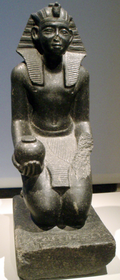
Khahotepre | Sobekhotep VI | 4 years 8 months and 29 days | c. 1725 BC |

|
Wahibre | Ibiau | 10 years and 8 months | 1725–1714 BC or 1712–1701 BC[114] |
|
Merneferre | Ay I | Longest reigning king of the dynasty | 23 years, 8 months and 18 days, 1701–1677 BC[114] or 1714–1691 BC |

|
Merhotepre | Ini | Possibly a son of his predecessor | 2 years, 3 or 4 months and 9 days, 1677–1675 BC[114] or 1691–1689 BC |
| — | Sankhenre | Sewadjtu | Attested only on the Turin canon | 3 years and 2–4 months, 1675–1672 BC[114] |

|
Mersekhemre | Ined | May be the same person as Neferhotep II | 3 years, 1672–1669 BC[114] |
| — | Sewadjkare II | Hori | Reigned 5 years | 5 years |

|
Merkawre | Sobekhotep VII | Reigned 2 years and 6 months[114] | 1664–1663 BC[114] |
| — | Name lost | Seven kings | Names lost in a lacuna of the Turin canon[114] | 1663 BC –?[114] |
| — | Name lost | |||
| — | Name lost | |||
| — | Name lost | |||
| — | Name lost | |||
| — | Name lost | |||
| — | Name lost | |||
| — | Mer[...]re | — | — | Unknown |
|
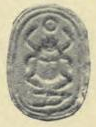
Merkheperre | — | — | Some time between 1663 BC and 1649 BC[114] |
| — | Merkare | — | Attested only on the Turin canon | Some time between 1663 BC and 1649 BC[114] |
| — | Name lost | — | Unknown | |

|
Sewadjare | Mentuhotep V | — | c. 1655 BC[114] |
| — | [...]mosre | — | — | Unknown |
| — | Ibi [...]maatre | — | — | Unknown |
| — | Hor[...] [...]webenre | — | — | Unknown |
| — | Se[...]kare | — | Unknown | Unknown |

|
Seheqenre | Sankhptahi | May be the son of his predecessor | Between 1663 and 1649 BC |
| — | [...]re | — | Unknown | Unknown |
| — | Se[...]enre | — | Unknown | Unknown – 1649 BC[114] |
The position of the following kings is uncertain:
| Image | Throne name | Personal name | Comments | Reign |
|---|---|---|---|---|

|
Djedhotepre | Dedumose I | Possibly a king of the 16th dynasty | c. 1654 BC |

|
Djedneferre | Dedumose II | Possibly a king of the 16th dynasty | Unknown |

|
Maare | Sobekhotep IX | Late 13th dynasty. | Unknown |

|
Sewahenre | Senebmiu | Late 13th dynasty. | After 1660 BC.[114] |

|
Mershepsesre | Ini II | Late 13th dynasty. | Unknown |

|
Menkhaure | Snaaib | Possibly a king of the Abydos Dynasty | Unknown |
Fourteenth Dynasty
[edit]The Fourteenth Dynasty was a local group from the eastern Delta, based at Avaris,[117] that ruled from either 1805 BC or c. 1710 BC until c. 1650 BC.
Some of the contested rulers of the 14th Dynasty (proposed by Kim Ryholt) are commonly identified by Egyptologists as being of Canaanite (Semitic) descent, owing to the distinct origins of the names of some of their kings and princes. However, the dynasty rulers are not referred to as Hyksos in the Turin kings list.[118] It is here given according to Ryholt; however, this reconstruction of the dynasty is heavily debated with the position of the five kings preceding Nehesy highly disputed.
| Image | Throne name | Personal name | Comments | Reign |
|---|---|---|---|---|

|
Sekhaenre | Yakbim | Chronological position uncertain, here given according to Ryholt[117] | 1805–1780 BC |

|
Nubwoserre | Ya'ammu | Chronological position uncertain, here given per Ryholt[117] | 1780–1770 BC |

|
Khawoserre[117] | Qareh | Chronological position uncertain, here given per Ryholt[117] | 1770–1760 BC |

|
Aahotepre[117] | 'Ammu | Chronological position uncertain, here given per Ryholt[117] | 1760–1745 BC |

|
Maaibre | Sheshi[119] | Chronological position, duration of reign and extend of rule uncertain, here given according to Ryholt.[117] Alternatively, he could be an early Hyksos king, a Hyksos ruler of the second part of the 15th Dynasty or a vassal of the Hyksos. | 1745–1705 BC |

|
Aasehre | Nehesy | Short reign, perhaps a son of Sheshi[117] | c. 1705 BC |
| — | Khakherewre | — | — | Unknown |
| — | Nebefawre | — | — | c. 1704 BC |
| — | Sehebre | — | Possibly identifiable with Wazad or Sheneh[114] | c. 1704 to 1699 BC |
|
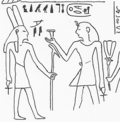
Merdjefare | — | Possibly identifiable with Wazad or Sheneh[114] | c. 1699 BC |
| — | Sewadjkare III | — | — | Unknown |
| — | Nebdjefare | — | — | 1694 BC |
| — | Webenre | — | — | Unknown |
| — | Name lost | — | Unknown | |
| — | [...]djefare | — | — | Unknown |
| — | [...]webenre | — | — | c. 1690 BC |
| — | Awibre II | — | — | Unknown |
| — | Heribre | — | — | Unknown |

|
— | Nebsenre[117] | Attested by a jar bearing his prenomen | At least 5 months of reign, some time between 1690 BC and 1649 BC |
| — | Name lost | — | Unknown | |
| — | [...]re | — | — | Unknown |

|
Sekheperenre[117] | — | Attested by a single scarab seal | 2 months, some time between 1690 BC and 1649 BC |
| — | Djedkherewre | — | — | Unknown |
| — | Sankhibre II | — | — | Unknown |
| — | Nefertum[...]re | — | — | Unknown |
| — | Sekhem[...]re | — | — | Unknown |
| — | Kakemure | — | — | Unknown |
| — | Neferibre | — | — | Unknown |
| — | — | I[...]re | — | Unknown |
| — | Khakare | — | — | Unknown |
| — | Akare[120] | — | Only known from the Turin canon | Unknown |
| — | Semenenre | Hapu | — | Unknown |
| — | Djedkare[117] | Anati | Only known from the Turin canon | Unknown |
| — | — | Bebnum[117] | Only known from the Turin canon | Some time between 1690 BC and 1649 BC |
| — | Name lost | Eight lines lost in the Turin canon | Unknown | |
| — | Name lost | Unknown | ||
| — | Name lost | Unknown | ||
| — | Name lost | Unknown | ||
| — | Name lost | Unknown | ||
| — | Name lost | Unknown | ||
| — | Name lost | Unknown | ||
| — | Name lost | Unknown | ||
| — | Senefer[...]re | — | — | Unknown |
| — | Men[...]re | — | — | Unknown |
| — | Djed[...]re | — | — | Unknown |
| — | Name lost | Three lines lost in the Turin canon | Unknown | |
| — | Name lost | Unknown | ||
| — | Name lost | Unknown | ||
| — | Ink[...] | — | — | Unknown |
| — | 'A[...][121] | — | Only known from the Turin canon. Name may be read as "Ineb" according to Alan Gardiner.[121] | Unknown |
| — | — | 'Apepi[117] | Possibly attested as a king's son by 5 scarabs-seals | c. 1650 BC |
| — | Name lost | Five lines lost in the Turin canon | Unknown | |
| — | Name lost | Unknown | ||
| — | Name lost | Unknown | ||
| — | Name lost | Unknown | ||
| — | Name lost | Unknown | ||
The position and identity of the following pharaohs is uncertain:
| Image | Throne name | Personal name | Comments | Reign |
|---|---|---|---|---|

|
— | Khamure[114] | — | Unknown |

|
— | Nuya[114] | Attested by a scarab-seal | Unknown |
|
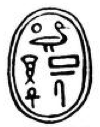
— | Sheneh[114] | May be identifiable with Sehebre or Merdjefare | Unknown |

|
— | Shenshek[114] | Attested by a scarab-seal | Unknown |

|
— | Wazad[114] | May be identifiable with Sehebre or Merdjefare | c. 1700 BC ? |

|
— | Yakareb[114] | — | Unknown |
|
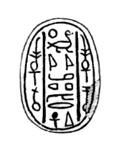
Meruserre | Yaqub-Har[119] | May belong to the 14th dynasty, the 15th dynasty or be a vassal of the Hyksos. | 17th–16th centuries BC |
The Turin King List provides additional names, none of which are attested beyond the list.
Fifteenth Dynasty
[edit]The Fifteenth Dynasty arose from among the Hyksos people who emerged from the Fertile Crescent to establish a short-lived governance over much of the Nile region, and ruled from 1674 to 1535 BC.
| Image | Throne name | Personal name | Comments | Reign |
|---|---|---|---|---|
| — | (Salitis) | Ruled Lower Egypt and founded the 15th Dynasty | c. 1650 BC | |

|
— | Semqen | Chronological position uncertain. | 1649 BC – Unknown |
|
— | 'Aper-'Anat | Chronological position uncertain. | Unknown |
| — | — | Sakir-Har | — | Unknown |
|
|
Meruserre | Yaqub-Har | From Turin papyrus. | either 8 or 18 years |

|
Seuserenre | Khyan | Apex of the Hyksos' power, conquered Thebes toward the end of his reign | likely 30–35 years |

|
Nebkhepeshre / Aqenenre / Auserre | Apepi | — | 1590 BC? |

|
Nakhtyre / Hotepibre | Khamudi | — | 1555–1544 BC |
Abydos Dynasty
[edit]The Second Intermediate Period may include an independent dynasty reigning over Abydos from c. 1650 BC until 1600 BC.[122][123][124]
Four attested kings may be tentatively attributed to the Abydos Dynasty, and they are given here without regard for their (unknown) chronological order:
| Image | Prenomen | Nomen | Comments | Reign |
|---|---|---|---|---|

|
Woseribre | Senebkay | Tomb discovered in 2014. Perhaps identifiable with a Woser[...]re of the Turin canon. | c. 1650 BC |
|
|
Menkhaure | Snaaib | May belong to the late 13th Dynasty.[125][126][127] | Uncertain |

|
Sekhemrekhutawy | Pantjeny | May belong to the late 16th Dynasty[128] | Uncertain |

|
Sekhemraneferkhau | Wepwawetemsaf | May belong to the late 16th Dynasty[128] | Uncertain |
| — | [...]hebre | — | Only known from the Turin Canon. Believed by Kim Ryholt to have been part of the Abydos dynasty.[129] | Uncertain |
Sixteenth Dynasty
[edit]The Sixteenth Dynasty was a native Theban dynasty emerging from the collapse of the Memphis-based 13th dynasty c. 1650 BC. They were finally conquered by the Hyksos 15th dynasty c. 1580 BC.
The 16th dynasty held sway over Upper Egypt only.
| Image | Throne name | Personal name | Comments | Reign |
|---|---|---|---|---|
| — | — | Name of the first king is lost here in the Turin King List and cannot be recovered | Unknown | |

|
Sekhemresementawy | Djehuti | – | 3 years |

|
Sekhemreseusertawy | Sobekhotep VIII | – | 16 years |

|
Sekhemresankhtawy | Neferhotep III | – | 1 year |

|
Seankhenre | Mentuhotepi | May be a king of the 17th Dynasty[126] | < 1 year |

|
Sewadjenre | Nebiryraw I | – | 26 years |

|
Neferkare (?) | Nebiryraw II | – | c. 1600 BC |

|
Semenre | – | – | c. 1600 BC |

|
Seuserenre | Bebiankh | – | 12 years |
|
|
Djedhotepre | Dedumose I | May be a king of the 13th Dynasty[126] | c. 1588–1582 BC |
|
|
Djedneferre | Dedumose II | – | c. 1588–1582 BC |
|
Djedankhre | Montemsaf | – | c. 1590 BC |

|
Merankhre | Mentuhotep VI | – | Short reign, c. 1585 BC |

|
Seneferibre | Senusret IV | – | Unknown |
| — | Sekhemre | Shedwast | May be the same as Sekhemre Shedtawy Sobekemsaf II | Unknown |
The 16th Dynasty may also have comprised the reigns of pharaohs Sneferankhre Pepi III[130] and Nebmaatre. Their chronological position is uncertain.[125][126]
Seventeenth Dynasty
[edit]The Seventeenth Dynasty was based in Upper Egypt and ruled from 1580 to 1550 BC and comprised the family of rulers that would eventually overthrow the Hyksos and establish the 18th Dynasty and New Kingdom
| Image | Throne name | Personal name | Comments | Reign |
|---|---|---|---|---|
|
Sekhemrewahkhaw | Rahotep | — | c. 1580 |

|
Sekhemre Wadjkhaw | Sobekemsaf I | — | At least 7 years |
|
Sekhemre Shedtawy | Sobekemsaf II | His tomb was robbed and burned during the reign of Ramesses IX. | Unknown to c. 1573 BC |

|
Sekhemre-Wepmaat | Intef V | — | c. 1573-1571 BC |

|
Nubkheperre | Intef VI | Reigned more than 3 years | c. 1571 to the mid-1560s BC |
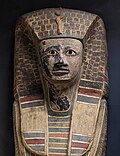
|
Sekhemre-Heruhirmaat | Intef VII | — | Late 1560s BC |

|
Senakhtenre | Ahmose | — | c. 1558 BC |

|
Seqenenre | Tao | Died in battle against the Hyksos. | 1558–1554 BC |

|
Wadjkheperre | Kamose | — | 1554–1549 BC |
The early 17th Dynasty may also have included the reign of a pharaoh Nebmaatre, whose chronological position is uncertain.[114]
New Kingdom
[edit]The New Kingdom (1550–1077 BC) is the period covering the Eighteenth, Nineteenth, and Twentieth dynasty of Egypt, from the 16th to the 11th century BC, between the Second Intermediate Period, and the Third Intermediate Period.
Through military dominance abroad, the New Kingdom saw Egypt's greatest territorial extent. It expanded far into Nubia in the south, and held wide territories in the Near East. Egyptian armies fought with Hittite armies for control of modern-day Syria.
Three of the best known pharaohs of the New Kingdom are Akhenaten, also known as Amenhotep IV, whose exclusive worship of the Aten is often interpreted as the first instance of monotheism, Tutankhamun known for the discovery of his nearly intact tomb, and Ramesses II who attempted to recover the territories in modern Israel/Palestine, Lebanon and Syria that had been held in the Eighteenth Dynasty. His reconquest led to the Battle of Qadesh, where he led the Egyptian armies against the army of the Hittite king Muwatalli II.
Eighteenth Dynasty
[edit]The Eighteenth Dynasty ruled from c. 1550 to 1292 BC:
| Image | Throne name | Personal name | Comments | Reign |
|---|---|---|---|---|
 |
Nebpehtire | Ahmose I (Ahmosis I) | Brother and successor to Kamose, conquered north of Egypt from the Hyksos. | |
 |
Djeserkare | Amenhotep I | Son of Ahmose I. Amenhotep I led campaigns in Nubia down to the 3rd Nile cataract.[133] He also introduced the practice of having the tomb and funerary temple in separate locations rather than in the same location.[134] It is possible that Amenhotep I and his mother Ahmose-Nefertari founded the tomb workers village of Deir-el-Medina, the two were honored as gods by later residents.[135] | |
 |
Aakheperkare | Thutmose I | Believed to be of non-royal origin.[137] His mother is known to be Senseneb. Thutmose I established family control over the Egyptian throne for the next 175 years.[133] Thutmose I defeated the Kingdom of Kush and destroyed Kerma in Nubia, he campaigned in Syria as far as the Euphrates River.[133] He is also the father of Thutmose II and Hatshepsut.[133] | |
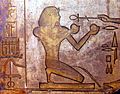 |
Aakheperenre | Thutmose II | Son of Thutmose I. Grandson of Ahmose I through his mother, Mutnofret.[139] | 1482-1480/1479 BC[140][141] |
 |
Maatkare | Hatshepsut | The second known female ruler of Egypt. Ruled jointly with her nephew Thutmose III.[142] Famous for her expedition to Punt documented on her famous Mortuary Temple at Deir el-Bahari. Built many temples and monuments. Ruled during the height of Egypt's power. Was the daughter of Thutmose I and the Great Wife of her brother Thutmose II. | 1479–1458 BC
|
 |
Menkheperre | Thutmose III | Son of Thutmose II. He ruled jointly with Hatshepsut, his aunt and step-mother, during the early part of her reign.[143] Famous for his territorial expansion into the Levant and Nubia. Under his reign, the Ancient Egyptian Empire was at its greatest extent. Ruled during the height of Egypt's Power. Before the end of his reign, he obliterated Hatshepsut's name and image from temples and monuments. | 1479–1425 BC
|
 |
Aakheperrure | Amenhotep II | Son of Thutmose III. Ruled during the height of Egypt's Power. | 1425–1400 BC
|
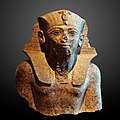 |
Menkheperure | Thutmose IV | Famous for his Dream Stele. Son of Amenhotep II. Ruled during the height of Egypt's Power. | 1400–1390 BC
|
 |
Nebmaatre | Amenhotep III | Father of Akhenaten and grandfather of Tutankhamun. Ruled Egypt at the height of its power. Built many temples and monuments, including his enormous Mortuary Temple. Was the son of Thutmose IV. | 1390–1352 BC
|
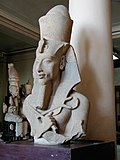 |
Neferkheperure Waenre | Akhenaten (originally Amenhotep IV) | Founder of the Amarna Period in which he changed the state religion from the polytheistic Ancient Egyptian religion to the Monotheistic Atenism, centered around the worship of the Aten, an image of the sun disc. He moved the capital to Akhetaten. Was the second son of Amenhotep III. He changed his name from Amenhotep (Amun is pleased) to Akhenaten (Effective for the Aten) to reflect his religion change. | 1352–1336 BC
|
 |
Ankhkheperure | Smenkhkare Djeserkheperu | Married to Meritaten, daughter of Akhenaten. Identity and sex of Smenkhare is uncertain, with suggestions they were either male relative of Akhenaten, or Queen Nefertiti, main wife of Akhenaten, who took ceremonial male identity as King. It's unknown if Smenkhkare ever was sole ruler, or if they died as co-regent of Akhenaten.[144] | |
| Ankhetkheperure Merwaenre | Nefernefruaten Akhetenhyes | Female pharaoh. Speculated to be former queen consort Neferneferuaten Nefertiti, because of name similarity. Often supposed to have been the same person as Smenkhkare, as they shared the same throne name; most scholars now see Neferneferuaten as ruling queen, while Smenkhkare was a male king. | 1336–1332 BC[147]
| |
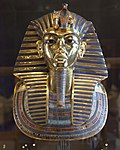 |
Nebkheperure | Tutankhamun (originally Tutankhaten) | Believed to be a son of Akhenaten.[148] He reinstated the polytheistic Ancient Egyptian religion. His name change from Tutankhaten to Tutankhamun reflects the change in religion from the monolatristic Atenism to the classic religion, of which Amun is a major deity. He is thought to have taken the throne at around age eight or nine and to have died around age eighteen or nineteen. | 1332–1323 BC[149]
|
 |
Kheperkheperure Irmaat | Ay II Itnetjer | Was Grand Vizier to Tutankhamun and an important official during the reigns of Akhenaten and Smenkhkare. Possibly the brother of Tiye, Great Wife of Amenhotep III, and also possibly father of Nefertiti, Great Wife of Akhenaten. Believed to have been born into nobility, but not royalty. Succeeded Tutankhamun due to his lack of an heir. | 1323–1320 BC[150]
|
 |
Djeserkheperure Setepenre | Horemheb | Born a Commoner. Was a General during the Amarna Period. Obliterated Images of the Amarna Pharaohs and destroyed and vandalized buildings and monuments associated with them. Succeeded Ay despite Nakhtmin being the intended heir. | 1320–1292 BC
|
Nineteenth Dynasty
[edit]The Nineteenth Dynasty ruled from 1292 to 1186 BC and includes one of the most famous pharaohs: Ramesses II the Great.
| Image | Throne name | Personal name | Comments | Reign |
|---|---|---|---|---|
 |
Menpehtire | Ramesses I[151] | Already Grand Vizier, of non-royal birth. Succeeded Horemheb due to his lack of an heir. | 1292–1290 BC
|
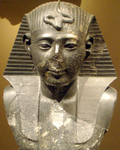 |
Menmaatre | Seti I Merneptah | Regained much of the territory that was lost under the reign of Akhenaten. | 1290–1279 BC
|
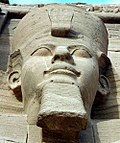 |
Usermaatre Setepenre (Ozymandias) | Ramesses II Meriamun (Ramesses the Great) | Continued expanding Egypt's territory until he reached a stalemate with the Hittite Empire at the Battle of Kadesh in 1275 BC, after which the famous Egyptian–Hittite peace treaty was signed in 1258 BC. Had one of the longest Egyptian reigns. Known for his large scale construction projects, including many now famous monuments. | 1279–1213 BC
|
 |
Baenre Meriamun | Merneptah Hetephirmaat[152] | Thirteenth son of Ramesses II. | 1213–1203 BC
|
 |
Userkheperure Setepenre | Seti II Merneptah[153] | Son of Merneptah. May have had to overcome a contest by Amenmesse before he could solidify his claim to the throne. | 1204–1198 BC
|
 |
Menmire Setepenre | Amenmesse Heqawast | Most likely a rival king ruling in Upper Egypt in opposition to Seti II. Suggested son of Merneptah. | 1203–1200 BC
|
 |
Akhenre (originally Sekhaenre) Setepenre | Siptah Merneptah (originally Ramesses Siptah)[154] | Possibly son of Seti II or Amenmesse, ascended to throne at a young age.[155] | 1198–1192 BC
|
 |
Sitre Meritamun | Tausret Setepetenmut | Seti II's widow, initially regent for Pharaoh Siptah, then briefly sole Pharaoh.[156] Also known as Twosret or Tawosret. | 1192–1190 BC
|
Twentieth Dynasty
[edit]The Twentieth Dynasty ruled from 1190 to 1077 BC:
| Image | Throne name | Personal name | Comments | Reign |
|---|---|---|---|---|
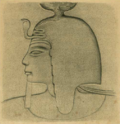 |
Userkhaure Setepenre Meriamun | Setnakhte Mereramun | Not related to Seti II, Siptah, or Tausret. May have usurped the throne from Tausret. Did not recognize Siptah or Tausret as legitimate rulers. Possibly a member of a minor line of the Ramesside royal family. Also called Setnakt. | 1190–1186 BC
|
 |
Usermaatre Meriamun | Ramesses III Heqaiunu | Son of Setnakhte. Fought the Sea Peoples in 1175 BC. assassinated in Harem conspiracy. | 1186–1155 BC
|
 |
Heqamaatre (originally Usermaatre) Setpenamun | Ramesses IV Heqamaat Meriamun | Son of Ramesses III. During his reign, Egyptian power started to decline. | 1155–1149 BC
|
 |
Usermaatre Sekheperenre | Ramesses V Amenhirkhepshef Meriamun | Son of Ramesses IV | 1149–1145 BC
|
 |
Nebmaatre Meriamun | Ramesses VI Amenhirkhepshef Netjerheqaiunu | Son of Ramesses III. Brother of Ramesses IV. Uncle of Ramesses V. | 1145–1137 BC
|
 |
Usermaatre Setpenre Meriamun | Ramesses VII Itamun Netjerheqaiunu | Son of Ramesses VI. | 1137–1130 BC
|
 |
Usermaatre Akhenamun | Ramesses VIII Sethirkhepshef Meriamun | An obscure Pharaoh, who reigned only around a year. Identifiable with Prince Sethiherkhepeshef II. Son of Ramesses III. Brother of Ramesses IV and Ramesses VI. Uncle of Ramesses V and Ramesses VII. He is the sole pharaoh of the Twentieth Dynasty whose tomb has not been found. | 1130–1129 BC
|
 |
Neferkare Setpenre | Ramesses IX Khaemwast Mereramun | Probably grandson of Ramesses III through his father, Montuherkhopshef. First cousin of Ramesses V and Ramesses VII. | 1129–1111 BC
|
 |
Khepermaatre Meriamun | Ramesses X Amenhirkhepshef Meriamun[157] | Possibly a son of Ramesses X. A poorly documented Pharaoh, his reign was about 3 years long, though previously estimated at 10 years. | 1111–1107 BC
|
 |
Menmaatre Setepenptah | Ramesses XI Khaemwast Mereramun Netjerheqaiunu[158] | Possibly the son of Ramesses X. During the second half of his reign, High Priest of Amun Herihor ruled over the south from Thebes, limiting his power to Lower (Northern) Egypt. He was eventually succeeded in the north by Smendes, possibly after an intervening reign. | 1107–1075 BC
|
 |
Usermaatre Heqawast | Ramesses XII Mereramun[159] | Possibly a son and successor of Ramesses XI, ruling before the succession of Herihor in the south and Smendes in the north. | 1075–1069 BC
|
Third Intermediate Period
[edit]The Third Intermediate Period (1069–664 BC) marked the end of the New Kingdom after the collapse of the Egyptian empire at the end of the Bronze Age. Two dynasties of Libyan origin ruled, giving this period its alternative name of the Libyan Period.
Twenty-First Dynasty
[edit]The Twenty-First Dynasty was based at Tanis and was a relatively weak group. Theoretically, they were rulers of all Egypt, but in practice their influence was limited to Lower Egypt. They ruled from 1069 to 943 BC.[160]
| Image | Throne name | Personal name | Comments | Reign |
|---|---|---|---|---|
|
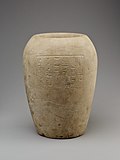
Hedjkheperre Setpenre | Nesbanebdjed Meriamun[161] (Smendes I) | Married to Tentamun, possible daughter of Ramesses XI. | 1069–1043 BC |

|
Neferkare Heqawast | Amenemnisu Meriamun | Obscure four-year reign. | 1043–1039 BC |

|
Aakheperre Setepenamun | Pasebakhenniut I (Psusennes I) Meriamun | Son of Pinedjem I, a High Priest of Amun and Pharaoh. Ruled for 40 to 51 years. Famous for his intact tomb at Tanis. Known as "The Silver Pharaoh" due to the magnificent silver coffin he was buried in. One of the most powerful rulers of the Dynasty. | 1039–991 BC |

|
Usermaatre Setepenamun | Amenemope Meriamun | Probably son of Psusennes I. | 991–981 BC |

|
Aakheperre Setepenre | Osorkon Meriamun (Osochor) | Son of Shoshenq A, Great Chief of the Meshwesh (Libya). | 981–975 BC |

|
Netjerikheperre Setpenamun | Siamun | Unknown Origins. Built extensively for a third intermediate period Pharaoh. One of the most powerful rulers of the dynasty. | 975–957 BC |

|
Titkheperre Setepenre | Pasebakhenniut II (Psusennes II Meriamun) | Possibly son of Siamun. | 957–943 BC |
Theban High Priests of Amun
[edit]The High Priests of Amun at Thebes were the de facto rulers of Upper Egypt during the Twenty-first dynasty, writing their names in cartouches and being buried in royal tombs.[162]
| Image | Throne name | Personal name | Comments | Reign |
|---|---|---|---|---|
 |
— | Piankh | Previously believed to have governed after Herihor. | 1085–1079 BC |
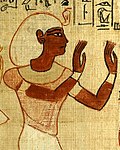 |
Hemnetjertepienamun | Herihor Siamun | Previously believed to have governed before Piankh. Eventually adopted royal titulary at Thebes, thus becoming ruler in the South and alongside the Tanite pharaoh in the North.[163] | 1079–1068 BC |
 |
Khakheperre Setepenamun | Pinedjem I Meriamun | Son of Piankh and successor of Herihor. Father of Psusennes I. High Priest for many years, eventually gave his seat to his son Masaharta, and declared himself king.[164] | 1063–1054 BC (High Priest)
1054–1031 BC (Pharaoh)[164] |
 |
— | Masaharta | Son of Pinedjem I. | 1054–1046 BC |
| — | Djedkhonsuefankh | Son of Pinedjem I. | 1046–1045 BC | |
 |
Usermaatre | Menkheperre | Son of Pinedjem I. Temporary (?) assumption of kingship after father's death. | 1045–990 BC |
 |
— | Nesbanebdjed II (Smendes II) | Son of Menkheperre. | 990–988 BC |
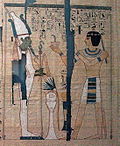 |
— | Pinedjem II | Son of Menkheperre, Father of Psusennes II. | 988–967 BC |
| — | Titkheprure | Hemnetjertepienamun Pasebakhaennuit (Psusennes III) | Son of Pinedjem II. Not the same person as King Psusennes II. | 967–post 957 BC |
Twenty-Second Dynasty
[edit]The pharaohs of the Twenty-Second Dynasty were Libyans, ruling from c. 943 to 731 BC.[165]
| Image | Throne name | Personal name | Comments | Reign |
|---|---|---|---|---|

|
Hedjkheperre Setpenre | Shoshenq I Meriamun | Son of Nimlot A, a brother of Osorkon the Elder and a Great Chief of the Meshwesh (Libyans). Possibly the biblical Shishaq | 943–922 BC |

|
Sekhemkheperre Setepenre | Osorkon I Meriamun | Son of Shoshenq I. | 922–887 BC |
|
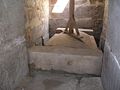
Hedjkheperre Setepenre | Takelot I Meriamun | Son of Osorkon I. | 887–874 BC |
|
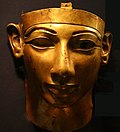
Heqakheperre Setepenre | Shoshenq IIa Meriamun | Obscure pharaoh, placement and identification uncertain. | 880s BC? |
| — | Tutkheperre Setepenre | Shoshenq IIb Meriamun | Obscure pharaoh, placement and identification uncertain. | 880s BC? |
| — | Maatkheperre Setepenre | Shoshenq IIc Meriamun | Obscure pharaoh, placement and identification uncertain. | 880s BC? |

|
Hedjkheperre Setepenamun | Harsiese Meriamun | An obscure rival pharaoh at Thebes. | 880–860 BC? |
|
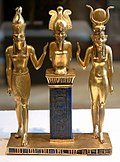
Usermaatre Setpenamun | Osorkon II Sibaste Meriamun | Son of Takelot I. | 873–830 BC |

|
Usermaatre Setpenre | Shoshenq III Sibaste Meriamun | — | 830–post 791 BC |
|
Hedjkheperre Setepenre | Shoshenq IV Sibaste Meriamun Netjerheqaiunu | — | ante 788–778 BC |

|
Usermaatre Setpenre | Pami I Sibaste Meriamun | — | 778–769 BC |
|
Aakheperre Setepenre | Shoshenq V Sibaste Meriamun Netjerheqawast | Son of Pami I | 769–731 BC |
Twenty-Third Dynasty
[edit]The designation Twenty-Third Dynasty is applied variously by scholars to branches of the Twenty-Second Dynasty ruling in mostly Upper Egypt (at least intermittently at Thebes), to various local rulers based at Herakleopolis, Hermopolis, Leontopolis, and to a line of kings who succeeded the Twenty-Second Dynasty at Tanis, all of Libyan origin.[166]
Upper Egyptian lines
[edit]| Image | Throne name | Personal name | Comments | Reign |
|---|---|---|---|---|

|
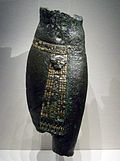
Hedjkheperre Setpenre | Takelot II Siese Meriamun | Previously thought to be a 22nd Dynasty pharaoh, he is now known to be the founder of the 23rd. | 834–809 BC |
|
Usermaatre Setpenamun | Pedubast I Sibaste Meriamun | A rival king, who seized Thebes from Takelot II. | 822–799 BC |
| — | — | Iuput I Siese Meriamun | Contemporary with Pedubast I; apparent successor to Takelot II | 809–798 BC |
| — | Usermaatre Meryamun | Shoshenq VI Meriamun | Successor to Pedubast I. | 799–793 BC |
|
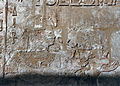
Usermaatre Setpenamun | Osorkon III Siese Meriamun | Son of Takelot II; recovered Thebes, then proclaimed himself king. | 791–764 BC |

|
Usermaatre Setpenamun | Takelot III Siese Meriamun | Co-ruler with his father Osorkon III for the first five years of his reign. | 768–756 BC |

|
Usermaatre Setpenamun | Rudamun Meriamun | Younger son of Osorkon III and brother of Takelot III. | 756–750 BC |
| — | Uasnetjerre/Hedjkheperre Setepenre | Shoshenq VII Saisetmeriamun | A poorly attested king, whose existence is disputed. | — |

|
Menkheperre | Ini Siese Meriamun | Reigned at Thebes and Abydos; possibly a contemporary of the 25th Dynasty. | 750–745 BC |
Rulers of Hermopolis, order uncertain:
| Image | Throne name | Personal name | Comments | Reign |
|---|---|---|---|---|
| — | Neferkheperre | Djehutyemhat | Possibly reigned after Nimlot I. | 745–735 BC? |
| — | — | Nimlot I | Possibly reigned before Djehutyemhat; submitted to Piye. | 745–735 BC? |
Rulers of Herakleopolis:
| Image | Throne name | Personal name | Comments | Reign |
|---|---|---|---|---|
| — | Neferkare | Peftjauawybast | Submitted to Piye | 750–720 BC? |
Rulers of Leontopolis:
| Image | Throne name | Personal name | Comments | Reign |
|---|---|---|---|---|

|
Usermaatre Setepenre | Iuput II Sibaste Meriamun | Submitted to Piye | 730–710 BC? |
Tanite Twenty-Third Dynasty
[edit]| Image | Throne name | Personal name | Comments | Reign |
|---|---|---|---|---|
| — | Sehetepibre | Pedubast II | Probable successor of Shoshenq V; throne name identification varies among scholars. | 731–725 BC? |

|
Usermaatre | Osorkon IV | Submitted to Piye and treated with Assyrians; suppressed by the 24th Dynasty? | 725–716 BC? |
| — | Neferkare | Pami II | Suppressed by the 25th Dynasty? | 712–702 BC? |
| — | Shepseskare Irenre | Gemenefkhonsbak | Local ruler of Tanis. | uncertain |
| — | Sekhemkare | — | Local ruler of Tanis. | uncertain |
| — | — | Pedubast III | Assyrian vassal. | fl. in 670–667 BC |
Twenty-Fourth Dynasty
[edit]The Twenty-fourth Dynasty was a short-lived rival dynasty located in the western Delta (Sais), with only two rulers ruling from 731 to 712 BC.[167]
| Image | Throne name | Personal name | Comments | Reign |
|---|---|---|---|---|

|
Shepsesre | Tefnakhte | Assumption of kingship disputed (King Shepsesre Tefnakhte could belong in the early 26th Dynasty) | 731–717 BC |

|
Wahkare | Bakenrenef (Bocchoris) | Son of Tefnakhte. Asserted his rule over Memphis and Tanis but eliminated by Shebitku | 717–712 BC |
Twenty-Fifth Dynasty
[edit]Nubians invaded Lower Egypt and took the throne of Egypt under Piye although they already controlled Thebes and Upper Egypt in the early years of Piye's reign. Piye's conquest of Lower Egypt established the Twenty-fifth Dynasty which ruled until 656 BC.[168]
| Image | Throne name | Personal name | Comments | Reign |
|---|---|---|---|---|
|
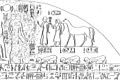
Usermaatre | Piye | King of Nubia; conquered Egypt in his 20th year; full reign at least 24 years, possibly 30+ years | 743–713 BC, according to Frédéric Payraudeau[169] |
|
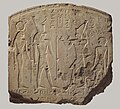
Djedkaure | Shebitku | Believed to be Shabaka's successor until the 2010s | 713–705 BC, according to Frédéric Payraudeau[169] |
|
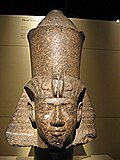
Neferkare | Shabaka | Believed to be Shebitku's predecessor until the 2010s | 705–690 BC, according to Frédéric Payraudeau[169] |

|
Khuinefertemre | Taharqa | Died in 664 BC | 690–664 BC[170] |

|
Bakare | Tantamani | Lost control of Upper Egypt in 656 BC when Psamtik I extended his authority into Thebes in that year. | 664–653 BC |
They were ultimately driven back into Nubia, where they established a kingdom at Napata (656–590), and, later, at Meroë (590 BC – AD 500).
Late Period
[edit]The Late Period runs from c. 664 to 332 BC, and includes periods of rule by native Egyptians and Persians.
Twenty-Sixth Dynasty
[edit]The Twenty-sixth Dynasty ruled from c. 664 to 525 BC.[171]
| Image | Throne name | Personal name | Comments | Reign |
|---|---|---|---|---|

|
Menibre? Iribre? | Tefnakht II (Stephinates) | Manetho's Stephinates. May have been a descendant of the Twenty-fourth Dynasty. The father of Necho I. | 685–678 BC |
| — | — | Nekauba (Nechepsos) | Manetho's Nechepsos. His existence has been questioned. | 678–672 BC |

|
Menkheperre | Nekau I (Necho I) | Was killed by an invading Kushite force in 664 BC under Tantamani. Father of Psamtik I. | 672–664 BC |
The son and successor of Nekau I, Psamtik I, managed to reunify Egypt and is generally regarded as the founder of the Twenty-sixth Dynasty.
| Image | Throne name | Personal name | Comments | Reign |
|---|---|---|---|---|

|
Wahibre | Psamtik I (Psammetichus I) | Reunified Egypt. Son of Necho I and father of Necho II. | 664–610 BC[172] |

|
Wehemibre | Nekau II (Necho II) | Most likely the pharaoh mentioned in several books of the Bible and the death of Josiah. Son of Psamtik I and father of Psamtik II. | 610–595 BC[172] |

|
Neferibre | Psamtik II (Psammetichus II) | Son of Necho II and father of Apries. | 595–589 BC[172] |

|
Haaibre | Wahibre (Apries) | Fled Egypt after Amasis II (who was a general at the time) declared himself pharaoh following a civil war. Son of Psamtik II. | 589–570 BC[172] |
|
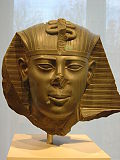
Khnemibre | Ahmose II (Amasis II) | He was the last great ruler of Egypt before the Persian conquest. According to the Greek historian Herodotus, he was of common origins. Father of Psamtik III. | 570–526 BC[172] |

|
Ankhkaenre | Psamtik III (Psammetichus III) | Son of Amasis II. Ruled for about six months before being defeated by the Persians in the Battle of Pelusium and subsequently executed for attempting to revolt. | 526–525 BC[172] |
Twenty-Seventh Dynasty
[edit]Egypt was conquered by the Persian Empire in 525 BC by king Cambyses II, the son of Cyrus the Great, and remained Persian satrapy for more than one hundred years until regaining independence in 404 BC. The Achaemenid kings were acknowledged as Pharaohs in this era, forming the 27th Dynasty:
| Image | Throne name | Name | Comments | Reign |
|---|---|---|---|---|

|
Mesutre | Kembydjet (Cambyses II) | Defeated Psamtik III at the Battle of Pelusium at 525 BC. | 525–1 July 522 BC[172] |
| — | — | Bardiya (Smerdis) / Gaumata | Son of Cyrus the Great. | 522 BC[172] |

|
Seteture | Deriush (Darius I) | Ascended throne by overthrowing Gaumata[citation needed] | 522–November 486 BC[172] |

|
— | Kheshayarusha (Xerxes I) | Assassinated by Artabanus of Persia. | November 486–December 465 BC[172] |
| — | — | Artabanus the Hyrcanian | — | 465-464 BC |

|
— | Arutakhshashas (Artaxerxes I) | Died in 424 BC | 464–424 BC |
| — | — | Xerxes II | A claimant. | 424–423 BC[172] |
| — | — | Sogdianus | A claimant. | 423–July 423 BC[172] |

|
— | Darius II | Died in 404 BC | July 423–March 404 BC[172] |
Several native rebellions took place during the 27th dynasty:
| Image | Throne name | Personal name | Comments | Dates |
|---|---|---|---|---|

|
Seheruibre | Petubastis III[173] | A native Egyptian rebel in the Delta. | 522/21–520 BC |
| — | Ahmose? Nebkaenre? | Psammetichus IV[173] | A proposed native Egyptian rebel leader. Exact date uncertain. | Possibly in the 480s BC |
Twenty-Eighth Dynasty
[edit]The Twenty-eighth Dynasty lasted only 6 years, from 404 to 398 BC, with one pharaoh:
| Image | Name | Comments | Reign |
|---|---|---|---|

|
Amunirdisu (Amyrtaeus) | Descendant of the Saite pharaohs of the Twenty-sixth Dynasty; led a successful revolt against the Persians. | 404–398 BC |
Twenty-Ninth Dynasty
[edit]The Twenty-ninth Dynasty ruled from 398 to 380 BC:
| Image | Throne name | Personal name | Comments | Reign |
|---|---|---|---|---|

|
Baenre Merynetjeru | Nefaarud I (Nepherites I) | Also known as Nepherites. Defeated Amyrtaeus in open battle and had him executed. | 398–393 BC |

|
Khnemmaatre Setepenkhnemu | Hakor (Achoris) | Son of Nefaarud I. | c. 392–c. 391 BC |

|
Userre Setepenptah | Pasherienmut (Psammuthes) | Possibly dethroned Hakor for a year. | c. 391 BC |
|
|
Khnemmaatre Setepenkhnemu | Hakor (Achoris) | Retook the throne from Psammuthes. | c. 390–c. 379 BC |
| — | — | Nefaarud II (Nepherites II) | Was deposed and likely killed by Nectanebo I after ruling for only 4 months. Son of Hakor. | c. 379 BC |
| — | — | Muthis | Possible pharaoh attested in Eusebius's epitome; not known archaeologically and his chronological placement is disputed. | Possibly between 393 and 380 BC |
Thirtieth Dynasty
[edit]The Thirtieth Dynasty ruled from 379/8 until Egypt once more came under Persian rule c. 340 BC:[174][175]
| Image | Throne name | Personal name | Comments | Reign |
|---|---|---|---|---|

|
Kheperkare | Nekhtnebef (Nectanebo I) | Also known as Nekhtnebef. Deposed and likely killed Nefaarud II, starting the last dynasty of native Egyptians. Father of Teos. | 379/8–361/0 BC |

|
Irimaatenre | Djedher (Teos) | Co-regent with his father Nectanebo I from about 365 BC. Was overthrown by Nectanebo II with the aid of Agesilaus II of Sparta. | 361/0–359/8 BC |
|
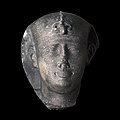
Snedjemibre Setepenanhur | Nakhthorhebyt Merihathor (Nectanebo II) | Last native ruler of ancient Egypt[176] to be recognized by Manetho. | 359/8–341/0 BC |
Thirty-First Dynasty
[edit]Egypt again came under the control of the Achaemenid Persians. After the practice of Manetho, the Persian rulers from 340 to 332 BC are occasionally designated as the Thirty-first Dynasty:
| Image | Name | Comments | Reign |
|---|---|---|---|

|
Artaxerxes III | Egypt came under Persian rule for the second time. Did not adopt any pharaonic titulary. | c. 341/339 – 338 BC[177] |

|
Artaxerxes IV Arses | Only reigned in Lower Egypt. Did not adopt any pharaonic titulary. | 338–336 BC |

|
Darius III | Upper Egypt returned to Persian control in 335 BC. His name, Deriush, was written in a cartouche as a pharaonic nomen would be. | 336–332 BC |
Native rebellions again took place during the 31st dynasty:
| Image | Throne name | Personal name | Comments | Dates |
|---|---|---|---|---|

|
Senensetepuniptah | Khababash | Rebel pharaoh who led an invasion in Nubia. | 338–335 BC[172] |
Hellenistic period
[edit]Argead Dynasty
[edit]The Macedonian Greeks under Alexander the Great ushered in the Hellenistic period with his conquest of Persia and Egypt. The Argeads ruled from 332 to 309 BC:
| Image | Throne name | Personal name | Comments | Reign |
|---|---|---|---|---|

|
Setpenre Meryamun | Aluksindres (Alexander the Great) | Formally Alexander III of Macedon conquered Persia and Egypt. | 332–13 June 323 BC[172] |

|
Setpenre Meryamun | Pelupuisa (Philip Arrhidaeus) | Formally Philip III of Macedon. Mentally disabled half-brother of Alexander the Great. | 323–317 BC |

|
Khaibre Setepenamun | Aluksindres (Alexander IV) | Formally Alexander IV of Macedon. Son of Alexander the Great and Roxana. | 317–309 BC |
Ptolemaic Dynasty
[edit]The second Hellenistic dynasty, the Ptolemies, ruled Egypt from 305 BC until Egypt became a province of Rome in 30 BC (whenever two dates overlap, that means there was a co-regency). The most famous member of this dynasty was Cleopatra VII, in modern times known simply as Cleopatra, who was successively the consort of Julius Caesar and, after Caesar's death, of Mark Antony, having children with both of them.
Cleopatra strove to create a dynastic and political union between Egypt and Rome, but the assassination of Caesar and the defeat of Mark Antony doomed her plans.[178]
Caesarion (Ptolemy XV Philopator Philometor Caesar) was the last king of the Ptolemaic Dynasty of Egypt, and he reigned jointly with his mother Cleopatra VII of Egypt, from September 2, 47 BC. He was the eldest son of Cleopatra VII, and possibly the only son of Julius Caesar, after whom he was named. Between the death of Cleopatra, on August 12, 30 BC, up to his own own death in late August 30 BC, he was nominally the sole pharaoh. Ultimately, he was killed on the orders of Octavian, who would become the Roman emperor Augustus. While younger children of Cleopatra did survive Egyptian-Roman war, Octavian denied them inheritance of Egypt.[179]
| Image | Throne name | Personal name | Comments | Reign |
|---|---|---|---|---|

|
Setpenre Meryamun | Ptolemy I Soter | — | 7 November 305 – January 282 BC[172] |
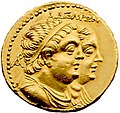
|
Weserkare Meryamun | Ptolemy II Philadelphos | — | 28 March 284 – 28 January 246 BC |

|
Iwaensenwinetjerwy Setepenre Sekhemankhenamun | Ptolemy III Euergetes | — | 28 January 246 – November/December 222 BC |

|
Iwaennetjerwymenekhwy Setepenptah Userkare Sekhemankhamun | Ptolemy IV Philopator | Died in unclear circumstances, possibly by fire in the palace or murder. | November/December 222 – July/August 204 BC |

|
Iwaennetjerwymer(wy)it Setepenptah Userkare Sekhemankhamun | Ptolemy V Epiphanes | Upper Egypt in revolt 207–186 BC | July/August 204 – September 180 BC |
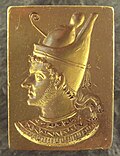
|
Iwaennetjerwyperu Setepenptahkheperi Irymaatamunre | Ptolemy VI Philometor | Lived under the control of Ptolemy VIII 164 BC–163 BC; restored 163 BC Died 145 BC | c. May 180 – October 164 BC[172]and
163 – c. July 145 BC[172] |

|
— | Cleopatra II | Wife of Ptolemy VI. Married Ptolemy VIII c. 145 BC; led revolt against him in 131 BC and became sole ruler of Egypt. Later reconciled with Ptolemy VIII; co-ruled with Cleopatra III and Ptolemy VIII until 116 BC. | 170 – October 164 BC
and 163–127 BC and 124–116 BC |

|
Iwaennetjerwyperwy Setepenptah Irymaatre Sekhemankhenamun | Ptolemy VIII Physcon | Proclaimed king by Alexandrians in 170 BC; ruled jointly with Ptolemy VI Philometor and Cleopatra II from 169 to 164 BC. Restored 145–131 BC and again in 127 BC. Died 116 BC | 171–163 BC
and 145–131 BC and 127–116 BC |
| — | — | Ptolemy Eupator | Son of Ptolemy VI and Cleopatra II, made co-regent but did later the same year | 152 BC |
| — | Panetjerhunu Meriyetef | Ptolemy VII Neos Philopator | Traditionally identified with a surviving son of Ptolemy VI who existed but never ruled; the posthumous designation Ptolemy VII Neos Philopator was probably applied to Ptolemy Memphites (below) | 145 BC (supposedly) |

|
— | Cleopatra III | Second wife of Ptolemy VIII. Restored with Ptolemy VIII in 127 BC; later co-regent with Ptolemy IX and X. Murdered by her own son Ptolemy X. | 142–131 BC
and 127–107 BC |
| — | — | Ptolemy Memphites | Probably posthumously Ptolemy VII Neos Philopator; possibly proclaimed King by mother Cleopatra II; soon killed by father Ptolemy VIII | 131 BC |
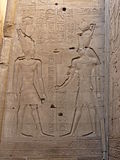
|
Iwa(en)netjermenekhnetjeretmeretmutesnedjet(et) Setepenptah Irimaatre Sekhemankhamun | Ptolemy IX Soter | Died 80 BC | 28 June 116–October 110 BC
and 88-81 BC[172] |

|
Iwa(en)netjermenekhenetjeretmenkhetre Setepenptah Irimaatre Senenankhenamun | Ptolemy X Alexander | Died 88 BC | October 110–February 109 BC
and 107-88 BC[172] |

|
— | Berenice III | Forced to marry Ptolemy XI; murdered on his orders 19 days later | 81–80 BC |
| — | Ptolemy XI Alexander | Young son of Ptolemy X Alexander; installed by Sulla; ruled for 80 days before being lynched by citizens for killing Berenice III | 80 BC[172] | |

|
Iwaenpanetjernehem Setepenptah Irimaatenre Sekhemankhamen | Ptolemy XII Auletes | Son of Ptolemy IX; deposed in 58 BC, then restored in 55 BC. | 80–58 BC[172]
and 55–51 BC[172] |

|
— | Cleopatra V Tryphaena | Wife of Ptolemy XII, mother of Berenice IV | 79–68 BC |
|
|
— | Cleopatra VI | Supposed daughter of Ptolemy XII, theorised by some Egyptologists to actually be the same person as Cleopatra V.[180] | 58–57 BC |

|
— | Berenice IV | Daughter of Ptolemy XII; forced to marry Seleucus Kybiosaktes, but had him strangled; later married Archelaos of Comana. Joint rule with Cleopatra VI until 57 BC. | 58–55 BC[172] |
| — | Ptolemy XIII Theos Philopator | Son and designated heir of Ptolemy XII Auletes alongside his sister Cleopatra. Supposedly drowned during Battle of the Nile (47 BC). | 51-47 BC | |
| — | Ptolemy XIV Philopator | Brother-husband and nominal co-ruler of Cleopatra. Died young, allegedly poisoned by his sister-wife.[181] | 47-44 BC | |

|
— | Cleopatra VII | Ruled jointly with her brother Ptolemy XIII, her brother Ptolemy XIV, and her son Ptolemy XV.[182] In modern usage, the stand-alone use of "Cleopatra" with no ordinal number usually refers to Cleopatra VII. Believed to have committed suicide. | 51[183] – 12 August 30 BC[172] |

|
— | Arsinoe IV | In opposition to Cleopatra VII | December 48 – January 47 BC |

|
Iwapanetjernetynehem Setepenptah Irimaatre Sekhem(ankh)enamun | Ptolemy XV Caesar | Eldest son of Cleopatra VII; aged 3 when proclaimed co-ruler with Cleopatra. Last known ruler of ancient Egypt when Rome took over. | 2 September 44 – late August 30 BC |
Native rebellions also took place under Greek rule:
| Image | Throne name | Personal name | Comments | Reign |
|---|---|---|---|---|
| — | — | Hugronaphor | Revolutionary pharaoh in the South | 205–199 BC |
| — | — | Ankhmakis | Revolutionary pharaoh in the South | 199–185 BC |
| — | — | Harsiesi | Revolutionary pharaoh in the South | 131–130 BC |
Queens considered Pharaohs by Sally-Ann Ashton:[184]
| Image | Throne name | Personal name | Comments | Reign |
|---|---|---|---|---|

|
Khenem(et)ibenmaat Mer(et)netjru | Arsinoe II | Wife of Ptolemy II | c. 277 – July 270 BC[172] |
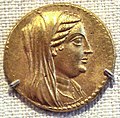
|
— | Berenice II | Wife of Ptolemy III. Murdered. | 244/243 – 222 BC |

|
— | Arsinoe III | Wife of Ptolemy IV. Murdered. | 220–204 BC |

|
— | Cleopatra I Syra | Wife of Ptolemy V, regent of her son Ptolemy VI during his minority. Possible nominal co-ruler with her husband and son. | c. February 193 – 176 BC[172] |
Rome
[edit]
Cleopatra VII had affairs with Roman dictator Julius Caesar and Roman general Mark Antony, but it was not until after her suicide (after Mark Antony was defeated by Octavian, who would later be Emperor Augustus Caesar) that Egypt became a province of the Roman Republic in 30 BC. Subsequent Roman emperors were accorded the title of pharaoh, although exclusively only while in Egypt.
The last Roman emperor to be conferred the title of pharaoh was Maximinus Daza (reigned 311–313 AD).[3][185]
See also
[edit]

- Egyptian chronology
- History of Egypt
- List of Ancient Egyptian Royal Consorts
References
[edit]- ^ a b Clayton 1995, p. 217. "Although paying lip-service to the old ideas and religion, in varying degrees, pharaonic Egypt had in effect died with the last native pharaoh, Nectanebo II in 343 BC."
- ^ Tyldesley, Joyce (2009). Cleopatra: Last Queen of Egypt. Profile Books. pp. 20–21. ISBN 978-1861979018.
The Ptolemies believed themselves to be a valid Egyptian dynasty, and devoted a great deal of time and money to demonstrating that they were the theological continuation of all the dynasties that had gone before. Cleopatra defined herself as an Egyptian queen, and drew on the iconography and cultural references of earlier queens to reinforce her position. Her people and her contemporaries accepted her as such.
- ^ a b von Beckerath, Jürgen (1999). Handbuch der ägyptischen Königsnamen. Verlag Philipp von Zabern. pp. 266–267. ISBN 978-3422008328.
- ^ "Digital Egypt for Universities". www.ucl.ac.uk. Retrieved 2019-02-12.
- ^ Toby A. H. Wilkinson: Royal Annals Of Ancient Egypt. Routledge, London 2012, ISBN 1-136-60247-X, p. 50.
- ^ Toby A. H. Wilkinson: Royal Annals Of Ancient Egypt. Routledge, London 2012, ISBN 1-136-60247-X, p. 61.
- ^ Cervello-Autuori, Josep (2003). "Narmer, Menes and the Seals from Abydos". In Hawass, Zahi (ed.). Egyptology at the Dawn of the Twenty-first Century: Proceedings of the Eighth International Congress of Egyptologists, 2000. Vol. 2. Cairo: American University in Cairo Press. pp. 168–75. ISBN 978-977-424-714-9.
- ^ Baker, Darrell D. (2008). Encyclopedia of the Pharaohs Volume 1: Predynastic to the Twentieth Dynasty 3300-1069 BC. Egypt: The American University in Cairo Press. p. 298. ISBN 978-977-416-221-3.
- ^ a b Thomas Schneider: Lexikon der Pharaonen. Albatros, Düsseldorf 2002, ISBN 3-491-96053-3, p. 259.
- ^ Thomas Schneider: Lexikon der Pharaonen. Albatros, Düsseldorf 2002, ISBN 3-491-96053-3, p. 139.
- ^ Thomas Schneider: Lexikon der Pharaonen. Albatros, Düsseldorf 2002, ISBN 3-491-96053-3, p. 199.
- ^ Thomas Schneider: Lexikon der Pharaonen. Albatros, Düsseldorf 2002, ISBN 3-491-96053-3, p. 138.
- ^ Thomas Schneider: Lexikon der Pharaonen. Albatros, Düsseldorf 2002, ISBN 3-491-96053-3, p. 181.
- ^ Thomas Schneider: Lexikon der Pharaonen. Albatros, Düsseldorf 2002, ISBN 3-491-96053-3, p. 311.
- ^ a b Thomas Schneider: Lexikon der Pharaonen. Albatros, Düsseldorf 2002, ISBN 3-491-96053-3, p. 137.
- ^ Baker, Darrell D. (2008). Encyclopedia of the Pharaohs Volume 1: Predynastic to the Twentieth Dynasty 3300-1069 BC. Egypt: The American University in Cairo Press. p. 3. ISBN 978-977-416-221-3.
- ^ Baker, Darrell D. (2008). Encyclopedia of the Pharaohs Volume 1: Predynastic to the Twentieth Dynasty 3300-1069 BC. Egypt: The American University in Cairo Press. p. 288. ISBN 978-977-416-221-3.
- ^ Wilke, Matthias (2015-04-22), "Emanuel Hirsch (1888 –1972) – "Jene zwei Göttinger Stiftsinspektorenjahre haben die Liebe zu Göttingen für immer in mir erweckt […] Aber […]", Stiftsgeschichte(n), Göttingen: Vandenhoeck & Ruprecht, pp. 187–196, doi:10.13109/9783666570377.187, ISBN 978-3-525-57037-1
- ^ Baker, Darrell D. (2008). Encyclopedia of the Pharaohs Volume 1: Predynastic to the Twentieth Dynasty 3300-1069 BC. Egypt: The American University in Cairo Press. p. 104. ISBN 978-977-416-221-3.
- ^ Felde, Rolf: Gottheiten, Pharaonen und Beamte im alten Ägypten, Norderstedt 2017, S. 125.
- ^ Baker, Darrell D. (2008). Encyclopedia of the Pharaohs Volume 1: Predynastic to the Twentieth Dynasty 3300-1069 BC. Egypt: The American University in Cairo Press. p. 5. ISBN 978-977-416-221-3.
- ^ a b c d Barry Kemp (a1), Andrew Boyce and James Harrell, The Colossi from the Early Shrine at Coptos in Egypt, in: Cambridge Archaeological Journal Volume 10, Issue 2 April 2000, 233
- ^ Altenmüller, Hartwig; Kloth, Nicole (January 1, 2008). Studien zur Altägyptischen Kultur Band 37. Helmut Buske Verlag. ISBN 978-3-87548-937-8 – via Google Books.
- ^ Ludwig David Morenz: Bild-Buchstaben und symbolische Zeichen. Die Herausbildung der Schrift der hohen Kultur Altägyptens (= Orbis Biblicus et Orientalis 205). Fribourg 2004, ISBN 3-7278-1486-1, p. 91.
- ^ "Aufstand gegen den Tod". Der Spiegel. 24 December 1995.
- ^ "Pharaonenliste 1". nefershapiland.de.
- ^ Günter Dreyer: Horus Krokodil, ein Gegenkönig der Dynastie 0. In: Renee Friedman and Barbara Adams (Hrsg.): The Followers of Horus, Studies dedicated to Michael Allen Hoffman, 1949–1990 (= Egyptian Studies Association Publication, vol. 2). Oxbow Publications, Bloomington (IN) 1992, ISBN 0-946897-44-1, p. 259–263.
- ^ P. Tallet, D. Laisnay: Iry-Hor et Narmer au Sud-Sinaï (Ouadi 'Ameyra), un complément à la chronologie des expéditios minière égyptiene. In: Bulletin de L'Institute Français D'Archéologie Orientale (BIFAO) 112. Ausgabe 2012, S. 381–395.
- ^ Jürgen von Beckerath: Handbuch der ägyptischen Königsnamen (= Münchner ägyptologische Studien, vol. 49. von Zabern, Mainz 1999, ISBN 3-8053-2591-6, p. 36–37.
- ^ Toby Wilkinson: Early Dynastic Egypt: Strategy, Society and Security. Routeledge, London 1999, ISBN 0-415-18633-1, p. 38, 56 & 57.
- ^ Stewart, John (2006). African States and Rulers (Third ed.). London: McFarland. p. 77. ISBN 0-7864-2562-8.
- ^ a b c d e f g h i j k l m n o p q r s t Stewart, John (2006). African States and Rulers (Third ed.). London: McFarland. p. 81. ISBN 0-7864-2562-8.
- ^ a b Elizabeth BLOXAM; Wouter CLAES; Tiphaine DACHY; Maude EHRENFELD; Ashraf EL-SENUSSI; Chloé GIRARDI; James HARRELL; Thomas C. HEAGY; Stan HENDRICKX; Christiane HOCHSTRASSER-PETIT; Dirk HUYGE; Clara JEUTHE; Adel KELANY; Christian KNOBLAUCH; Béatrix MIDANT-REYNES; Norah MOLONEY; Aurélie ROCHE; Adel TOHAMEY (January 2014). "Who Was Menes?" (PDF). Archéo nil. 24: 59–92. doi:10.3406/arnil.2014.1071. S2CID 248280047. Retrieved 24 September 2022.
- ^ Toby A.H. Wilkinson (1999). Early Dynastic Egypt. Routledge. p. 67. ISBN 0-415-26011-6.
- ^ Baker, Darrell D. (2008). Encyclopedia of the Pharaohs Volume 1: Predynastic to the Twentieth Dynasty 3300-1069 BC. Egypt: The American University in Cairo Press. p. 7. ISBN 978-977-416-221-3.
- ^ a b Toby A.H. Wilkinson (1999). Early Dynastic Egypt. Routledge. p. 71. ISBN 0-415-26011-6.
- ^ Baker, Darrell D. (2008). Encyclopedia of the Pharaohs Volume 1: Predynastic to the Twentieth Dynasty 3300-1069 BC. Egypt: The American University in Cairo Press. p. 92. ISBN 978-977-416-221-3.
- ^ Wolfgang Helck: Untersuchungen zur Thinitenzeit (= Ägyptologische Abhandlungen (ÄA), Vol. 45). Harrassowitz, Wiesbaden 1987, ISBN 3-447-02677-4, p. 124.
- ^ Baker, Darrell D. (2008). Encyclopedia of the Pharaohs Volume 1: Predynastic to the Twentieth Dynasty 3300-1069 BC. Egypt: The American University in Cairo Press. p. 95. ISBN 978-977-416-221-3.
- ^ Toby A.H. Wilkinson (1999). Early Dynastic Egypt. Routledge. p. 73. ISBN 0-415-26011-6.
- ^ a b Wolfgang Helck: Untersuchungen zur Thinitenzeit (Agyptologische Abhandlungen), ISBN 3-447-02677-4, O. Harrassowitz (1987), p. 124
- ^ Baker, Darrell D. (2008). Encyclopedia of the Pharaohs Volume 1: Predynastic to the Twentieth Dynasty 3300-1069 BC. Egypt: The American University in Cairo Press. p. 78. ISBN 978-977-416-221-3.
- ^ a b Toby A.H. Wilkinson (1999). Early Dynastic Egypt. Routledge. p. 75. ISBN 0-415-26011-6.
- ^ Toby A.H. Wilkinson (1999). Early Dynastic Egypt. Routledge. p. 77. ISBN 0-415-26011-6.
- ^ Quiles, Anita; Tristant, Yann (April 2023). "Radiocarbon-Based Modeling of the Reign of King Den (1st Dynasty, Egypt) and the Start of the Old Kingdom". Radiocarbon. 65 (2): 485–504. Bibcode:2023Radcb..65..485Q. doi:10.1017/RDC.2023.15. ISSN 0033-8222.
- ^ Baker, Darrell D. (2008). Encyclopedia of the Pharaohs Volume 1: Predynastic to the Twentieth Dynasty 3300-1069 BC. Egypt: The American University in Cairo Press. p. 55. ISBN 978-977-416-221-3.
- ^ Nicolas-Christophe Grimal: A History of Ancient Egypt. Blackwell, Oxford UK / Cambridge USA 1992, ISBN 978-0-631-19396-8, p. 53.
- ^ Baker, Darrell D. (2008). Encyclopedia of the Pharaohs Volume 1: Predynastic to the Twentieth Dynasty 3300-1069 BC. Egypt: The American University in Cairo Press. p. 376. ISBN 978-977-416-221-3.
- ^ Toby A.H. Wilkinson (1999). Early Dynastic Egypt. Routledge. p. 79. ISBN 0-415-26011-6.
- ^ Baker, Darrell D. (2008). Encyclopedia of the Pharaohs Volume 1: Predynastic to the Twentieth Dynasty 3300-1069 BC. Egypt: The American University in Cairo Press. p. 299. ISBN 978-977-416-221-3.
- ^ Wilkinson (1999) pp. 83–84
- ^ a b c Toby A.H. Wilkinson (1999). Early Dynastic Egypt. Routledge. p. 83. ISBN 0-415-26011-6.
- ^ Dietrich Wildung: Die Rolle ägyptischer Könige im Bewußtsein ihrer Nachwelt. Teil I. Posthume Quellen über die Könige der ersten vier Dynastien. In: Münchener Ägyptologische Studien, vol. 17. Deutscher Kunstverlag, Munich/Berlin 1969, p. 31–33.
- ^ Wilkinson (1999) p. 79
- ^ Wilkinson (1999) pp. 87–88
- ^ Pascal Vernus, Jean Yoyotte, The Book of the Pharaohs, Cornell University Press 2003, p. 27
- ^ Jürgen von Beckerath: Handbuch der ägyptischen Königsnamen. Deutscher Kunstverlag, Munich/Berlin 1984, ISBN 3-422-00832-2, p. 171.
- ^ Toby A. H. Wilkinson: Early Dynastic Egypt. Routledge, London/New York 2002, ISBN 1-134-66420-6, p. 75–76.
- ^ Jürgen von Beckerath: Handbuch der ägyptischen Königsnamen. 2. verbesserte und erweiterte Auflage. von Zabern, Mainz 1999, S. 44–45.
- ^ Thomas Schneider: Lexikon der Pharaonen. Albatros, Düsseldorf 2002, ISBN 3-491-96053-3, page 175.
- ^ Toby A.H. Wilkinson (1999). Early Dynastic Egypt. Routledge. p. 93. ISBN 0-415-26011-6.
- ^ Wilkinson, Toby (1999). Early Dynastic Egypt. Routledge. pp. 83 & 95. ISBN 0-415-18633-1.
- ^ Wilkinson, Toby. Royal Annals of Ancient Egypt. pp. 79 & 258.
- ^ "Pharaohs - Timeline Index". www.timelineindex.com. Retrieved 2020-03-23.
- ^ Clayton (1994) p.32
- ^ Lehner, Mark (1997). Geheimnis der Pyramiden (in German). Düsseldorf: Econ. pp. 94–96. ISBN 3-572-01039-X.
- ^ Clayton (1994) p.42
- ^ Thomas Schneider: Lexikon der Pharaonen. Albatros, Düsseldorf 2002, ISBN 3-491-96053-3, pp. 278–279.
- ^ Miroslav Verner (2000): "Who was Shepseskara, and when did he reign?", in: Miroslav Bárta, Jaromír Krejčí (editors): Abusir and Saqqara in the Year 2000, Academy of Sciences of the Czech Republic, Oriental Institute, Prague, ISBN 80-85425-39-4, p. 581–602, available online Archived 2011-02-01 at the Wayback Machine.
- ^ Dodson & Hilton (2004) p.73
- ^ Ryholt & Bardrum (2000) pp.87–100.
- ^ Jürgen von Beckerath: Handbuch der ägyptischen Königsnamen, Münchner ägyptologische Studien, Heft 49, Mainz : P. von Zabern, 1999, ISBN 3-8053-2591-6, available online Archived 2015-12-22 at the Wayback Machine
- ^ Kim Ryholt: "The Late Old Kingdom in the Turin King-list and the Identity of Nitocris", Zeitschrift für Ägyptische Sprache und Altertumskunde, 127, 2000, p. 99
- ^ Kamal, Ahmed Bey (1912). "Annales du Service des antiquités de l'Egypte". Journal des savants. 12: 132. doi:10.3406/jds.1913.4146. ISSN 0021-8103.
- ^ Gustave Jéquier, Maṣlaḥat al-Āthār (1993): Les pyramides des reines Neit et Apouit (in French), Cairo: Institut français d'archéologie orientale, OCLC 195690029, see plate 5.
- ^ Percy Newberry (1943): "Queen Nitocris of the Sixth Dynasty", in: The Journal of Egyptian Archaeology, vol. 29, pp=51–54
- ^ Gae Callender: "Queen Neit-ikrety/Nitokris", in: Miroslav Barta, Filip Coppens, Jaromic Krecji (editors): Abusir and Saqqara in the year 2010/1, Prague: Czech Institute of Egyptology, Faculty of Arts, Charles University, 2011, ISBN 978-80-7308-384-7, see pp. 249–250
- ^ a b Turin Kinglist, Columns IV,18 to V,10, Ancient Egypt dot org. Accessed 10 February 2010.
- ^ Lepsius, Karl (1859). Denkmaler aus Aegypten und Aethiopien. pp. 115h.
- ^ Breasted, James (1906). Ancient Records of Egypt (PDF). Vol. 1. The University of Chicago Press. p. 175.
- ^ Gauthier, Henri (1907). MIFAO 17 Le livre des rois d'Egypte Des origines à la fin de la XIIe dynastie. The French Institute of Oriental Archeology. pp. 143–144.
- ^ Couyat, Jean; Montet, Pierre (1912). MIFAO 34 Les inscriptions hieroglyphiques et hieratiques du Ouâdi Hammâmât (PDF). The French Institute of Oriental Archeology. pp. 96, 103–104 Plate=XXXIX.
- ^ Baker, Darrell (2008). The Encyclopedia of the Pharaohs. Predynastic to the Twentieth Century: 3300-1069 BCE. Vol. 1. Stacey International. p. 133. ISBN 978-1-905299-37-9.
- ^ Schenkel, Wolfgang (1965). Memphis Herakleopolis Theben Die Epigraphischen Zeugnisse Der 7.-11. Dynastie Ägyptens. Wiesbaden: Otto Harrassowitz. pp. 27–28.
- ^ Margaret Bunson: Encyclopedia of Ancient Egypt, Infobase Publishing, 2009, ISBN 978-1-4381-0997-8, available online, see p. 181
- ^ Labib Habachi: King Nebhepetre Menthuhotep: his monuments, place in history, deification and unusual representations in form of gods, in: Annales du Service des Antiquités de l'Égypte 19 (1963), pp. 16–52
- ^ Wolfram Grajetzki (2006) pp. 23–25
- ^ Wolfram Grajetzki (2006) pp. 25–26
- ^ a b c Wolfram Grajetzki (2006) pp. 27–28
- ^ http://www.digitalegypt.ucl.ac.uk//chronology/amenemhatI.html Amenemhat I
- ^ Wolfram Grajetzki (2006) pp. 28–35
- ^ Baker, Darrell D. (2008). Encyclopedia of the Pharaohs Volume 1: Predynastic to the Twentieth Dynasty 3300-1069 BC. Egypt: The American University in Cairo Press. p. 20. ISBN 978-977-416-221-3.
- ^ a b c d Marc Van De Mieroop (2021). A History of Ancient Egypt. Wiley Blackwell. p. 98. ISBN 978-1-119-62087-7.
- ^ Marc Van De Mieroop (2021). A History of Ancient Egypt. Wiley Blackwell. p. 99. ISBN 978-1-119-62087-7.
- ^ Murnane (1977) p.2
- ^ Baker, Darrell D. (2008). Encyclopedia of the Pharaohs Volume 1: Predynastic to the Twentieth Dynasty 3300-1069 BC. Egypt: The American University in Cairo Press. p. 391. ISBN 978-977-416-221-3.
- ^ Marc Van De Mieroop (2021). A History of Ancient Egypt. Wiley Blackwell. pp. 112–113. ISBN 978-1-119-62087-7.
- ^ Murnane (1977) p.7
- ^ Baker, Darrell D. (2008). Encyclopedia of the Pharaohs Volume 1: Predynastic to the Twentieth Dynasty 3300-1069 BC. Egypt: The American University in Cairo Press. p. 24. ISBN 978-977-416-221-3.
- ^ a b Marc Van De Mieroop (2021). A History of Ancient Egypt. Wiley Blackwell. p. 109. ISBN 978-1-119-62087-7.
- ^ Murnane (1977) p.9
- ^ Baker, Darrell D. (2008). Encyclopedia of the Pharaohs Volume 1: Predynastic to the Twentieth Dynasty 3300-1069 BC. Egypt: The American University in Cairo Press. p. 395. ISBN 978-977-416-221-3.
- ^ Marc Van De Mieroop (2021). A History of Ancient Egypt. Wiley Blackwell. p. 100. ISBN 978-1-119-62087-7.
- ^ Josef Wegner, The Nature and Chronology of the Senwosret III–Amenemhat III Regnal Succession: Some Considerations based on new evidence from the Mortuary Temple of Senwosret III at Abydos, JNES 55, Vol.4, (1996), pp.251
- ^ Baker, Darrell D. (2008). Encyclopedia of the Pharaohs Volume 1: Predynastic to the Twentieth Dynasty 3300-1069 BC. Egypt: The American University in Cairo Press. p. 398. ISBN 978-977-416-221-3.
- ^ Marc Van De Mieroop (2021). A History of Ancient Egypt. Wiley Blackwell. p. 104. ISBN 978-1-119-62087-7.
- ^ Wolfram Grajetzki (2006) pp. 56–61
- ^ Baker, Darrell D. (2008). Encyclopedia of the Pharaohs Volume 1: Predynastic to the Twentieth Dynasty 3300-1069 BC. Egypt: The American University in Cairo Press. p. 26. ISBN 978-977-416-221-3.
- ^ "Amenemhat III". University College London.
- ^ "Amenemhat IV Maakherure (1807/06-1798/97 BC)". Digital Egypt for Universities.
- ^ Baker, Darrell D. (2008). Encyclopedia of the Pharaohs Volume 1: Predynastic to the Twentieth Dynasty 3300-1069 BC. Egypt: The American University in Cairo Press. p. 30. ISBN 978-977-416-221-3.
- ^ Grajetzki (2006) pp. 61–63
- ^ Baker, Darrell D. (2008). Encyclopedia of the Pharaohs Volume 1: Predynastic to the Twentieth Dynasty 3300-1069 BC. Egypt: The American University in Cairo Press. p. 456. ISBN 978-977-416-221-3.
- ^ a b c d e f g h i j k l m n o p q r s t u v w x y z aa ab ac ad ae af ag ah ai aj ak al am an ao K. S. B. Ryholt, The Political Situation in Egypt during the Second Intermediate Period, c.1800–1550 BC, Carsten Niebuhr Institute Publications, vol. 20. Copenhagen: Museum Tusculanum Press, 1997
- ^ a b Thomas Schneider: Lexikon der Pharaonen, Albatros, Düsseldorf 2002, ISBN 3-491-96053-3
- ^ Thomas Schneider: Lexikon der Pharaonen, Albatros, 2002
- ^ a b c d e f g h i j k l m n K.S.B. Ryholt: The Political Situation in Egypt during the Second Intermediate Period, c.1800–1550 BC, Carsten Niebuhr Institute Publications, vol. 20. Copenhagen: Museum Tusculanum Press, 1997
- ^ Ilin-Tomich, Alexander (2016). "Second Intermediate Period". UCLA Encyclopedia of Egyptology: 3.
- ^ a b "Kings of the 2nd Intermediate Period". www.ucl.ac.uk.
- ^ Baker, Darrell D. (2008). Encyclopedia of the Pharaohs Volume 1: Predynastic to the Twentieth Dynasty 3300-1069 BC. Egypt: The American University in Cairo Press. p. 12. ISBN 978-977-416-221-3.
- ^ a b Baker, Darrell D. (2008). Encyclopedia of the Pharaohs Volume 1: Predynastic to the Twentieth Dynasty 3300-1069 BC. Egypt: The American University in Cairo Press. p. 4. ISBN 978-977-416-221-3.
- ^ Detlef Franke: "Zur Chronologie des Mittleren Reiches. Teil II: Die sogenannte Zweite Zwischenzeit Altägyptens", In Orientalia 57 (1988), p. 259
- ^ Ryholt, K. S. B. (1997). The Political Situation in Egypt During the Second Intermediate Period, C. 1800–1550 B.C. Museum Tusculanum Press. p. 164. ISBN 978-87-7289-421-8.
- ^ "Giant Sarcophagus Leads Penn Museum Team in Egypt To the Tomb of a Previously Unknown Pharaoh". Penn Museum. January 2014. Retrieved 16 January 2014.
- ^ a b Jürgen von Beckerath: Untersuchungen zur politischen Geschichte der Zweiten Zwischenzeit in Ägypten, Glückstadt, 1964
- ^ a b c d Jürgen von Beckerath: Chronologie des pharaonischen Ägyptens, Münchner Ägyptologische Studien 46. Mainz am Rhein, 1997
- ^ Jürgen von Beckerath: Handbuch der ägyptischen Königsnamen, Münchner ägyptologische Studien 49, Mainz 1999.
- ^ a b Marcel Marée: A sculpture workshop at Abydos from the late Sixteenth or early Seventeenth Dynasty, in: Marcel Marée (editor): The Second Intermediate period (Thirteenth-Seventeenth Dynasties), Current Research, Future Prospects, Leuven, Paris, Walpole, Massachusetts. 2010 ISBN 978-90-429-2228-0. p. 247, 268
- ^ Baker, Darrell D. (2008). Encyclopedia of the Pharaohs Volume 1: Predynastic to the Twentieth Dynasty 3300-1069 BC. Egypt: The American University in Cairo Press. p. 111. ISBN 978-977-416-221-3.
- ^ Wolfgang Helck, Eberhard Otto, Wolfhart Westendorf, Stele – Zypresse: Volume 6 of Lexikon der Ägyptologie, Otto Harrassowitz Verlag, 1986, Page 1383
- ^ Nadig, Peter (2016). Hatszepsut (in Polish). Prószyński i S-ka. p. 85. ISBN 978-83-8069-417-0
- ^ a b c Kara Cooney. Hatszepsut. Kobieta, która została królem [The Woman Who Would be King] (in Polish). WAB. 2016. p. 8 ISBN 978-83-280-2771-8
- ^ a b c d Marc Van De Mieroop (2021). A History of Ancient Egypt. Wiley Blackwell. p. 146. ISBN 978-1-119-62087-7.
- ^ Marc Van De Mieroop (2021). A History of Ancient Egypt. Wiley Blackwell. p. 168. ISBN 978-1-119-62087-7.
- ^ Marc Van De Mieroop (2021). A History of Ancient Egypt. Wiley Blackwell. p. 169. ISBN 978-1-119-62087-7.
- ^ Nadig, Peter (2016). Hatszepsut (in Polish). Prószyński i S-ka. p. 88. ISBN 978-83-8069-417-0
- ^ Cooney, Kara (2018). When Women Ruled the World: Six Queens of Egypt. National Geographic. pp. 103–104. ISBN 978-1426219771.
- ^ Nadig, Peter (2016). Hatszepsut (in Polish). Prószyński i S-ka. p. 89. ISBN 978-83-8069-417-0
- ^ Dodson & Hilton 2004: 126, 131
- ^ Cooney, Kara (2016). Hatszepsut. Kobieta, która została królem [The Woman Who Would be King] (in Polish). WAB. p. 8. ISBN 978-83-280-2771-8.
- ^ Nadig, Peter (2016). Hatszepsut (in Polish). Prószyński i S-ka. p. 100. ISBN 978-83-8069-417-0.
- ^ Cooney, Kara (2018). When Women Ruled the World: Six Queens of Egypt. National Geographic. pp. 151–152. ISBN 978-1426219771.
- ^ Cooney, Kara (2018). When Women Ruled the World: Six Queens of Egypt. National Geographic. pp. 151–152. ISBN 978-1426219771.
- ^ Naunton, Chris (2018). Searching for the Lost Tombs of Egypt. Thames & Hudson. pp. 181–182. ISBN 978-0500051993.
- ^ Naunton, Chris (2018). Searching for the Lost Tombs of Egypt. Thames & Hudson. p. 380. ISBN 978-0500051993.
- ^ Cooney, Kara (2016). Hatszepsut. Kobieta, która została królem (in Polish). WAB. p. 8. ISBN 978-83-280-2771-8.
- ^ Naunton, Chris (2018). Searching for the Lost Tombs of Egypt. Thames & Hudson. p. 380. ISBN 978-0500051993.
- ^ Naunton, Chris (2018). Searching for the Lost Tombs of Egypt. Thames & Hudson. pp. 187–188. ISBN 978-0500051993.
- ^ Naunton, Chris (2018). Searching for the Lost Tombs of Egypt. Thames & Hudson. p. 380. ISBN 978-0500051993.
- ^ Naunton, Chris (2018). Searching for the Lost Tombs of Egypt. Thames & Hudson. p. 380. ISBN 978-0500051993.
- ^ "Ramesses I Menpehtire". Digital Egypt. University College London. 2001. Retrieved 2007-09-29.
- ^ "King Merenptah". Digital Egypt. University College London. 2001. Retrieved 2007-09-29.
- ^ "Sety II". Digital Egypt. University College London. 2001. Retrieved 2007-10-27.
- ^ "Siptah Sekhaenre/Akhenre". Digital Egypt. University College London. 2001. Retrieved 2007-10-27.
- ^ Cooney, Kara (2018). When Women Ruled the World: Six Queen of Egypt. National Geographic. p. 230. ISBN 978-1426219771.
- ^ Cooney, Kara (2018). When Women Ruled the World: Six Queen of Egypt. National Geographic. pp. 223, 230–231, 236–237. ISBN 978-1426219771.
- ^ Grimal (1992) p.291
- ^ "Ramesses XI Menmaatre-setpenptah". Retrieved 2007-10-28.
- ^ Mladjov 2017.
- ^ Dates follow Krauss 2015 and Frédéric Payraudeau 2020: 32, 555.
- ^ Cerny p.645
- ^ Dates follow Frédéric Payraudeau 2020: 32, 555.
- ^ He is recognized as king by Ronald Leprohon in the The Great Name: Ancient Egyptian Royal Titulary (2013). Society of Biblical Literature. p. 137, by Aiden Dodson & Dyan Hilton in The Complete Royal Families of Ancient Egypt (2004). Thames & Hudson. pp. 198, 200–201. ISBN 0-500-05128-3, and by Payraudeau 2020, pp. 63–67. However, he is not viewed as such by Chris Naunton in Searching for the Lost Tombs of Egypt (2018). Thames & Hudson. pp. 201–202. ISBN 978-0-500-05199-3, nor by Nicholas Grimal in Dzieje starożytnego Egiptu [Histoire de l'Egypte ancienne] (in Polish) (2nd ed.) (2004). PIW. pp. 322, 323. ISBN 83-06-02917-8.
- ^ a b Grimal, Nicholas (2004). Dzieje starożytnego Egiptu [Histoire de l'Egypte ancienne] (in Polish) (2nd ed.). PIW. pp. 322–323. ISBN 83-06-02917-8.
- ^ Dates follow Frédéric Payraudeau 2020: 34, 555.
- ^ Dates follow Frédéric Payraudeau 2020: 35-36, 556.
- ^ Dates follow Frédéric Payraudeau 2020: 37, 556.
- ^ Dates follow Frédéric Payraudeau 2020: 557.
- ^ a b c F. Payraudeau, Retour sur la succession Shabaqo-Shabataqo, Nehet 1, 2014, p. 115–127
- ^ Stewart, John (1989). African States and Rulers. London: McFarland. p. 88. ISBN 0-89950-390-X.
- ^ "Late Period Kings". Retrieved 2007-10-27.
- ^ a b c d e f g h i j k l m n o p q r s t u v w x y z aa Stewart, John (2006). African States and Rulers (Third ed.). London: McFarland. p. 83. ISBN 0-7864-2562-8.
- ^ a b Placed in this dynasty only for chronological reasons, as he was not related to the Achaemenids.
- ^ Lloyd 1994, p. 358.
- ^ Depuydt 2006, pp. 269–270.
- ^ "Nakhthorhebyt". Digital Egypt for Universities. Retrieved March 1, 2011.
- ^ Depuydt 2010, pp. 192, 202.
- ^ Cooney, Kara (2018). When Women Ruled the World: Six Queens of Egypt. National Geographic. pp. 254–255. ISBN 978-1426219771.
- ^ Cooney, Kara (2018). When Women Ruled the World: Six Queens of Egypt. National Geographic Books. pp. 306–307. ISBN 978-1426219771.
- ^ Tyldesley, Joyce (2006), Chronicle of the Queens of Egypt, WW Norton, p. 200, ISBN 0-500-05145-3.
- ^ Tyldesley, Joyce. Cleopatra: Last Queen of Egypt. Profile Books. 2009. pp. 145-146. ISBN 978-1861979018
- ^ Tyldesley, Joyce (2009). Cleopatra: Last Queen of Egypt. Profile Books. p. 22. ISBN 978-1861979018.
Cleopatra's 'reign' is in fact a succession of co-regencies with her brother Ptolemy XIII (51-47), her brother Ptolemy XIV (47-44) and her son Ptolemy XV Caesar (44-30).
- ^ Tyldesley, Joyce (2009). Cleopatra: Last Queen of Egypt. Profile Books. p. 59. ISBN 978-1861979018.
- ^ Ashton, Sally-Ann (2014-09-19). The Last Queens of Egypt: Cleopatra's Royal House. Routledge. pp. 112–113. ISBN 978-1-317-86873-6.
- ^ Vernus, Pascal; Yoyotte, Jean (2003). The Book of the Pharaohs. Cornell University Press. pp. 238–256. ISBN 978-0-8014-4050-2.
maximinus pharaoh.
Further reading
[edit]- Beckerath, Jürgen von, Chronologie des pharaonischen Ägypten, Mainz am Rhein: Philipp von Zabern, 1997.
- Breasted, J. H., History of Egypt from the Earliest Time to the Persian Conquest, 1909
- Cerny, J. 'Egypt from the Death of Ramesses III to the End of the Twenty-First Dynasty' in: The Middle East and the Aegean Region c.1380–1000 BC, Cambridge University Press, 1975 ISBN 0-521-08691-4
- Clayton, Peter A. (1995). Chronicle of the Pharaohs: The Reign-by-Reign Record of the Rulers and Dynasties of Ancient Egypt. The Chronicles Series (Reprinted ed.). London: Thames and Hudson. ISBN 978-0-500-05074-3.
- Depuydt, Leo (2006). "Saite and Persian Egypt, 664 BC–332 BCE". In Erik Hornung; Rolf Krauss; David A. Warburton (eds.). Ancient Egyptian Chronology (PDF). Leiden: Brill. pp. 265–283. ISBN 978-90-04-11385-5.
- Depuydt, Leo (2010). "New Date for the Second Persian Conquest, End of Pharaonic and Manethonian Egypt: 340/39 B.C.E.". Journal of Egyptian History. 3 (2): 191–230. doi:10.1163/187416610X541709.
- Dodson, Aidan and Hilton, Dyan. The Complete Royal Families of Ancient Egypt. Thames & Hudson. 2004. ISBN 0-500-05128-3
- Gardiner, Sir Alan, Egyptian Grammar: Being an Introduction to the Study of Hieroglyphs, Third Edition, Revised. London: Oxford University Press, 1964. Excursus A, pp. 71–76.
- Grimal, Nicolas, A History of Ancient Egypt, Blackwell Books: 1992
- Hornung, Erik, Rolf Krauss, and David A. Warburton (eds.), Ancient Egyptian Chronology, Leiden: Brill, 2006.
- Krauss, Rolf, "Egyptian Chronology: Ramesses II through Shoshenq III, with analysis of the lunar dates of Thutmoses III," Ägypten und Levante 25 (2015): 335-382.
- Leprohon, Ronald J., The Great Name: Ancient Egyptian Royal Titulary, Society of Biblical Literature: Atlanta, 2013.
- Lloyd, Alan B. (1994). "Egypt, 404–332 B.C.". In D.M. Lewis; John Boardman; Simon Hornblower & M. Ostwald (eds.). The Cambridge Ancient History VI: The Fourth Century B.C. (2nd ed.). Cambridge University Press. pp. 337–360. ISBN 0-521-23348-8.
- Mladjov, Ian, "The Transition between the Twentieth and Twenty-First Dynasties Revisited," Birmingham Egyptology Journal 5 (2017): 1-23.
- Murnane, William J. Ancient Egyptian Coregencies, Studies in Ancient Oriental Civilization. No. 40. The Oriental Institute of the University of Chicago, 1977
- Payraudeau, Frédéric, L'Égypte et la vallée du Nil Tome 3: Les époques tardives (1069–332 av. J.-C.), Paris: Presses universitaires de France, 2020.
- Rice, Michael, Who's Who in Ancient Egypt, Routledge 1999
- Ryholt, Kim & Bardrum, Steven, The Late Old Kingdom in the Turin King-list and the Identity of Nitocris. Zeitschrift für ägyptische Sprache und Altertumskunde 127. 2000.
- Shaw, Garry. The Pharaoh, Life at Court and on Campaign, Thames and Hudson, 2012.
- Wilkinson, Toby A. H., Early Dynastic Egypt, Routledge 1999, ISBN 0-415-18633-1
- Ventura Dr. R., Egypt, History & Civilisation Published by Osiris, PO Box 107 Cairo.
- Verner, Miroslav, The Pyramids – Their Archaeology and History, Atlantic Books, 2001, ISBN 1-84354-171-8
External links
[edit]- Egyptian Royal Genealogy (Old Broken Link) Archived 2009-04-07 at the Wayback Machine
- Manetho and the King Lists Review of different primary king lists
- Chronology Table - 0 Dynasty&History Period, by Dariusz Sitek Multi-pages of list of pharaohs in different king lists, without the god kings, in Egyptian hieroglyphs and English
- Egyptian Journey 2003: History: King Lists Hyperlink texts of the Manetho, Abydos & Turin king lists, without the god-kings
- Comparing the major Egyptian king lists Compares the Karnak, Adydos and Saqqara king lists
- Digital Egypt for Universities
Ancient Egypt topics | |
|---|---|
| |
| |
| |
|


Original source: https://en.wikipedia.org/wiki/List of pharaohs
Status: article is cached
 EncycloReader
is supported by the
EncycloReader
is supported by the  KSF
KSF