List of sweet potato cultivars
 From Wikipedia - Reading time: 16 min

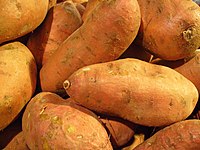
This list of sweet potato cultivars provides some information about varieties and cultivars of sweet potato (Ipomoea batatas). The sweet potato was first domesticated in the Americas more than 5,000 years ago.[1] As of 2013, there are approximately 7,000 sweet potato cultivars. People grow sweet potato in many parts of the world, including New Zealand, Australia, the Philippines, Japan, Hawaii, China, and North America. However, sweet potato is not widely cultivated in Europe.[2]
People breed sweet potatoes mainly either for food (their nutritious storage roots) or for their attractive vines. (The variety 'Vardaman' is grown for both.) The first table below lists sweet potato cultivars grown for their edible roots; the second table lists cultivars bred as ornamental vines. In the first table, the Parentage column briefly explains how the sweet potato cultivar was bred. Sweet potato plants with desirable traits are selectively bred to produce new cultivars.
Sweet potato cultivars differ in many ways. One way people compare them is by the size, shape, and color of the roots. The more orange the flesh of a sweet potato root is, the more nutritious carotene it has. (Humans metabolize carotene into vitamin A.) The skin of a sweet potato root is a different color than the flesh. The biological word for the outer skin is epidermis; the flesh is called the pith or medulla. The first table below has a general description of the color of the root's flesh and skin.
In the mid-20th century, sweet potato growers in the Southern United States began marketing orange-fleshed sweet potatoes as "yams", in an attempt to differentiate them from pale-fleshed sweet potatoes.[3] Even though these growers called their products yams, true yams are significantly different. All sweet potatoes are variations of one species: I. batatas. Yams are any of various tropical species of the genus Dioscorea. A yam tuber is starchier, dryer, and often larger than the storage root of a sweet potato, and the skin is more coarse.[3] This list does not include yams.
Cultivars bred for edible roots
[edit] | This list is incomplete; you can help by adding missing items. (December 2011) |
Many of the sweet potato cultivars below were bred at agricultural experiment stations. An agricultural experiment station (AES) is a research center where scientists work to increase the quality and quantity of food production. Agricultural experiment stations are usually operated by a government agency and/or a university.
| Name | Plant breeder | Parentage | Root skin (epidermis) colour | Root flesh (medulla) colour | Notes | Origin |
|---|---|---|---|---|---|---|
| Acadian | Louisiana State University[4] | L21 × L131[4] | copper | orange | US | |
| Allgold / Okla. 240 | Oklahoma State University–Stillwater[4] | Creole × Triumph (Parent 10)[4] | tan[1] | orange | US | |
| Americana | ? | ? | ? | ? | ? | |
| Apache | USDA (United States Department of Agriculture)[4] | (Yellow Yam 149 × Nancy Hall 42–1) × (Pelican Processor Triumph)[4] | orange | ? | US | |
| Australian Canner | Department of Agriculture (Australia)[4] | ? | ? | ? | Adaptation trials/naming by USDA et al.[4] | Australia |
| Ayamurasaki | ? | indigenous | sangria | plum | Also called beniimo | Okinawa |
| Baker / V 2158 | Norfolk, Virginia[4] | Virginian × numbered seedling[4] | ? | ? | US | |
| Beauregard | Baton Rouge, Louisiana[4] | open-pollinated seedling of L78-21[4] | rose[5] | orange[5] | First cultivated in 1987[5] | US |
| Bonara | ? | ? | ? | ? | ? | |
| Campeon | ? | ? | light red[6] | white[6] | Commonly called boniato[6] (a word for sweet potato in Cuban Spanish) | ? |
| Canbake / G-52-15-1 | Georgia Agricultural Experiment Station (AES)[4] | ? | ? | ? | US | |
| Caro-Gold | Clemson College[4] | C317 × Goldrush[4] | bright purple | orange | US | |
| Carolina Bunch | US Vegetable Laboratory (USDA Agricultural Research Service); South Carolina AES[4] | open pollinated seedling of Excel[4] | light copper | deep orange | US | |
| Carolina Nugget | North Carolina State University[4] | HM1-36 × Lakan[4] | rosy | medium orange | First cultivated in 1954[4] | US |
| Carolina Ruby | North Carolina Agricultural Research Service (NCARS)[4] | open pollinated seedling of Beauregard[4] | dark red to purple-red[5] | dark orange[5] | First cultivated in 1988[5] | US |
| Caromex | North Carolina State University[4] | NC228 × NC234[4] | dark copper | deep orange | First cultivated in 1971[4] | US |
| Carver | Tuskegee Institute[4] | Centennial × Jewel[4] | deep rose | deep orange | US | |
| Centennial / L-3-77 | Louisiana AES (Baton Rouge, Louisiana)[4] | Unit IPR × Pelican Processor[4] | orange[7] | orange[7] | US | |
| Chipper | ? | ? | ? | ? | ? | |
| Covington NC98-608 | North Carolina State University[4] | ? | rose[5] | orange[5] | Smooth skin[5] | US |
| Cliett Bunch Porto Rico / Georgia Bunch Porto Rico | University of Georgia Coastal Plain Experiment Station (Tifton, Georgia)[4] | mutation from Vining Porto Rico[4] | ? | ? | Similar to Vining Porto Rico[4] | US |
| Coastal Red | University of Georgia Coastal Plain Experiment Station (Tifton, Georgia)[4] | open-pollinated seedling from GA-76[4] | red | medium orange | First cultivated in 1978[4] | US |
| Coppergold | L. A. Sharum (Fort Smith, Arkansas)[4] | selected mutation in Allgold[4] | russet copper | ? | US | |
| Cordner | Texas AES and Oklahoma State University[4] | copper[5] | medium orange[5] | ? | First cultivated in 1983[5] | US |
| Creole | ? | ? | ? | ? | ? | |
| Darby | Louisiana AES (Baton Rouge, Louisiana)[4] | open pollinated seedling of L 83-523[4] | dark rose | orange | Purple stems[4] | US |
| Don Juan | Puerto Rico AES (Río Piedras, Puerto Rico)[4] | selected from native stock[4] | ? | ? | Puerto Rico | |
| Earlyport | Louisiana AES (Baton Rouge, Louisiana)[4] | (Mameyita × seedling L-4-6) × (seedling L-5 × Triumph)[4] | copper | orange | Similar to Porto Rico[4] | US |
| Earlysweet / T-3 | University of Georgia Coastal Plain Experiment Station (Tifton, Georgia)[4] | Porto Rico × unnamed breeding lines[4] | light-skinned | deep orange | US | |
| Eureka | Louisiana State University AES; University of California AES[4] | L9-163 × LO-132[4] | copper | orange | US | |
| Evangeline | Louisiana[8] | ? | rose | orange[8] | US | |
| Excel | USDA and the South Carolina AES[4] | open-pollinated seedling of Regal polycrossed in 1981 to 29 other parental selections[4] | light copper | orange | Skin color is slightly lighter than that of Jewel[4] | US |
| GA90-16 | Georgia AES; US Vegetable Laboratory (USDA ARS)[4] | ? | ? | white | Low sugar, low maltose[4] | US |
| Garnet | ? | ? | pale copper | brilliant orange | Commonly called "yams" in the United States to distinguish them from O'Henry sweet potatoes[4] | US |
| Georgia Jet | ? | ? | purplish red | deep orange | US | |
| Georgia Red / T-6 | University of Georgia Coastal Plain Experiment Station (Tifton, Georgia)[4] | Porto Rican crosses[4] | coppery-red skin | ? | Similar to Porto Rico[4] | US |
| Gold Rush | Louisiana AES (Baton Rouge, Louisiana)[4] | (Mameyita × Seedling L4-6) × (Seedling L-5 × Triumph)[4] | light copper | deep orange | Purple stems[4] | US |
| Golden Belle | Bryce Woods (Rogers, Arkansas)[4] | Nancy Gold mutation[4] | ? | golden | Flesh color differs from Nancy Hall. | US |
| Goldmar | Maryland AES (College Park, Maryland)[4] | Redmar mutation[4] | golden | ? | Cultivated in 1973. Similar to Redmar, but different skin color.[4] | US |
| Grand Asia | ? | ? | pink | white | Boniato-type similar to 'Japanese'[9] | ? |
| Hannah Sweet | ? | ? | ? | ? | ? | |
| Hayman White | ? | ? | tan[10] | cream[10] | An heirloom variety of the Eastern United States[11][12] | US |
| Heartogold | Louisiana State University[4] | Mameyita × Yellow Yam[4] | flesh-colored | deep orange | US | |
| Hernandez | Louisiana State University AES[4] | seedling of L70-323[4] | burnt orange[5] | deep orange[5] | First cultivated in 1992[5] | US |
| HiDry | Clemson University; USDA[4] | fourth-generation, open-pollinated selection from MK-14[4] | white | cream | Cultivated for industrial use[4] | US |
| Hoolehua Gold | ? | ? | pale red | orange | ? | |
| Hoolehua Red | ? | ? | red | off-white | ? | |
| Hopi / HM-122 | USDA Horticultural Field Station (Meridian, Mississippi)[4] | ? | ? | ? | US | |
| Houhere | Māori traditional | pre-European "kūmara" type[13] | pink | yellow | Rectangular tubers | New Zealand |
| Hutihuti | Māori traditional | pre-European "kūmara" type[14] | cream | cream | Long, thin, up to 20 roots per plant[13] | New Zealand |
| Iliua | ? | ? | ? | ? | ? | |
| Japanese / Oriental | ? | ? | purplish red | pale | Boniato-type.[9] Comparatively lower moisture.[8] | ? |
| Jersey Orange / Orange Little Stern | Kansas State College; Rutgers University[4] | ? | orange-brown | deep orange | Size and shape are similar to that of Jersey Yellow[4] | US |
| Jersey Red | ? | ? | ? | ? | An heirloom variety[10] | US |
| Jersey Yellow | ? | ? | golden, buff, or tan | cream to bright yellow | An heirloom variety[10] | US |
| Jewel | North Carolina State University | ? | copper[5] | deep orange[5] | First cultivated in 1970.[5] Commonly called "yams" in the United States to distinguish them from O'Henry sweet potatoes. | US |
| Kandee / K1716 | Kansas State College[4] | La 1946 Cross 17 × 1 (yellow yam × Nancy Hall)[4] | reddish bronze | bright orange | US | |
| Kona B | ? | ? | pale red to orange-red | light orange | ? | |
| Kote Buki | ? | ? | purplish red | white | Mid-season | ? |
| Lakan / L-0-123 | Louisiana AES (Baton Rouge, Louisiana)[4] | (Unit IPR × Pelican. Processor) × (Mameyita × L-4-6)[4] | reddish-bronze to reddish-tan | bright orange | US | |
| Mameyita | ? | ? | ? | ? | ? | |
| Maryland Golden | ? | ? | ? | ? | US | |
| Miguela | ? | ? | ? | ? | ? | |
| Murasaki | ? | ? | hybiscus | pale | Low moisture[8] | ? |
| Murff Bush Porto Rico | E. L. Murff (Normangee, Texas)[4] | Porto Rico mutation[4] | copper[7] | orange[7] | First cultivated in 1949. Similar to Porto Rico.[4] | US |
| Nancy Gold | Kansas State College AES[4] | Nancy Hall mutation[4] | buff-colored | deep-orange | Skin color differs from Nancy Hall[4] | US |
| Nancy Hall | ? | ? | tan | yellow | ? | |
| Nemagold / Okla. 46 | Oklahoma State University–Stillwater[4] | Yellow Jersey (Orlis strain) × Okla. 29[4] | ? | ? | US | |
| Northern Star | ? | ? | ? | ? | Cultivated in Australia | ? |
| Nugget / NC-171 | North Carolina AES (Raleigh, North Carolina)[4] | NC-124 × (NC-41 × B5965)[4] | ? | ? | US | |
| O'Henry | Henry Wayne Bailey [(Vardaman, MS)][15] | Beauregard mutation[15] | coppery tan | lemon cream | Variant of Beauregard[8] | US |
| Okla. 46 | Oklahoma State University–Stillwater[4] | Okla. 29 × Orlis [Okla. 29-Parent 10 (see Allgold) × L37 (see Red Gold)][4] | golden russet | orange | Roots and vines are like yellow Jersey or Orlis; shouldered leaves | US |
| Oklamar / Okla. 52 | Oklahoma State University–Stillwater AES[4] | Oklahoma 5 × Australian Canner[4] | purple | salmon | US | |
| Oklamex Red | Oklahoma and New Mexico AES | B 1564 × PI 153655 | dark red | salmon | Extremely sweet, moist root; yam-type | US |
| Onokeo | ? | ? | violet | ivory | ? | |
| Onolena / HES number 14 | Vegetable Crops Department, University of Hawaii (Honolulu)[4] | Porto Rico × Nancy Hall[4] | tan | dark orange | Similar to Porto Rico[4] | US |
| Orange Sunset | Plant & Food Research | ? | purple | orange and purple | First cultivated in 2014[16] | New Zealand |
| Orlis | Kansas State College[4] | mutation from Common Little Stem Jersey[4] | bronze | ? | Similar to Little Stem Jersey | US |
| Owairaka Red | Fay Gock and Joe Gock[17] | waina type[18][16] | dark red | yellow | As of 2000, the preeminent cultivar of New Zealand (followed by Toka Toka Gold and Beauregard)[19] | New Zealand |
| Papota | USDA ARS; Tropical Agricultural Research Station[4] | International Institute of Tropical Agr. seedling[4] | white | beige | Turnip-shaped root[4] | US |
| Parapara | Māori traditional | ? | pink | ? | Medicinal variety, used to feed babies, the elderly, and the sick[20] | New Zealand |
| Pelican Processor / L-5 / L-4-5 | Louisiana AES (Baton Rouge, Louisiana)[4] | selfed seedling of Americana[4] | cream | light cream | US | |
| Picadita | ? | ? | purple-red[6] | white[6] | Commonly called boniato[6] (a word for sweet potato in Cuban Spanish) | ? |
| Pope | North Carolina State University[4] | NC 288 × 304[4] | light salmon | medium orange | US | |
| Poporo | Māori traditional | ? | purple | purple | traditional sweet and dry variety[20] | New Zealand |
| Porto Rico 198 / Porto Rican / Puerto Rican | North Carolina[5] | ? | rose-pink[5] | orange mottled[5] | First cultivated in 1966[5] | US |
| Purple Dawn | Plant & Food Research | ? | purple | purple | First cultivated in 2014[16] | New Zealand |
| Purple Heart / Okinawa | Okinawa Island | ? | tan | grape | Also cultivated in Hawaii | Japan |
| Queen Mary / L-126 | Louisiana AES (Baton Rouge, Louisiana)[4] | Porto Rico × Nancy Hall[4] | ? | ? | Similar to Porto Rico[4] | US |
| Ranger | Louisiana State University[4] | Porto Rico × Nancy Hall[4] | flesh-colored | orange | Similar to Nancy Hall | US |
| Rapoza | ? | ? | ivory | purple | ? | |
| Rekarawa | Māori traditional | ? | white | ? | chestnut flavour[20] | New Zealand |
| Rekamaroa | Māori traditional | pre-European "kūmara" type[13][14] | white | ? | New Zealand | |
| Red Diane | ? | ? | ? | ? | ? | |
| Red Garnet | ? | ? | deep red to purple[15] | orange[15] | ? | |
| Red Jewel | ? | ? | red | deep orange | ? | |
| Red Nancy | Kansas State College[4] | mutation of Nancy Gold[4] | red | orange | Similar to Nancy Gold[4] | US |
| Redglow | University of Georgia AES; California AES[4] | open pollinated seedling of GA-109[4] | light, purple-red | deep orange | US | |
| Redgold / Okla. 26 | Oklahoma State University–Stillwater[4] | Okla. 2 × L37 (seedlings involving Creole, Nancy Hall and Porto Rico)[4] | red | orange | US | |
| Redmar / Md 2416 | Maryland AES (College Park, Maryland) | [(K18400 × B6313) × Shoreland × (Virginian × K1846)] | red | ? | First cultivated in 1971. Similar to Nemagold[4] | US |
| Regal | USDA ARS; South Carolina AES (Clemson University); Texas Agricultural Station (Texas A&M University)[4] | seedling of W-99 polycrossed with 29 other parental selections[4] | dark purplish-red | orange to deep orange | US | |
| Resisto | USDA; South Carolina AES; Texas AES[4] | seedling of W-56[4] | reddish-copper | dark orange | US | |
| Rojo Blanco | Tuskegee Institute[4] | Rose Centennial × White Triumph[4] | deep red | milk white | US | |
| Romanawa | Māori traditional[20] | ? | gold | yellow/orange | New Zealand | |
| Rose Centennial | ? | ? | ? | ? | ? | |
| Ruddy | US Vegetable Laboratory (USDA ARS); South Carolina AES[4] | open pollinated seedling of W-119[4] | red skin | orange | US | |
| Scarlet | North Carolina Agricultural Research Service (NCARS)[4] | selected from meristem-tip culture derived clones of Jewel[4] | ? | orange | US | |
| Shore Gold | Virginia Tech Experiment Station[4] | open pollinated seedling of L7-177 from the Louisiana breeding program[4] | light copper | bright orange | US | |
| Southern Delite | USDA ARS; Clemson University[4][15] | an open pollinated seedling of W-99[4] | rose to dark copper | orange | Made publicly available in 1986.[15] Skin color varies with soil type[4] | US |
| Stokes Purple | Unknown (North Carolina)[21] | purple gray | dark purple | Made publicly available in 2012. | US | |
| Sumor | USDA ARS; United States Vegetable Laboratory; South Carolina AES (Clemson University); Edisto Research and Education Center[4] | open pollinated seedling of W-154[4] | light tan | white to yellow | Comparatively high vitamin C[15] | US |
| Sunnyside | USDA (Beltsville, Maryland and Louisiana)[4] | (Yellow Yam × Nancy Hall) × (Pelican Processor × Triumph)[4] | ? | ? | US | |
| Sweet Red | North Carolina State University[4] | open pollinated seedling of NC 258[4] | deep copper-red | deep orange | US | |
| Tango | USDA; Missouri AES (Columbia, Missouri); Sweet Potato Cooperative Group (Beltsville, Maryland)[4] | Nancy Hall × Porto Rico 1-10[4] | ? | ? | US | |
| Tanhoma | Oklahoma State University–Stillwater AES[4] | selection Australian Canner[4] | ? | ? | US | |
| Taputini | Māori traditional | pre-European "kūmara" type[14] | cream | cream | Long, thin, up to 20 roots per plant[13] | New Zealand |
| Toka Toka Gold | ? | ? | gold | white | Became commercially available in 1972[22][16] | New Zealand |
| Topaz | Texas AES[4] | open pollinated seedling of W-26[4] | bronze | medium orange | ? | |
| Travis | Louisiana AES[4] | polycross with L3-217 as seed parent[4] | rose | deep orange | First cultivated in 1980 | US |
| UPLSP-1 | ? | ? | ? | ? | Cultivated in the Philippines[23] | ? |
| UPLSP-2 | ? | ? | ? | ? | Cultivated in the Philippines[23] | ? |
| U.P.R. number 3 | Puerto Rico AES (Río Piedras, Puerto Rico)[4] | selected from Mameya; open-pollinated[4] | ? | ? | Puerto Rico | |
| U.P.R. number 7 | Puerto Rico AES (Río Piedras, Puerto Rico)[4] | L-240[4] | ? | deep orange | Puerto Rico | |
| Vardaman | ? | ? | golden[7] | light orange | US | |
| Virginian / V-53 | Truck Experiment Station (near Norfolk, Virginia)[4] | Maryland Golden × B-219[4] | purplish-red to copper-red | bright orange | US | |
| VSP-5 | ? | ? | ? | ? | Cultivated in the Philippines[23] | ? |
| VSP-6 | ? | ? | ? | ? | Cultivated in the Philippines[23] | ? |
| Waimanalo Red | ? | ? | red | pearl | ? | |
| Waina | ? | ? | ? | ? | Vining variety brought to New Zealand in the 1800s[18] | ? |
| White Delite | North Carolina State University[4] | cross between a University of Georgia breeding clone (GA41) and an unknown pollen parent[4] | purplish pink[5][9] | white[5] | First cultivated in 1979[5] | US |
| White Triumph | ? | ? | ? | ? | ? | |
| Whitestar | USDA (Beltsville, Maryland)[4] | cultivar Laupahoehoe (Hawaii)[4] | white | pale | US | |
| Yellow Yam | ? | ? | ? | ? | ? |
Cultivars bred for ornamental vines
[edit] | This list is incomplete; you can help by adding missing items. (November 2013) |
| Name | Cultivator(s) | Leaf color | Leaf shape | Notes |
|---|---|---|---|---|
| Black Heart / Ace of Spades / Purple Heart | ? | dark purplish with purple veins | heart | |
| Blackie | ? | purple and green blend | ? | Darker than Black Heart |
| Bronze Beauty | ? | copper | ? | Same leaf shape as Blackie |
| Copper | ? | chartreuse to purple | ? | |
| Freckles | ? | green and yellow mottled | ? | |
| Gold Finger | ? | lime green | lobed | |
| Ivory Jewel | ? | green and ivory streaked | heart | |
| Lady Fingers | ? | green with purple veins | lobed | |
| Marguerite / Chartreuse / Sulfur | ? | chartreuse | ? | |
| Mini Blackie | ? | dark green with purple veins | ? | Leaf color is lighter than that of lacinato kale |
| NCORNSP011MNLC / Illusion® Midnight Lace | ? | dark green with purple veins | ? | |
| NCORNSP012EMLC / Illusion® Emerald Lace | ? | chartreuse | lobed | |
| Purple Tuber | ? | ? | ? | |
| Seki Blakhrt / Chillin™ / Blackberry Heart | ? | ? | ? | |
| Sidekick Black | ? | deep purple | lobed | |
| Sidekick Lime | ? | green | lobed | |
| Sweet Caroline Bewitched Purple / PP18574 | Craig Yencho; Ken Pecota (2006)[24][25] | dark green to vivid burgundy | ? | |
| Sweet Caroline Bronze / PP15437 | Craig Yencho; Ken Pecota; Cindy Pierce (2002)[24][25] | ? | ? | |
| Sweet Caroline Green | ? | ? | ? | |
| Sweet Caroline Green Yellow | ? | ? | ? | |
| Sweet Caroline Light Green | ? | ? | ? | |
| Sweet Caroline Purple | ? | ? | ? | |
| Sweet Caroline Red | ? | ? | ? | |
| Sweet Caroline Sweetheart Light Green | ? | ? | ? | |
| Sweet Caroline Sweetheart Red | ? | ? | ? | |
| Sweet Georgia Heart Purple | ? | ? | ? | |
| Terrace Lime | ? | ? | ? | |
| Tricolor | ? | green, white, pink | ? | Medium-size leaves |
| Vardaman | ? | ? | ? |
See also
[edit]- Food security
- Lists of cultivars
- Plant breeding
- Staple food
References
[edit]- ^ a b "Sweetpotato". International Potato Center. Retrieved 21 November 2013.
- ^ Núñez, Carlos (7 May 2013). "Sweet potatoes a growing niche in Europe". FreshPlaza. Retrieved 22 November 2013.
- ^ a b Schultheis, Jonathan (30 January 1998). "What is the Difference Between a Sweetpotato and a Yam?". NC Cooperative Extension. Archived from the original on 2019-09-24. Retrieved 2016-09-08.
- ^ a b c d e f g h i j k l m n o p q r s t u v w x y z aa ab ac ad ae af ag ah ai aj ak al am an ao ap aq ar as at au av aw ax ay az ba bb bc bd be bf bg bh bi bj bk bl bm bn bo bp bq br bs bt bu bv bw bx by bz ca cb cc cd ce cf cg ch ci cj ck cl cm cn co cp cq cr cs ct cu cv cw cx cy cz da db dc dd de df dg dh di dj dk dl dm dn do dp dq dr ds dt du dv dw dx dy dz ea eb ec ed ee ef eg eh ei ej ek el em en eo ep eq er es et eu ev ew ex ey ez fa fb fc fd LaBonte, Don R. (ed.). "Sweetpotato, Lists 1-26 Combined". Vegetable Cultivar Descriptions for North America. Department of Horticulture, Louisiana State University. Archived from the original on 4 March 2016. Retrieved 3 May 2012.
- ^ a b c d e f g h i j k l m n o p q r s t u v w x y "Industry". North Carolina Sweet Potato Commission. 2013. Archived from the original on 16 January 2013. Retrieved 20 November 2013.
- ^ a b c d e f Stephens, James M. (2015) [1994]. "Boniato—Ipomoea batatas (L.) Poir". EDIS. University of Florida. Retrieved 2018-07-12.
- ^ a b c d e "Watch Your Garden Grow – Sweet Potato". University of Illinois Extension. University of Illinois. Retrieved 22 November 2013.
- ^ a b c d e "Sweet Potato Varieties". About Sweet Potatoes. North Carolina Sweet Potato Commission. Archived from the original on 4 September 2011. Retrieved 20 November 2013.
- ^ a b c "Identifying Boniato-Type Sweetpotato Cultivars Adapted to NC Growing Conditions". New Crops & Organics. North Carolina State University. Retrieved 2018-07-12.
- ^ a b c d Higgins, Adrian (14 November 2012). "Rare sweet potatoes make a comeback". The Washington Post. Retrieved 22 November 2013.
- ^ Kasper, Rob (26 November 2008). "Aging's a fine thing for sweet potatoes". The Baltimore Sun. Retrieved 22 November 2013.
- ^ Eaton, Lorraine (19 November 2010). "Haymans, an Eastern Shore sweet potato prized for generations". The Washington Post. Washington, D.C. Retrieved 22 November 2013.
- ^ a b c d Yen, D. E. (1963). "The New Zealand Kumara or Sweet Potato". Economic Botany. 17 (1): 31–45. Bibcode:1963EcBot..17...31Y. doi:10.1007/BF02985351. S2CID 32823869.
- ^ a b c Harvey, Catherine F.; Gill, Geoffrey P.; Crossman, Catherine; Fraser, Lena G. (1997). "Assessing relationships of kumara cultivars by RAPD analysis". New Zealand Journal of Botany. 35 (4): 479–485. Bibcode:1997NZJB...35..479H. doi:10.1080/0028825X.1987.10410171.
- ^ a b c d e f g "Sweet Potato Varieties". sweetpotatoes.com. Wayne Bailey Produce Company. 2012. Archived from the original on 2 December 2013. Retrieved 21 November 2013.
- ^ a b c d Cui, Rongbin; Zhu, Fan (2019). "Physicochemical and functional properties of sweetpotato flour". Journal of the Science of Food and Agriculture. 99 (10): 4624–4634. Bibcode:2019JSFA...99.4624C. doi:10.1002/jsfa.9702. ISSN 0022-5142. PMID 30895624.
- ^ Lee, Lily (18 April 2016). "The Joe Gock Story". Auckland Zhong Shan Clan Association. Retrieved 7 June 2023.
- ^ a b Lewthwaite, S. L.; Fletcher, P. J.; Fletcher, J. D.; Triggs, C. M. (2011). "Cultivar decline in sweetpotato (Ipomoea batatas)". New Zealand Plant Protection. 64: 160–167. doi:10.30843/nzpp.2011.64.5976.
- ^ Shaw, S.; van de Westelaken, T.; Sorrenson, I.; Searle, B.; Hederley, D. (2008). "Effects of plant population and planting date on growth and development of kumara cultivar Owairaka Red" (PDF). Agronomy New Zealand (38): 61–68. Archived from the original (PDF) on 2 December 2013. Retrieved 22 November 2013.
- ^ a b c d Te Reka O Te Kai: Maara Kai Practical Guide (PDF). Te Waka Kai Ora. 2010. ISBN 978-0-473-17533-7. Retrieved 2021-06-23.
- ^ "Farmers markets: Stokes Purple is a sweet potato of mystery - Los Angeles Times". Los Angeles Times. 2 November 2012. Archived from the original on 2015-01-01. Retrieved 2015-01-01.
- ^ Lewthwaite, SL (2005). Sweetpotato products in a modern world: the New Zealand experience. II International Symposium on Sweetpotato and Cassava: Innovative Technologies for Commercialization 703. pp. 31–38. doi:10.17660/actahortic.2006.703.2. ISBN 90-6605-387-9.
- ^ a b c d Cabanilla, Liborio S. (1996). Sweetpotato in the Philippines: Production, processing, and future prospects (PDF). Lima: International Potato Center. pp. 37–38. ISBN 92-9060-178-7. OCLC 36071607. Retrieved 22 November 2013.
- ^ a b "Sweetpotato Breeding and Genetics Program". North Carolina State University. Retrieved 27 November 2013.
- ^ a b Reeber, Meri. "Ornamental Sweetpotatoes for the Home Landscape" (PDF). North Carolina State University. Retrieved 27 November 2013.
Further reading
[edit]- "Boniato". Gardening Solutions. University of Florida.
Sweet potatoes | |
|---|---|
| Cultivation |
|
| Culinary usage |
|
| Diseases |
|
| Related |
|
 Category Category | |
Original source: https://en.wikipedia.org/wiki/List of sweet potato cultivars
Status: article is cached
 EncycloReader
is supported by the
EncycloReader
is supported by the  KSF
KSF