Locally profinite group
 From Wikipedia - Reading time: 5 min
In mathematics, a locally profinite group is a Hausdorff topological group in which every neighborhood of the identity element contains a compact open subgroup. Equivalently, a locally profinite group is a topological group that is Hausdorff, locally compact, and totally disconnected. Moreover, a locally profinite group is compact if and only if it is profinite; this explains the terminology. Basic examples of locally profinite groups are discrete groups and the p-adic Lie groups. Non-examples are real Lie groups, which have the no small subgroup property.
In a locally profinite group, a closed subgroup is locally profinite, and every compact subgroup is contained in an open compact subgroup.
Examples
[edit]Important examples of locally profinite groups come from algebraic number theory. Let F be a non-archimedean local field. Then both F and are locally profinite. More generally, the matrix ring and the general linear group are locally profinite. Another example of a locally profinite group is the absolute Weil group of a non-archimedean local field: this is in contrast to the fact that the absolute Galois group of such is profinite (in particular compact).


Representations of a locally profinite group
[edit]Let G be a locally profinite group. Then a group homomorphism is continuous if and only if it has open kernel.

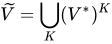
Let be a complex representation of G.[1] is said to be smooth if V is a union of where K runs over all open compact subgroups K. is said to be admissible if it is smooth and is finite-dimensional for any open compact subgroup K.


We now make a blanket assumption that is at most countable for all open compact subgroups K.

The dual space carries the action of G given by . In general, is not smooth. Thus, we set where is acting through and set . The smooth representation is then called the contragredient or smooth dual of .





The contravariant functor
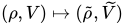
from the category of smooth representations of G to itself is exact. Moreover, the following are equivalent.
- is admissible.
- is admissible.[2]
- The canonical G-module map is an isomorphism.


When is admissible, is irreducible if and only if is irreducible.
The countability assumption at the beginning is really necessary, for there exists a locally profinite group that admits an irreducible smooth representation such that is not irreducible.
Hecke algebra of a locally profinite group
[edit]Let be a unimodular locally profinite group such that is at most countable for all open compact subgroups K, and a left Haar measure on . Let denote the space of locally constant functions on with compact support. With the multiplicative structure given by



becomes not necessarily unital associative -algebra. It is called the Hecke algebra of G and is denoted by . The algebra plays an important role in the study of smooth representations of locally profinite groups. Indeed, one has the following: given a smooth representation of G, we define a new action on V:


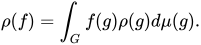
Thus, we have the functor from the category of smooth representations of to the category of non-degenerate -modules. Here, "non-degenerate" means . Then the fact is that the functor is an equivalence.[3]


Notes
[edit]References
[edit]- Corinne Blondel, Basic representation theory of reductive p-adic groups
- Bushnell, Colin J.; Henniart, Guy (2006), The local Langlands conjecture for GL(2), Grundlehren der Mathematischen Wissenschaften [Fundamental Principles of Mathematical Sciences], vol. 335, Berlin, New York: Springer-Verlag, doi:10.1007/3-540-31511-X, ISBN 978-3-540-31486-8, MR 2234120
- Milne, James S. (1988), Canonical models of (mixed) Shimura varieties and automorphic vector bundles, MR 1044823
Original source: https://en.wikipedia.org/wiki/Locally profinite group
Status: article is cached
 EncycloReader
is supported by the
EncycloReader
is supported by the  KSF
KSF