Material properties (thermodynamics)
 From Wikipedia - Reading time: 7 min
| Thermodynamics | |||||||||||||||||||||
|---|---|---|---|---|---|---|---|---|---|---|---|---|---|---|---|---|---|---|---|---|---|
 | |||||||||||||||||||||
|
|||||||||||||||||||||
|
|||||||||||||||||||||
| |||||||||||||||||||||






The thermodynamic properties of materials are intensive thermodynamic parameters which are specific to a given material. Each is directly related to a second order differential of a thermodynamic potential. Examples for a simple 1-component system are:
- Compressibility (or its inverse, the bulk modulus)
- Isothermal compressibility
- Adiabatic compressibility


- Specific heat (Note - the extensive analog is the heat capacity)
- Specific heat at constant pressure
- Specific heat at constant volume


- Coefficient of thermal expansion
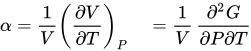
where P is pressure, V is volume, T is temperature, S is entropy, and N is the number of particles.
For a single component system, only three second derivatives are needed in order to derive all others, and so only three material properties are needed to derive all others. For a single component system, the "standard" three parameters are the isothermal compressibility , the specific heat at constant pressure , and the coefficient of thermal expansion .


For example, the following equations are true:
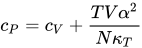
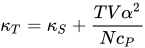
The three "standard" properties are in fact the three possible second derivatives of the Gibbs free energy with respect to temperature and pressure. Moreover, considering derivatives such as and the related Schwartz relations, shows that the properties triplet is not independent. In fact, one property function can be given as an expression of the two others, up to a reference state value.[1]

The second principle of thermodynamics has implications on the sign of some thermodynamic properties such isothermal compressibility.[1][2]
See also
[edit]
- List of materials properties (thermal properties)
- Heat capacity ratio
- Statistical mechanics
- Thermodynamic equations
- Thermodynamic databases for pure substances
- Heat transfer coefficient
- Latent heat
- Specific heat of melting (Enthalpy of fusion)
- Specific heat of vaporization (Enthalpy of vaporization)
- Thermal mass
External links
[edit]- The Dortmund Data Bank is a factual data bank for thermodynamic and thermophysical data.
References
[edit]- ^ a b S. Benjelloun, "Thermodynamic identities and thermodynamic consistency of Equation of States", Link to Archiv e-print Link to Hal e-print
- ^ Israel, R. (1979). Convexity in the Theory of Lattice Gases. Princeton, New Jersey: Princeton University Press. doi:10.2307/j.ctt13x1c8g
- Callen, Herbert B. (1985). Thermodynamics and an Introduction to Thermostatistics (2nd ed.). New York: John Wiley & Sons. ISBN 0-471-86256-8.
Original source: https://en.wikipedia.org/wiki/Material properties (thermodynamics)
Status: article is cached
 EncycloReader
is supported by the
EncycloReader
is supported by the  KSF
KSF