Categories
Miomachairodus
 From Wikipedia - Reading time: 6 min
| Miomachairodus Temporal range:
| |
|---|---|
Scientific classification 
| |
| Domain: | Eukaryota |
| Kingdom: | Animalia |
| Phylum: | Chordata |
| Class: | Mammalia |
| Order: | Carnivora |
| Suborder: | Feliformia |
| Family: | Felidae |
| Subfamily: | †Machairodontinae |
| Genus: | †Miomachairodus Schmidt-Kittler 1976 |
| Type species | |
| Miomachairodus pseudaeluroides | |
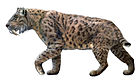
Miomachairodus is an extinct genus of large machairodontine (saber-toothed cat). It is known from Miocene-age fossils in China and Turkey and persisted until the Late Miocene (early Vallesian).[1] Fossils of this machairodont have been found in the Vallesian-age Bahe Formation in Shaanxi, China, and Yeni Eskihisar in Anatolia. This Turkish site is of Miocene age and is well known for its pollen studies.[2]
Discovery and naming[edit]
The genus was first named by Norbert Schmidt-Kittler in 1976 based on material from Akcakoy, Turkey.[3]
In 2022, material from the Guanigou fauna in the Linxia Basin was described as Miomachairodus sp., and the authors suggested that it represented a new species of Miomachairodus. The fossil, a partial maxilla from the early Late Miocene (early Bahean), represented the oldest known machairodontine in Asia. They refrained from definitively naming the species because it lacked the fourth premolar.[4] The fossil material had previously been assigned to Machairodus palanderi in 2013.[5]
Description[edit]
The Miomachairodus sp. from the Linxia Basin is known only from a single fossil (HMV2039), a partial maxilla with the first, second, and third incisors, the canine, and the third premolar present, as well as the alveolus of the second premolar and a broken fourth premolar. The incisors are small and the canine tooth has "distinct but small" serrations. It was distinguished from M. pseudailuroides by having a shorter diastemata between the canine and third premolar, and in the differing morphology of the third premolar. The describing paper estimated it was a large carnivoran that weighed more than 100 kilograms (220 lb).[4]
Classification[edit]
A 2018 phylogenetic analysis recovered Miomachairodus pseudailuroides as basal to most of the rest of Machairodontinae.[6]
| Machairodontinae |
| |||||||||||||||||||||||||||||||||||||||
References[edit]
- ^ Miomachairodus in the Paleobiology Database
- ^ Fortelius, Mikael. Geology and paleontology of the Miocene Sinap Formation, Turkey.
- ^ Schmidt-Kittler, Norbert (1976). "Raubtiere aus dem Jungtertiär Kleinasiens" [Carnivores from the Late Tertiary of Asia Minor]. Palaeontographica Abteilung A (in German). 155: 1–131.
- ^ a b Jiangzuo, Qigao; Wang, Shiqi; Deng, Tao (2023). "Chronological framework and palaeoecology of Carnivora from the Linxia Basin, China". Palaeogeography, Palaeoclimatology, Palaeoecology. 615: 111463. Bibcode:2023PPP...61511463J. doi:10.1016/j.palaeo.2023.111463. S2CID 257061069.
- ^ Deng, T., Hou, S. K., Xie, G. P., Wang, S. Q., Shi, Q. Q., Chen, S. K., ... & Lu, X. K. (2013). "Chronostratigraphic subdivision and correlation of the Upper Miocene of the Linxia Basin in Gansu, China". Journal of Stratigraphy. 37: 417–427.
{{cite journal}}: CS1 maint: multiple names: authors list (link) - ^ Piras, Paolo; Silvestro, Daniele; Carotenuto, Francesco; Castiglione, Silvia; Kotsakis, Anastassios; Maiorino, Leonardo; Melchionna, Marina; Mondanaro, Alessandro; Sansalone, Gabriele; Serio, Carmela; Vero, Veronica Anna; Raia, Pasquale (2018). "Evolution of the sabertooth mandible: A deadly ecomorphological specialization". Palaeogeography, Palaeoclimatology, Palaeoecology. 496: 166–174. Bibcode:2018PPP...496..166P. doi:10.1016/j.palaeo.2018.01.034.
Further reading[edit]
- Viranta, S.; Werdelin, L. (2003). "Carnivora". In Fortelius M.; Kappelman J.; Sen S.; Bernor R. (eds.). Geology and Paleontology of the Miocene Sinap Formation, Turkey. New York: Columbia University Press. pp. 178–193.
- Viranta, S.; Werdelin, L. (1999). Fossil remains of a primitive sabertooth cat (Miomachairodus pseudailuroides) from Anatolia (Abstr.) Abstracts of 79th Annual Meeting, American Society of Mammalogists.
Machairodontinae | ||
|---|---|---|
| ||
| Homotherini |
|  |
| Metailurini |
| |
| Smilodontini |
| |
| Incertae sedis: |
| |
Original source: https://en.wikipedia.org/wiki/Miomachairodus
Status: article is cached
 EncycloReader
is supported by the
EncycloReader
is supported by the  KSF
KSF