Moduli of abelian varieties
 From Wikipedia - Reading time: 4 min
Abelian varieties are a natural generalization of elliptic curves to higher dimensions. However, unlike the case of elliptic curves, there is no well-behaved stack playing the role of a moduli stack for higher-dimensional abelian varieties.[1] One can solve this problem by constructing a moduli stack of abelian varieties equipped with extra structure, such as a principal polarisation. Just as there is a moduli stack of elliptic curves over constructed as a stacky quotient of the upper-half plane by the action of ,[2] there is a moduli space of principally polarised abelian varieties given as a stacky quotient of Siegel upper half-space by the symplectic group .[3] By adding even more extra structure, such as a level n structure, one can go further and obtain a fine moduli space.


Constructions over characteristic 0
[edit]Principally polarized Abelian varieties
[edit]Recall that the Siegel upper half-space is the set of symmetric complex matrices whose imaginary part is positive definite.[4] This an open subset in the space of symmetric matrices. Notice that if , consists of complex numbers with positive imaginary part, and is thus the upper half plane, which appears prominently in the study of elliptic curves. In general, any point gives a complex torus



with a principal polarization from the matrix [3]page 34. It turns out all principally polarized Abelian varieties arise this way, giving the structure of a parameter space for all principally polarized Abelian varieties. But, there exists an equivalence where


for

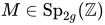
hence the moduli space of principally polarized abelian varieties is constructed from the stack quotient
![{\displaystyle {\mathcal {A}}_{g}=[\operatorname {Sp} _{2g}(\mathbb {Z} )\backslash H_{g}]}](https://wikimedia.org/api/rest_v1/media/math/render/svg/7e8c289adb80fec9a49766910b20b33abadbd543)
which gives a Deligne-Mumford stack over . If this is instead given by a GIT quotient, then it gives the coarse moduli space .


Principally polarized Abelian varieties with level n structure
[edit]In many cases, it is easier to work with principally polarized Abelian varieties equipped with level n-structure because this breaks the symmetries and gives a moduli space instead of a moduli stack.[5][6] This means the functor is representable by an algebraic manifold, such as a variety or scheme, instead of a stack. A level n-structure is given by a fixed basis of

where is the lattice . Fixing such a basis removes the automorphisms of an abelian variety at a point in the moduli space, hence there exists a bona fide algebraic manifold without a stabilizer structure. Denote


![{\displaystyle \Gamma (n)=\ker[\operatorname {Sp} _{2g}(\mathbb {Z} )\to \operatorname {Sp} _{2g}(\mathbb {Z} /n)]}](https://wikimedia.org/api/rest_v1/media/math/render/svg/4aa44fc4aa8d1ebe2e47dd0b575a0ee464ea61c5)
and define

as a quotient variety.
References
[edit]- ^ On the moduli stack of abelian varieties without polarization: https://mathoverflow.net/q/358411/2893
- ^ Hain, Richard (2014-03-25). "Lectures on Moduli Spaces of Elliptic Curves". arXiv:0812.1803 [math.AG].
- ^ a b Arapura, Donu. "Abelian Varieties and Moduli" (PDF).
- ^ Birkenhake, Christina; Lange, Herbert (2004). Complex Abelian Varieties. Grundlehren der mathematischen Wissenschaften (2 ed.). Berlin Heidelberg: Springer-Verlag. pp. 210–241. ISBN 978-3-540-20488-6.
- ^ Mumford, David (1983), Artin, Michael; Tate, John (eds.), "Towards an Enumerative Geometry of the Moduli Space of Curves", Arithmetic and Geometry: Papers Dedicated to I.R. Shafarevich on the Occasion of His Sixtieth Birthday. Volume II: Geometry, Progress in Mathematics, Birkhäuser, pp. 271–328, doi:10.1007/978-1-4757-9286-7_12, ISBN 978-1-4757-9286-7
- ^ Level n-structures are used to construct an intersection theory of Deligne–Mumford stacks
See also
[edit]- Schottky problem
- Siegel modular variety
- Moduli stack of elliptic curves
- Moduli of algebraic curves
- Hilbert scheme
- Deformation Theory
Original source: https://en.wikipedia.org/wiki/Moduli of abelian varieties
Status: article is cached
 EncycloReader
is supported by the
EncycloReader
is supported by the  KSF
KSF