Categories
Montipora grisea
 From Wikipedia - Reading time: 5 min
| Montipora grisea | |
|---|---|
| |
Conservation status
| |
Scientific classification 
| |
| Domain: | Eukaryota |
| Kingdom: | Animalia |
| Phylum: | Cnidaria |
| Class: | Hexacorallia |
| Order: | Scleractinia |
| Family: | Acroporidae |
| Genus: | Montipora |
| Species: | M. grisea
|
| Binomial name | |
| Montipora grisea Bernard, 1897
| |
Montipora grisea is a small polyped stony coral in the family Acroporidae.
Description
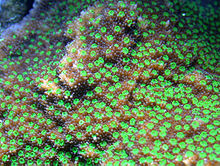
[edit]It is an encrusting species considered to be massively sized, with "thick unifacial plates."[2] It is usually dark brown or green in color, but also appears in shades of blue or pink.[2] These corals have small bumps, known as thecal papillae, that are fused together around the corallite.[3] They also have a coenosteum papillae that is present.[3]
-
 Pink
Pink -
 Green
Green -
 Brown
Brown
Distribution & habitat
[edit]Montipora grisea has a vast range, found within the reefs of forty-five countries and territories throughout the Indian and Pacific oceans. It exists at depths of 3 to 20 meters, with a preference for "shallow, tropical reef environments on upper reef slopes."[4]
Despite being considered a common species with a presently large population, Montipora grisea faces an array of threats.[4] It is moderately susceptible to bleaching, though notably less so than Acropora corals.[4] Other threats include predation from the crown-of-thorns starfish, harvesting for the aquarium trade, climate change and ocean acidification.[4]
Reproduction and Development
[edit]These corals can be hermaphroditic or gonochoric.[5] Their zygote produces planktonic planula larvae.[6] Metamorphosis takes place early before larval settlement occurs on the opposite side of the mouth.[6]
References
[edit]- ^ DeVantier, L.; Hodgson, G.; Huang, D.; Johan, O.; Licuanan, A.; Obura, D.O.; Sheppard, C.; Syahrir, M.; Turak, E. (2014). "Montipora grisea". IUCN Red List of Threatened Species. 2014: e.T133420A54258298. doi:10.2305/IUCN.UK.2014-1.RLTS.T133420A54258298.en. Retrieved 16 February 2022.
- ^ a b Australian Institute of Marine Science, 2013. Montipora grisea. Montipora grisea. Corals of the World.
- ^ a b Veron J. E. N. (1993). In Biogeographic database of hermatypic coral species of the central Indo-Pacific, genera of the world story, Australian Institute of Marine Science, 57-58.
- ^ a b c d Australian Institute of Marine Science, 2013. Montipora grisea. Montipora grisea. Corals of the World.
- ^ Khalesi, M. K. (2015). Corals. Springer Handbook of Marine Biotechnology, 179–217.
- ^ a b Bernard, H. M. (1897). XI.—Notes, morphological and systematic, on the Madreporarian Subfamily Montiporinæ (Montipora and Anacropora), with an account of the Phylogeny of the Madreporidæz, Macmillan and Co, 20, 117–135.
 | This Scleractinia-related article is a stub. You can help Wikipedia by expanding it. |
Original source: https://en.wikipedia.org/wiki/Montipora grisea
Status: article is cached
 EncycloReader
is supported by the
EncycloReader
is supported by the  KSF
KSF