Table of Contents Categories
Mueller special counsel investigation
 From Wikipedia - Reading time: 68 min
| Trump–Russia relations |
|---|
 |
| ||
|---|---|---|
|
Business and personal
45th and 47th President of the United States Incumbent
Tenure
Policies
Appointments (
Presidential campaigns
Impeachments
Legal proceedings
  |
||

The Robert Mueller special counsel investigation was an investigation into 45th U.S. president Donald Trump regarding Russian interference in the 2016 United States elections and was conducted by special prosecutor Robert Mueller from May 2017 to March 2019. It was also called the Russia investigation, Mueller probe, and Mueller investigation.[1][2] The investigation focused on three points:
- Russian interference in the 2016 United States elections
- Trump associates and their connection to Russian officials and espionage
- Possible obstruction of justice by Trump and his associates
While the investigation found no evidence that President Trump or any of his aides coordinated with the Russian government's 2016 election interference[3] and there was insufficient evidence of a criminal conspiracy, members of the campaign were indicted, including national security advisor Michael Flynn and the chair of the Trump presidential campaign, Paul Manafort.[4] The investigation resulted in charges against 34 individuals and three companies, eight guilty pleas, and a conviction at trial.[5][6] The report did not reach a conclusion about possible obstruction of justice by Trump, citing a Justice Department guideline that prohibits the federal indictment of a sitting president.[7][8][9] However, Attorney General William Barr pointed to ten episodes of potential obstruction.[10]
The investigation was created by Deputy Attorney General Rod Rosenstein. Former FBI director Mueller was chosen to lead due to a shortage of senate-confirmed U.S. attorneys. The dismissal of James Comey was a factor in the decision to use a Special Counsel. The Mueller investigation took over the FBI's investigation, Crossfire Hurricane. The Mueller investigation's scope included allegations of "links and/or coordination" between the Russian government and individuals associated with the Trump campaign.[7][11] Mueller was mandated to pursue "any matters that arose or may arise directly from the investigation." The probe included a criminal investigation that looked into potential conspiracy and obstruction of justice charges against Trump and members of his campaign or his administration.[12]
The investigation concluded in March 2019. The report concluded that the Russian Internet Research Agency's social media campaign supported Trump's presidential candidacy while attacking Clinton's, and Russian intelligence hacked and released damaging material from the Clinton campaign and Democratic Party organizations.[13] The investigation "identified numerous links between the Russian government and the Trump campaign", and determined that the Trump campaign "expected it would benefit electorally" from Russian hacking efforts. However, "the investigation did not establish that members of the Trump campaign conspired or coordinated with the Russian government in its election interference activities".[14][15][16][17]
On potential obstruction of justice by Trump, the investigation "does not conclude that the President committed a crime", as investigators would not indict a sitting president per an Office of Legal Counsel opinion.[18][19] However, the investigation "does not exonerate" Trump, finding public and private actions "by the President that were capable of exerting undue influence over law enforcement investigations".[20] The report states that Congress can decide whether Trump obstructed justice,[21] and has the authority to take action against him.[22][23][24] Attorney General William Barr and Deputy Attorney General Rod Rosenstein, decided on March 24, 2019, that the evidence was insufficient to establish a finding Trump committed obstruction of justice.[25] Upon his resignation in May 2019, Mueller stated, "The Constitution requires a process other than the criminal justice system to formally accuse a sitting president of wrongdoing."[26][27][17] In July 2019, Mueller testified to Congress that a president could be charged with obstruction of justice, or other crimes, after he left office.[28]
Original claims of Russian election involvement
[edit]The first public US government assertion of Russian efforts to influence the 2016 election came in a joint statement on September 22, 2016, by Senator Dianne Feinstein and House member Adam Schiff, the top Democrats on the Senate and House Intelligence Committees, respectively.[29][30] The US Intelligence Community released a similar statement fifteen days later.[31][32]
In January 2017, an assessment was released by the Office of the Director of National Intelligence, then headed by Obama appointee James Clapper, which asserted that Russian leadership had favored presidential candidate Donald Trump over rival candidate Hillary Clinton, adding that Russian President Vladimir Putin had personally ordered an "influence campaign" to harm Clinton's electoral chances and "undermine public faith in the US democratic process".[33] The Russian government interfered in the 2016 presidential election by bolstering the candidacies of Trump, Bernie Sanders, and Jill Stein in order to increase political instability in the United States as well as to damage the Clinton presidential campaign.[34][35]
Origin and powers
[edit]Original FBI investigations
[edit]When the special counsel was appointed by Rod Rosenstein in May 2017, the special counsel took over an existing counterintelligence investigation by the Federal Bureau of Investigation (FBI) into Russian interference in the 2016 United States elections and numerous secretive links between Trump associates and Russian officials.[36] According to reports, Australian officials informed American officials that in May 2016, a Trump presidential campaign adviser, George Papadopoulos, told the Australian High Commissioner to Britain, Alexander Downer, that Russian officials were in possession of politically damaging information relating to Hillary Clinton, the rival presidential candidate to Trump from Democratic Party. Since the FBI, in response to this information, opened an investigation into the links between Trump associates and Russian officials on July 31, 2016, the meeting between Papadopoulos and Downer is considered to be the 'spark' that led to the Mueller investigation.[37] In February 2018, the Nunes memo, written by staff for U.S. Representative Devin Nunes, stated that the information on Papadopoulos "triggered the opening of" the original FBI investigation,[38] rather than the Steele dossier by Christopher Steele as asserted by Trump and his allies.[39]
The special counsel also took over an FBI investigation on whether President Trump had committed obstruction of justice, which began within eight days after Trump's dismissal of FBI Director James Comey. CNN reported in December 2018 that then-acting FBI Director Andrew McCabe started the investigation based on Comey's firing—which had been recommended in writing by Rosenstein in what became known as the Comey memo—and also Comey's allegation that Trump had asked him to stop investigating Trump's former national security adviser Michael Flynn.[40] In February 2019, McCabe confirmed he launched the obstruction of justice investigation for those reasons—before he was fired from the FBI for allegedly lying to FBI agents after he leaked information about an investigation into the Clinton Foundation to a reporter. He said he gave additional reasons such as Trump's multiple depictions of the investigation into Trump associates and Russia as a "witch hunt", as well as Trump allegedly telling Deputy Attorney General Rod Rosenstein to mention the Russia probe in Rosenstein's memo to recommend firing Comey, and Trump's comments to the Russian ambassador and NBC relating Comey's firing to the Russia probe.[41]
Appointment and original oversight
[edit]A special counsel investigation is subject to oversight by the attorney general.[42] After questions arose regarding contacts between then-senator Jeff Sessions and Russian ambassador Sergei Kislyak in 2016, one of the first things Sessions did after being appointed attorney general, was to recuse himself from any Justice Department investigations regarding Russian interference in the election.[43]
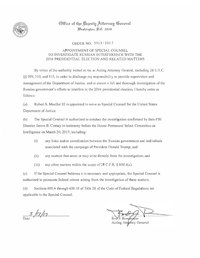
Once Attorney General Sessions recused, oversight of any Russia investigation into the 2016 election fell to the Deputy Attorney General Rod Rosenstein, a Trump appointee. As part of his oversight, Rosenstein appointed Robert Mueller as special counsel in May 2017 with the mandate "to oversee the previously-confirmed FBI investigation of Russian government efforts to influence the 2016 presidential election and related matters".[44]
Rosenstein has said he would recuse himself from supervision of Mueller if he himself were to become a subject in the investigation due to his role in the dismissal of Comey.[45]
Reasons for appointing a special counsel
[edit]Firing of James Comey
[edit]The special counsel appointment on May 17, 2017, came after protests, mostly from Democrats, over President Trump firing the FBI Director James Comey on May 9, 2017.[46][47] In Congress, in reaction to Comey's firing, over 130 Democratic lawmakers called for a special counsel to be appointed, over 80 Democratic lawmakers called for an independent investigation, while over 40 Republican lawmakers expressed questions or concerns.[48] Complicating the situation, Comey arranged to leak to the press classified information, notes from an interview with the president where Trump asked him to end the probe into Michael Flynn.[49] Comey would later be rebuked by the Department of Justice's Office of Inspector General for this action.[50] Trump fired Comey on the recommendations of Attorney General Jeff Sessions and Deputy Attorney General Rod Rosenstein,[51] although Deputy Director of the FBI Andrew McCabe claimed Rosenstein did not want to write the recommendation to fire Comey, and only did so because Trump ordered him to.[52]
The New York Times reported on January 11, 2019, that FBI counterintelligence grew concerned about Trump's ties to Russia during the 2016 campaign but held off opening an investigation because of uncertainty about how to proceed on such a sensitive matter. Trump's behavior during the days immediately before and after Comey's firing caused them to begin investigating whether Trump had been working on behalf of Russia against U.S. interests, knowingly or unknowingly. The FBI merged that counterintelligence investigation with a criminal obstruction of justice investigation related to Comey's firing. Mueller took over that investigation upon his appointment, although it was not immediately clear if he had pursued the counterintelligence angle.[53]
The New York Times reported in August 2020 that Rosenstein curtailed a May 2017 FBI inquiry into Trump's personal and financial dealings in Russia, giving the bureau the impression that the special counsel would investigate it, though Rosenstein instructed Mueller not to.[54][55]
Authority
[edit]Deputy Attorney General Rod Rosenstein, in his role as Acting Attorney General for matters related to the campaign due to the recusal of Attorney General Jeff Sessions, appointed Mueller, a former Director of the FBI, to serve as Special Counsel for the United States Department of Justice (DOJ) with authority to investigate Russian interference in the 2016 United States elections, including exploring any links or coordination between Trump's 2016 presidential campaign and the Russian government; "any matters that arose or may arise directly from the investigation"; and any other matters within the scope of 28 C.F.R. § 600.4(a).[56]
As Rosenstein later informed Congress, he elected to use a Special Counsel rather than have the FBI itself oversee the investigation because he did not believe acting Director of the FBI Andrew McCabe was the right person to lead the investigation. Instead, he would appoint a Special Counsel, as had been done in the past. U.S. Attorneys serve as special counsel, but in May 2017 there were only three Senate-confirmed U.S. Attorneys serving at the time, the Senate having not yet confirmed the new president's nominees, and those three had remained as holdovers from the previous administration pending the arrival of the new attorneys. As a result, Rosenstein decided to select Robert Mueller, though he was retired, because of his reputation.[57][58][59][60]
As special counsel, Mueller had the power to issue subpoenas,[61] hire staff members, request funding, and prosecute federal crimes in connection with the election interference along with other crimes he may uncover.[62] The constitutionality of indicting a sitting president remains an unsettled legal question.[63][64][65][66]
Release of findings
[edit]
The Special Counsel law requires a special counsel to confidentially provide the current attorney general with a report of findings. The attorney general, in this case William Barr, is then required to provide a summary of the findings to Congress, although he has considerable discretion in how much detail he provides. The full release of the Mueller findings to Congress and the public is not assured.[67] Should Congress be dissatisfied with the summary it is provided, it could subpoena Mueller's full report, and, if necessary, sue in federal court. Congress could also call Mueller to testify.[68][69]
White House attorneys expect to preview whatever findings Barr decides to provide to Congress and the public, in order to consider asserting executive privilege to withhold the release of information gleaned from internal documents and interviews with White House officials.[70] Commentators have noted that executive privilege cannot be invoked if the purpose is to shield wrongdoing or unlawful conduct.[71][72]
On March 14, 2019, the House voted 420–0 in favor of a non-binding resolution calling for the full special counsel report to be released to Congress and the public, excluding classified or grand jury information.[73] The same day the bill was brought before the Senate for unanimous consent, but was blocked by Senator Lindsey Graham, who said it needed a clause requiring the appointment of a special counsel to investigate allegations against the 2016 Clinton campaign.[74] On March 15, Trump stated "there should be no Mueller Report" because "this was an illegal & conflicted investigation."[citation needed] Five days later he stated, "I told the House, 'If you want, let [the public] see it,'" adding, "that's up to the Attorney General."[75][76] On March 25, 2019, Senate majority leader Mitch McConnell blocked an effort by minority leader Chuck Schumer for the Senate to take up the same resolution approved by the House eleven days earlier.[77]
The special counsel delivered its report to Attorney General Barr on March 22, 2019.[78] Two days later, on March 24, Barr sent a four-page letter of the report to Congress, describing the conclusions on Russian interference in the 2016 presidential election and obstruction of justice.[7]
Barr said the report would be delivered to Congress by mid-April, with some redactions of any information that would "potentially compromise sources and methods" or "unduly infringe on the personal privacy and reputational interests of peripheral third parties".[79] A two-volume redacted version of the full report was publicly released on April 18, 2019.[80] A less-redacted version of the report will eventually provided to a limited number of members of Congress.[81][82]
Grand juries
[edit]On August 3, 2017, Mueller empaneled a grand jury in Washington, D.C., as part of his investigation. The grand jury has the power to subpoena documents, require witnesses to testify under oath, and issue indictments for targets of criminal charges if probable cause is found.
The Washingtonian grand jury is separate from an earlier Virginian grand jury investigating Michael Flynn; the Flynn case has been absorbed into Mueller's overall investigation.[83]
The grand jury has issued subpoenas to those involved in the Trump Tower meeting held on June 9, 2016, at Trump Tower, which was also the location of Trump's presidential campaign headquarters.[84]
- Rinat Akhmetshin, a Russian-born lobbyist and former Soviet Army officer, a participant in the Donald Trump Jr. meeting, testified under oath for several hours on August 11, 2017.[85][86]
- Sam Clovis, an Iowa radio talk show host who worked on Trump's 2016 Presidential campaign, testified during the week of August 23, 2017.[87]
- Jason Maloni, spokesman for Paul Manafort, testified under oath for more than two hours on September 15, 2017.[88] Maloni was employed by Manafort following the five months he served as Chairman of Trump's campaign for president in 2016, to answer questions about Manafort's involvement in Trump's campaign.
- Carter Page, a former foreign-policy adviser to Trump's presidential campaign[89][when?]
- George Nader, Lebanese-American businessman who unofficially advises UAE Crown Prince Mohammed bin Zayed Al-Nahyan, testified during the week preceding March 5, 2018.[90]
NBC News reported on August 25, 2017, that "in recent days" the grand jury subpoenaed witness testimony from the executives of six public relations firms, who worked with Trump campaign chairman Paul Manafort on lobbying efforts in Ukraine.[91]
On January 16, 2018, The New York Times reported that Steve Bannon was subpoenaed by Mueller to testify before the standing grand jury in Washington, DC.[92] Reuters and CNN reported the next day that Bannon had struck a deal with Mueller's team to be interviewed by prosecutors instead of testifying before the grand jury.[93][94] On February 15, 2018, multiple sources reported that those interviews had taken place over several days that week.[95][96][97] TMZ reported that Kristin M. Davis, the "Manhattan Madam" who had previously worked for Roger Stone, was subpoenaed in June 2018.[98] On August 10, 2018, federal judge Beryl A. Howell found Stone's former aide Andrew Miller to be in contempt of court for refusing to testify before the grand jury.[99] Also that day, the Mueller investigation subpoenaed Randy Credico, whom Stone had described as his "backchannel" to Julian Assange.[100] The Wall Street Journal reported on November 14, 2018, that Mueller's investigators are examining whether Stone engaged in witness tampering by intimidating Credico into supporting Stone's assertions.[101]
Jerome Corsi, former Washington bureau chief of Infowars, was subpoenaed to appear on September 7, 2018, before a Mueller grand jury. Corsi's attorney said he expected his client to be asked about his association with Roger Stone, who had appeared to know in advance that WikiLeaks would release damaging information about the Clinton campaign.[102]
Legal teams
[edit]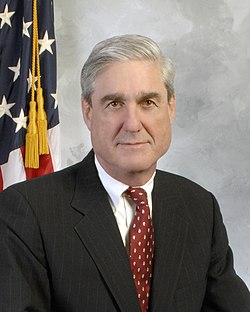
The investigation involved multiple legal teams: the attorneys that took part in the investigation (supervised by Special Counsel Robert Mueller); the team that defended President Trump in his personal capacity; and the team that represented the White House as an institution separate from the President.
According to CNN, as of August 2018, the prosecution team included 15 attorneys, led by Mueller.[103] The additional supporting staff brought the number over 30. There were a few reported departures from Mueller's team.[104]
The defense had two components: Emmet Flood representing the White House,[105] and a team representing Trump personally, including Jay Sekulow, Andrew Ekonomou, Rudy Giuliani, the Raskin & Raskin law firm, and Joanna Hendon. Former members of the defense team include white-collar crimes expert John Dowd[106] and Ty Cobb representing the office of the presidency.[105]
Mueller's legal team was consistently attacked as biased against President Trump, who once referred to this team as "The 13 Angry Democrats".[107][108][109][110] According to Politifact, while 13 of the 17 team members were indeed Democrats (the rest unaffiliated to either of the two major parties), Mueller is a registered Republican, and choosing to hire or not hire career attorneys on the basis of political affiliation is contrary to both Justice Department policy and federal law.[111]
Changes to oversight leadership
[edit]Whitaker's succession
[edit]As the Mueller investigation progressed, Trump repeatedly expressed anger over Attorney General Sessions' decision to recuse.[112] In July 2017, Trump said that Sessions should have informed him about Sessions' impending recusal before Trump even nominated him, then Trump would have nominated someone else for attorney general.[113] In May 2018, Trump said that he wished that he had nominated someone other than Sessions for Attorney General.[114] In August 2018, Trump declared that Sessions' job was safe at least until the November 2018 United States midterm elections.[115] Sessions resigned as attorney general on November 7, 2018, the day after the midterm elections, writing that he had resigned at Trump's request.[116][117]
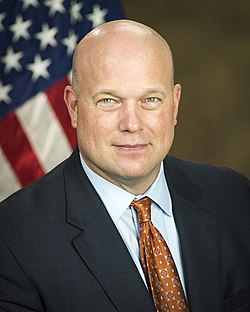
With Sessions' resignation, Trump appointed Matthew Whitaker, Sessions' chief of staff, as Acting Attorney General on November 7, 2018.[116] This meant that Whitaker assumed oversight of the Mueller investigation from Deputy Attorney General Rosenstein.[118][119]
Previously in August 2017, one month prior to joining the Justice Department as Sessions' chief of staff, Whitaker wrote an opinion column for CNN titled "Mueller's investigation of Trump is going too far".[120] He stated that Mueller's investigation is a "lynch mob", that it should be limited and should not probe into Trump's finances.[121][122] Whitaker also argued in 2017 that the Trump Tower meeting was neither improper nor evidence of collusion.[123] The New York Times reported that White House aides and other people close to Trump anticipated that Whitaker would "rein in" the investigation.[124]
Whitaker, a vocal Trump supporter, had publicly criticized the Mueller investigation on several occasions before joining the Justice Department in September 2017, asserting it was "going too far" and referring to it as a "lynch mob".[125] Whitaker is also a personal friend of Sam Clovis,[126] a former co-chair of the Trump campaign who has testified to Mueller's investigators and grand jury. Because of his prior statements and involvement,[127] many Democrats and some Republicans have asserted that Whitaker's potential conflicts of interest require him to recuse himself from overseeing Mueller,[128][129] although Whitaker reportedly indicated he had no intention of doing so.[130] Justice Department ethics officials typically review conflicts of interest to recommend recusals,[131][132][133] but their findings are not binding and are usually kept confidential.[citation needed]
Barr's succession
[edit]On December 7, 2018, President Trump declared that he would nominate William Barr for the vacant post of Attorney General. Barr was previously Attorney General under President George H. W. Bush.[134]
During his January 2019 confirmation hearings, Barr suggested the investigation's findings could be withheld from the public, as their release is not mandated by law. In June 2018, Barr had sent an unsolicited 19-page memo to deputy attorney general Rod Rosenstein and Trump attorneys arguing that the Special Counsel's approach to potential obstruction of justice by Trump was "fatally misconceived" and that, based on his knowledge, Trump's actions were within his presidential authority.[135] In June 2017, Barr had characterized the obstruction investigation as "asinine" and that it was "taking on the look of an entirely political operation to overthrow the president". Trump stated in a February 2019 interview that he had not committed to releasing the Mueller report.[136][137][138]
On February 14, 2019, Barr was sworn in as attorney general after the Senate approved his appointment by a 54–45 vote that day,[139][140] thus gaining oversight of the Mueller investigation from Whitaker.[141]
Topics
[edit]Deputy Attorney General Rod Rosenstein authorized Robert Mueller to investigate and prosecute "any links and/or coordination between the Russian government and individuals associated with the campaign of President Donald Trump", as well as "any matters that arose or may arise directly from the investigation" and any other matters within the scope of 28 CFR 600.4 – Jurisdiction.[142][143]
The investigation's broad scope allowed Mueller to investigate many topics, including: Russian election interference; links between Trump associates and Russian officials; alleged conspiracy between Trump campaign and Russian agents; potential obstruction of justice; financial investigations; lobbyists; Trump as a subject of investigation; other topics; and the Facebook–Cambridge Analytica data scandal.
Cost–benefit analysis
[edit]A cost–benefit analysis of the investigation shows a net benefit for the government, with far more income than expenses.
By December 2018, the investigation had cost approximately $32 million[144] but gained approximately $48 million.[145] More than half of the cost of the investigation was for personnel compensation and benefits. The gains were accrued primarily by uncovering unpaid taxes by targets in the investigation, seizing assets, and collecting fines.[146]
Criminal charges
[edit]The Special Counsel indicted 34 people—seven U.S. nationals, 26 Russian nationals, and one Dutch national—and three Russian organizations. Two additional individuals were charged as a result of referrals to other FBI offices.[147]

Charges were filed against Trump campaign members George Papadopoulos, Paul Manafort, Rick Gates, Michael Flynn, and Michael Cohen. Charges were also filed against bank account seller Richard Pinedo,[148] and lawyer Alex van der Zwaan as well as Paul Manafort associate Konstantin Kilimnik. Also indicted were Russia-based Internet Research Agency and related organizations and individuals directed by Yevgeny Prigozhin, and a group of Russian hackers referred to as Viktor Netyksho, et al.[149] On March 16, 2020, the US government dropped the charges against Prigozhin-owned companies Concord Management and Consulting and Concord Catering.[150]
Following the guilty plea of Michael Cohen for lying to the Senate Intelligence Committee, ranking member Mark Warner stated the committee had made multiple criminal referrals of individuals to Mueller and continues to examine witness testimonies for other false statements.[151] The Democrat-controlled House Intelligence Committee voted in February 2019 to refer dozens of witness testimony transcripts and thousands of other documents to Mueller's office. Committee Republicans had blocked Democrat efforts to release the documents to Mueller's office when Republicans controlled the Committee in 2018.[152]
On January 25, 2019, Roger Stone, a long time advisor to Donald Trump, was arrested by the FBI at a pre-dawn raid in Florida.[153] The indictment filed by the Office of the Special Counsel contained 7 charges, including obstructing an official proceeding, witness tampering, and lying to congress in regard to the investigation into Russian interference in the 2016 US election and his involvement with WikiLeaks.[154] In the charging document, prosecutors alleged that, after the first Wikileaks release of hacked DNC emails in July 2016, "a senior Trump Campaign official was directed to contact Stone about any additional releases and what other damaging information [WikiLeaks] had regarding the Clinton Campaign. Stone thereafter told the Trump Campaign about potential future releases of damaging material by [WikiLeaks]." The indictment also alleged that Stone had discussed Wikileaks releases with multiple senior Trump campaign officials. By the time of those contacts, it had been publicly reported that the DNC emails had been hacked by Russians and provided to Wikileaks.[155][156] Stone was convicted of all charges in November 2019, after the conclusion of the investigation and his sentence was commuted by Trump.[157]
Indictments
[edit]A total of thirty-four individuals and three companies were indicted by Mueller's investigators. Eight have pleaded guilty to or been convicted of felonies, including five Trump associates and campaign officials. None of those five convictions "involved a conspiracy between the campaign and Russians"[158] and "Mueller did not charge or suggest charges for [...] whether the Trump campaign worked with the Russians to influence the election".[159] The investigation was, however, more complex. On May 29, 2019, in a press conference, Mueller stated that "If we had confidence that the president clearly did not commit a crime, we would have said that. We did not, however, make a determination as to whether the president did commit a crime... A president cannot be charged with a federal crime while he is in office. That is unconstitutional. Even if the charge is kept under seal and hidden from public view – that too is prohibited."[160]
Dozens of ongoing investigations originally handled by the Special Counsel's office were forwarded to district and state prosecutors, other Department of Justice (DoJ) branches, and other federal agencies.[161] The following (in alphabetical order) were indicted during the Mueller investigation:
- 13 Russians implicated in election interference: Mueller's team indicted thirteen Russian citizens, the Internet Research Agency (IRA), Concord Management and Consulting and Concord Catering with conducting social media campaigns about the U.S. elections.[162] Twelve of the Russian defendants, who were alleged to be members of the Russian GRU cyber espionage group known as Fancy Bear, were charged in June 2018 with hacking and leaking DNC emails.[163] The other Russian indicted, who was not a direct employee of Fancy Bear, was Russian business tycoon Yevgeny Prigozhin, who was alleged to have served as the financier for the organization.[164] The US government dropped all charges against Concord Management and Consulting and Concord Catering in March 2020.[150] In November 2019, Time magazine reported that it was "unlikely that any of the Russians will ever face a trial in the United States, but the charges make it harder for them to travel overseas".[165]
- Michael Cohen, Trump's personal lawyer, pled guilty to making hush payments to Stormy Daniels and Karen McDougal in violation of campaign finance laws, and was convicted for several unrelated counts of bank and tax fraud.[166][167]
- Lieutenant General Michael Flynn, who had been appointed as National Security Advisor by the incoming Trump administration, was dismissed from his position and later pled guilty to making false statements to FBI investigators about his conversations with Russian Ambassador to the United States Sergey Kislyak during the presidential transition.[168][169]
- Rick Gates, former Trump Deputy Campaign Chairman, was indicted along with Paul Manafort in October 2017 on charges related to their consultation work with pro-Russian political figures in Ukraine. The charges were dropped after he pleaded guilty to conspiracy against the United States for making false statements in the investigation into Russian interference in the 2016 United States elections.[170]
- Konstantin Kilimnik, Manafort's business partner in Ukraine, was indicted for witness tampering at the behest of Manafort;[171] Kilimnik is suspected of working for Russian intelligence.[172]
- Paul Manafort, former Trump campaign chairman was found guilty on eight felony counts of tax evasion and bank fraud,[173] pursuant to his earlier lobbying activities for the Party of Regions of former Ukrainian president Viktor Yanukovich.[174][175] He later pled guilty to conspiracy to defraud and obstruction of justice;[176][177] in total, he was sentenced to over seven years in jail[178] in February 2018.
- George Papadopoulos, Trump campaign foreign policy adviser, was convicted for making false statements to the FBI.[179]
- Roger Stone, a longtime Trump advisor who had met with a Russian person offering to sell derogatory financial information about Hillary Clinton,[180] was indicted on seven charges of lying to Congress and witness tampering. He pled not guilty.[181] The jury subsequently found him guilty on all seven counts.[182]
- Alex van der Zwaan, a Dutch lawyer with the global law firm of Skadden, Arps, Slate, Meagher & Flom, he pleaded guilty to one count of making a false statement to investigators while answering questions about Russian interference in the 2016 United States elections.[183]
Conclusions
[edit]
Report sent to Attorney General
[edit]On March 22, 2019, the special counsel's office concluded their investigation and sent a report to the Department of Justice where it was received by Attorney General William Barr. Barr, at Trump's nomination, had become attorney general on February 14, 2019, gaining oversight of the investigation from Trump-appointed Acting Attorney General Matthew Whitaker. Whitaker had assumed oversight from Rosenstein on November 7, 2018, after the resignation of then-Attorney General Jeff Sessions, who had recused himself from the investigation. Both Barr and Whitaker had been critical of the Mueller investigation before their appointments. Barr has faced bipartisan pressure to release the full report to the public, to the maximum extent permissible by law.[184]
On March 24, 2019, Attorney General Barr sent a four-page letter to Congress regarding the special counsel's findings regarding Russian interference and obstruction of justice.[185] Barr said that on the question of Russian interference in the election, Mueller detailed two ways in which Russia attempted to influence the election, firstly disinformation and social media campaigns by the Internet Research Agency to cause social discord, and secondly computer hacking and strategic release of emails from the Hillary Clinton presidential campaign and Democratic Party organizations.[186][187] However, Barr quoted the report as saying: "[T]he investigation did not establish that members of the Trump Campaign conspired or coordinated with the Russian government in its election interference activities."[188][185][189][190]
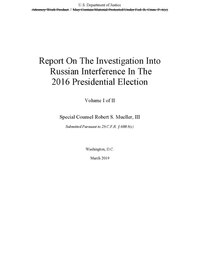
On the question of obstruction of justice, Barr said no conclusion was reached by the special counsel, noting that Mueller wrote "while this report does not conclude that the President committed a crime, it also does not exonerate him".[189][191] Barr and Rosenstein concluded that the evidence for obstruction of justice could not form the basis for a prosecution.[192][193][194] On April 18, Barr and Rosenstein held a press conference ninety minutes before a redacted version of the report, titled Report on the Investigation into Russian Interference in the 2016 Presidential Election, was released to Congress and the public.[195] A less-redacted version is planned to be accessible to "a bipartisan group of leaders from several Congressional committees".[196]
Follow-up to Attorney General's letter
[edit]The New York Times reported on April 3, 2019, that some members of the special counsel had told associates that they believe Barr's letter did not adequately portray their findings, which they considered to be more troubling for Trump than reported.[197] The next day, The Washington Post reported that members of Mueller's team, who spoke anonymously, reported that the evidence gathered on obstruction of justice was "much more acute than Barr suggested".[198] These members of Mueller's team said they believed that the evidence showed Trump obstructed justice, but that the entire team could not draw a conclusion because they were split over the evidence and law.[198][199] The Washington Post report did not explain why they believed their findings to be more serious than Barr's conclusions and it is unknown how many members of the special counsel hold these opinions.[200]
Barr's letter quoted Mueller's report as stating, "the evidence does not establish that the President was involved in an underlying crime related to Russian election interference", leading Barr to write, "the evidence developed during the Special Counsel's investigation is not sufficient to establish that the President committed an obstruction-of-justice offense", and concluding, "while not determinative, the absence of such evidence bears upon the President's intent with respect to obstruction". Some legal analysts challenged Barr's reasoning that Trump would not have intended to obstruct justice solely because he knew he had not committed a crime, noting that one can have intent to obstruct justice for other reasons, such as protecting associates from harm.[201][202][203][190]
In May 2021, federal judge Amy Berman Jackson ruled the Barr DOJ had misled her and Congress by asserting a heavily redacted March 2019 internal memorandum[204] contained only deliberative analysis of whether Trump should be charged with obstruction of justice. Jackson had seen the unredacted memo and concluded it contained "strategic" analysis to justify a decision Barr had already made. She ordered the memo to be publicly released within two weeks, pending any appeal by the DOJ.[205][206]
Congressional requests for full report
[edit]On April 3, 2019, the House Judiciary Committee, which did not receive the unredacted report by its April 2 deadline,[207] voted 24–17 along party lines to approve a resolution which authorizes subpoenas of the full report.[208][207] The resolution also authorized subpoenas related to five of President Donald Trump's former top advisers, including strategist Steve Bannon, communications director Hope Hicks, chief of staff Reince Priebus, former-White House counsel Donald McGahn and counsel Annie Donaldson.[209][210]
The Justice Department discussed the report with White House attorneys, and Barr discussed it in an April 18, 2019, press conference, a few hours before its release to Congress and the public later that day.[195]
On April 19, 2019, House Judiciary Chairman Jerry Nadler issued a subpoena for the release of the full unredacted report.[211][212] On May 3, 2019, Nadler informed Barr that a subpoena had been issued giving him until May 6 to release the full unredacted Mueller Report to the House Judiciary Committee.[213][214][215][216] On May 6, after Barr failed to meet the committee's deadline to release the full report, the committee agreed to hold a vote to start Contempt of Congress proceedings against Barr on May 8.[217][218] A law issued in 1857 gives Congress the power to issue criminal charges for this matter.[219] Trump's announcement of executive privilege came just hours before the House Judiciary Committee planned to vote on whether to hold Barr in contempt. On May 8, 2019, after Trump invoked executive privilege, the House Judiciary Committee voted unanimously to reject White House's assertion of executive privilege and approve a motion put forward by Rep. Matt Gaetz (R-Fl) which states that a vote to hold Barr in contempt would not "be construed as a directive for the Attorney General to violate Federal law or rules."[220][221] In a 24–16 vote, the House Judiciary Committee voted to hold Barr in contempt.[222][220]
Release of redacted report
[edit]On April 18, 2019, a redacted version of the Special Counsel's report titled Report on the Investigation into Russian Interference in the 2016 Presidential Election, was released to Congress and the public. About one-eighth of the lines in the public version were redacted.[223][224][225] The report was in two volumes, the first about Russian interference in the election and potential involvement of Trump associates, and the second on possible obstruction of justice by Trump.
Russian interference
[edit]The report concluded that Russian interference in the 2016 presidential election did occur "in sweeping and systematic fashion" and "violated U.S. criminal law".[226][227]
The first method detailed in the final report was the usage of the Internet Research Agency, waging "a social media campaign that favored presidential candidate Donald J. Trump and disparaged presidential candidate Hillary Clinton".[228] The Internet Research Agency also sought to "provoke and amplify political and social discord in the United States".[229]
The second method of Russian interference saw the Russian intelligence service, the GRU, hacking into email accounts owned by volunteers and employees of the Clinton presidential campaign, including that of campaign chairman John Podesta, and also hacking into "the computer networks of the Democratic Congressional Campaign Committee (DCCC) and the Democratic National Committee (DNC)". As a result, the GRU obtained hundreds of thousands of hacked documents, and the GRU proceeded by arranging releases of damaging hacked material via the WikiLeaks organization and also GRU's personas "DCLeaks" and "Guccifer 2.0".[13][230][231]
The Russians had also hacked old Republican Party domains and emails, but, according to James Comey, "none of that was released", and there was no sign "that the Trump campaign or the current RNC was successfully hacked".[232] According to the ODNI assessment, the Russians did not release the Republican content in the same way they did the Democrat's content.[33]
Conspiracy vs collusion
[edit]The investigation did not establish that members of the 2016 Trump campaign "conspired" or "coordinated" with Russia and did not evaluate whether or not "collusion" occurred.[233]
To establish whether a crime was committed by members of the Trump campaign with regard to Russian interference, investigators "applied the framework of conspiracy law", and not the concept of "collusion", because collusion "is not a specific offense or theory of liability found in the United States Code, nor is it a term of art in federal criminal law".[234][235][233] They also investigated if members of the Trump campaign "coordinated" with Russia, using the definition of "coordination" as having "an agreement — tacit or express — between the Trump campaign and the Russian government on election interference". Investigators further elaborated that merely having "two parties taking actions that were informed by or responsive to the other's actions or interests" was not enough to establish coordination.[236]
The report writes that the investigation "identified numerous links between the Russian government and the Trump campaign", found that Russia "perceived it would benefit from a Trump presidency" and that the 2016 Trump presidential campaign "expected it would benefit electorally" from Russian hacking efforts. However, ultimately "the investigation did not establish that members of the Trump campaign conspired or coordinated with the Russian government in its election interference activities".[14][15] The evidence was not necessarily complete due to encrypted, deleted, or unsaved communications as well as false, incomplete, or declined testimony.[237][238][239][240][241]
Obstruction of justice
[edit]The second volume of the report investigated the topic of obstruction of justice, describing ten episodes where Trump may have obstructed justice as president and one episode before he was elected, and analyzing each in terms of the criteria needed to constitute criminal obstruction.[242][243][244] The investigation found both public and private actions "by the President that were capable of exerting undue influence over law enforcement investigations, including the Russian-interference and obstruction investigations".[20] However, Trump mostly failed to influence it because his subordinates or associates refused to carry out his instructions.[245][246][247] The Mueller team refrained from charging Trump with obstruction because investigators abided by a DOJ Office of Legal Counsel (OLC) opinion that a sitting president cannot stand trial,[18][19] and they feared that charges would affect Trump's governing and possibly preempt a potential impeachment.[21][19][248] In addition, investigators felt it would be unfair to accuse Trump of a crime without charges and without a trial in which he could clear his name.[18][19][249] Since they had decided "not to make a traditional prosecutorial judgment" on whether to "initiate or decline a prosecution," the special counsel's office "did not draw ultimate conclusions about the President's conduct." The report "does not conclude that the president committed a crime",[228][250] but specifically did not exonerate Trump on obstruction of justice, because investigators were not confident that Trump was innocent after examining his intent and actions.[251][252] The report concluded that Congress has the authority to take further action against Trump on the question of obstruction of justice, stating that no one is above the law.[22][23][252][245]
End of investigation
[edit]On May 29, 2019, Mueller announced that he was retiring as special counsel and that the office would be shut down, and he spoke publicly about the report for the first time.[253] Saying "[t]he report is my testimony," he indicated he would have nothing to say that wasn't already in the report. On the subject of obstruction of justice, he said he had been prohibited by Justice Department policy from charging the president with a crime and that any potential wrongdoing by a president must be addressed by a "process other than the criminal justice system".[254] This suggested that the investigation could now be picked up by Congress.[27][17][26] He stressed that the central conclusion of his investigation was "that there were multiple, systematic efforts to interfere in our election. That allegation deserves the attention of every American."[255] He also stated: "If we had had confidence that the President clearly did not commit a crime, we would have said so. We did not, however, make a determination as to whether the president did commit a crime".[27][17]
The House Judiciary and Intelligence committees subpoenaed Mueller on June 25, 2019, with a letter saying that "the American public deserves to hear directly from you about your investigation and conclusions." Mueller reluctantly agreed to testify publicly with a scheduled date of July 17.[256] This date was later pushed back to July 24.[257] During his testimony, Mueller answered Republican Representative Ken Buck that a president could be charged with obstruction of justice (or other crimes) after the president left office.[28]
Following the Trump–Ukraine scandal, the House of Representatives launched an impeachment inquiry against Trump in September 2019 but did not pursue an article of impeachment related to the Mueller investigation.[258][259]
Reactions
[edit]Investigations into origins of probes
[edit]There have been numerous calls and requests to open a counter-investigation into the origins of the FBI's Crossfire Hurricane probe, with attention on the Foreign Intelligence Surveillance Act (FISA) documents against Carter Page and the Steele dossier.[260][261]
On April 9, 2019, Attorney General William Barr testified before the House Appropriations Subcommittee. Barr announced that the Department of Justice will be "reviewing the conduct" of the FBI's Russia probe.[260][261] "I am reviewing the conduct of the investigation and trying to get my arms around all the aspects of the counterintelligence investigation that was conducted during the summer of 2016," Barr said.[262] When asked whether he was suggesting that spying occurred, Barr said, "I think that spying did occur. But the question is whether it was predicated, adequately predicated. And I'm not suggesting it wasn't adequately predicated, but I need to explore that."[263]
During Attorney General Barr's testimony before the Senate Judiciary Committee on May 1, Barr again said he was looking into the origins of the FBI's Russia probe. "Many people seem to assume that the only intelligence collection that occurred was a single confidential informant [referring to Stefan Halper] and a FISA warrant," Barr stated. "I’d like to find out whether that is in fact true. It strikes me as a fairly anemic effort if that was the counterintelligence effort designed to stop a threat as it's being represented." When asked by Republican Senator John Cornyn "Can we state with confidence that the Steele dossier was not part of the Russian disinformation campaign" Barr responded "No. That is one of the areas that I am reviewing. I'm concerned about it. And I don't think it's entirely speculative."[264][265] When asked about FISA abuses by the DOJ and FBI during his testimony, Barr responded "These are the things I need to look at, and I have to say as I said before, to the extent that there was any overreach, it was a few people in the upper echelons of the (FBI) and perhaps the department, but those people are no longer there", Barr said.[266]
Barr appointed a federal prosecutor, John Durham, to assist in the investigation.[267] On October 24, 2019, news media reported that Durham had opened a criminal probe into the matter, giving him the power to empanel a grand jury and to compel testimony.[268] On December 1, 2020, the Associated Press reported that Barr had appointed Durham as a Special Counsel under the federal statute governing such appointments to conduct an investigation into "…the investigation of Special Counsel Robert S. Mueller III," by which was meant the FBI personnel who worked on Crossfire Hurricane before joining the Mueller team.[269]
On December 9, 2019, DOJ Inspector General Michael Horowitz released a report on the FBI's use of the FISA process and related matters, concluding that no "political bias or improper motivation influenced the FBI's decision to seek FISA authority on Carter Page," but also found 17 "significant inaccuracies and omissions" in the FBI's four FISA applications made to the Foreign Intelligence Surveillance Court to obtain warrants for the surveillance of Page.[270]
On May 7, 2020, the United States House Permanent Select Committee on Intelligence released dozens of transcripts from the Russia probe which committee chairman Adam Schiff said "detail evidence of the Trump campaign's efforts to invite, make use of, and cover up Russia's help in the 2016 presidential election."[271] Top officials from the Obama administration also testified that they had no empirical evidence of a conspiracy between Trump associates and Russian officials.[272][better source needed]
See also
[edit]


- Nobody Is Above the Law, a nationwide protest held on November 8, 2018
- RT America, the American arm of the Russian state media network RT
- Russian espionage in the United States
- Russian involvement in regime change
- Special Counsel Independence and Integrity Act, a proposed law that sought to protect the investigation
- Timelines related to Donald Trump and Russian interference in United States elections
References
[edit]- ^ Panetta, Grace (January 23, 2019). "Here's how a grand jury works and why the government shutdown is affecting the grand juries in the Mueller investigation". Business Insider. Archived from the original on January 24, 2019. Retrieved January 24, 2019.
- ^ Wolfe, Amelia Thomson-DeVeaux and Julia (March 7, 2019). "Is The Russia Investigation Really Another Watergate?". FiveThirtyEight. Archived from the original on October 24, 2021. Retrieved March 25, 2019.
- ^ Mazzetti, Mark; Benner, Katie (March 24, 2019). "Mueller Finds No Trump-Russia Conspiracy, but Stops Short of Exonerating President on Obstruction". The New York Times. Retrieved September 12, 2024.
- ^ Megerian, Chris (April 18, 2019). "Mueller finds no conspiracy, but report shows Trump welcomed Russian help". Los Angeles Times. Archived from the original on March 23, 2020. Retrieved February 1, 2021.
- ^ Breslow, Jason (December 9, 2018). "All The Criminal Charges To Emerge From Robert Mueller's Investigation". NPR.org. Archived from the original on December 24, 2020. Retrieved December 24, 2020.
- ^ "Here Are All of the Indictments, Guilty Pleas and Convictions From Robert Mueller's Investigation". Time. Archived from the original on December 24, 2020. Retrieved December 24, 2020.
- ^ a b c Mazzetti, Mark; Benner, Katie (March 24, 2019). "Mueller Finds No Trump-Russia Conspiracy, but Stops Short of Exonerating President on Obstruction". The New York Times. Archived from the original on November 9, 2021. Retrieved March 24, 2019.
- ^ Phillips, Kristine. "Trump's aides were eager to take Russian dirt on Clinton. But it wasn't a conspiracy, Mueller report said". USA TODAY. Archived from the original on July 29, 2020. Retrieved July 29, 2020.
- ^ Mueller Report Archived April 19, 2019, at the Wayback Machine, Vol. II, p. 1.
- ^ Pramuk, Jacob (April 18, 2019). "Mueller report recounts 10 episodes involving Trump and questions of obstruction". CNBC. Archived from the original on April 26, 2019. Retrieved April 21, 2019.
- ^ Budryk, Zack (March 24, 2019). "Trump Jr.: 'Collusion truthers' need to be 'held accountable' after Mueller report". The Hill. Archived from the original on August 9, 2021. Retrieved March 25, 2019.
- ^ Strohm, Chris; Pettypiece, Shannon (March 12, 2018). "Mueller Weighs Putting Off Trump Obstruction Decision". Bloomberg News. Archived from the original on September 5, 2018. Retrieved March 13, 2018.
- ^ a b Mackey, Robert; Risen, James; Aaronson, Trevor (April 18, 2019). "Annotating special counsel Robert Mueller's redacted report". The Intercept. Archived from the original on April 23, 2019. Retrieved April 23, 2019.
- ^ a b Ostriker, Rebecca; Puzzanghera, Jim; Finucane, Martin; Datar, Saurabh; Uraizee, Irfan; Garvin, Patrick. "What the Mueller report says about Trump and more". The Boston Globe. Archived from the original on April 19, 2019. Retrieved April 22, 2019.
- ^ a b Law, Tara. "Here Are the Biggest Takeaways From the Mueller Report". Time. Archived from the original on April 22, 2019. Retrieved April 22, 2019.
- ^ Mueller Report Archived April 19, 2019, at the Wayback Machine, vol. II, p. 2: Fourth, if we had confidence after a thorough investigation of the facts that the President clearly did not commit obstruction of justice, we would so state. Based on the facts and the applicable legal standards, however, we are unable to reach that judgment. The evidence we obtained about the President's actions and intent presents difficult issues that prevent us from conclusively determining that no criminal conduct occurred. Accordingly, while this report does not conclude that the President committed a crime, it also does not exonerate him.
- ^ a b c d LaFraniere, Sharon; Sullivan, Eileen (May 29, 2019). "Mueller, in First Comments on Russia Inquiry, Declines to Clear Trump". The New York Times. Archived from the original on January 26, 2021. Retrieved May 29, 2019.
- ^ a b c Day, Chad; Gresko, Jessica (April 19, 2019). "How Mueller made his no-call on Trump and obstruction". Associated Press. Archived from the original on April 19, 2019. Retrieved April 19, 2019.
- ^ a b c d Gajanan, Mahita. "Despite Evidence, Robert Mueller Would Not Say Whether Trump Obstructed Justice. Here's Why". Time. Archived from the original on April 20, 2019. Retrieved April 20, 2019.
- ^ a b Edelman, Adam (April 18, 2019). "Trump failed at obstruction because his aides refused to carry out orders, Mueller finds". NBC News. Archived from the original on May 20, 2019. Retrieved May 21, 2019.
- ^ a b Strohm, Chris. "Mueller's Signal on Obstruction: Congress Should Take On Trump". Bloomberg News. Archived from the original on April 19, 2019. Retrieved April 20, 2019.
- ^ a b Mascaro, Lisa (April 19, 2019). "Mueller drops obstruction dilemma on Congress". Associated Press. Archived from the original on April 20, 2019. Retrieved April 20, 2019.
- ^ a b Dennis, Steven; Strohm, Chris; McLaughlin, David (April 18, 2019). "Top Takeaways From the Mueller Report". Bloomberg News. Archived from the original on April 20, 2019. Retrieved April 20, 2019.
- ^ Mueller Report Archived April 19, 2019, at the Wayback Machine, vol. II, p. 8: With respect to whether the President can be found to have obstructed justice by exercising his powers under Article II of the Constitution, we concluded that Congress has authority to prohibit a President's corrupt use of his authority in order to protect the integrity of the administration of justice. [...] The conclusion that Congress may apply the obstruction laws to the President's corrupt exercise of the powers of office accords with our constitutional system of checks and balances and the principle that no person is above the law.
- ^ Montoya-Galvez, Camilo (March 24, 2019). "The key findings from the Justice Department summary of Mueller's report". CBS News. Archived from the original on May 15, 2019. Retrieved April 23, 2019.
- ^ a b "As he exits, Mueller suggests only Congress can 'formally accuse a sitting president of wrongdoing'". The Washington Post. May 29, 2019. Archived from the original on May 30, 2019. Retrieved May 30, 2019.
- ^ a b c Herb, Jeremy (May 29, 2019). "Mueller: 'If we had had confidence that the President clearly did not commit a crime, we would have said so'". CNN. Archived from the original on May 29, 2019. Retrieved May 29, 2019.
- ^ a b Thomsen, Jacqueline (July 24, 2019). "Mueller: Trump could be charged with obstruction of justice after leaving office". The Hill. Archived from the original on July 24, 2019. Retrieved July 24, 2019.
- ^ "Key lawmakers accuse Russia of campaign to disrupt U.S. election". The Washington Post. Archived from the original on February 9, 2021. Retrieved March 29, 2019.
- ^ "Feinstein, Schiff Statement on Russian Hacking". United States Senator for California. Archived from the original on November 8, 2016. Retrieved March 29, 2019.
- ^ Sanger, David E.; Savage, Charlie (October 7, 2016). "U.S. Says Russia Directed Hacks to Influence Elections". The New York Times. Archived from the original on October 7, 2016.
- ^ "Joint Statement from the Department Of Homeland Security and Office of the Director of National Intelligence on Election Security". Department of Homeland Security. October 7, 2016. Archived from the original on December 10, 2016. Retrieved June 18, 2017.
- ^ a b ODNI (January 6, 2017). Background to 'Assessing Russian Activities and Intentions in Recent US Elections': The Analytic Process and Cyber Incident Attribution (PDF) (Report). Office of the Director of National Intelligence. Archived (PDF) from the original on June 26, 2017. Retrieved March 21, 2023.
- ^ Shane, Scott; Mazzetti, Mark (February 16, 2018). "Inside a 3-Year Russian Campaign to Influence U.S. Voters". The New York Times. ISSN 0362-4331. Archived from the original on February 17, 2018. Retrieved February 17, 2018.
- ^ Feldman, Brian (January 6, 2017). "DNI Report: High Confidence Russia Interfered With U.S. Election". New York. Archived from the original on October 21, 2017. Retrieved October 6, 2017.
- ^ Mosk, Matthew; Madden, Pete. "Robert Mueller takes over FBI's Russia investigation at pivotal moment". ABC News. Archived from the original on November 8, 2021. Retrieved March 23, 2019.
- ^ Multiple sources:
- Zappone, Chris (November 22, 2018). "George Papadopoulos spreading disinformation to Australia". Sydney Morning Herald. Archived from the original on March 27, 2019. Retrieved March 27, 2019.
After Papadopoulos told Downer in 2016 that Russia possessed damaging material about then-US presidential candidate Hillary Clinton, Downer told US authorities, helping prompt the investigation led by Robert Mueller.
- "Former Donald Trump aide George Papadopoulos, who was outed by Alexander Downer asks for prison delay". news.com.au. November 17, 2018. Archived from the original on March 27, 2019. Retrieved March 27, 2019.
This information has been described as the starting point that led to an FBI investigation and then the Mueller probe into Russia's efforts to interfere with the 2016 election.
- "Ex-Trump adviser takes aim at Alexander Downer after Mueller report". The Guardian. March 26, 2019. Archived from the original on March 27, 2019. Retrieved March 27, 2019.
George Papadopoulos, who famously met Alexander Downer at a London bar in what some have said was a trigger for the Robert Mueller investigation into Trump-Russian collusion
- "Robert Mueller's report on Trump-Russia probe may name Australians". SBS News. SBS World News. Archived from the original on March 27, 2019. Retrieved March 27, 2019.
The drinks – Downer and Papadopoulos say they only had one gin and tonic each – were credited with sparking the FBI investigation that eventually led to Mueller's appointment.
- "Alexander Downer interviewed by FBI over Russian interference in US election, report says". ABC News. May 16, 2018. Archived from the original on March 28, 2019. Retrieved March 27, 2019.
The results, summarised and sent to Washington on August 2 last year, reportedly laid the foundations for what is now special counsel Robert Mueller's investigation. The breakthrough stemmed from a night of heavy drinking Mr Downer had with former Trump campaign aide George Papadopoulos at the Kensington Wine Rooms in London in May 2016.
- Mitchell, Peter (September 12, 2018). "Downer, Papadopoulos, a few gins and the Mueller probe". The Australian Financial Review. Archived from the original on September 12, 2018. Retrieved March 27, 2019.
It was a meeting between Downer and Papadopoulos at London bar the Kensington Wine Rooms in May 2016 that has been credited with sparking the FBI investigation into Russia election interference that then led to the Mueller probe.
- "Russia probe a hangover from Downer bar talk". The Australian. January 2018. Retrieved March 27, 2019.
Alexander Downer, sparked the chain of events that led to Robert Mueller's probe into alleged Russian interference
- "Analysis | A (so far) complete timeline of the investigation into Trump and Russia". The Washington Post. Archived from the original on April 12, 2019. Retrieved March 27, 2019.
July 31, 2016 The FBI begins investigating possible links between the Russian government and Trump's campaign. The investigation is triggered when Australian authorities contact the agency — realizing that Papadopoulos's May mention of Russian dirt to Downer, the diplomat, was validated by the release of stolen data.
- Zappone, Chris (November 22, 2018). "George Papadopoulos spreading disinformation to Australia". Sydney Morning Herald. Archived from the original on March 27, 2019. Retrieved March 27, 2019.
- ^ Multiple sources:
- "We annotated the full Nunes memo on the Russia probe". PBS. February 2, 2018. Archived from the original on March 27, 2019. Retrieved March 27, 2019.
The memo underscores the intensifying partisan debate over special counsel Robert Mueller's probe into the Trump campaign's possible ties to Russia. ... The Papadopoulos information triggered the opening of an FBI counterintelligence investigation in late July 2016 by FBI agent Pete Strzok.
- Emmons, Alex; Aaronson, Trevor (February 2, 2018). "Nunes memo accidentally confirms the legitimacy of the FBI's investigation". The Intercept. Archived from the original on March 27, 2019. Retrieved March 27, 2019.
Despite rhetoric that could help to undermine Mueller's investigation, the Nunes memo specifically says that George Papadopoulos sparked the counterintelligence investigation that ultimately led to the resignation of National Security Adviser Michael Flynn, the firing of FBI Director James Comey, and the appointment of Mueller as special counsel.
- French, David (February 2, 2018). "The Big Flaw in the Memo". National Review. Archived from the original on March 22, 2019. Retrieved March 27, 2019.
Well, if the newly released Nunes memo is correct, House Republicans and the Trump administration just confirmed the Times'scoop ... Ironically enough, the memo in fact confirms the necessity of the Special Counsel Robert Mueller.
- Yuhas, Alex (February 4, 2018). "What is the Devin Nunes memo about and how does it affect Trump?". The Guardian. Archived from the original on March 27, 2019. Retrieved March 27, 2019.
The four-page document released on Friday is at the heart of a firestorm over Donald Trump, Russia and special counsel Robert Mueller. What's in it? ... the memo acknowledges that Papadopoulos, not Page, "triggered the opening of an FBI counterintelligence investigation in late July 2016".
- Easley, Jonathan (February 2, 2018). "Memo: Papadopoulos info triggered FBI's Russia investigation". The Hill. Archived from the original on March 27, 2019. Retrieved March 27, 2019.
according to the memo released Friday by House Intelligence Committee Republicans ... Russia investigation itself — and by extension, special counsel Robert Mueller's probe — was launched from ... "information" about Papadapoulos, rather than the dossier.
- Levitz, Eric (February 2, 2018). "6 Quick Takeaways From the Nunes Memo". Intelligencer. Archived from the original on March 27, 2019. Retrieved March 27, 2019.
But the memo doesn't just fail to discredit the investigation into the Trump campaign — it actually confirms its validity. The core of the GOP's argument against the Mueller probe has been that it was based on unsubstantiated allegations gathered by a Clinton operative. The memo suggests this might be true of the Carter Page warrant — but not of the broader investigation.
- Tucker, Eric; Jalonick, Mary; Day, Chad. "Trump claims memo 'totally vindicates' him in Russia probe". Associated Press. Archived from the original on March 27, 2019. Retrieved March 27, 2019.
Even as Democrats described it as inaccurate, some Republicans quickly cited the memo — released over the objections of the FBI and Justice Department — in their arguments that Mueller's investigation is politically tainted. A closer read presents a far more nuanced picture ... the memo confirms the FBI's counterintelligence investigation into the Trump campaign began in July 2016, months before the surveillance warrant was sought, and was "triggered" by information concerning campaign aide George Papadopoulos.
- "We annotated the full Nunes memo on the Russia probe". PBS. February 2, 2018. Archived from the original on March 27, 2019. Retrieved March 27, 2019.
- ^ Rupar, Aaron (March 22, 2019). "Fox News has normalized a lie about the origins of the Russia investigation". Vox. Archived from the original on November 8, 2021. Retrieved March 23, 2019.
- ^ Brown, Pamela; Herb, Jeremy (December 7, 2018). "The frantic scramble before Mueller got the job". CNN. Archived from the original on May 23, 2019. Retrieved March 25, 2019.
- ^ Pelley, Scott (February 14, 2019). "Andrew McCabe: The full 60 Minutes interview". CBS News. Archived from the original on February 19, 2019. Retrieved March 25, 2019.
- ^ "28 CFR 600.7 – Conduct and accountability". Legal Information Institute. Cornell. Archived from the original on November 9, 2018. Retrieved November 10, 2018.
- ^ Landler, Mark; Lichtblau, Eric (March 2, 2017). "Jeff Sessions Recuses Himself From Russia Inquiry". The New York Times. Archived from the original on March 2, 2017. Retrieved November 10, 2018.
- ^ "Appointment of Special Counsel" (Press release). US Department of Justice. May 17, 2017. Archived from the original on August 5, 2017. Retrieved November 19, 2018.
- ^ Gurman, Sadie; Tucker, Eric; Horwitz, Jeff (June 3, 2017). "Special counsel Mueller's investigation seems to be growing". Associated Press. Archived from the original on June 4, 2017. Retrieved June 4, 2017.
I've talked with Director Mueller about this," Rosenstein said. "He's going to make the appropriate decisions, and if anything that I did winds up being relevant to his investigation then, as Director Mueller and I discussed, if there's a need from me to recuse, I will.
- ^ Taylor, Jessica; Johnson, Carrie. "Former FBI Director Mueller Appointed As Special Counsel To Oversee Russia Probe". NPR. Archived from the original on October 27, 2021. Retrieved March 24, 2019.
- ^ Parks, Miles; Farrington, Dana; Taylor, Jessica (May 15, 2017). "The James Comey Saga, In Timeline Form". NPR. Archived from the original on October 20, 2021. Retrieved March 24, 2019.
- ^ Carlsen, Audrey; Davis, Kenan; Lee, Jasmine C.; Lai, K. K. Rebecca; Fessenden, Ford; Pearce, Adam (May 10, 2017). "How Every Lawmaker Has Reacted to Comey's Firing So Far". The New York Times. Archived from the original on October 19, 2021. Retrieved March 25, 2019.
- ^ Collinson, Stephen (June 8, 2017). "James Comey hoped leak would lead to special counsel on Russia". CNN. Archived from the original on November 8, 2021. Retrieved March 24, 2019.
- ^ Mark Moore, Bob Fredericks and Aaron Feis, "James Comey violated FBI rules, set 'dangerous example' by leaking memo: DOJ watchdog", New York Post, August 29, 2019.
- ^ Ruiz, Rebecca R. (May 17, 2017). "Robert Mueller, Former F.B.I. Director, Named Special Counsel for Russia Investigation". The New York Times. Archived from the original on May 17, 2017. Retrieved May 18, 2017.
- ^ Swaine, Jon (February 8, 2019). "Rosenstein did not want to write memo justifying Comey firing – new book". The Guardian. Archived from the original on February 8, 2019. Retrieved August 18, 2023.
- ^ "F.B.I. Opened Inquiry Into Whether Trump Was Secretly Working on Behalf of Russia". The New York Times. January 11, 2019. Archived from the original on January 12, 2019. Retrieved January 12, 2019.
- ^ Schmidt, Michael S. (August 30, 2020). "Justice Dept. Never Fully Examined Trump's Ties to Russia, Ex-Officials Say". The New York Times. Archived from the original on August 30, 2020.
- ^ Basu, Zachary (August 30, 2020). "NYT: Rosenstein secretly curtailed counterintelligence probe into Trump's Russia ties". Axios. Archived from the original on January 26, 2021. Retrieved August 30, 2020.
- ^ Rosenstein, Rod (May 17, 2017). "Rod Rosenstein's Letter Appointing Mueller Special Counsel". The New York Times. Archived from the original on May 18, 2017. Retrieved May 18, 2017.
- ^ Zapotosky, Matt. "Rosenstein says, in hindsight, he would not have signed application to surveil former Trump campaign adviser". The Washington Post. ISSN 0190-8286. Archived from the original on October 7, 2020. Retrieved December 24, 2020.
- ^ "Rod Rosenstein defends Mueller appointment, approval of FISA applications in Russia probe". NBC News. June 3, 2020. Archived from the original on December 14, 2020. Retrieved December 24, 2020.
- ^ Schwartz, Ian (June 3, 2020). "Rosenstein: If I Knew Then What I Know Now I Would Not Have Signed Warrant Application For Carter Page". www.realclearpolitics.com. Archived from the original on January 3, 2021. Retrieved December 24, 2020.
- ^ "READ: Rosenstein's opening statement before Judiciary Committee". CNN. Archived from the original on January 14, 2021. Retrieved December 24, 2020.
- ^ Johnson, Kevin (May 17, 2017). "Justice Department taps former FBI Director Robert Mueller as special counsel for Russia investigation". USA Today. Archived from the original on July 9, 2017.
- ^ Tanfani, Joseph (May 17, 2017). "Former FBI Director Robert Mueller named special prosecutor for Russia investigation". Los Angeles Times. Archived from the original on May 17, 2017. Retrieved May 17, 2017.
- ^ "Can a president be indicted?". The Hill. May 29, 2018. Archived from the original on May 29, 2018. Retrieved June 2, 2018.
- ^ Liptak, Adam (May 29, 2017). "A Constitutional Puzzle: Can the President Be Indicted?". The New York Times. Archived from the original on July 1, 2018. Retrieved June 2, 2018.
- ^ Epps, Garrett (May 23, 2018). "The Only Way to Find Out If the President Can Be Indicted". The Atlantic. Archived from the original on June 5, 2018. Retrieved June 2, 2018.
- ^ Savage, Charlie (July 22, 2017). "Can the President Be Indicted? A Long-Hidden Legal Memo Says Yes". The New York Times. Archived from the original on May 31, 2018. Retrieved June 2, 2018.
- ^ Benner, Katie (February 22, 2019). "Will the Mueller Report Be Made Public? It's Largely Up to the New Attorney General". The New York Times. Archived from the original on February 23, 2019.
- ^ Kelly, Caroline (February 24, 2019). "Schiff: Dems willing to have Mueller testify, subpoena report if it's not made public". CNN. Archived from the original on November 8, 2021. Retrieved February 24, 2019.
- ^ Schiff, Adam (February 24, 2019). "The Justice Department cannot take the position that a sitting president can't be indicted, and at the same time withhold evidence of any wrongdoing. That would amount to immunity. We will do what is necessary to make sure Mueller's report is made public". Twitter. Archived from the original on November 12, 2021. Retrieved February 25, 2019.
- ^ Brown, Pamela; Diamond, Jeremy; Liptak, Kevin; Westwood, Sarah (March 18, 2019). "White House expects to see Mueller findings before they go to Congress". CNN. Archived from the original on November 6, 2021. Retrieved March 20, 2019.
- ^ Gaziano, Todd. "Executive Privilege Can't Shield Wrongdoing". The Heritage Foundation. Archived from the original on November 6, 2021. Retrieved March 21, 2019.
- ^ "Primer on Executive Privilege and the Executive Branch Approach to Congressional Oversight". Lawfare. June 16, 2017. Archived from the original on January 13, 2024. Retrieved March 21, 2019.
- ^ Foran, Clare (March 14, 2019). "House passes resolution calling for public release of Mueller report". CNN. Archived from the original on November 8, 2021. Retrieved March 17, 2019.
- ^ Carney, Jordain (March 14, 2019). "Graham blocks resolution calling for Mueller report to be made public". The Hill. Archived from the original on November 6, 2021. Retrieved March 23, 2019.
- ^ Collinson, Stephen (March 21, 2019). "Why Trump suddenly says public should see Mueller's report". CNN. Archived from the original on November 8, 2021. Retrieved March 21, 2019.
- ^ "Remarks by President Trump Before Marine One Departure". whitehouse.gov. Archived from the original on January 20, 2021. Retrieved March 1, 2021 – via National Archives.
- ^ "McConnell blocks Schumer effort to call for public release of Mueller report". NBC News. March 25, 2019. Archived from the original on November 8, 2021. Retrieved March 26, 2019.
- ^ LaFraniere, Sharon; Benner, Katie (March 22, 2019). "Mueller Delivers Report on Russia Investigation to Attorney General". The New York Times. Archived from the original on March 22, 2019.
- ^ Barrett, Devlin; Demirjian, Karoun (March 29, 2019). "Mueller report will be delivered by 'mid-April, if not sooner,' attorney general tells Congress". The Washington Post. Archived from the original on November 25, 2020. Retrieved March 29, 2019.
- ^ "Mueller report documents links between Trump campaign and Russia, steps to thwart probe; finds no conspiracy". USA Today. Archived from the original on April 18, 2019. Retrieved April 18, 2019.
- ^ Benner, Katie (April 15, 2019). "Mueller Report Will Be Released Thursday, Justice Dept. Says". The New York Times. Archived from the original on April 15, 2019. Retrieved April 15, 2019.
- ^ Polantz, Katelyn (April 17, 2019). "Justice Dept. to release two versions of redacted Mueller report". CNN. Archived from the original on January 26, 2021. Retrieved April 18, 2019.
- ^ Wilber, Del Quentin; Tau, Byron (August 3, 2017). "Special Counsel Robert Mueller Impanels Washington Grand Jury in Russia Probe". The Wall Street Journal. Archived from the original on August 3, 2017. Retrieved August 4, 2017.
- ^ Liptak, Kevin; Brown, Pamela (August 3, 2017). "Mueller issues grand jury subpoenas". CNN. Archived from the original on August 4, 2017. Retrieved August 4, 2017.
- ^ Manson, Katrina (August 30, 2017). "Russian lobbyist testifies to Mueller grand jury". Financial Times. Archived from the original on September 2, 2017. Retrieved September 2, 2017.
- ^ Day, Chad; Tucker, Eric (August 31, 2017). "Source: Grand jury hears from lobbyist in Trump Tower chat". Associated Press. Archived from the original on September 2, 2017. Retrieved September 2, 2017.
- ^ Dilanian, Ken; Memoli, Mike (October 31, 2017). "Top Trump campaign aide Clovis spoke to Mueller team, grand jury". NBC News. Archived from the original on April 10, 2018. Retrieved April 11, 2018.
- ^ Hamburger, Tom; Hsu, Spencer S. (September 15, 2017). "Manafort spokesman testifies to Russia grand jury for more than two hours". The Washington Post. ISSN 0190-8286. Archived from the original on September 17, 2017. Retrieved September 17, 2017.
- ^ Herb, Jeremy; Raju, Manu (October 17, 2017). "Carter Page subpoenaed by Senate intel committee". CNN. Archived from the original on January 24, 2018. Retrieved January 21, 2018.
- ^ Mazzetti, Mark; Kirkpatrick, David D.; Goldman, Adam (March 6, 2018). "Adviser to Emirates With Ties to Trump Aides Is Cooperating With Special Counsel". The New York Times. ISSN 0362-4331. Archived from the original on March 7, 2018. Retrieved March 7, 2018.
- ^ Dilanian, Ken; Lee, Carol E.; Winter, Tom (August 25, 2017). "Public relations execs tied to Manafort project get grand jury subpoenas". NBC News. Archived from the original on August 25, 2017. Retrieved August 26, 2017.
- ^ Schmidt, Michael S. (January 16, 2018). "Bannon Is Subpoenaed in Mueller's Russia Investigation". The New York Times. ISSN 0362-4331. Archived from the original on January 16, 2018. Retrieved January 16, 2018.
- ^ Freifeld, Karen; Zengerle, Patricia (January 18, 2018). "Trump ex-aide Bannon agrees to Mueller probe interview, avoiding..." Reuters. Archived from the original on June 13, 2018. Retrieved February 22, 2018.
- ^ Scannell, Kara; Vazquez, Maegan (January 17, 2018). "Bannon to do interview with special counsel". CNN. Archived from the original on September 5, 2018. Retrieved February 21, 2018.
- ^ Jackson, Hallie (February 15, 2018). "Steve Bannon met with Mueller multiple times over past week". NBC News. Archived from the original on September 5, 2018. Retrieved February 21, 2018.
- ^ Levy, Gabrielle (February 15, 2018). "Steve Bannon interviewed by Robert Mueller". U.S. News & World Report. Archived from the original on June 13, 2018. Retrieved February 21, 2018.
- ^ Carter, Brandon (February 15, 2018). "Bannon interviewed by Mueller in past week: report". The Hill. Archived from the original on June 12, 2018. Retrieved February 21, 2018.
- ^ "Manhattan Madam Kristin Davis Subpoenaed by Robert Mueller". TMZ. July 20, 2018. Archived from the original on July 21, 2018.
- ^ Hsu, Spencer S.; Barrett, Devlin (August 10, 2018). "Judge holds Roger Stone associate in contempt for refusing to testify in Russia investigation". The Washington Post. Archived from the original on August 10, 2018. Retrieved August 10, 2018.
- ^ Murray, Sara (August 10, 2018). "Mueller subpoenas Randy Credico, who Roger Stone says was his WikiLeaks back channel". CNN. Archived from the original on August 11, 2018. Retrieved August 11, 2018.
- ^ Holliday, Shelby; Viswanatha, Aruna (November 14, 2018). "Mueller Probes Possible Witness Intimidation by Roger Stone". The Wall Street Journal. Archived from the original on November 14, 2018. Retrieved November 14, 2018.
- ^ Haberman, Maggie (September 5, 2018). "Jerome Corsi, Conspiracy Theorist, Is Subpoenaed in Mueller Investigation". The New York Times. Archived from the original on September 5, 2018. Retrieved September 5, 2018.
- ^ Polantz, Katelyn (August 31, 2018). "Two prosecutors leave Mueller's office". CNN. Archived from the original on September 5, 2018. Retrieved August 31, 2018.
- ^ Levine, Mike; Thomas, Pierre (September 28, 2017). "Special counsel's Russia investigation team loses 2nd FBI veteran". ABC News. Archived from the original on December 4, 2017. Retrieved December 5, 2017.
- ^ a b Apuzzo, Matt; Schmidt, Michael S. (May 2, 2018). "Trump to Add Clinton Impeachment Lawyer Emmet Flood to Replace Ty Cobb". The New York Times. Archived from the original on May 2, 2018. Retrieved May 2, 2018.
- ^ Kwong, Jessica (December 5, 2017). "Trump's lawyer John Dowd has won high-profile white-collar criminal cases". Newsweek. Archived from the original on August 23, 2018. Retrieved September 23, 2018.
- ^ Le Miere, Jason (August 21, 2018). "Sean Hannity compares Robert Mueller to Joseph Stalin's brutal secret police chief in latest attack". Newsweek. Archived from the original on November 12, 2020. Retrieved April 25, 2019.
- ^ McDonald, Scott (March 28, 2019). "Rush Limbaugh calls Mueller investigation, its aftermath "A Manufactured Coup" because of 2016 election". Newsweek. Archived from the original on October 8, 2020. Retrieved April 25, 2019.
- ^ Mascaro, Lisa (July 2, 2017). "Pro-Trump group launches new attack ad against special counsel Robert Mueller". Los Angeles Times. Archived from the original on April 25, 2019. Retrieved April 25, 2019.
- ^ "Donald J. Trump on Twitter". Twitter. Archived from the original on August 23, 2018. Retrieved September 10, 2018.
- ^ Jacobson, Louis (March 21, 2018). "Checking Trump's claims on Mueller team's partisanship". PolitiFact. Archived from the original on September 6, 2018. Retrieved September 10, 2018.
- ^ Karl, Jonathan; Vlasto, Chris (March 4, 2017). "Trump flashes anger over Sessions recusal, Russia stories in tense Oval Office meeting". ABC News. Archived from the original on August 11, 2018. Retrieved November 19, 2018.
- ^ Baker, Peter; Schmidt, Michael; Haberman, Maggie (July 19, 2017). "Citing Recusal, Trump Says He Wouldn't Have Hired Sessions". The New York Times. Archived from the original on July 19, 2017. Retrieved March 28, 2019.
- ^ "Trump wishes he hadn't picked Jeff Sessions for attorney general". CNN. May 30, 2018. Archived from the original on May 31, 2018. Retrieved March 28, 2019.
- ^ Micklethwait, John; Talev, Margaret; Jacobs, Jennifer (August 30, 2018). "Trump Says He'll Keep Sessions Until November Despite 'Illegal' Probe". Bloomberg News. Archived from the original on August 2, 2019. Retrieved March 28, 2019.
- ^ a b "Jeff Sessions forced out as attorney general". CBS News. November 7, 2018. Archived from the original on March 28, 2019. Retrieved March 28, 2019.
- ^ Barrett, Devlin; Zapotosky, Matt; Dawsey, Josh (November 7, 2018). "Jeff Sessions forced out as attorney general". The Washington Post. Archived from the original on November 18, 2018. Retrieved November 19, 2018.
- ^ Krawczyk, Kathryn (November 7, 2018). "Rod Rosenstein is no longer in charge of the Mueller probe". The Week. Archived from the original on November 8, 2018. Retrieved November 7, 2018.
- ^ Breuninger, Kevin (November 7, 2018). "Trump's new Acting Attorney General Matthew Whitaker will take over Mueller probe oversight". NBC News. Archived from the original on November 7, 2018. Retrieved November 7, 2018.
- ^ Whitaker, Matthew (August 6, 2017). "Mueller's investigation of Trump is going too far". CNN. Archived from the original on October 14, 2018. Retrieved November 7, 2018.
- ^ Reilly, Ryan J. (September 22, 2017). "Jeff Sessions' New Chief Of Staff: Mueller's Russia Probe Could Be A 'Witch Hunt': Matthew Whitaker thinks Deputy Attorney General Rod Rosenstein should "order Mueller to limit the scope of his investigation."". HuffPost. Archived from the original on November 7, 2018. Retrieved November 7, 2018.
- ^ Fleishmann, Glenn (November 10, 2018). "Matthew Whitaker Takes His Twitter Account Private, After His Tweet About the 'Mueller Lynch Mob' Reveals Conflicts". Fortune. Archived from the original on November 10, 2018. Retrieved November 10, 2018.
- ^ Mackey, Robert (November 7, 2018). "Jeff Sessions Replaced by Aide Who Said Mueller Should Be Barred From Probing Trump Finances". The Intercept. Archived from the original on September 10, 2019. Retrieved March 28, 2019.
- ^ Goldman, Adam; Shear, Michael D.; Smith, Mitch (November 9, 2018). "Matthew Whitaker: An Attack Dog With Ambition Beyond Protecting Trump". The New York Times. Archived from the original on November 10, 2018. Retrieved November 11, 2018.
- ^ Gruber-Miller, Stephen (November 8, 2018). "What has new Acting Attorney General Matt Whitaker said about the Mueller investigation?". The Des Moines Register. Retrieved November 19, 2018.
- ^ Rozsa, Matthew (November 8, 2018). "Matt Whitaker has a close friendship with Sam Clovis, an Iowa politician and witness in the Mueller investigation". Salon. Archived from the original on November 18, 2018. Retrieved November 19, 2018.
- ^ Breuninger, Kevin (November 8, 2018). "Acting Attorney General Whitaker's views on Mueller probe prompt calls for recusal from Democrats and legal experts". CNBC. Archived from the original on November 21, 2018. Retrieved November 19, 2018.
- ^ Papenfuss, Mary (November 18, 2018). "Trump Hammered On Acting Attorney General Matt Whitaker By Conservative Group". HuffPost. Archived from the original on November 20, 2018. Retrieved November 19, 2018.
- ^ Hamburger, Tom; Helderman, Rosalind S. (November 15, 2018). "Warner intensifies call for Whitaker to recuse himself from special counsel probe, citing friendship with key witness". The Washington Post. Archived from the original on November 19, 2018. Retrieved November 19, 2018.
- ^ Sheth, Sonam; Panetta, Grace (November 8, 2018). "Trump's new acting attorney general, who has publicly railed against Mueller, reportedly will not recuse himself from the Russia probe". Business Insider. Archived from the original on November 19, 2018. Retrieved November 19, 2018.
- ^ Goldman, Adam; Wong, Edward (November 7, 2018). "Trump Installs a Critic of the Mueller Investigation to Oversee It". The New York Times. Archived from the original on November 9, 2018. Retrieved November 10, 2018.
- ^ Benner, Katie; Haberman, Maggie (September 26, 2018). "Matthew Whitaker, a Trump Loyalist, Is Seen as Ascendant Amid Rosenstein Chaos". The New York Times. Archived from the original on November 11, 2018. Retrieved November 11, 2018.
- ^ Barrett, Devlin; Zapotosky, Matt; Dawsey, Josh (November 8, 2018). "Acting attorney general Whitaker has no intention of recusing himself from Russia probe, associates say". The Washington Post. Archived from the original on November 9, 2018. Retrieved November 10, 2018.
- ^ Faulders, Katherine; Karl, Jonathan; Turner, Trish (December 7, 2018). "Trump announces he'll nominate William Barr as next attorney general". ABC News. Archived from the original on December 11, 2020. Retrieved March 28, 2019.
- ^ Blake, Aaron (January 15, 2019). "Barr confirms he shared his Mueller memo with lots of people around Trump". The Washington Post. Archived from the original on January 4, 2021. Retrieved April 26, 2019.
- ^ Rogers, Katie (February 3, 2019). "Trump Won't Commit to Making Mueller Report Public". The New York Times. Archived from the original on February 3, 2019.
- ^ de Vogue, Ariane; Jarrett, Laura (December 19, 2018). "Trump's pick for attorney general warns Mueller's obstruction inquiry 'fatally misconceived' in memo to DOJ". CNN. Archived from the original on November 8, 2021. Retrieved February 4, 2019.
- ^ Sommer, Will (June 17, 2017). "Trump allies hit Mueller on relationship with Comey". The Hill. Archived from the original on November 6, 2021. Retrieved February 4, 2019.
- ^ Ewing, Philip (February 14, 2019). "Attorney General William Barr Swears Oath Of Office After Senate Confirmation". NPR. Archived from the original on November 9, 2021. Retrieved March 28, 2019.
- ^ Daniel, Annie; Lee, Jasmine C. (February 14, 2019). "How Every Senator Voted on Barr's Confirmation as Attorney General". The New York Times. ISSN 0362-4331. Archived from the original on March 18, 2021. Retrieved March 28, 2019.
- ^ Breuninger, Kevin (February 14, 2019). "Senate confirms Trump's attorney general pick William Barr, who will now oversee Mueller probe". CNBC. Archived from the original on July 8, 2021. Retrieved March 28, 2019.
- ^ "28 CFR 600.4 – Jurisdiction". Legal Information Institute. Cornell. July 25, 2016. Archived from the original on February 27, 2018. Retrieved February 21, 2018.
- ^ Kevin Breuninger. "Robert Mueller's Russia probe cost nearly $32 million in total, Justice Department says". Archived from the original on December 22, 2021. Retrieved December 22, 2021.
- ^ McCarthy, Tom; Swaine, Jon; York, Jon Swaine New (March 23, 2019). "Q&A: What does the Mueller report mean for Trump?". The Guardian. ISSN 0261-3077. Retrieved August 10, 2024.
- ^ Gillespie, Emily (December 14, 2018). "Mueller Investigation Cost $25 Million So Far, Report Says. It's Pulled in Nearly $48 Million from Tax Cheats". Fortune. Archived from the original on December 16, 2018. Retrieved December 16, 2018.
- ^ Turner, Ashley (March 22, 2019). "What we know about special counsel Mueller's Russia probe so far". CNBC. Archived from the original on November 8, 2021. Retrieved March 25, 2019.
- ^ Fandos, Nicholas (February 16, 2018). "Russians Bought Bank Accounts From California Man, Mueller Says". The New York Times. Archived from the original on February 16, 2018. Retrieved February 17, 2018.
- ^ "United States of America vs Viktor Netyksho, et al". Justice.gov. US District Court for the District of Columbia. July 13, 2018. Archived from the original on September 3, 2018. Retrieved March 25, 2019.
- ^ a b Shubber, Kadhim (March 17, 2020). "US drops election meddling case against Russia entities". The Financial Times. Archived from the original on January 26, 2021. Retrieved April 15, 2020.
- ^ Lee, Carol E.; Hunt, Kasie; Dilanian, Ken; Haake, Garrett (November 29, 2018). "Senate committees scouring testimony for misleading statements in Russia probe". NBC News. Archived from the original on December 1, 2018. Retrieved December 1, 2018.
- ^ "House Intelligence Committee votes to send documents to Mueller". NBC News. February 6, 2019. Archived from the original on February 13, 2021. Retrieved February 7, 2019.
- ^ "Longtime Trump adviser Roger Stone indicted by special counsel in Russia investigation". The Washington Post. Archived from the original on January 25, 2019. Retrieved January 25, 2019.
- ^ "US v Roger Stone". justice.gov. United States Department of Justice. Archived from the original on January 25, 2019. Retrieved January 25, 2019.
- ^ Hennessey, Susan; Jurecic, Quinta; Kahn, Matthew; Sugarman, Lev; Wittes, Benjamin (January 25, 2019). "'Get Me Roger Stone': What to Make of the 'Dirty Trickster's' Indictment". Lawfare. Archived from the original on January 10, 2024. Retrieved January 26, 2019.
- ^ Polantz, Katelyn; Murray, Sara; Shortell, David (January 25, 2019). "Mueller indicts Roger Stone, says he was coordinating with Trump officials about WikiLeaks' stolen emails". CNN. Archived from the original on January 26, 2019. Retrieved January 26, 2019.
- ^ Hsu, Spencer S.; Weiner, Rachel; Zapotosky, Matt (November 15, 2019). "Roger Stone guilty on all counts in federal trial of lying to Congress, witness tampering". The Washington Post. Archived from the original on December 12, 2019. Retrieved November 15, 2019.
- ^ Jansen, Bart; Vanden Brook, ToM; Johnson, Kevin; Cummings, William (March 25, 2019). "Mueller's investigation is done. Here are the 34 people he indicted along the way". USA Today. Archived from the original on March 28, 2019. Retrieved April 4, 2019.
- ^ Beckwith, Ryan Teague (March 24, 2019). "Here Are All of the Indictments, Guilty Pleas and Convictions From Robert Mueller's Investigation". Time. Archived from the original on April 20, 2019. Retrieved April 16, 2019.
- ^ Smith, David (May 29, 2019). "Robert Mueller breaks silence to insist he did not exonerate Trump". The Guardian. Archived from the original on May 21, 2020. Retrieved July 23, 2019 – via www.theguardian.com.
- ^ Carlisle, Madeline; Paschal, Olivia (March 22, 2019). "After Mueller: The Ongoing Investigations Surrounding Trump". The Atlantic. Archived from the original on April 8, 2019. Retrieved April 8, 2019.
- ^ Apuzzo, Matt; LaFraniere, Sharon (February 16, 2018). "13 Russians Indicted as Mueller Reveals Effort to Aid Trump Campaign". The New York Times. Archived from the original on February 17, 2018. Retrieved February 17, 2018.
- ^ Mazzetti, Mark; Benner, Katie (July 13, 2018). "U.S. Indicts 12 Russian Agents in 2016 Election Hacking". The New York Times. Archived from the original on September 5, 2018. Retrieved July 13, 2018.
- ^ Prokop, Andrew (December 17, 2019). "All of Robert Mueller's indictments and plea deals in the Russia investigation". Vox. Archived from the original on July 14, 2018. Retrieved March 25, 2020.
- ^ Beckwith, Ryan Teague (November 15, 2019). "Here Are All of the Indictments, Guilty Pleas and Convictions From Robert Mueller's Investigation". Time. Archived from the original on January 27, 2021. Retrieved January 25, 2021.
- ^ Ryan, Paul Seamus (December 13, 2018). "All Evidence Points to Campaign Finance Crimes By President Trump". Just Security. Archived from the original on April 10, 2019. Retrieved April 16, 2019.
- ^ Abrams, Abigail (March 23, 2019). "Trump Still Faces More Than a Dozen Investigations". Time. Archived from the original on April 29, 2019. Retrieved April 16, 2019.
- ^ Dilanian, Ken (February 10, 2017). "Official: Flynn discussed sanctions with Russians before taking office". NBC News. Archived from the original on March 2, 2017. Retrieved March 28, 2019.
- ^ Shear, Michael D.; Goldman, Adam (December 1, 2017). "Michael Flynn Pleads Guilty to Lying to the F.B.I. and Will Cooperate With Russia Inquiry". The New York Times. Archived from the original on December 14, 2017. Retrieved December 14, 2017.
- ^ "How the Russia Investigation Entangled Rick Gates, a Manafort Protégé". The New York Times. June 16, 2017. Archived from the original on October 30, 2017. Retrieved March 14, 2022.
- ^ Vogel, Kenneth P. (June 8, 2018). "Mueller Adds Obstruction Charge on Manafort and Indicts His Right-Hand Man". The New York Times. Archived from the original on September 5, 2018. Retrieved June 8, 2018.
- ^ Basu, Zachary (February 15, 2019). "Judge fixates on Manafort's relationship with suspected Russian intelligence operative". Axios. Archived from the original on April 18, 2019. Retrieved April 16, 2019.
- ^ LaFraniere, Sharon (August 21, 2018). "Paul Manafort Convicted in Fraud Trial". The New York Times. Archived from the original on September 4, 2018. Retrieved August 21, 2018.
- ^ Abou-Sabe, Kenzi; Winter, Tom; Tucker, Max (June 27, 2017). "What did ex-Trump aide Paul Manafort really do in Ukraine?". NBC News. Archived from the original on October 14, 2019. Retrieved April 16, 2019.
- ^ Bociurkiw, Michael (August 6, 2018). "Paul Manafort's work for Ukraine fit neatly with Putin's agenda". CNN. Archived from the original on April 18, 2019. Retrieved April 16, 2019.
- ^ Maza, Christina (September 14, 2018). "Trump-Russia investigation: Paul Manafort guilty plea reveals details of foreign influence on campaign chairman". Newsweek. Archived from the original on October 14, 2018. Retrieved September 15, 2018.
- ^ Polantz, Katelyn (September 14, 2018). "Paul Manafort pleads guilty and agrees to cooperate with Mueller investigation". CNN. Archived from the original on September 29, 2018. Retrieved September 15, 2018.
- ^ Voreacos, David; Harris, Andrew M (March 13, 2019). "Manafort's Second Sentencing Pushes Prison Total to 7 1/2 Years". Bloomberg News. Archived from the original on April 16, 2019. Retrieved April 16, 2019.
- ^ Apuzzo, Matt (April 9, 2018). "F.B.I. Raids Office of Trump's Longtime Lawyer Michael Cohen". The New York Times. ISSN 0362-4331. Archived from the original on April 9, 2018. Retrieved April 9, 2018.
- ^ Ogles, Jacob (April 18, 2019). "Mueller report: Roger Stone met with Russian selling dirt on Hillary Clinton". Florida Politics. Archived from the original on April 19, 2019. Retrieved April 20, 2019.
- ^ Mazzetti, Mark; Sullivan, Eileen; Haberman, Maggie (January 25, 2019). "Indicting Roger Stone, Mueller Shows Link Between Trump Campaign and WikiLeaks". The New York Times. Archived from the original on January 29, 2019. Retrieved January 29, 2019.
- ^ Spencer S. Hsu, Rachel Weiner and Matt Zapotosky. Roger Stone guilty on all counts in federal trial of lying to Congress, witness tampering. Archived December 12, 2019, at the Wayback Machine Washington Post, November 15, 2019.
- ^ Dilanian, Ken (February 21, 2018) [February 20, 2018]. "Russia probe: Lawyer Alex van der Zwaan, oligarch's son-in-law, pleads guilty". Nbcnews.com. Archived from the original on June 14, 2018. Retrieved March 14, 2022.
- ^ Taylor, Jessica (March 23, 2019). "Attorney General Barr Faces Bipartisan Pressure To Make Mueller Report Public". NPR. Archived from the original on November 6, 2021. Retrieved March 24, 2019.
- ^ a b Barr, William (March 24, 2019). "English: The Attorney General" (PDF). Wikimedia Commons. Archived (PDF) from the original on October 13, 2021. Retrieved March 24, 2019.
- ^ Kirby, Jen (March 24, 2019). "Read: Attorney general delivers summary of special counsel's report". Vox. Archived from the original on March 25, 2019. Retrieved March 26, 2019.
- ^ Paul, Deanna. "What Barr's letter does — and doesn't — tell us about proving conspiracy and collusion". The Washington Post. Archived from the original on March 31, 2019. Retrieved April 1, 2019.
- ^ Johnson, Kevin; Jansen, Bart; Phillips, Kristine (March 24, 2019). "Mueller Report: Investigation finds no evidence of Russia conspiracy, leaves obstruction question open". USA Today. Archived from the original on November 8, 2021. Retrieved March 24, 2019.
- ^ a b Herb, Jeremy; Jarrett, Laura; Polantz, Katelyn (March 24, 2019). "Mueller did not find Trump or his campaign conspired with Russia, also did not exonerate him on obstruction". CNN. Archived from the original on October 21, 2021. Retrieved March 24, 2019.
- ^ a b Barr, William P. (March 24, 2019). "Read Attorney General William Barr's Summary of the Mueller Report". The New York Times. Archived from the original on November 12, 2021. Retrieved March 24, 2019.
- ^ "Mueller Report Live Updates: No Trump-Russia Conspiracy". The New York Times. March 24, 2019. Archived from the original on March 24, 2019. Retrieved March 24, 2019.
- ^ Basu, Zachary (March 24, 2019). "Mueller investigation finds no Trump campaign conspiracy with Russia". Axios.com. Archived from the original on November 8, 2021. Retrieved March 24, 2019.
- ^ Schmidt, Michael S.; Savage, Charlie (March 24, 2019). "Barr Goes Beyond Mueller in Clearing Trump on Obstruction, Drawing Scrutiny". The New York Times. Archived from the original on March 25, 2019.
- ^ Farrell, Greg (March 24, 2019). "Mueller Leaves Obstruction Question to Barr, Who Clears Trump". Bloomberg.com. Archived from the original on November 8, 2021. Retrieved March 27, 2019.
- ^ a b Mazzetti, Mark; Haberman, Maggie; Fandos, Nicholas; Benner, Katie (April 17, 2019). "White House and Justice Dept. Officials Discussed Mueller Report Before Release". The New York Times. Archived from the original on April 17, 2019.
- ^ Baker, Peter (April 18, 2019). "Mueller Report Is Released: Live Updates". The New York Times. ISSN 0362-4331. Archived from the original on April 18, 2019. Retrieved April 18, 2019.
- ^ Fandos, Nicholas; Schmidt, Michael S.; Mazzetti, Mark (April 3, 2019). "Some on Mueller's Team See Their Findings as More Damaging for Trump Than Barr Revealed". The New York Times. Archived from the original on April 3, 2019.
- ^ a b "'Complete and total exoneration'? Team Mueller: Nope, not so much". The Washington Post. Archived from the original on April 4, 2019.
- ^ Mangan, Dan (April 4, 2019). "Some Mueller team members say there is evidence Trump obstructed justice". CNBC. Archived from the original on November 8, 2020. Retrieved April 4, 2019.
- ^ Wise, Justin (April 4, 2019). "Some Mueller team members say obstruction evidence was more 'acute' than what Barr suggested: report". The Hill. Archived from the original on January 26, 2021. Retrieved April 4, 2019.
- ^ Hemel, Daniel (March 26, 2019). "Perspective | Barr is wrong: Obstruction of justice doesn't require another underlying crime". The Washington Post. Archived from the original on November 25, 2020. Retrieved April 5, 2019.
- ^ "Did Trump Obstruct Justice? Here's What Former Prosecutors Think". Time. Archived from the original on November 11, 2020. Retrieved April 5, 2019.
- ^ "Opinion | What Watergate can teach us about Mueller's report and obstruction of justice". NBC News. April 3, 2019. Archived from the original on November 24, 2020. Retrieved June 12, 2019.
- ^ "Memorandum for the Attorney General". United States Department of Justice. March 24, 2019. Archived from the original on May 5, 2021. Retrieved August 16, 2021.
- ^ Schmidt, Michael S. (May 4, 2021). "Judge Says Barr Misled on How His Justice Dept. Viewed Trump's Actions". The New York Times. Archived from the original on May 4, 2021.
- ^ Katelyn Polantz. "Secret William Barr memo saying not to charge Trump must be released, judge says". CNN. Archived from the original on May 5, 2021. Retrieved May 5, 2021.
- ^ a b "House Judiciary Committee approves subpoenas for Mueller report". Los Angeles Times. Associated Press. April 3, 2019. Archived from the original on February 2, 2021. Retrieved April 3, 2019.
- ^ Tillett, Emily (April 3, 2019). "House Judiciary passes resolution to authorize subpoenas full Mueller report". CBS News. Archived from the original on April 3, 2019. Retrieved April 3, 2019.
- ^ Fandos, Nicholas (April 3, 2019). "House Democrat Demands Six Years of Trump Tax Returns From I.R.S.". The New York Times. Archived from the original on April 3, 2019.
- ^ Jalonick, Mary Clare. "House Judiciary panel approves subpoenas for Mueller report". Associated Press. Archived from the original on December 3, 2020. Retrieved April 26, 2019.
- ^ Shabad, Rebecca (April 19, 2019). "House Judiciary Chairman Nadler subpoenas full, unredacted Mueller report". NBC News. Archived from the original on November 29, 2020. Retrieved April 19, 2019.
- ^ Mascaro, Lisa (April 20, 2019). "Democrats subpoena Mueller report amid calls for impeachment". Associated Press. Archived from the original on November 15, 2020. Retrieved April 22, 2019.
- ^ Jalonick, Mary Clare (May 3, 2019). "Democrats threaten contempt for Barr over Mueller report". WCIV. Associated Press. Archived from the original on January 11, 2021. Retrieved May 7, 2019.
- ^ "Nadler gives Barr new deadline to comply with list of requests regarding Mueller report". CBS News. May 3, 2019. Archived from the original on November 8, 2020. Retrieved May 4, 2019.
- ^ "Democrats may hold AG Barr in contempt of Congress. What is that and can it actually be used?". USA Today. Archived from the original on January 5, 2021. Retrieved May 3, 2019.
- ^ Desiderio, Rew; Cheney, Kyle. "Nadler delivers ultimatum to Barr before holding AG in contempt". Politico. Archived from the original on May 5, 2019. Retrieved March 6, 2021.
- ^ Mak, Tim (May 6, 2019). "House Judiciary Plans Contempt Vote For Attorney General Barr Over Mueller Report". NPR. Archived from the original on October 30, 2020. Retrieved May 6, 2019.
- ^ "House Judiciary Committee schedules a Wednesday vote to hold Attorney General William Barr in contempt of Congress". MarketWatch. Associated Press. Archived from the original on November 7, 2020. Retrieved May 6, 2019.
- ^ Act of January 24, 1857, Ch. 19, sec. 1, 11 Stat. 155.
- ^ a b "House Judiciary votes to hold Barr in contempt for defying Mueller report subpoena". CBS News. May 8, 2019. Archived from the original on December 7, 2020. Retrieved May 16, 2019.
- ^ "House Judiciary Committee approves amendment opposing Trump's assertion of executive privilege". The Washington Times. Archived from the original on January 26, 2021. Retrieved May 8, 2019.
- ^ "House Judiciary Committee votes to hold Barr in contempt after Trump asserts executive privilege". NBC News. May 8, 2019. Archived from the original on May 13, 2019. Retrieved May 16, 2019.
- ^ Pramuk, Jacob (April 18, 2019). "Mueller report recounts 10 episodes involving Trump and questions of obstruction". CNBC. Archived from the original on April 26, 2019. Retrieved April 18, 2019.
- ^ "Special Counsel's Office". United States Department of Justice. October 16, 2017. Archived from the original on February 23, 2018. Retrieved April 18, 2019.
- ^ "The Mueller Report by the Numbers". The Wall Street Journal. April 18, 2019. Archived from the original on April 18, 2019. Retrieved April 19, 2019.
- ^ Inskeep, Steve; Detrow, Scott; Johnson, Carrie; Davis, Susan; Greene, David. "Redacted Mueller Report Released; Congress, Trump React". NPR. Archived from the original on May 17, 2019. Retrieved April 22, 2019.
- ^ "The Mueller Report". YaleGlobal Online. MacMillan Center. May 19, 2021. Archived from the original on April 22, 2019. Retrieved April 22, 2019.
- ^ a b "Main points of Mueller report". Agence France-Presse. Archived from the original on April 20, 2019. Retrieved April 20, 2019.
- ^ Harris, Shane; Nakashima, Ellen; Timberg, Craig (April 18, 2019). "Through email leaks and propaganda, Russians sought to elect Trump, Mueller finds". The Washington Post. Archived from the original on October 23, 2020. Retrieved April 23, 2019.
- ^ Dunleavy, Jerry (April 18, 2019). "Mueller says Russia's GRU stole Clinton, DNC emails and gave them to WikiLeaks". Washington Examiner. Archived from the original on April 23, 2019. Retrieved April 23, 2019.
- ^ Mueller Report Archived April 19, 2019, at the Wayback Machine, vol. I, p. 4: At the same time that the IRA operation began to focus on supporting candidate Trump in early 2016, the Russian government employed a second form of interference: cyber intrusions (hacking) and releases of hacked materials damaging to the Clinton Campaign. The Russian intelligence service known as the Main Intelligence Directorate of the General Staff of the Russian Army (GRU) carried out these operations. In March 2016, the GRU began hacking the email accounts of Clinton Campaign volunteers and employees, including campaign chairman John Podesta. In April 2016, the GRU hacked into the computer networks of the Democratic Congressional Campaign Committee (DCCC) and the Democratic National Committee (DNC). The GRU stole hundreds of thousands of documents from the compromised email accounts and networks. Around the time that the DNC announced in mid-June 2016 the Russian government's role in hacking its network, the GRU began disseminating stolen materials through the fictitious online personas "DCLeaks" and "Guccifer 2.0." The GRU later released additional materials through the organization WikiLeaks.
- ^ Gaouette, Nicole (January 10, 2017). "FBI's Comey: Republicans also hacked by Russia". CNN. Archived from the original on January 4, 2022. Retrieved March 21, 2023.
- ^ a b Desiderio, Andrew; Cheney, Kyle (July 24, 2019). "Mueller refutes Trump's 'no collusion, no obstruction' line". Politico. Archived from the original on October 27, 2021. Retrieved April 21, 2022.
- ^ Morais, Betsy (April 18, 2019). "Collusion by any other name". Columbia Journalism Review. Archived from the original on April 20, 2019. Retrieved April 23, 2019.
- ^ Mueller Report Archived April 19, 2019, at the Wayback Machine, vol. I, p. 2: In evaluating whether evidence about collective action of multiple individuals constituted a crime, we applied the framework of conspiracy law, not the concept of "collusion." In so doing, the Office recognized that the word "collud[e]" was used in communications with the Acting Attorney General confirming certain aspects of the investigation's scope and that the term has frequently been invoked in public reporting about the investigation. But collusion is not a specific offense or theory of liability found in the United States Code, nor is it a term of art in federal criminal law. For those reasons, the Office's focus in analyzing questions of joint criminal liability was on conspiracy as defined in federal law.
- ^ Mueller Report Archived April 19, 2019, at the Wayback Machine, vol. I, p. 2: In connection with that analysis, we addressed the factual question whether members of the Trump Campaign "coordinat[ed]" — a term that appears in the appointment order — with Russian election interference activities. Like collusion, "coordination" does not have a settled definition in federal criminal law. We understood coordination to require an agreement — tacit or express — between the Trump Campaign and the Russian government on election interference. That requires more than the two parties taking actions that were informed by or responsive to the other's actions or interests. We applied the term coordination in that sense when stating in the report that the investigation did not establish that the Trump Campaign coordinated with the Russian government in its election interference activities.
- ^ Mueller Report Archived April 19, 2019, at the Wayback Machine, Vol. 1, p. 10: The investigation did not always yield admissible information or testimony, or a complete picture of the activities undertaken by subjects of the investigation. Some individuals invoked their Fifth Amendment right against compelled self-incrimination and were not, in the Office's judgment, appropriate candidates for grants of immunity. The Office limited its pursuit of other witnesses and information-such as information known to attorneys or individuals claiming to be members of the media-in light of internal Department of Justice policies. See, e.g., Justice Manual §§ 9–13.400, 13.410. Some of the information obtained via court process, moreover, was presumptively covered by legal privilege and was screened from investigators by a filter (or "taint") team. Even when individuals testified or agreed to be interviewed, they sometimes provided information that was false or incomplete, leading to some of the false-statements charges described above. And the Office faced practical limits on its ability to access relevant evidence as well-numerous witnesses and subjects lived abroad, and documents were held outside the United States. Further, the Office learned that some of the individuals we interviewed or whose conduct we investigated-including some associated with the Trump Campaign—deleted relevant communications or communicated during the relevant period using applications that feature encryption or that do not provide for long-term retention of data or communications records. In such cases, the Office was not able to corroborate witness statements through comparison to contemporaneous communications or fully question witnesses about statements that appeared inconsistent with other known facts.
- ^ "The Surprises in the Mueller Report". Politico. April 19, 2019. Archived from the original on February 27, 2021. Retrieved March 6, 2021.
- ^ Ratnam, Gopal (April 19, 2019). "Mueller says messaging apps likely destroyed Trump-Russia evidence". Roll Call. Archived from the original on October 19, 2019. Retrieved June 6, 2019.
- ^ Lemon, Jason (April 18, 2019). "Trump campaign figures deleted communications before Mueller could see them, potentially altering report". Newsweek. Archived from the original on May 8, 2019. Retrieved May 8, 2019.
- ^ Yen, Hope (May 2019). "AP Fact Check: Trump, Barr distort Mueller report findings". Associated Press. Archived from the original on May 2, 2019. Retrieved May 2, 2019.
- ^ Farley, Robert; Robertson, Lori; Gore, D'Angelo; Spencer, Saranac Hale; Fichera, Angelo; McDonald, Jessica (April 19, 2019). "What the Mueller Report Says About Obstruction". FactCheck.org. Archived from the original on April 22, 2019. Retrieved April 22, 2019.
- ^ Desjardins, Lisa. "11 moments Mueller investigated for obstruction of justice". PBS Newshour. Archived from the original on April 22, 2019. Retrieved April 22, 2019.
- ^ Barrett, Devlin; Zapotosky, Matt (April 17, 2019). "Mueller report lays out obstruction evidence against the president". The Washington Post. Archived from the original on April 20, 2019. Retrieved April 20, 2019.
- ^ a b Schmidt, Michael; Savage, Charlie (April 18, 2019). "Mueller Rejects View That Presidents Can't Obstruct Justice". The New York Times. Archived from the original on April 18, 2019. Retrieved April 19, 2019.
- ^ Fabian, Jordan (April 18, 2019). "Mueller report shows how Trump aides sought to protect him and themselves". The Hill. Archived from the original on April 18, 2019. Retrieved April 18, 2019.
- ^ Pramuk, Jacob (April 18, 2019). "Trump barely disrupted Russia investigation, Mueller report says". CNBC. Archived from the original on November 7, 2020. Retrieved April 19, 2019.
- ^ Gregorian, Dareh; Ainsley, Julia (April 18, 2019). "Mueller report found Trump directed White House lawyer to 'do crazy s---'". NBC News. Archived from the original on April 18, 2019. Retrieved April 19, 2019.
- ^ Schmidt, Michael S.; Savage, Charlie (April 18, 2019). "Mueller leaves door open to charging Trump after he leaves office". San Francisco Chronicle. Archived from the original on February 3, 2021. Retrieved April 26, 2019.
- ^ Neuhauser, Alan (April 18, 2019). "The Mueller Report: Obstruction or Exoneration?". US News. Archived from the original on May 6, 2019. Retrieved May 6, 2019.
- ^ Blake, Aaron. "The 10 Trump actions Mueller spotlighted for potential obstruction". The Washington Post. Archived from the original on April 18, 2019. Retrieved April 19, 2019.
- ^ a b "Mueller report: Eight things we only just learned". BBC News. April 18, 2019. Archived from the original on April 18, 2019. Retrieved April 18, 2019.
- ^ "Charging Trump was not an option, says Robert Mueller". BBC. May 29, 2019. Archived from the original on May 29, 2019. Retrieved May 29, 2019.
- ^ Segers, Grace (May 29, 2019). "Mueller: If it were clear president committed no crime, "we would have said so"". CBS News. Archived from the original on February 14, 2021. Retrieved May 29, 2019.
- ^ Vesoulis, Abby (May 29, 2019). "How Mueller's Farewell Subtly Rebuked Trump". Time. Archived from the original on February 9, 2021. Retrieved May 29, 2019.
- ^ Jalonick, Mary Clare (June 25, 2019). "Mueller agrees to testify before 2 House panels next month". The Boston Globe. Archived from the original on June 26, 2019. Retrieved June 25, 2019.
- ^ Cheney, Kyle; Desiderio, Andrew; Bresnahan, John (July 12, 2019). "Mueller testimony delayed by 1 week". Politico.com. Archived from the original on July 17, 2019. Retrieved July 17, 2019.
- ^ Cheney, Kyle; Caygle, Heather; Bresnahan, John (December 10, 2019). "Why Democrats sidelined Mueller in impeachment articles". Politico. Archived from the original on February 4, 2021. Retrieved October 8, 2021.
- ^ Blake, Aaron (December 10, 2019). "Democrats ditch 'bribery' and Mueller in Trump impeachment articles. But is that the smart play?". The Washington Post. Archived from the original on February 4, 2021. Retrieved October 8, 2021.
- ^ a b Scannell, Kara; Cohen, Marshall (May 2, 2019). "Barr's investigation into origins of Russia probe expands". CNN. Archived from the original on May 3, 2019. Retrieved May 3, 2019.
- ^ a b Stieb, Matt (April 10, 2019). "The Counter-Investigations Into the Mueller Report Are About to Begin". Intelligencer. Archived from the original on April 19, 2019. Retrieved May 3, 2019.
- ^ "Barr 'reviewing the conduct' of FBI's 2016 probe of Trump team Russia contacts". NBC News. April 9, 2019. Archived from the original on May 3, 2019. Retrieved May 3, 2019.
- ^ Video Archived December 15, 2020, at the Wayback Machine of April 10 hearing, by AP.
- ^ Bertrand, Natasha (May 1, 2019). "Barr reviewing Steele dossier's allegations". Politico. Archived from the original on March 3, 2021. Retrieved March 6, 2021.
- ^ "Barr says he "can't state that with confidence" that infamous dossier wasn't Russian disinformation". CNN. May 1, 2019. Archived from the original on May 3, 2019. Retrieved May 3, 2019.
- ^ Barrett, Devlin; Zapotosky, Matt; Demirjian, Karoun; Helderman, Rosalind (May 1, 2019). "Barr spars with Democrats over 'snitty' Mueller letter". The Washington Post. Archived from the original on May 1, 2019. Retrieved May 2, 2019.
- ^ Johnson, Kevin (May 14, 2019). "Attorney General taps top Connecticut federal prosecutor for review of Trump-Russia inquiry". USA TODAY. Archived from the original on May 16, 2019. Retrieved May 17, 2019.
- ^ Katie Benner and Adam Goldman (October 24, 2019). "Justice Dept. Is Said to Open Criminal Inquiry Into Its Own Russia Investigation". The New York Times. Archived from the original on October 25, 2019. Retrieved October 24, 2019.
- ^ Balsamo, Michael; Tucker, Eric (December 1, 2020). ""Barr Appoints Special Counsel in Russia Probe Investigation"". Archived from the original on December 1, 2020. Retrieved December 1, 2020.
- ^ Berenson, Tessa (December 9, 2019). "Inspector General Finds FBI Probe into Trump Campaign Was Justified, But Not Perfect". Time. Archived from the original on December 11, 2019. Retrieved December 30, 2019.
- ^ Gazis, Olivia (May 7, 2020). "House Intelligence Committee releases dozens of transcripts from Russia probe". www.cbsnews.com. Archived from the original on May 23, 2020. Retrieved May 31, 2020.
- ^ Singman, Brooke (May 7, 2020). "House intel transcripts show top Obama officials had no 'empirical evidence' of Trump-Russia collusion". Fox News. Archived from the original on May 30, 2020. Retrieved May 31, 2020.
Further reading
[edit]- Mike Levine (July 23, 2019): The Russia probe: A timeline from Moscow to Mueller. Published by ABC News. Archived from the original on July 2, 2023.
- "A visual guide to the Roger Stone-WikiLeaks side of the Russia investigation", Washington Post, November 28, 2018
- "Meet the Mueller team", CNN. October 5, 2018.
- Frank, Thomas (January 12, 2018). "Secret Money: How Trump Made Millions Selling Condos To Unknown Buyers." BuzzFeed News.
- Yourish, Karen (December 10, 2017). "Confused by all the news about Russia and the 2016 presidential election? We are here to help" The New York Times.
- "Inside the secretive nerve center of the Mueller investigation", The Washington Post. December 2, 2017.
- Anderson, Robert (November 9, 2017). "How Robert Mueller Works a Case", Time.
External links
[edit]

- Full redacted report from the Special Counsel. Volume 2 begins on page 200. (Version hosted at Justice.gov) (searchable).
- Full redacted report from the Special Counsel. Volume 2 begins on page 200. via Archive.org (searchable)
- Report On The Investigation Into Russian Interference In The 2016 Presidential Election at LibriVox (public domain audiobooks)
- Audio version of the Mueller report from Audible (free registration needed)
- Official Website of the United States Department of Justice: Office of Special Counsel via Justice Department Archived February 23, 2018, at the Wayback Machine
- "Joint Statement from the Department Of Homeland Security and Office of the Director of National Intelligence on Election Security", October 7, 2016. via DHS
- James Comey's opening statement preceding the Senate Intelligence Committee hearing on June 8, 2017 via US Senate
- Litigation Documents Related to the Mueller Investigation via Lawfare
- Letter to Congress from Attorney General William Barr laying out the findings of special counsel Robert Mueller's Russia investigation., March 24, 2019, 28 CFR § 600.9(c) via ___?[better source needed]
First presidency of Donald Trump (2017–2021) | |||||||||||
|---|---|---|---|---|---|---|---|---|---|---|---|
| |||||||||||
| General |
| ||||||||||
| Events |
| ||||||||||
| Policies |
| ||||||||||
| Protests |
| ||||||||||
| Related |
| ||||||||||
| |||||||||||

Original source: https://en.wikipedia.org/wiki/Mueller special counsel investigation
Status: article is cached
 EncycloReader
is supported by the
EncycloReader
is supported by the  KSF
KSF