Categories
Mustafa IV
 From Wikipedia - Reading time: 9 min
 | Some of this article's listed sources may not be reliable. (October 2016) |
| Mustafa IV | |||||
|---|---|---|---|---|---|
| Ottoman Caliph Custodian of the Two Holy Mosques Amir al-Mu'minin | |||||
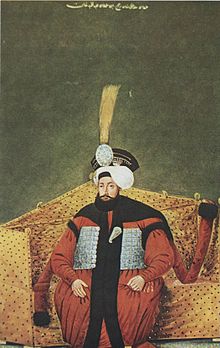 Portrait by Konstantin Kapıdağlı, c. 1804-1806 | |||||
| Sultan of the Ottoman Empire (Padishah) | |||||
| Reign | 29 May 1807 – 28 July 1808 | ||||
| Predecessor | Selim III | ||||
| Successor | Mahmud II | ||||
| Born | 8 September 1779 Constantinople, Ottoman Empire | ||||
| Died | 16 November 1808 (aged 29) Constantinople, Ottoman Empire | ||||
| Burial | Tomb of Abdul Hamid I, Fatih, Istanbul | ||||
| Consorts |
| ||||
| Issue | Şehzade Ahmed Emine Sultan | ||||
| |||||
| Dynasty | Ottoman | ||||
| Father | Abdul Hamid I | ||||
| Mother | Sineperver Sultan | ||||
| Religion | Sunni Islam | ||||
| Tughra |  | ||||

Mustafa IV (/ˈmʊstəfə/; Ottoman Turkish: مصطفى رابع, romanized: Muṣṭafâ-yi râbiʿ; 8 September 1779 – 16 November 1808) was the Sultan of the Ottoman Empire from 1807 to 1808.
Early life[edit]
Mustafa IV was born on 8 September 1779 in Constantinople. He was the son of Sultan Abdul Hamid I (1774–1789) and Sineperver Sultan.[1][2]
Both he and his brother, Mahmud II, were the last remaining male members of the House of Osman after their cousin, the reformist Sultan Selim III (1789–1807). They alone were therefore eligible to inherit the throne from Selim, by whom they were treated favorably. Since Mustafa was the elder, he took precedence over his brother to the throne.[3] During his short reign, Mustafa would both save his cousin's life, and order him murdered. Mustafa was Sultan Selim III's favourite crown prince, but he deceived his cousin and co-operated with the rebels to take his throne.
Reign[edit]
Mustafa ascended to the throne after the deposition of his cousin, Selim, on 29 May 1807.[4] He came to the throne in the wake of the turbulent events that led to the fatwa against Selim for "introduce[ing] among the Muslims the manners of infidels and showing an intention to suppress the Janissaries."[5] Selim fled to the palace, where he swore fealty to his cousin as the new sultan, and attempted to commit suicide. Mustafa spared his life by smashing the cup of poison that his cousin attempted to drink.[5]
Mustafa's brief reign was turbulent. Immediately upon ascending to the throne, the Janissaries rioted throughout Constantinople, looting and murdering anyone who appeared to support Selim.[6] More threatening, however, was a truce signed with the Russians, which freed Mustafa Bayrakdar, a pro-reformist commander stationed on the Danube to march his army back to Constantinople in an effort to restore Selim. With the aid of the Grand Vizier of Adrianople, the army marched on the capital and seized the palace.[5]

Sarıbeyzade Aleko, the interpreter of Fenerli Divan-ı Hümayun, was executed on 11 September 1807 because he was involved in spying on government affairs that were not related to his job. It was written that he gave the betrayal and state secrets to the enemy in the label hanging around his neck. This execution tightened Ottoman-French relations. French envoy Sebastiani protested the execution of Aleko, who was under the patronage of the government by going to Babıali. After the cease-fire agreement signed in the Russian lada and the turmoil in the Silistra army, the Ottoman troops returned to Edirne, who had no army character left.[7]
Meanwhile in Istanbul and Edirne, after a long winter, centre frosts were experienced, shortages and wood shortages were experienced. The situation of the troops and the cadre of Edirne was devastated. Soldiers were asked to dispatch soldiers from the provincial governors, until only an exquisite number of soldiers had come from a few places near Istanbul such as Izmit and Şile. The pro-Nizam-ı Cedid protestors in Anatolia and Çapanoğlu Süleyman Bey, in the first place, had cut all kinds of aid towards Istanbul.[8]
Attempting to secure his position by positing himself as the only surviving heir of Osman, Mustafa ordered both Selim and his brother Mahmud murdered at Topkapı Palace, Constantinople. He then ordered his guards to show the rebels Selim's body,[6] and they promptly tossed it into the inner courtyard of the palace. Mustafa then ascended his throne, assuming that Mahmud was also dead, but the prince had been hiding in the furnace of a bath.[9] Just as the rebels demanded that Mustafa "yield his place to a worthier," Mahmud revealed himself, and Mustafa was deposed. The failure of his short reign prevented the efforts to undo the reforms, which continued under Mahmud.
Death[edit]
Mustafa was later killed on Mahmud's orders on 16 November 1808, and was buried in his father's mausoleum.[10]
Family[edit]
Due to his short reign, Mustafa IV did not have a large family. He had four known consorts, a son and a daughter, both of whom died newborn.
Consorts[edit]
Mustafa IV had four known consorts: [11] [12] [13]
- Şevkinür Kadın. BaşKadin (first consort). She died in 1812 and was buried in Abdülhamid I's mausoleum.
- Peykidil Kadın. She was executed in 1808 by Mahmud II, accused of having plotted against him together with Mustafa IV.
- Dilpezir Kadın. She died in 1809 and was buried in Abdülhamid I's mausoleum.
- Seyare Kadın. She died in 1817 and was buried in Abdülhamid I's mausoleum.
Sons[edit]
Mustafa IV had only one son: [14]
- Şehzade Ahmed (1808/1809 - 1809).
Daughters[edit]
Mustafa IV had only one daughter: [15] [16]
- Emine Sultan (6 May 1809 - October 1809). She is buried with her father in the Hamidiye mausoleum.
References[edit]
- ^ Yavuz Bahadıroğlu, Resimli Osmanlı Tarihi, Nesil Yayınları (Ottoman History with Illustrations, Nesil Publications), 15th Ed., 2009, page 395, ISBN 978-975-269-299-2
- ^ Haskan 2018, p. 85.
- ^ Kinross, Lord (1977). The Ottoman Centuries: The Rise and Fall of the Turkish Empire. Perennial. p. 437. ISBN 0-688-03093-9..
- ^ Haskan 2018, p. 86.
- ^ a b c Kinross 1977, p. 433
- ^ a b Goodwin, Jason (1998). Lords of the Horizon: A History of the Ottoman Empire. Picador. p. 291. ISBN 0312420668.
- ^ Sakaoğlu 2015, p. 380.
- ^ Sakaoğlu 2015, p. 381.
- ^ Kinross 1977, p. 434.
- ^ Haskan 2018, p. 86-87.
- ^ Ziya, Mehmet (2004). Istanbul ve Boğaziçi: Bizans ve Osmanlı medeniyetlerinin Ölümsüz Mirası, Volume 1. BIKA.
- ^ Haskan, Mehmet Nermi (January 1, 2018). Hamîd-i Evvel Külliyesi ve Çevresi. Istanbul Ticaret Borsasi. ISBN 978-6-051-37663-9. p. 94
- ^ Danacı-Yıldız, Aysel (2008). Osmanlı Araştırmaları - Volume 31: III. Selim'in Katilleri. Istanbul 29 Mayis University. p. 81 and n. 150.
- ^ Kinross, Lord (1977). The Ottoman Centuries: The Rise and Fall of the Turkish Empire. Perennial. p. 437. ISBN 0-688-03093-9.
- ^ Danacı-Yıldız, Aysel (2008). Osmanlı Araştırmaları - Volume 31: III. Selim'in Katilleri. İstanbul 29 Mayıs University. p. 81 and n. 150.
- ^ Haskan, Mehmet Nermi (1 January 2018). Hamîd-i Evvel Külliyesi ve Çevresi. Istanbul Ticaret Borsasi. ISBN 978-6-051-37663-9. p. 87
Sources[edit]
- Haskan, Mehmet Nermi (1 January 2018). Hamîd-i Evvel Külliyesi ve Çevresi. Istanbul Ticaret Borsasi. ISBN 978-6-051-37663-9.
- Sakaoğlu, Necdet (2015). Bu Mülkün Sultanları. Alfa Yayıncılık. ISBN 978-6-051-71080-8.
External links[edit]
 Media related to Mustafa IV at Wikimedia Commons
- http://www.uslanmam.com/turk-kulturu/651298-sultan-i-abdulhamid-turbesi-eminonu.html Archived 11 February 2011 at the Wayback Machine
Ottoman Sultans / Caliphs | |
|---|---|
| |
| |
§ First Ottoman caliph
|
 Category
 Ottoman princes Ottoman princes | ||
|---|---|---|
| 1st generation |
|  |
| 2nd generation |
| |
| 3rd generation |
| |
| 4th generation |
| |
| 5th generation |
| |
| 6th generation |
| |
| 7th generation |
| |
| 8th generation |
| |
| 9th generation |
| |
| 10th generation |
| |
| 11th generation |
| |
| 12th generation |
| |
| 13th generation |
| |
| 14th generation |
| |
| 15th generation |
| |
| 16th generation |
| |
| 17th generation |
| |
| 18th generation |
| |
| 19th generation |
| |
| 20th generation |
| |
| 21st generation |
| |
| 22nd generation |
| |
| 23rd generation |
| |
Authority control | |
|---|---|
| General | |
| National libraries | |
| Biographical dictionaries | |
| Other | |

Original source: https://en.wikipedia.org/wiki/Mustafa IV
Status: article is cached
 EncycloReader
is supported by the
EncycloReader
is supported by the  KSF
KSF