Categories
Naha Airport
 From Wikipedia - Reading time: 11 min
Naha Airport 那覇空港 Naha Kūkō | |||||||||||||||
|---|---|---|---|---|---|---|---|---|---|---|---|---|---|---|---|
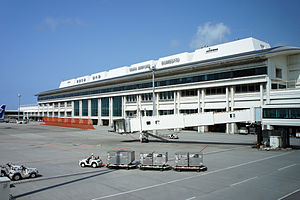 | |||||||||||||||
| Summary | |||||||||||||||
| Airport type | Public / military | ||||||||||||||
| Owner/Operator | Ministry of Land, Infrastructure, Transport and Tourism | ||||||||||||||
| Serves | Okinawa Prefecture | ||||||||||||||
| Opened | 1933 | ||||||||||||||
| Hub for |
| ||||||||||||||
| Focus city for |
| ||||||||||||||
| Elevation AMSL | 11 ft / 3 m | ||||||||||||||
| Coordinates | 26°11′45″N 127°38′45″E / 26.19583°N 127.64583°E | ||||||||||||||
| Website | www | ||||||||||||||
| Map | |||||||||||||||
  ROAH Location in Japan 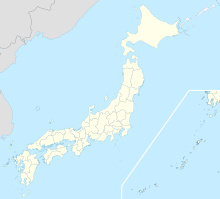 ROAH ROAH (Japan) | |||||||||||||||
| Runways | |||||||||||||||
| |||||||||||||||
| Statistics (2015) | |||||||||||||||
| |||||||||||||||
Source: Japanese Ministry of Land, Infrastructure, Transport and Tourism[2] | |||||||||||||||
Naha Airport (那覇空港, Naha Kūkō) (IATA: OKA, ICAO: ROAH) is a second class airport located 4 km (2.5 mi) west of the city hall[3] in Naha, Okinawa. It is Japan's seventh busiest airport and the primary air terminal for passengers and cargo traveling to and from Okinawa Prefecture, Japan. It handles scheduled international traffic to Taiwan, Hong Kong, South Korea, Thailand, Singapore and mainland China. The airport is also home to Naha Air Base of the Japan Air Self-Defense Force.
Naha Airport served 17.5 million passengers in 2014, an increase of roughly three million passengers in two years.


History[edit]
Oroku Aerodrome (小禄飛行場), an Imperial Japanese Navy airfield, opened in 1933. The base was taken over by the United States in 1945 and was renamed Naha Airport (那覇飛行場). Pan American World Airways and Northwest Orient began service to Naha in 1947.
The airport was closed for refurbishment between 1952 and 1954. Japan Airlines began service to Okinawa during this time and initially used Kadena Air Base.
Air America operated interisland flights to Miyako and Ishigaki from 1964 to 1967, when Southwest Airlines (now Japan Transocean Air) took over these routes.
Okinawa was returned to Japan in 1972. In 1982, Naha Airport was transferred from US military control to the Japan Air Self-Defense Force.
The airport was a popular connecting point between Taipei and Shanghai prior to the opening of nonstop cross-Strait flights between mainland China and Taiwan.[citation needed]
The basic and detailed design engineering works in addition to the later construction management phase of the main passenger terminal were awarded in the 1990s in part to the Japan Branch of the American design-build engineering company, The Austin Company, which joined Japanese firms in a joint venture design consortium.
Peach, a low-cost carrier (LCC) based at Kansai International Airport in Osaka, announced that it would establish its second hub at Naha in July 2014, which would initially have flights to Osaka, Fukuoka, Ishigaki and Taipei.[4] ANA Holdings, the parent company of both Peach and Vanilla Air, opened a new LCC terminal in a refurbished portion of the airport's cargo area in October 2012, and plans to open new international facilities in October 2014.[5]
Development[edit]
 | This section needs to be updated. (April 2023) |
The airport has been undergoing major development projects that will continue to transform the airport:
- In 2008, the government agreed to significantly expand the domestic terminal, which will require the relocation of cargo facilities and the international terminal.
- The construction of a second 2,700 m (8,900 ft) parallel runway began on March 1, 2014 (opening March 26, 2020), on 160 hectares (400 acres) of reclaimed land.[1]
- The new international terminal opened in February 2014. The international terminal is again being expanded and will grow by 3,000 m2 (32,000 sq ft) in November 2016. [needs update]A new building connecting the domestic and international terminals is due to be completed in 2020 along with the second runway.[6]
- A LCCT terminal has been in operation since 2012.
- In addition, a 6-lane under bay tunnel for auto transport linking the airport with the Naha Port boosting the utility of the intermodal facility was completed in 2011. This tunnel will also link a 2.6-hectare (6.4-acre) Free Trade Zone near the Airport with another 122-hectare (300-acre) FTZ located at Nakagusuku Bay.
Terminals[edit]
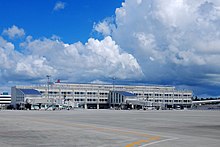

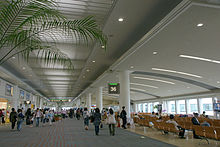
- Domestic Terminal (1999) - replaced former domestic terminal, extended to include LCCT, other extensions works to conclude in 2016.
- Cargo Terminal (2009) - Former domestic terminal became the cargo terminal
- LCCT Terminal (2012) - north annex of domestic terminal (Peach Domestic & International only).
- New International Terminal (2014) - replaced old international terminal
Airlines and destinations[edit]
Passenger[edit]
| Airlines | Destinations |
|---|---|
| Air China | Beijing–Capital |
| All Nippon Airways | Fukuoka, Hiroshima, Matsuyama, Miyako, Osaka–Itami, Osaka–Kansai, Sendai, Tokyo–Haneda Seasonal: Sapporo–Chitose, Shizuoka[7] |
| ANA Wings | Fukuoka, Ishigaki, Iwakuni, Kumamoto, Matsuyama, Miyako, Nagoya–Centrair |
| Asiana Airlines | Seoul–Incheon[8] |
| Batik Air Malaysia | Kuala Lumpur–International, Taipei–Taoyuan[9] |
| China Airlines | Kaohsiung, Taipei–Taoyuan |
| China Eastern Airlines | Shanghai–Pudong[10] |
| EVA Air | Taipei–Taoyuan |
| HK Express | Hong Kong |
| Hong Kong Airlines | Hong Kong |
| Japan Air Commuter | Okinoerabu |
| Japan Airlines | Osaka–Itami, Tokyo–Haneda |
| Japan Transocean Air | Fukuoka, Ishigaki, Komatsu, Kumejima, Miyako, Nagoya–Centrair, Okayama, Osaka–Kansai Charter: Taipei–Taoyuan |
| Jeju Air | Seoul–Incheon |
| Jetstar Asia | Singapore[11] |
| Jetstar Japan | Nagoya–Centrair, Osaka–Kansai, Tokyo–Narita |
| Jin Air | Busan,[12] Seoul–Incheon |
| Juneyao Air | Shanghai–Pudong[13] |
| Korean Air | Seoul–Incheon[14] |
| Peach | Fukuoka, Kaohsiung,[15] Osaka–Kansai, Sapporo–Chitose,[16] Sendai,[16] Seoul–Incheon, Taipei–Taoyuan |
| Ryukyu Air Commuter | Amami Oshima, Ishigaki, Kitadaito, Kumejima, Minamidaito, Yonaguni, Yoron |
| Skymark Airlines | Fukuoka, Ibaraki, Kobe, Nagoya–Centrair, Shimojishima,[17] Tokyo–Haneda |
| Solaseed Air | Fukuoka,[18] Ishigaki, Kagoshima, Kobe, Miyazaki, Nagoya–Centrair, Tokyo–Haneda |
| Spring Airlines | Shanghai–Pudong (begins 26 January 2024)[19] |
| Starlux Airlines | Taipei–Taoyuan |
| Tigerair Taiwan | Kaohsiung,[20] Taipei–Taoyuan |
| T'way Air | Seoul–Incheon[21] |
Cargo service[edit]
All Nippon Airways operates an overnight cargo hub at Naha Airport, which receives inbound Boeing 767 freighter flights from key destinations in Japan, China and Southeast Asia between 1 and 4 a.m., followed by return flights between 4 and 6 a.m., allowing overnight service between these regional hubs as well as onward connections to other ANA and partner carrier flights.[22]
The hub began operations in 2009; by 2013 it served eight cities, and ANA had chartered a Nippon Cargo Airlines Boeing 747 freighter to handle demand on the trunk route from Narita International Airport.[23]
Statistics[edit]
 | Graphs are unavailable due to technical issues. There is more info on Phabricator and on MediaWiki wiki. |
Accidents and incidents[edit]
- On July 27, 1970, Flying Tiger Line Flight 45, a Douglas DC-8-63AF flying to Da Nang Air Force Base from Los Angeles via San Francisco and Tokyo, was on its final approach when it crashed 0.4 miles short of Runway 18, killing all 4 crew members.[24][25]
- On December 11, 1994, Armaldo Forlani planted a bomb on Philippine Airlines Flight 434, which exploded while the flight was en route from Cebu to Tokyo, killing one passenger and injuring ten other passengers. The plane made an emergency landing at Naha Airport safely.
- On August 20, 2007, China Airlines Flight 120, a Boeing 737-800, was taxiing to the ramp after landing when suddenly a fire started beneath the right wing, quickly engulfing the entire plane. All passengers and crew members were evacuated safely. Investigations later revealed that part of the slat drive mechanism pierced the fuel tank, and the leaking fuel ignited when it came into contact with hot engine parts.
- On June 3, 2015, an All Nippon Airways Boeing 737 bound for Sapporo aborted takeoff at Naha after a JASDF CH-47 Chinook helicopter crossed its departure path without clearance. An inbound Japan Transocean Air flight landed on the same runway, stopping 400 meters behind the ANA aircraft, despite an air traffic control order to go around, which the JTA pilot claimed to have received after landing.[26]
- On December 4, 2020, Japan Airlines Flight 904, operated by a Boeing 777-200 from Okinawa Naha airport to Tokyo Haneda suffered a fan blade failure in one of its two PW4084 engines. None of the 189 occupants on board were injured in the incident.[27]
Access[edit]
The airport is served by the Okinawa Urban Monorail (Yui Rail) which carries passengers from Naha Airport Station to the center of Naha, and to the terminal at Tedako-Uranishi Station in Urasoe. Bus service is also available to many parts of Okinawa Island.
References[edit]
- ^ a b https://www.japantimes.co.jp/news/2019/03/24/national/politics-diplomacy/base-laden-okinawa-vies-become-tourism-magnet/#.XrOGB8B7mUk/ Naha Airport to open second runway on March 26, 2020 at the Wayback Machine (archived 2019-03-25)
- ^ "Naha Airport" (PDF). Japanese Ministry of Land, Infrastructure, Transport and Tourism. Archived from the original (PDF) on 21 October 2016. Retrieved 7 January 2017.
- ^ AIS Japan Archived 2016-05-17 at the Portuguese Web Archive
- ^ Yoshikawa, Tadayuki (21 January 2014). ピーチ、那覇-福岡線開設 7月に第2ハブ稼働. Aviation Wire. Archived from the original on 25 January 2014. Retrieved 22 January 2014.
- ^ ANA、那覇の国際線LCCターミナル公開 10日からピーチ使用. Aviation Wire. 8 February 2014. Archived from the original on 14 February 2014. Retrieved 10 February 2014.
- ^ "Naha Airport to expand its international terminal". Archived from the original on 2015-05-03. Retrieved 2015-05-07.
- ^ ANA Dec 2022/Jan 2023 Shizuoka Operations Aeroroutes. 24 August 2022.
- ^ "Asiana Airlines Resumes Additional Regional Service in Nov/Dec 2022". Aeroroutes.
- ^ "Batik Air Malaysia Adds Okinawa From Aug 2023; Osaka Increases". Retrieved 12 April 2023.
- ^ "Mainland Chinese Carriers NS23 International / Regional Network – 23APR23". Aeroroutes. Retrieved 24 April 2023.
- ^ Greg Waldron (14 July 2023). "Nagoya sees international recovery, as Jetstar Asia reboots Okinawa flights". FlightGlobal.
- ^ "Jin Air Resumes Busan – Okinawa Service in NW23". Aeroroutes. Retrieved 16 August 2023.
- ^ "Mainland Chinese Carriers August – October 2023 Japan Network – 30JUL23". Aeroroutes. Retrieved 31 July 2023.
- ^ "Korean Air Rebuilding Its Network In Japan, China and Israel". Simple Flying. 17 November 2022.
- ^ "Peach plans Okinawa – Kaohsiung launch in late-April 2018". routesonline. Archived from the original on 25 January 2018. Retrieved 26 January 2018.
- ^ a b Liu, Jim. "Peach expands Okinawa service in W20". Routesonline. Retrieved 1 September 2020.
- ^ Liu, Jim. "Skymark Airlines adds Shimojishima service from late-Oct 2020". Routesonline. Retrieved 19 August 2020.
- ^ Liu, Jim. "Solaseed Air adds Okinawa – Fukuoka service from late-March 2020". Routesonline. Retrieved 11 February 2020.
- ^ "Spring Airlines Adds Shanghai – Okinawa Service From late-Jan 2024". Aeroroutes. Retrieved 7 December 2023.
- ^ "tigerair Taiwan adds Kaohsiung – Okinawa route in Mar 2017". routesonline. Archived from the original on 10 November 2016. Retrieved 9 November 2016.
- ^ T'Way Air NW22 Japan Operations – 27OCT22 Aeroroutes. 27 October 2022.
- ^ "Archived copy" (PDF). Archived from the original (PDF) on 2013-08-21. Retrieved 2013-07-17.
{{cite web}}: CS1 maint: archived copy as title (link) - ^ 全日空「沖縄貨物ハブ」上昇気流 国内外で路線拡充. The Nikkei (in Japanese). 24 August 2013. Retrieved 26 August 2013.
- ^ "ASN Aircraft accident McDonnell Douglas DC-8-63AF N785FT Okinawa-Naha AFB (AHA)". aviation-safety.net. Retrieved 2022-12-19.
- ^ AIRCRAFT ACCIDENT REPORT (PDF). NTSB. 1971-12-29.
- ^ "ANA jet aborts take-off after SDF copter cuts across its path at Naha airport". Japan Today. 4 June 2015. Archived from the original on 28 July 2015. Retrieved 5 June 2015.
- ^ "Incident: JAL B772 at Okinawa on Dec 4th 2020, engine shut down in flight after uncontained failure, parts of engine cowl dropped".
External links[edit]


- Airport website (in Japanese)
- Airport website (in English)
- Airports of Okinawa
- Naha Airport Guide from Japan Airlines
- Current weather for ROAH at NOAA/NWS
- Accident history for OKA at Aviation Safety Network
Airports in Japan | |||||||||||||||||
|---|---|---|---|---|---|---|---|---|---|---|---|---|---|---|---|---|---|
1 Joint civil-military use | |||||||||||||||||
| Major hubs |
| ||||||||||||||||
| International |
| ||||||||||||||||
| Domestic |
| ||||||||||||||||
| General aviation |
| ||||||||||||||||
| Military |
| ||||||||||||||||
| Heliports |
| ||||||||||||||||
| Defunct |
| ||||||||||||||||
| Statistics | List of the busiest airports in Japan | ||||||||||||||||


Original source: https://en.wikipedia.org/wiki/Naha Airport
Status: article is cached
 EncycloReader
is supported by the
EncycloReader
is supported by the  KSF
KSF