Categories
Parishes of Barbados
 From Wikipedia - Reading time: 9 min
Politics of Barbados |
|---|
 |
|
The country of Barbados is divided into sub-regions known as parishes.
Terminology
[edit]They are legally styled as the "Parish of (parish name)" as opposed to the American naming convention with "Parish" coming after the name.[1][2] The use of the term "parish" derives from the island's religious Anglican history under the Church of England.
History
[edit]The system of parish churches was originally based on the system of the Church of England and was the visible expression forming the basis of the parliamentary representation in Barbados. The differing size and shape of each parish were primarily influenced by the large plantation estates of cotton, sugar cane and tobacco that existed during the colonial years of Barbados. As various chapels of ease were created during the 17th century across the island, some local churches were elevated to parish church status, leading to the formation of new parishes surrounding those freshly created vestries.
By 1629, the English settlers after landing at James Town formed six original parishes on the island which were:[3]
- The Parish of Christ Church,
- The Parish of St. James,
- The Parish of St. Lucy,
- The Parish of St. Michael,
- The Parish of St. Peter, and
- The Parish of St. Thomas
By 1645, the land holding of Barbados increased and the shape of the original six was reconfigured giving way to an additional five parishes.[3] Some prior churches of the state within the existing parishes were elevated to the level of parish church and as a consequence they formed new parishes around those new vestries:
- The Parish of St. Andrew,
- The Parish of St. George,
- The Parish of St. John,
- The Parish of St. Joseph, and
- The Parish of St. Philip.
Thus Barbados was converted into the current eleven parishes of today corresponding to the earlier church parishes. As was common under the British system, each parish had a single main parishional church (or cathedral in the case of Bridgetown having been elevated to city status), which acted as a sort of capital for each parish.[4][5] The parishes each held their own local government councils until these were abolished in 1959, following a brief administrative districting experiment within Barbados until 1967.[4]
List
[edit] Atlantic Ocean
Saint Lucy
Saint
Peter Saint
Andrew Saint
James Saint
Thomas Saint
Joseph Saint
John Saint
George Saint
Michael Christ
Church Saint
Philip BARBADOS
|
Within the country, travel is unrestricted to everyone in moving about from parish to parish. With increasing urban sprawl and new construction projects across the country many neighbourhoods and even parishional border-lines today are ill-defined.
The eleven parishes are:
| Short name | Long name | Land area | Population (census 2010) |
Density | Historic vestry |
|---|---|---|---|---|---|
| Christ Church | The Parish of Christ Church[6] | 57 km2 (22 sq mi) | 54,336 | 953.3/km2 | 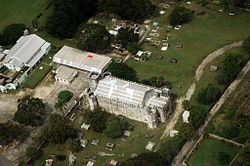 |
| St. Andrew | The Parish of Saint Andrew[7] | 36 km2 (14 sq mi) | 5,139 | 142.8/km2 |  |
| St. George | The Parish of Saint George | 44 km2 (17 sq mi) | 19,767 | 449.3/km2 | |
| St. James | The Parish of Saint James[7] | 31 km2 (12 sq mi) | 28,498 | 449.3/km2 | |
| St. John | The Parish of Saint John | 34 km2 (13 sq mi) | 8,963 | 263.6/km2 |  |
| St. Joseph | The Parish of Saint Joseph[7] | 26 km2 (10 sq mi) | 6,620 | 254.6/km2 |  |
| St. Lucy | The Parish of Saint Lucy[7] | 36 km2 (14 sq mi) | 9,758 | 271.1/km2 | |
| St. Michael | The Parish of Saint Michael[7] | 39 km2 (15 sq mi) | 88,529 | 2,270.0/km2 | |
| St. Peter | The Parish of Saint Peter | 34 km2 (13 sq mi) | 11,300 | 332.4/km2 |  |
| St. Philip | The Parish of Saint Philip[7] | 60 km2 (23 sq mi) | 30,662 | 511.0/km2 | |
| St. Thomas | The Parish of Saint Thomas | 34 km2 (13 sq mi) | 14,249 | 419.1/km2 |
See also
[edit]- Constituency Councils
- Geography of Barbados
- History of Barbados
- Transport in Barbados
- Barbadian vehicle registration plates
- ISO 3166-2:BB
- List of cities in Barbados
- List of West Indian first-level country subdivisions
- List of Caribbean islands by area
- List of Caribbean islands by political affiliation
- List of Caribbean island countries by population
- List of metropolitan areas in the West Indies
References
[edit]- ^ Laws of Barbados, Volume 2, p.573, 286.
- ^ U-Ming, Mike. "Fear and panic as Barbados regularisation deadline loom". Barbados Cultural Association of British Columbia – History of Barbados. Archived from the original on June 12, 2009.
- ^ a b "The Barbados Parliament – Parliament History". Barbados Parliament website. Archived from the original on May 23, 2007. Retrieved 2007-05-01.
- ^ a b Carrington, Sean; Fraser, Henry (2007). "Vestry". A~Z of Barbados Heritage. Macmillan Caribbean - Macmillan Publishers Limited Press. ISBN 978-0-333-92068-8.
- ^ Alleyne, Warren (1978). Historic Bridgetown. Barbados: Barbados National Trust.
- ^ Laws of Barbados, Volume 2, p.573
- ^ a b c d e f Laws of Barbados, Volume 2, p.586
Further reading
[edit]- Laws of Barbados (Laws, statutes, etc. compilations) – 1875. Vol. 1. Stamford Street and Charing Cross, London: William Clowes and Sons. 1875 [1875]. p. 586. Retrieved 3 January 2010.
External links
[edit]
|  | |
Original source: https://en.wikipedia.org/wiki/Parishes of Barbados
Status: article is cached
 EncycloReader
is supported by the
EncycloReader
is supported by the  KSF
KSF