Categories
Paseo de la Princesa
 From Wikipedia - Reading time: 6 min
| Paseo de la Princesa | |
|---|---|
  Midpoint of Paseo de la Princesa with Fuente Raíces (Roots Fountain) and endpoint of promenade at Puerta de San Juan of city wall under La Fortaleza | |
 | |
| General information | |
| Type | Promenade |
| Architectural style | Fortification,Spanish Renaissance, Neoclassical |
| Location | Old San Juan, Puerto Rico |
| Opened | 1852-54 |
| Owner | Government of Puerto Rico |
Paseo de la Princesa (English: Promenade of the Princess or Princess Promenade), is a partially waterfront 19th century pedestrian promenade around 500 meters in length located in the historic district of Old San Juan in Puerto Rico that is lined with Victorian lampposts and benches, large trees touching overhead, gardens, and varying fountains, sculptures, and statues, and hosts food and artisan street vendor carts, musical and theatrical street entertainers, and cultural restaurants and festivals.[1]
Constructed between 1852 and 1854 in honor Princess of Asturias Infanta Isabel of Spain, the first-born of Queen Isabella II of Spain, the promenade runs adjacent and parallel to the entire southern portion of the City Wall of San Juan and the Real Cárcel La Princesa (The Princess Royal Jail), also known as the Antigua Prisión La Princesa (The Princess Old Prison), which was built in 1837 and today houses the Puerto Rico Tourism Company.[2]
Officially, the promenade starts at Bastión de la Derecha de San Justo y Pastor (Left-side Bastion of San Justo and Pastor) in Marina, the southernmost sub-barrio in Old San Juan on the San Juan Islet, passing through the popular Fuente Raíces (Roots Fountain), a large sculptural fountain overlooking San Juan Bay that represents Puerto Rican identity, a mixture of Taino, Spanish, and Sub-Saharan African ancestry and culture, and ending at the western portion of City Wall of San Juan at Puerta de San Juan (San Juan Gate), formerly known as Puerta de Agua (Water Gate), which lies under La Fortaleza, the 16 century executive residence of the Governor of Puerto Rico, and is the starting location of Paseo Del Morro (Promenade of The Morro), the waterfront promenade covering the rest of the western portion of the city wall culminating at the bottom of Castillo San Felipe del Morro on the westernmost point of the San Juan Islet overlooking the entrance to San Juan Bay.[3]

Overview[edit]
Paseo de la Princesa is often described as one of the most scenic city walkways in the world and, due to its location close to the cruise ship harbor, it is often the starting point for sightseeing in Old San Juan.[4]

Fuente Raíces (Roots Fountain) located on a plaza at the midpoint of the promenade is a sculpture fountain representing and celebrating the ancestral roots of the Puerto Rican identity: the European culture brought by the Spanish and other settlers, the African culture brought by the African slaves and the native Taino culture.[5] This plaza also hosts a small wooden dock that offers great views of San Juan Bay, El Yunque and the Sierra de Luquillo to the east, and of other municipalities such as Cataño and Bayamón to the west.
The iconic Puerta de San Juan (San Juan Gate) is the only remaining city gate, and it is found at the end the promenade. This city gate was originally called the Puerta de Agua (water gate) because it offered access to San Juan's harbor. Today, the gate also offers access to La Fortaleza, the Capilla del Cristo and the Parque de las Palomas. There is also a built waterside promenade that continues along the city walls towards El Morro, named Paseo del Morro.
Other landmarks and attractions are the Americas Heritage Fountain, the San Justo y Pastor Bastion, the La Concepción Bastion, and a playground for children. The promenade also hosts an open air café and a restaurant that serves traditional Puerto Rican food called Princesa Gastrobar.[6] Piraguas, piña coladas and platanutres (fried plantain chips) are popular drinks and snacks to buy in the esplanade.[7] During the weekends and festival celebrations, one can find live music, street vendors, traditional street food and temporary art exhibitions. There is live jazz on Fridays and Saturdays, and salsa music and dance on Saturdays and Sundays.[8]
History[edit]
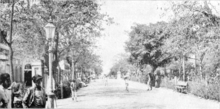
The area used to host an interim prison, first built in 1837, called La Princesa Prison (Spanish: Antigua Prisión de la Princesa), named after Isabella II of Spain. While the promenade itself dates to 1853, the area originally was used by the Spanish military as an area to provide clear fields of fire for the cannons and guns that were located outside of the city walls. Puerto Rico Governor and Sr. Lieutenant General Don Fernando de Norzagaray foresaw an expansion of the prison and the construction of its tower. The prison had capacity for about 240 prisoners and continued to operate until 1965.[9]
The area where the promenade is located fell into disrepair in the 20th century but after housing was built in the area it was rehabilitated and restored in 1989. The Puerto Rico Tourism Company is now headquartered in the former prison. The company also installed a time capsule in 1995, located on the promenade in front of the former prison building. This time capsule was opened in 2020, and two more capsules were installed afterwards. These capsules are stated to be opened in 2045.[10] La Princesa building also houses a small art exhibition and often hosts cultural events.[11]
Gallery[edit]
-
 View of La Fortaleza and La Concepción Bastion from the western end of La Princesa.
 -
 View of La Princesa and Raíces Fountain from the eastern end of the path.
 -
 Closeup of some of the sculptures of the Raíces Fountain.
 -
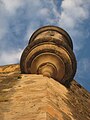 A garita on the Derecha de San Justo Bastion located near the eastern end of the path.
 -
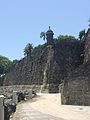 A garita on the city walls of Old San Juan.
 -
 View of Isla de Cabras across San Juan Bay.
 -
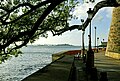 La Princesa and the city walls of San Juan.
 -
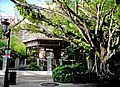 Open air café in La Princesa.
 -
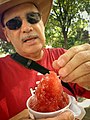 Man eating a piragua (Puerto Rican shaved ice) in Paseo de la Princesa in 2014
See also[edit]

- List of streets in San Juan, Puerto Rico
References[edit]
- ^ "Paseo De La Princesa". Discover Puerto Rico. Retrieved 2021-09-23.
- ^ "Historia del Viejo San Juan: La princesa del Paseo de la Princesa". El Adoquín Times. Retrieved 2024-01-25.
- ^ "El Paseo de la Princesa, en Puerto Rico". Sobre Caribe (in Spanish). Retrieved 2024-01-24.
- ^ "Paseo de la Princesa - Most Romantic Walk in the Caribbean". San Juan Puerto Rico. Retrieved 2021-09-23.
- ^ "Fuente Raíces | San Juan & Around, Puerto Rico Attractions". Lonely Planet. Retrieved 2021-09-23.
- ^ "Home". princesapr. Retrieved 2021-09-23.
- ^ Hyperakt (2021-09-22). "La Cubanita". On the Grid. Retrieved 2021-09-23.
- ^ "Paseo de La Princesa in Old San Juan | Discovering Puerto Rico". 2009-07-14. Retrieved 2021-09-23.
- ^ "Antigua Prisión La Princesa". Puerto Rico Historic Buildings Drawings Society. Retrieved 2021-09-23.
- ^ Costa, Juan R. "Abren cápsulas del tiempo enterradas hace 25 años en Turismo". www.noticel.com. Retrieved 2021-09-23.
- ^ "Paseo de La Princesa in Old San Juan | Discovering Puerto Rico". 2009-07-14. Retrieved 2021-09-23.
External links[edit]
 Media related to Paseo de la Princesa at Wikimedia Commons
Original source: https://en.wikipedia.org/wiki/Paseo de la Princesa
Status: article is cached
 EncycloReader
is supported by the
EncycloReader
is supported by the  KSF
KSF