Pyranose oxidase
 From Wikipedia - Reading time: 7 min
| pyranose oxidase | |||||||||
|---|---|---|---|---|---|---|---|---|---|
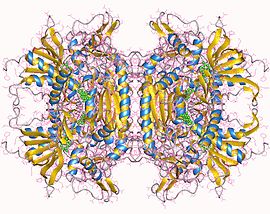 Pyranose oxidase tetramer, Trametes ochracea | |||||||||
| Identifiers | |||||||||
| EC no. | 1.1.3.10 | ||||||||
| CAS no. | 37250-80-9 | ||||||||
| Databases | |||||||||
| IntEnz | IntEnz view | ||||||||
| BRENDA | BRENDA entry | ||||||||
| ExPASy | NiceZyme view | ||||||||
| KEGG | KEGG entry | ||||||||
| MetaCyc | metabolic pathway | ||||||||
| PRIAM | profile | ||||||||
| PDB structures | RCSB PDB PDBe PDBsum | ||||||||
| Gene Ontology | AmiGO / QuickGO | ||||||||
| |||||||||
In enzymology, a pyranose oxidase (EC 1.1.3.10) is an enzyme that catalyzes the chemical reaction
- D-glucose + O2 2-dehydro-D-glucose + H2O2

Thus, the two substrates of this enzyme are D-glucose and O2, whereas its two products are 2-dehydro-D-glucose and H2O2.
Pyranose oxidase is able to oxidize D-xylose, L-sorbose, D-galactose,[1] and D-glucono-1,5-lactone, which have the same ring conformation and configuration at C-2, C-3 and C-4.[2]
This enzyme belongs to the family of oxidoreductases, specifically those acting on the CH-OH group of donor with oxygen as acceptor. The systematic name of this enzyme class is pyranose:oxygen 2-oxidoreductase. Other names in common use include glucose 2-oxidase, and pyranose-2-oxidase. This enzyme participates in pentose phosphate pathway. It employs one cofactor, FAD.
Structural studies[edit]
As of late 2007, 8 structures have been solved for this class of enzymes, with PDB accession codes 1TT0, 1TZL, 2F5V, 2F6C, 2IGK, 2IGM, 2IGN, and 2IGO.
Use in biosensors[edit]
Recently, pyranose oxidase has been gaining on popularity within biosensors.[1] Unlike glucose oxidase, it can produce higher power output, given that it is not glycosylated, has more favorable value of Michaelis-Menten constants, and can catalytically convert both anomers of glucose. It reacts with a wider range of substrates. Pyranose oxidase does not cause an unwanted pH shift. It is also possible to easily express and produce it in high yields using E. coli.[1]
References[edit]
- ^ a b c Abrera AT, Sützl L, Haltrich D (April 2020). "Pyranose oxidase: A versatile sugar oxidoreductase for bioelectrochemical applications". Bioelectrochemistry. 132: 107409. doi:10.1016/j.bioelechem.2019.107409. PMID 31821902.
- ^ Janssen FW, Ruelius HW (November 1968). "Carbohydrate oxidase, a novel enzyme from Polyporus obtusus. II. Specificity and characterization of reaction products". Biochimica et Biophysica Acta (BBA) - Enzymology. 167 (3): 501–10. doi:10.1016/0005-2744(68)90040-5. PMID 5722278.
Further reading[edit]
- Machida Y, Nakanishi T (1984). "Purification and properties of pyranose oxidase from Coriolus versicolor". Agricultural and Biological Chemistry. 48 (10): 2463–2470. doi:10.1271/bbb1961.48.2463.
- Neidleman SL, Amon Jr WF, Geigert J (1981). "Process for the production of fructose". Chem. Abstr. 94: 20737.
- Ruelius HW, Kerwin RM, Janssen FW (November 1968). "Carbohydrate oxidase, a novel enzyme from Polyporus obtusus. I. Isolation and purification". Biochimica et Biophysica Acta (BBA) - Enzymology. 167 (3): 493–500. doi:10.1016/0005-2744(68)90039-9. PMID 5725162.

Original source: https://en.wikipedia.org/wiki/Pyranose oxidase
Status: article is cached
 EncycloReader
is supported by the
EncycloReader
is supported by the  KSF
KSF