Categories
RCD Espanyol
 From Wikipedia - Reading time: 22 min
 | ||||
| Full name | Reial Club Deportiu Espanyol de Barcelona, S.A.D. | |||
|---|---|---|---|---|
| Nickname(s) | Periquitos (Parakeets) Blanc-i-blaus (White and Blue) | |||
| Short name | RCDE | |||
| Founded | 28 October 1900 (as Sociedad Española de Football) | |||
| Stadium | RCDE Stadium | |||
| Capacity | 40,000[1] | |||
| Owner | Velocity Sport Limited | |||
| President | Alan Pace | |||
| Head coach | Manolo González | |||
| League | La Liga | |||
| 2024–25 | La Liga, 14th of 20 | |||
| Website | rcdespanyol.com | |||
| ||||






| Departments of RCD Espanyol | ||||||||||||||||
|---|---|---|---|---|---|---|---|---|---|---|---|---|---|---|---|---|
|


Reial Club Deportiu Espanyol de Barcelona (Catalan: [rəˈjal ˈklub dəpuɾˈtiw əspəˈɲɔl də βəɾsəˈlonə]; "Royal Spanish Sports Club of Barcelona"), commonly known as RCD Espanyol, is a Spanish professional sports club based in Barcelona, Catalonia, Spain. The club competes in La Liga, the top tier of Spanish football.
Founded in 1900 in Barcelona, Espanyol currently play their home games just outside the city at the RCDE Stadium, which holds up to 40,000 spectators. Domestically, Espanyol has won the Copa del Rey four times, most recently in 2006. In international competitions, the club reached the UEFA Cup final in 1988 and 2007. It has a long-standing local rivalry with FC Barcelona.
Name
[edit]
Initially known as the Sociedad Española de Football on its foundation, the name was changed to Club Español de Fútbol in 1901. In 1906, the club folded due to financial reasons and most of the players joined the X Sporting Club, which came to win the Campionat de Catalunya three times in a row before disappearing in 1908 to merge with the Spanish Jiu-Jitsu Club to be effectively relaunched as the Club Deportivo Español, and in 1910, they adopted their present-day colours. Espanyol is one of several Spanish football clubs granted patronage by the Spanish crown and thus entitled to use Real in their names and the royal crown on their badge. This right was granted to Espanyol in 1912 by Alfonso XIII and the club subsequently became known as the Real Club Deportivo Español.[2]
Following the abdication of the same king in 1931 and the declaration of the Second Spanish Republic, due to prohibition of royal symbols, the club adopted the more Catalan/republican friendly name, Club Esportiu Espanyol. After the Spanish Civil War, the name was reverted.
The club took the Catalan spelling for its name in February 1995. The word "Deportiu" in Reial Club Deportiu Espanyol de Barcelona is a Catalanised form of the original word "Deportivo" (Castilian), despite the correct word being "Esportiu" in the Catalan language. This choice was made in order to retain the initials "RCD" in the club's name.
History
[edit]Foundation and club culture
[edit]Espanyol was founded on 28 October 1900 by Ángel Rodríguez Ruiz, an engineering student at the University of Barcelona.[3] The club's original home was in the well-off district of Sarrià; Espanyol was the first club in Spain formed exclusively by Spanish fans of the game, with the other early clubs having links to Britain or central Europe.
-
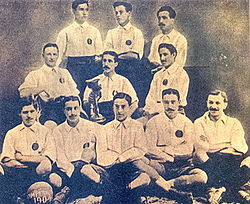 CD Espanyol de Barcelona, Catalan champions in 1904
 -
 RCD Español in 1912

A friend of the club founder owned a textile business and happened to have an abundance of yellow material left over from a job. In 1910, the club changed its name to the Club Deportivo Español and at the proposal of Eduardo Corrons, the club's number one partner for many years, the club agreed to choose blue and white stripes as shirt colours and as the central colours of the club badge.[4] Blue and white were chosen in homage to the colours on the shield of the great Sicilian-Aragonese Admiral Roger de Lluria, who sailed the Mediterranean protecting the interests of the Crown of Aragon in the Middle Ages.[4] The club was successful from the very beginning, winning the first Campionat de Catalunya in 1903 and subsequently playing in the first Copa del Rey in 1903.[5]
In 1906, Club Español de Football had to suspend its activities due to a lack of players, since most of them were university students who enrolled to study at universities outside Catalonia. X Sporting Club took advantage of this as most of the remaining Español players joined them, which meant a big leap in quality for the club, and as a result the X won the Catalan championship three times in a row between 1905 and 1908, beating the likes of FC Internacional and FC Barcelona for the title.[6] This historic side had the likes of Pedro Gibert, José Irízar, and Santiago Massana. It was not until 1909 that X and Español were restructured again, when several of the former university students returned to Barcelona with the idea of refounding Club Español de Football, which they achieved on 27 December 1908, when X merged with the Spanish Jiu-Jitsu Club.[6]
In the 1910s, they won the Campionat de Catalunya three times, in 1911–12, 1914–15, and 1917–18, winning later largely thanks to their backline led by Ricardo Zamora. They also reached the final of the Copa del Rey twice in 1911 and 1915, but lost to Athletic Bilbao on both occasions.[7]
In 1994, Espanyol created its reserve team, Espanyol B,[8] currently playing in the Segunda División B.
Two UEFA Cup finals (1988–2009)
[edit]Javier Clemente was hired in 1986. In his first season, he took the team to a joint-best third place, qualifying for the UEFA Cup. They defeated Borussia Mönchengladbach, A.C. Milan, Inter Milan, TJ Vitkovice, and Club Brugge KV to reach the final, losing on penalties to Bayer 04 Leverkusen after a 3–3 aggregate draw.[9] Two relegations followed, but the club remained in La Liga from winning the 1993–94 Segunda División until relegated at the conclusion of the 2019-20 COVID pandemic impacted season.
Juli Pardo oversaw the transformation of the club into a Sociedad Anónima Deportiva.[10] In the wake of the accumulated debt, the club were forced to sell the Sarrià Stadium, which was eventually demolished in 1997.[10]
Paco Flores' Espanyol won the 2000 Copa del Rey Final 2–1 against Atlético Madrid at Mestalla, a first cup win since 1940.[11] Six years later, under Miguel Ángel Lotina, the club won again, this time 4–1 against Real Zaragoza in Madrid, with goals by Raúl Tamudo, Luis García (two) and Coro.[12]

With this cup win, Espanyol entered the UEFA Cup. They won all their group games, before dispatching Livorno, Maccabi Haifa, Benfica, and Werder Bremen to reach the final. In the final, held on 16 May at Hampden Park in Glasgow, Espanyol fell to fellow La Liga side Sevilla, losing 3–1 in a shootout following a 2–2 draw.[13] They became the only football team in UEFA Cup history to remain unbeaten in the tournament, yet not take home the trophy. Walter Pandiani, who would leave the club at the end of the season, was the UEFA Cup's top goalscorer that season. On 9 June 2007, Tamudo became Espanyol's highest-ever goalscorer after surpassing the 111 goals scored by Rafael Marañón, and ended the night with 113.
On 31 May 2009, Espanyol played its last match at the Estadio Olímpico de Montjuic, a 3–0 defeat of Málaga. Espanyol had played in the Estadi Olímpic after moving from their previous ground in Sarria. With the move, club talisman Raúl Tamudo had the unique distinction of having played in three different home stadiums with his club: Sarrià, Montjuïc and, beginning in the 2009–10 season, the Cornellà-El Prat.
Recent years (2009–present)
[edit]
In January 2009, former Espanyol defender Mauricio Pochettino was hired as manager with the club in the relegation zone – his first senior job.[14] He won 2–1 against rivals Barcelona at the Camp Nou in February to help keep the club up; Barcelona, under Pep Guardiola, won the treble that season.[15]
After 12 seasons playing at the Estadi Olímpic de Montjuïc, Espanyol moved to the Estadi de Cornellá-El Prat. The new stadium was officially inaugurated on 2 August 2009 with a match between Espanyol and Liverpool; Espanyol won 3–0, with Luis García scoring the first goal at the ground, followed by a Ben Sahar double.[16] Six days later, Espanyol captain Daniel Jarque died from a cardiac arrest aged 26 in the Florence neighbourhood of Coverciano, where the club was at the time after playing several fixtures in Italy.[17] Since then, in the 21st minute – his former shirt number – of every Espanyol match, an ovation is made in his honour for a full minute.
After Pochettino left in 2012, the club maintained their position in the top flight under a series of other managers. In January 2016, Chinese businessman Chen Yansheng took over the club by acquiring a 54% stake.[18] In the 2018–19 season, Espanyol finished 7th, thus returning to the Europa League for the first time since their final run in 2006–07.[19] However, the club suffered relegation for the first time since 1994 the following season, after a 1–0 loss at Barcelona.[20][21] On 3 August 2020 the club published an official statement urging La Liga to suspend relegation; nevertheless relegation was not avoided.[22] Espanyol won promotion back to La Liga at the first attempt on 8 May 2021 following a 0–0 draw against Zaragoza, with four matches to spare in the 42-game season.
Since 2022, Espanyol have been involved in a strategic cooperation with LEYU SPORTS, who became the official Asian partner of the club.[23] On 28 May 2023, Espanyol were relegated to the Segunda División after two seasons in La Liga. Following a 4th place finish in the Segunda División, the club was promoted back to La Liga following a promotion 2–0 (2–1 aggregate) win against Real Oviedo on 23 June 2024.[citation needed]
Rivalries
[edit]El derbi barceloní
[edit]In the first half of the 20th century during the Miguel Primo de Rivera dictatorship (1923–1930), FC Barcelona was seen as a symbol of Catalan identity. This contrasted with RCD Espanyol which cultivated alignment with the central authority.[24]
In 1918, the municipalities of Catalonia promoted a campaign to ask the Spanish Government for a Statute of Autonomy. FC Barcelona joined that request and the Catalan press recognised FC Barcelona as a major cultural arm of the Catalan independence movement. The city's other team, RCD Espanyol, dissociated itself from the claim due to the former's success on the European stage.[25][26]
Today FC Barcelona is the club that is closer to the political powers in Catalonia. Its last presidents have linked the club with the Catalan independence movement and the holding of a referendum, even though this causes discomfort among some Catalan fans and those in the rest of Spain who feel neglected and think the team is biased against them.[27] Although some of RCD Espanyol's directors have expressed pro-independence stances, the club stays out of politics. It is believed that most of the team's fans are against the independence of Catalonia.[28]
On numerous occasions RCD Espanyol has complained of unfavourable treatment towards the club in favour of FC Barcelona by some sections of Catalonian public media such as TV3.[29][30][31]
Despite these differences in ideology, the derbi (derby) has always been more relevant to Espanyol supporters than those of Barcelona (who hold El Clásico in higher regard instead) due to the difference in objectives.[citation needed]
Though it is the most played local derby in the history of La Liga, it is also the most unbalanced, with Barcelona overwhelmingly dominant. In the league table, Espanyol has only managed to finish above Barça on three occasions in almost 70 years and the only all-Catalan Copa del Rey final was won by Barça in 1957. Espanyol has the consolation of achieving the largest margin win with a 6–0 victory in 1951.
Espanyol achieved a 2–1 win against FC Barcelona during the 2008–09 season, becoming the first team to defeat Barcelona at Camp Nou in their treble-winning season.[32]
Espanyol lost 0–1 to FC Barcelona on 8 July 2020, to be relegated to the Segunda División.[20][21]
Stadium
[edit]From 1923 until 1997, Espanyol played their home games in Estadi de Sarrià in the Sarrià-Sant Gervasi district of Barcelona. In 1997, they moved to the Estadi Olímpic Lluís Companys on Montjuïc. For the beginning of the 2009–10 season, Espanyol moved into the newly constructed RCDE Stadium (also known as Estadi Cornellà-El Prat) between Cornellà de Llobregat and El Prat de Llobregat.
-
 Estadi de Sarrià
 -
 Estadi Olímpic de Montjuïc
 -
 RCDE Stadium
Competition summary
[edit]- 87 seasons in Primera División
- 6 seasons in Segunda División
- 8 participations in UEFA Cup / UEFA Europa League
- 2 participations in Inter-Cities Fairs Cup
- 2 participations in UEFA Intertoto Cup
Achievements
[edit]- In 1928, Espanyol became a founding member of La Liga, and in 1929, the team won their first Copa del Rey. Espanyol has completed the highest number of seasons in La Liga without winning the title.
- The team has qualified for the UEFA Cup/Europa League eight times (including the qualifications following their 2000 and 2006 Spanish Cup wins, which in earlier eras would instead have granted entry to the UEFA Cup Winners' Cup).
- Espanyol reached the UEFA Cup final in 1988,[33][34][35][36] losing to Bayer Leverkusen of then-West Germany on penalty kicks (3–2), after a two-legged final of contrasts ended level (3–0 in Barcelona, 0–3 in Leverkusen).[37][38] They reached a second final in 2007, losing to compatriots Sevilla, again on penalties (3–1) after a memorable match at Hampden Park, Glasgow ended 1–1 after normal time, and 2–2 after extra time.
Honours
[edit]Men's football
[edit]National
[edit]League
[edit]- Segunda División[39]
- Winners (2): 1993–94, 2020–21
Cups
[edit]- Copa del Rey[40]
- Winners (4): 1928–29, 1940, 1999–2000, 2005–06
Regional
[edit]- Campionat de Catalunya[41]
- Winners (9): 1902–03, 1903–04, 1911–12, 1914–15, 1917–18, 1928–29, 1932–33, 1936–37, 1939–40
- Supercopa de Catalunya
- Winners (1): 2016[42]
Women's football
[edit]League
[edit]- Primera División
- Winners (1): 2005–06
Cups
[edit]- Copa de la Reina
- Winners (6): 1996, 1997, 2006, 2009, 2010, 2012
Players
[edit]Current squad
[edit]- As of 5 August 2025[43]
Note: Flags indicate national team as defined under FIFA eligibility rules; some limited exceptions apply. Players may hold more than one non-FIFA nationality.
|
|


Reserve team
[edit]Note: Flags indicate national team as defined under FIFA eligibility rules; some limited exceptions apply. Players may hold more than one non-FIFA nationality.
|
|
Returning from loan
[edit]Note: Flags indicate national team as defined under FIFA eligibility rules; some limited exceptions apply. Players may hold more than one non-FIFA nationality.
|
Out on loan
[edit]Note: Flags indicate national team as defined under FIFA eligibility rules; some limited exceptions apply. Players may hold more than one non-FIFA nationality.
|
|

Retired numbers
[edit]Note: Flags indicate national team as defined under FIFA eligibility rules; some limited exceptions apply. Players may hold more than one non-FIFA nationality.
|
- Notes
Players with most appearances
[edit]- As of 12 September 2020
Competitive, professional matches only.
| # | Name | Years | La Liga | Segunda División | Copa del Rey | Copa de la Liga | UEFA Cup | Other | Total |
|---|---|---|---|---|---|---|---|---|---|
| 1 |  Raúl Tamudo Raúl Tamudo
|
1996–2010 | 340 | — | 26 | — | 14 | 9[a] | 389 |
| 2 | Antonio Argilés
|
1950–1964 | 301 | 14[b] | 38 | — | 4[c] | 357 | |
| 3 | José María
|
1965–1976 | 269 | 31 | 33 | 2 | 11[d] | 346 | |
| 4 |  Thomas N'Kono Thomas N'Kono
|
1982–1990 | 241 | 33[e] | 30 | 19 | 10 | — | 333 |
| 5 |  Mauricio Pochettino Mauricio Pochettino
|
1994–2006 | 275 | — | 30 | — | 13 | 2[f] | 320 |
| 6 | Fernando Molinos
|
1974–1984 | 264 | 43 | 6 | 6 | — | 319 | |
| 7 | Manuel Zúñiga
|
1979–1988 | 259 | 29 | 18 | 9 | 315 | ||
| 8 | Marañón
|
1974–1983 | 261 | 43 | 4 | 6 | 314 | ||
| 9 | Arteaga
|
1993–2003 | 238 | 28 | 32 | — | 10 | 2[g] | 310 |
| 10 | Diego Orejuela
|
1982–1991 | 216 | 33[h] | 27 | 15 | 12 | — | 303 |
Notes
- ^ 6 appearances in UEFA Intertoto Cup and 3 appearances in Supercopa de España
- ^ All appearances in La Liga relegation play-offs
- ^ All appearances in Inter-Cities Fairs Cup
- ^ 8 appearances in Inter-Cities Fairs Cup and 3 appearances in Intertoto Cup
- ^ Including 2 appearances in La Liga relegation play-offs
- ^ All appearances in Supercopa de España
- ^ All appearances in Supercopa de España
- ^ Including 2 appearances in La Liga relegation play-offs and 1 appearance in La Liga promotion play-offs
Coaches
[edit]
|
|
|


Club officials
[edit] | This section does not cite any sources. (August 2022) |
- As of 12 March 2024[46]
Current technical staff
[edit]| Role | Name | Appointed |
|---|---|---|
| Manager | Manolo González
|
Mar 12, 2024 |
| Assistant managers | Gerard Garrido
|
Jul 1, 2024 |
| Fitness coach | Dani Parra David Martín
|
Jul 1, 2021 |
| Goalkeeping coach | Iñigo Arteaga
|
Jul 4, 2023 |
| Analyst | David Llobet Igor Labaien
|
- |
| Club doctor | Narciso Amigó Quique Pérez
|
- |
| Physiotherapist | Albert Torner Adrià García Daniel Marco Francesc Soriano Carles Busquets
|
- |
| Nutritionist | Robert Bausells
|
- |
| Kit man | Ángel Inac Víctor Ruiz Oscar Busquet
|
- |
| Delegate | Guillem Calzón
|
- |
Board of directors
[edit]| Role | Name |
|---|---|
| Owner |  Velocity Sport Limited Velocity Sport Limited
|
| President | Alan Pace
|
| Vice president | John McArthur
|
| Board Secretary | Jorge Sarró Riu
|
| Board Vice Secretary | Iñaki Frías Inchausti
|
| Board of Directors | Alan Pace John McArthur Harold Reid Lynn Pace Rafael Marañón
|
| Business and Coordination Director | Michael Emmerson
|
| Sport General Area Manager | Óscar Perarnau Figueras
|
| CEO | José María Durán
|
| Professional Football Director | Francisco Rufete
|
| Professional Football Management | Raúl Tamudo
|
| Academy director | Luis Vicente Mateo
|
| Femenino Football Director | Raquel Cabezón
|
| Femenino Sporting Director | Francisca Camúñez Moreno
|
| Head of medical services | Manolo González Postigo
|
| Marketing and Commercial Director | Antoni Alegre Puzo
|
| Financial Director | Joan Fitó Pardo
|
| Chief Communications Officer | Agustín Rodríguez Mas
|
| Social area Director | Alberto Ariza Navarro
|
| Head of Ciutat Esportiva Dani Jarque's Schools and Academies |
Eloy Pérez García
|
| Stadium Director | Josep Toldrà Alegret
|
| Office manager | Olga Moscatel Vivet
|
| Administration and human resources manager | Laura Carranza
|
| Security Director | Antoni Guerra Rojas
|
| Telecommunications Director | Ángel Rojas Gómez
|
| Business Coordination and Expansion in America | Austin Neville
|
Presidents
[edit]
|
|
|
|


Historical departments of RCD Espanyol
[edit]Until the 1990s, Espanyol had several sporting sections. In March 2017, the Association of Supporters and Shareholders of RCD Espanyol boosted a project for recovering the sporting sections of the club, but this time without any economic link with the football team. The new multi-sports club was created with the name of Seccions Deportives Espanyol (Sporting sections Espanyol).[47]
Two months later, the association confirmed that Espanyol would start competing in the 2017–18 season, with a roller hockey team and women's volleyball teams.[48] In the next season, the basketball section was refounded and a new section of handball would be created.
Men's basketball
[edit]- Copa del Rey
- Winners (1): 1941
- Catalan championship
- Winners (2): 1931, 1932
- Runners-up (3): 1941, 1943, 1954
Women's basketball
[edit]- Copa de la Reina
- Winners (1): 1943
- Runners-up (1): 1944
Men's rink hockey
[edit]- Copa del Rey
- Winners (11): 1944, 1947, 1948, 1949, 1951, 1954, 1955, 1956, 1957, 1961, 1962
- Runners-up (4): 1946, 1952, 1953, 1958
Women's volleyball
[edit]- Superliga
- Winners (3): 1985, 1988, 1991
- Copa de la Reina
- Winners (5): 1984, 1985, 1986, 1990, 1992
Men's baseball
[edit]- División de Honor
- Winners (2): 1946, 1953
See also
[edit]- RCD Espanyol B
- RCD Espanyol cantera
- Ciutat de Barcelona Trophy
References
[edit]- ^ RCDE Stadium – RCD Espanyol Official Page
- ^ "History". RCD Espanyol. Retrieved 27 January 2018.
- ^ "Homenage a Ángel Rodríguez" [Tribute to Angel Rodriguez]. www.rcdespanyol.com (in Spanish). 28 October 2019. Retrieved 20 April 2024.
- ^ a b "Por qué el Espanyol se llamó Español" [Why Espanyol was called Spanish]. as.com (in Spanish). 8 February 2018. Retrieved 20 April 2024.
- ^ "Spain - Cup 1903". 13 January 2000. Retrieved 20 April 2024.
- ^ a b "Nou Velòdrom de Barcelona" [Clearing the equation: the role of Club X in the founding of RCD Espanyol de Barcelona (1902 – 1909)]. Chiefe. 16 September 2021. Archived from the original on 23 May 2022. Retrieved 27 July 2022.
- ^ "Spain - Cup 1915". RSSSF. 19 January 2000. Retrieved 28 July 2022.
- ^ "Squad of Espanyol B 1994-95 Tercera División". www.bdfutbol.com. Retrieved 2022-12-09.
- ^ "El Espanyol tocó la gloria ante el Bayer Leverkusen" [Espanyol touched glory against Bayer Leverkusen]. Mundo Deportivo (in Spanish). 4 May 2013. Retrieved 28 February 2020.
- ^ a b "Mor Juli Pardo, expresident de l'Espanyol" (in Catalan). Corporació Catalana de Mitjans Audiovisuals. 11 May 2018.
- ^ Segurola, Santiago (28 May 2000). "El Espanyol se corona en Mestalla" [Espanyol crowned in Mestalla]. El País (in Spanish). Retrieved 28 February 2020.
- ^ "El Espanyol conquista su cuarta Copa del Rey" [Espanyol win their fourth Copa del Rey]. El Mundo (in Spanish). 12 April 2006. Retrieved 28 February 2020.
- ^ "Palop ensures cup joy for Sevilla". UEFA. 17 May 2007.
- ^ "Pochettino replaces luckless Mané at Espanyol". UEFA. 20 January 2009. Retrieved 28 February 2020.
- ^ Bate, Adam (1 October 2016). "How Mauricio Pochettino's Espanyol beat Pep Guardiola's Barcelona". Sky Sports. Retrieved 28 February 2020.
- ^ Collins, Ben (2 August 2009). "Reds suffer pain in Spain". Retrieved 28 February 2020.
- ^ "Espanyol stunned by Jarque death". BBC. 8 August 2009.
- ^ "New Espanyol owner aiming for Champions League within three years". The Guardian. 22 January 2016.
- ^ Gillingham, Geoff (30 August 2019). "Friendly Europa League draw for Sevilla, Getafe and Espanyol". Marca. Retrieved 28 February 2020.
- ^ a b Roche, Calum (9 July 2020). "Barcelona keep title race alive as they relegate rivals Espanyol". Diario AS. Archived from the original on 20 April 2021. Retrieved 8 July 2020.
- ^ a b Sid Lowe (9 July 2020). "Espanyol slip away to Barcelona's tune but the silence will sting too". The Guardian.
- ^ RCD Espanyol de Barcelona Comunicado Oficial, 3 August 2020
- ^ "乐鱼与西班牙人达成战略合作,共创数字体育新潮流 - IT之家". www.ithome.com. Retrieved 2022-12-02.
- ^ Missiroli, Antonio (March 2002). "European football cultures and their integration: the 'short' Twentieth Century". Europa (web portal). Retrieved 1 July 2009.
- ^ Burns, Jimmy (November 6, 2017). "In troubled times, FC Barcelona defines modern Catalonia". POLITICO.
- ^ "FC Barcelona, more than a club". Barcelona.de.
- ^ Temprano, Alejandra (2016-01-11). "El Barça cae en su trampa con el tuit de la vergüenza de Bartomeu". esdiario.com. Retrieved 2017-06-17.[permanent dead link]
- ^ "Joan Collet: "Vamos a dar guerra al Madrid"". MARCA.com (in Spanish). 2015-09-10. Retrieved 2017-06-17.
- ^ "El Espanyol "exige" la retirada de la campaña 'Si sientes el Barça, sientes Cataluña'". ELMUNDO (in Spanish). Retrieved 2017-06-17.
- ^ SERGI LÓPEZ-EGEA (2016-03-03). "Ensenyament retira un texto ofensivo con el Espanyol". El Periódico (in Spanish). Retrieved 2017-06-17.
- ^ "El Espanyol y el Joventut denuncian pensamiento único en Cataluña". Economiadigital. Retrieved 2017-06-18.
- ^ "How Mauricio Pochettino's Espanyol beat Pep Guardiola's Barcelona". skysports.com. 1 October 2016.
- ^ Licia Granello (October 22, 1987). "Il Milan è già disperato". la Repubblica (in Italian). p. 25.
- ^ Licia Granello (November 5, 1987). "Un Milan senza attacco Una partita senza storia". la Repubblica (in Italian). p. 33.
- ^ Gianni Mura (November 26, 1987). "Ma l' Inter soffre ancora". la Repubblica (in Italian). p. 23.
- ^ Gianni Mura (December 10, 1987). "L' Inter perde l' ultima chance". la Repubblica (in Italian). p. 23.
- ^ "Finale UEFA Tre gol dell' Espanyol". la Repubblica (in Italian). May 5, 1988. p. 33.
- ^ "Coppa UEFA Il Bayer vince ai rigori". la Repubblica (in Italian). May 19, 1988. p. 23.
- ^ "Spain – List of Second Division Champions". RSSSF. Retrieved 9 April 2016.
- ^ "Spain – List of Cup Finals". RSSSF. Retrieved 9 April 2016.
- ^ "Spain – List of Champions of Catalonia". RSSSF. Retrieved 17 February 2017.
- ^ "El Espanyol gana la Supercopa" [Espanyol win the Supercup]. Mundo Deportivo. Roger Torelló. 25 October 2016. Retrieved 6 May 2018.
- ^ "RCD Espanyol - Equips" [RCD Espanyol - Teams] (in Spanish). RCD Espanyol. Retrieved 18 July 2024.
- ^ "First Team RCD Espanyol Marc Roca Junqué #21". rcdespanyol.com. RCD Espanyol de Barcelona S.A.D. Archived from the original on 3 December 2021. Retrieved 24 December 2018.
- ^ "Nico Melamed, dorsal 21" [Nico Melamed, number 21 jersey] (in Spanish). RCD Espanyol. 31 August 2021. Retrieved 9 September 2021.
- ^ "Teams". RCD Espanyol.
- ^ "Pericos sobre ruedas" (in Spanish). La Vanguardia. 15 March 2017. Retrieved 26 May 2017.
- ^ "Reneix el gegant adormit" (in Catalan). L'Esportiu de Catalunya. 26 May 2017. Retrieved 26 May 2017.
External links
[edit]
- Official website (in English, Catalan, Spanish, and Chinese)
- RCD Espanyol at La Liga (in English and Spanish)
- RCD Espanyol at UEFA (in English and Spanish)
| |
| Teams |
|
| Home stadium |
|
| Related articles |
|
| Other sports |
|
| Seasons |
|
| |


Authority control databases | |
|---|---|
| International | |
| National | |


Original source: https://en.wikipedia.org/wiki/RCD Espanyol
Status: article is cached
 EncycloReader
is supported by the
EncycloReader
is supported by the  KSF
KSF