Categories
Rayo Vallecano
 From Wikipedia - Reading time: 19 min
 | ||||
| Full name | Rayo Vallecano de Madrid, SAD | |||
|---|---|---|---|---|
| Nickname(s) | Los Franjirrojos (The Red Sashes) Rayito (Little Thunderbolt) Orgullo de la clase obrera (The Pride of the Working class) | |||
| Founded | 29 May 1924 as Agrupación Deportiva El Rayo | |||
| Ground | El Campo de Fútbol de Vallecas | |||
| Capacity | 14,708[1] | |||
| Owner | Raúl Martín Presa | |||
| President | Raúl Martín Presa | |||
| Head coach | Iñigo Pérez | |||
| League | La Liga | |||
| 2023–24 | La Liga, 17th of 20 | |||
| Website | rayovallecano.es | |||
| ||||








Rayo Vallecano de Madrid, S.A.D. (Spanish pronunciation: [ˈraʝo βaʎeˈkano ðe maˈðɾið]),[a] often abbreviated to Rayo (Spanish for "thunderbolt"), is a Spanish professional football club based in Madrid, in the neighbourhood of Vallecas. The club competes in La Liga, the top flight of Spanish football.
Founded on 29 May 1924, the club is known for its sociocultural tradition, recognized for representing the barrio-local culture and its working-class status. Its home matches has been played at the 14,708-capacity Campo de Fútbol de Vallecas stadium since 1976.[2]
During its history, Rayo has spent 19 seasons in the top-flight, and have played in one European competition, the UEFA Cup in the 2000–01 season. The club won the 2017–18 Segunda División. By historical performance, Rayo is the third best club in Community of Madrid, after Real Madrid and Atlético Madrid.
History
[edit]Establishment and early years
[edit]Rayo Vallecano was founded on 29 May 1924 in the hometown of Prudencia Priego, wife of the club's first president Julián Huerta. Greatly inspired by River Plate (a Football club from Argentina), in 1949, after an agreement with Atlético Madrid, a red diagonal stripe was added to the team's kit, and the club reached Tercera División for the first time in its history.[3]
Yo-yo years
[edit]One of the perennial yo-yo clubs of Spanish football, and always in the shadow of the two biggest clubs in the city (Real Madrid and Atlético Madrid), Rayo Vallecano spent many years during the 1980s and 1990s moving back and forth between La Liga and Segunda División. The 1983–84 season was the worst during the 1980s. The club finished in the last position in Segunda División and was relegated to Segunda División B.[4]
Due to a tragedy Rayo Vallecano turned out to be Laurie Cunningham's last club; he was killed in a car crash just outside Madrid in 1989, after a sole season. He had recently won an F.A. Cup winners medal with Wimbledon F.C. in England the previous year and had also represented neighbours Real Madrid for four years.
They appeared to have consolidated their top flight status after gaining promotion in 1999, and the team's most successful season came in 2000–01 when they reached the quarter-finals of the UEFA Cup, going out only to eventual runners-up Alavés;[5] Rayo finished ninth in the previous campaign, but entered the competition via the fair play draw.[6]
2003–11: Segunda División and below
[edit]
However, the club shortly thereafter fell on hard times, enduring successive relegations in 2003 and 2004. For 2005–06 manager Míchel, a Real Madrid legend in the 1980s and '90s, was hired.[7]
Rayo finished the 2006–07 season in second place in Segunda División B, winning the promotion play-off semifinal but losing in the final to Eibar (1–2 aggregate).[8] The following campaign, the team returned to division two after a four-year absence after a victorious run in the playoffs, disposing of Benidorm in the semi-final and Zamora in the last game 2–1 on aggregate.[9]
In its first seasons back in the second tier of Spanish football, Rayo finished comfortably, often either in or just outside the promotion places. In 2010–11, the team ranked in second position and returned to the top flight after an eight-year absence, only trailing champions Real Betis in spite of very serious economic problems.[10][11][12]
2011–: La Liga and Segunda División yo-yo
[edit]

In March 2014, Huawei agreed to sponsor Rayo Vallecano for two league matches against Real Madrid and Athletic Bilbao.[13]
In August 2015, Rayo Vallecano purchased the majority of Oklahoma City FC, a NASL expansion franchise which had yet to officially play a game renaming the club to Rayo OKC, despite the stadium increasingly needing work. It was the first ever entry of a Spanish club into the American sports market and mirrored a 2013 sponsorship agreement with Qbao in terms of expanding the club's profile overseas.[14][15] Rayo OKC folded after a year due to Rayo Vallecano's relegation from La Liga and a dispute between the co-owners led to less finance for the U.S. side.
In May 2016, Rayo Vallecano were relegated to the Segunda División, finishing 18th in the 2015–16 La Liga season. This ended their five-year streak in La Liga, their longest ever stay in the top-flight.[16] Their first season back in the second division was a poor one, with both problems on the field and off, and they finished in 12th position. Rayo went through three managers in the 2016–17 Segunda División season before finally settling on club legend Míchel.[17] He revived the club from the relegation places to 12th, almost making the playoffs.
At the start of the 2017–18 Segunda División season, the club appointed their recently retired goalkeeper David Cobeño as the sporting director of the club.[18] They secured their promotion with a 1–0 over CD Lugo with one game remaining.[19] That season the club won Segunda División with 76 points in 42 games.[20]
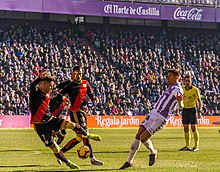
On 20 March 2019, the club appointed Paco Jémez as head coach,[21] and on 4 May, Rayo was relegated back to the Segunda División after losing 4–1 to Levante UD, eventually finishing last.[22][23]
In August 2020, the club appointed Andoni Iraola as head coach.[24] They finished sixth and won promotion in the playoffs against Girona FC; despite losing the first leg at home 1–2, the team came back to win the second leg 2–0 away to claim a place in La Liga for 2021–22.[25] In February 2022, Iraola's side defeated RCD Mallorca to make the semi-finals of the Copa del Rey; it was the second time in club history and first since 1982.[26] The club finished 12th in La Liga. This was a big achievement as they were by far the league's smallest team, and most had predicted that they would be relegated.[27]
Previous names
[edit]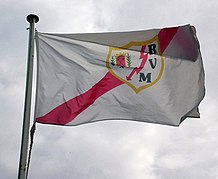
- Agrupación Deportiva El Rayo (29 May 1924 – 13 November 1947)
- Agrupación Deportiva Rayo Vallecano (13 November 1947 – 1995)
- Rayo Vallecano de Madrid (1995–present)
N.B. Affiliate of Atlético Madrid in 1949–50
Honours
[edit]League
[edit]- Segunda División
- Winners: 2017–18
- Runners-up: 1988–89, 1991–92, 1994–95, 2010–11
- Segunda División B
- Winners: 1955–56, 1964–65, 1984–85, 2007–08
Regional Titles
- Workers Federation of Soccer: 1931–1932
- First Regional Division: 1948–1949
- Second Regional Division: 1940–1941
- Copa de Castilla: 1952–1953, 1967–1968, 1970–1971, 1972–1973, 1981–1982
- Madrid Cup: 1952–1953, 1966–1967
- Copa Ramón Triana: 1971–1972, 1973–1974
Season to season
[edit]
|
|
|
|
|
- 22 seasons in La Liga
- 38 seasons in Segunda División
- 5 seasons in Segunda División B
- 11 seasons in Tercera División (third level before 1977–78)
European history
[edit]| Season | Round | Club | Home | Away | Aggregate |
|---|---|---|---|---|---|
| 2000–01 UEFA Cup | Qualifying round |  Constel·lació Esportiva Constel·lació Esportiva
|
6–0 | 10–0 | 16–0 |
| First round |  Molde Molde
|
1–1 | 1–0 | 2–1 | |
| Second round |  Viborg Viborg
|
1–0 | 1–2 | 2–2 (a) | |
| Third round |  Lokomotiv Moscow Lokomotiv Moscow
|
2–0 | 0–0 | 2–0 | |
| Fourth round |  Bordeaux Bordeaux
|
4–1 | 2–1 | 6–2 | |
| Quarter-finals |  Alavés Alavés
|
2–1 | 0–3 | 2–4 |
Current squad
[edit]- As of 9 September 2024[28]
Note: Flags indicate national team as defined under FIFA eligibility rules. Players may hold more than one non-FIFA nationality.
|
|


Reserve team
[edit]Note: Flags indicate national team as defined under FIFA eligibility rules. Players may hold more than one non-FIFA nationality.
|

Out on loan
[edit]Note: Flags indicate national team as defined under FIFA eligibility rules. Players may hold more than one non-FIFA nationality.
|
Current technical staff
[edit]| Position | Staff |
|---|---|
| Head coach | Iñigo Pérez
|
| Assistant coach | Adrián López
|
| Kit man | José Vargas Kiko Jiménez
|
| Delegate | Miguel Ortiz
|
| Goalkeeping coach | Pedro Moncayo
|
| Analyst | Óscar Díaz
|
| Rehab fitness coach | Sergio Vázquez
|
| Physiotherapist | Marcos Marín Miguel Ángel Martín
|
| Doctor | Carlos Beceiro Giovanni Mazzocca
|
Last updated: September 2022
Source: Rayo Vallecano
Notable former players
[edit]Note: this list includes players that have played at least 100 league games and/or have reached international status.
|
|
|
|


Coaches
[edit]
|
|
|

Club presidents
[edit]
|
|
|
|
Stadium
[edit]
Campo de Fútbol de Vallecas is a football stadium located on Calle Payaso Fofó 1, Vallecas. Opened on 10 May 1976, at first it was called "New Stadium Vallecas", but in January 2004, 13 years after the arrival of the Ruiz-Mateos family in 1991, it changed denominations, as the wife was also named by her husband, businessman José María, the first woman president of an elite football team.
It has a capacity of 14,708 spectators in an all-seated format and dimensions of 100×67 m. after the enlargement of the width and the reduction of the length of the pitch after the remodelling of the grandstands, compulsory due to the elimination of the fences surrounding the pitch. The pitch is one the smallest in La Liga. Additionally, one of the goal ends does not have a grandstand, just a big wall with information panels.[29]
In June 2009, the club announced plans for the construction of a new stadium. Nevertheless, the Autonomous Community of Madrid, owner of the stadium, has not any plan as far as it is known in 2023.
Club culture and supporters
[edit]The fans do not have a good relationship with the current owner Raúl Martín Presa and regularly chant for him to leave.[30][31]
In late March 2012, in support of the 2011–12 Spanish protests, the squad decided to take one day off from training to join the demonstrations.[32] In 2014, 85-year-old Vallecas resident Carmen Martínez Ayuso was evicted from her house after living there since the 1960s. Rayo Vallecano and particularly coach Paco Jémez were touched by her story, and subsequently offered to fund Martínez for the foreseeable future.[33]
In February 2017, Ukrainian player Roman Zozulya left the club after one training session due to chants of "Nazi" by Rayo fans accusing him of belonging to far-right groups; Zozulya denied ever belonging to any far-right groups, and immediately returned to his parent club Real Betis. In 2019, when Zozulya was playing for Albacete, a match was called off at half-time after fans once again sang "Zozulya you are a Nazi".[34]
Anthems and songs
[edit]Although most people recognise the supporting songs by ska-punk band Ska-P (Rayo Vallecano and Como un rayo), Rayo Vallecano has an official anthem which played at their home stadium before matches.
The club is also known for chanting the song "La Vida Pirata" (English: "The Pirate Life"), a song about pirates, which the Bukaneros are named after.
Spanish:
La vida pirata es la vida mejor (bis)
sin trabajar (bis)
Sin estudiar (bis)
Con la botella de ron (bis)
Soy capitán (bis)
del Santa Inés (bis)
Y en cada puerto tengo una mujer (bis)
La rubia es (bis)
Fenomenal (bis)
Y la morena tampoco esta mal (bis)
Las inglesas con su seriedad (bis)
Y las francesas que todo lo dan (bis)
Si alguna vez (bis)
Me he de casar (bis)
Me he de casar (bis)
Con la del Rayo, una, una y nada más (bis).
English:
''The pirate life is the best life (bis)
without working (bis)
without studying (bis)
With the bottle of rum (bis)
I am captain (bis)
of the "Santa Inés"' (bis)
and in each port, I have a woman (bis)
the blonde is (bis)
phenomenal (bis)
and the brunette is not bad either (bis)
The English women with their seriousness (bis)
And the French women who give everything (bis)
If ever (bis)
I have to marry (bis)
I have to marry (bis)
with the one of Rayo, one, one and no more (bis)''
Notes
[edit]- ^ In isolation, Vallecano is pronounced [baʎeˈkano].
References
[edit]- ^ "Estadio de Vallecas | Rayo - Web Oficial". Estadio de Vallecas | Rayo - Web Oficial (in Spanish). Archived from the original on 2017-07-08. Retrieved 2020-01-18.
- ^ "Estadio de Vallecas | Rayo - Web Oficial". Estadio de Vallecas | Rayo - Web Oficial (in Spanish). Archived from the original on 2017-07-08. Retrieved 2020-01-18.
- ^ "Historia resumida del Rayo" [Brief history of Rayo] (in Spanish). Rayo Vallecano. Archived from the original on 7 April 2014. Retrieved 4 April 2014.
- ^ "Classification 2nd Division 1983-84". www.bdfutbol.com. Archived from the original on 2019-04-25. Retrieved 2019-11-05.
- ^ "Alaves through as Rayo fall". BBC Sport. 15 March 2001. Archived from the original on 7 April 2014. Retrieved 4 April 2014.
- ^ "El 'Fair Play', ¿una puerta abierta para jugar en Europa?" ['Fair Play', open door to play in Europe?] (in Spanish). Terra. 20 March 2013. Archived from the original on 7 April 2014. Retrieved 4 April 2014.
- ^ "Michel, nuevo entrenador del Rayo" [Michel, new Rayo manager] (in Spanish). ABC. 23 June 2005. Archived from the original on 9 April 2014. Retrieved 4 April 2014.
- ^ "El Eibar regresa a Segunda tras remontar ante el Rayo Vallecano" [Eibar returns to Segunda after coming back from behind against Rayo Vallecano] (in Spanish). Diario AS. 24 June 2007. Archived from the original on 7 April 2014. Retrieved 4 April 2014.
- ^ "El Rayo vuelve a la División de Plata del fútbol español" [Rayo return to silver category of Spanish football] (in Spanish). Marca. 15 June 2008. Archived from the original on 14 May 2014. Retrieved 4 April 2014.
- ^ Dona Teresa takes off mask Archived 2011-04-26 at the Wayback Machine; Football Scouting, 1 March 2011
- ^ Unpaid Rayo have sights set on La Liga payday Archived 2012-10-04 at the Wayback Machine; Reuters, 30 March 2011
- ^ Los jugadores del Rayo Vallecano seguirán sin cobrar (Rayo Vallecano players will still not be paid) Archived 2011-09-27 at the Wayback Machine; El Correo Gallego, 26 February 2011 (in Spanish)
- ^ "Huawei sponsors Rayo Vallecano for two matches, against Real Madrid and Bilbao". GSM Insider. 30 March 2014. Archived from the original on 30 March 2014. Retrieved 30 March 2014.
- ^ "Rayo Vallecano set to buy Oklahoma City FC". 22 August 2015. Archived from the original on 2021-03-05. Retrieved 2018-06-02.
- ^ "El Rayo compra la mayoría de acciones del Oklahoma City" [Rayo purchases majority of Oklahoma City shares] (in Spanish). AS. 19 August 2015. Archived from the original on 20 August 2015. Retrieved 21 August 2015.
- ^ "La Liga: Getafe and Rayo Vallecano relegated, Sporting Gijon stay up". Archived from the original on 2018-06-16. Retrieved 2018-06-02.
- ^ "Míchel has been appointed the new coach of Rayo Vallecano". Archived from the original on 2017-09-21. Retrieved 2018-06-02.
- ^ "David Cobeño, new sports director". Archived from the original on 2018-07-26. Retrieved 2018-06-02.
- ^ "Rayo Vallecano win promotion to La Liga". 27 May 2018. Archived from the original on 2018-07-26. Retrieved 2018-06-02.
- ^ "Jornada 42 de Segunda División, Temporada 2017/2018 - liga smartbank, segunda division, campeonato nacional de liga de segunda división, segunda division española, laliga 2 española". www.resultados-futbol.com. Archived from the original on 2019-12-26. Retrieved 2019-12-26.
- ^ "Paco Jémez nuevo entrenador del Rayo Vallecano". Rayo Vallecano (in Spanish). Archived from the original on 2020-09-28. Retrieved 2021-10-28.
- ^ "Rayo Vallecano relegated to the Segunda Division". Football Espana. Archived from the original on 2019-05-07. Retrieved 2019-05-07.
- ^ "Primera División, Temporada 2018/2019". www.resultados-futbol.com. Archived from the original on 2019-11-01. Retrieved 2019-12-26.
- ^ "Andoni Iraola nuevo entrenador del Rayo Vallecano". Rayo Vallecano | Rayo (in Spanish). Archived from the original on 2021-10-27. Retrieved 2021-10-27.
- ^ Brennan, Feargal (2021-06-20). "WATCH: 10-man Rayo Vallecano secure La Liga promotion with battling Girona win". Football Espana. Archived from the original on 2021-10-27. Retrieved 2021-10-27.
- ^ "El Rayo de Iraola hace historia en Copa Del Rey al volver 40 años después a semis" [Iraola's Rayo make history in the Copa del Rey by returning to the semis after 40 years]. Marca (in Spanish). 2 February 2022. Archived from the original on 2 February 2022. Retrieved 2 February 2022.
- ^ Lowe, Sid (2021-09-20). "The Tiger who came for free: Falcao is back and scoring in La Liga". The Guardian. ISSN 0261-3077. Archived from the original on 2023-02-11. Retrieved 2023-02-11.
- ^ "Plantilla Rayo Vallecano de Madrid" (in Spanish). Rayo Vallecano. Archived from the original on 29 July 2017. Retrieved 23 September 2022.
- ^ Lowe, Sid (2012-02-27). "Rayo Vallecano's barrio boys bounce to a different beat in Real defeat". The Guardian. ISSN 0261-3077. Archived from the original on 2023-02-11. Retrieved 2023-02-10.
- ^ Lowe, Sid (2021-12-20). "Rayo Vallecano: a mess, 'problem after problem' … and top four in La Liga". The Guardian. ISSN 0261-3077. Archived from the original on 2023-02-11. Retrieved 2023-02-11.
- ^ Lowe, Sid (2021-09-20). "The Tiger who came for free: Falcao is back and scoring in La Liga". The Guardian. ISSN 0261-3077. Archived from the original on 2023-02-11. Retrieved 2023-02-11.
- ^ "Rayo Vallecano players strike over Spanish austerity cuts". When Saturday Comes. 29 March 2012. Archived from the original on 31 March 2012. Retrieved 30 March 2012.
- ^ Villalba, Juanjo (January 2015). "Spanish Football Team Rescues an Old Lady". Vice Magazine. 13 (1): 15.
- ^ sport, Guardian (2019-12-15). "Rayo Vallecano match abandoned after 'Nazi' chants; Real Madrid draw". The Guardian. ISSN 0261-3077. Archived from the original on 2023-02-10. Retrieved 2023-02-10.
External links
[edit]
- Official website (in Spanish)
- Official Radio website (in Spanish)
- Official Community VK (in Russian)
- Futbolme team profile (in Spanish)
- BDFutbol team profile
- Pasión por el Rayo – Non-official website – Rayo Vallecano news (in Spanish)
- Rayo Herald – Updated club info (in Spanish)
Authority control databases | |
|---|---|
| International | |
| National | |

Original source: https://en.wikipedia.org/wiki/Rayo Vallecano
Status: article is cached
 EncycloReader
is supported by the
EncycloReader
is supported by the  KSF
KSF