Categories
Rhinella diptycha
 From Wikipedia - Reading time: 5 min
| Rhinella diptycha | |
|---|---|
| |

| |
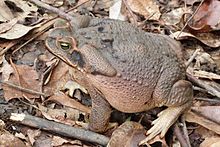
| Two variants showing opposite extremes in the amount of dark markings possible in the species | |
Conservation status
| |
Scientific classification 
| |
| Domain: | Eukaryota |
| Kingdom: | Animalia |
| Phylum: | Chordata |
| Class: | Amphibia |
| Order: | Anura |
| Family: | Bufonidae |
| Genus: | Rhinella |
| Species: | R. diptycha
|
| Binomial name | |
| Rhinella diptycha (Cope, 1862)
| |

| |
| Range in red | |
| Synonyms | |
| |
Rhinella diptycha, sometimes referred to as Cope's toad, Schneider's toad, cururu toad, or rococo toad, is a toad found in northern Argentina, Paraguay, Uruguay, eastern Bolivia, and eastern and southern Brazil.[1][2][3]
Classification[edit]
It is one of three rather similar species sometimes referred to as "cururu toads" in Brazil, the others being R. jimi and R. marina (cane toad). Like those, R. diptycha is a large toad, females up to 25 cm (9.8 in) in snout–to–vent length and males up to 18 cm (7.1 in).[3]
Rhinella diptycha is a widespread and very common species that occurs in a variety of habitats but most commonly in open and urban ones. It breeds in permanent and temporary ponds, preferring ones without much vegetation.[1] Its natural habitats include dry savanna, freshwater marshes, and intermittent freshwater marshes. It is threatened by habitat loss. It is sometimes kept as a pet,[4] but pet trade is not occurring at levels that would constitute a threat.[1]
References[edit]
- ^ a b c d Lucy Aquino; Steffen Reichle; Guarino Colli; Norman Scott; Esteban Lavilla & Jose Langone (2004). "Rhinella diptycha". IUCN Red List of Threatened Species. 2004: e.T54628A11177973. doi:10.2305/IUCN.UK.2004.RLTS.T54628A11177973.en.
- ^ Frost, Darrel R. (2020). "Rhinella diptycha (Cope, 1862)". Amphibian Species of the World: an Online Reference. American Museum of Natural History. Retrieved 24 January 2020.
- ^ a b "Rhinella schneideri". AmphibiaWeb: Information on amphibian biology and conservation. [web application]. Berkeley, California: AmphibiaWeb. 2016. Retrieved 3 April 2016.
- ^ "About Rococo Care". Ask Toadily Toads. Retrieved 3 April 2016.
Frogs in the Rhinella genus | |
|---|---|
| |
 Frogs portal Frogs portal |
 | This Bufonidae article is a stub. You can help Wikipedia by expanding it. |
Original source: https://en.wikipedia.org/wiki/Rhinella diptycha
Status: article is cached
 EncycloReader
is supported by the
EncycloReader
is supported by the  KSF
KSF