Categories
Saxifraga
 From Wikipedia - Reading time: 14 min
| Saxifraga | |
|---|---|
| |
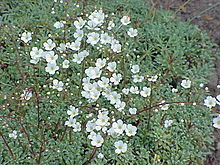
| Saxifraga cochlearis | |
Scientific classification 
| |
| Kingdom: | Plantae |
| Clade: | Tracheophytes |
| Clade: | Angiosperms |
| Clade: | Eudicots |
| Order: | Saxifragales |
| Family: | Saxifragaceae |
| Genus: | Saxifraga Tourn. ex L. (1753) |
| Type species | |
| Saxifraga granulata L.
| |
| Sections | |
|
See text | |
| Synonyms[1] | |
|
Synonyms
| |
Saxifraga is the largest genus in the family Saxifragaceae, containing about 473 species of holarctic perennial plants, known as saxifrages[1][2] or rockfoils.[3] The Latin word saxifraga means literally "stone-breaker", from Latin saxum ("rock" or "stone") + frangere ("to break"). It is usually thought to indicate a medicinal use for treatment of urinary calculi (known as kidney or bladder stones), rather than breaking rocks apart.[2][4]
Description
[edit]Most saxifrages are small perennial, biennial (e.g. S. adscendens) or annual (e.g. S. tridactylites) herbaceous plants whose basal or cauline leaves grow close to the ground, often in a rosette. The leaves typically have a more or less incised margin; they may be succulent, needle-like and/or hairy, reducing evaporation.[5][6][7]
The inflorescence or single flower clusters rise above the main plant body on naked stalks. The small actinomorphic hermaphrodite flowers have five petals and sepals and are usually white, but red to yellow in some species. Stamens, usually 10, rarely 8, insert at the junction of the floral tube and ovary wall, with filaments subulate or clavate. As in other primitive eudicots, some of the 5 or 10 stamens may appear petal-like.[citation needed] and it lives in tundral ecosystems.[5][8][6]
Taxonomy
[edit]A genus of about 473 species.[1] The former monotypic genus Saxifragella has been submersed within Saxifraga, the largest genus in Saxifragaceae, as Saxifraga bicuspidata.[9][5] Also the genus Saxifragopsis (strawberry saxifrage) was previously included in Saxifraga.[10]
Subdivision
[edit]Based on morphological criteria, up to 15 sections were recognised.[11] Subsequent molecular phylogenetic studies reduced this to 13 sections with 9 subsections. The former sections Micranthes and Merkianae are more closely related to the Boykinia and Heuchera clades.[12] Modern floras separate these groups as the genus Micranthes.[13][6]
The thirteen sections (with subsections) are:[14]
- Irregulares
- Saxifragella
- Pseudocymbalaria
- Bronchiales
- Ciliatae
- Cymbalaria
- Cotylea
- Gymnopera
- Mesogyne
- Trachyphyllum
- Ligulatae
- Porphyrion
- Squarrosae
- Mutatae
- Oppositifoliae
- Florulentae
- Kabschia
- Saxifraga
- Tridactylites
- Androsaceae
- Arachnoideae
- Saxifraga
Selected species
[edit]- Saxifraga adscendens – ascending saxifrage
- Saxifraga aizoides – Yellow mountain saxifrage,[15] yellow saxifrage[15]
- Saxifraga aizoon – Aizoon rockfoil
- Saxifraga algisii
- Saxifraga anadyrensis
- Saxifraga androsacea
- Saxifraga aquatica
- Saxifraga arachnoidea
- Saxifraga × arendsii – mossy saxifrage, mossy rockfoil
- Saxifraga aspera L. – rough saxifrage,[15] stiff-haired saxifrage[15]
- Saxifraga bicuspidata
- Saxifraga biflora
- Saxifraga bronchialis L. – matte saxifrage
- Saxifraga bryoides L. – mossy saxifrage[15]
- Saxifraga burseriana L. – AGM
- Saxifraga caesia – blue green saxifrage[15]
- Saxifraga callosa Sm. – limestone saxifrage[15]
- Saxifraga canaliculata
- Saxifraga carpatica
- Saxifraga cernua – drooping saxifrage, nodding saxifrage, bulblet saxifrage
- Saxifraga cervicornis
- Saxifraga cespitosa – tufted saxifrage
- Saxifraga ciliata
- Saxifraga cochlearis – spoon-leaved saxifrage
- Saxifraga columnaris Schmalh.
- Saxifraga corsica
- Saxifraga consanguinea W.W.Sm.
- Saxifraga cotyledon L. – great alpine rockfoil, greater evergreen saxifrage
- Saxifraga crustata Vest. – crusted-leaved saxifraga, silver saxifrage, encrusted saxifrage
- Saxifraga cuneifolia – shield-leaved saxifrage,[15] lesser London pride
- Saxifraga cymbalaria – celandine saxifrage
- Saxifraga decipiens
- Saxifraga dinnikii Schmalh.
- Saxifraga eschscholtzii – cushion saxifrage
- Saxifraga exarata – furrowed saxifrage[15]
- Saxifraga flagellaris Willd. ex Sternb. – whiplash saxifrage, spider saxifrage, "spider plant"
- Saxifraga florulenta
- Saxifraga forbesei
- Saxifraga fortunei Hook.f. – fortune saxifrage
- Saxifraga × geum – Robertsoniana saxifrage (S. hirsuta x S. umbrosa)
- Saxifraga globulifera – Gibraltar saxifrage
- Saxifraga granulata L. – meadow saxifrage,[15] bulbous saxifrage,[15] fair maids of France[15] (type species)
- Saxifraga grisebachii - Engleria saxifrage
- Saxifraga groenlandica
- Saxifraga hederacea
- Saxifraga hirculus L. – yellow marsh saxifrage, marsh saxifrage, "bog saxifrage"
- Saxifraga hirsuta – kidney saxifrage[15]
- Saxifraga hyperborea – pygmy saxifrage
- Saxifraga hypnoides – mossy saxifrage,[15] Dovedale moss
- Saxifraga juniperifolia
- Saxifraga korshinskii Kom.
- Saxifraga lactea Turcz.
- Saxifraga longifolia – Pyrenean saxifrage[15]
- Saxifraga maderensis – Madeira saxifrage,[15] Madeira breakstone[15]
- Saxifraga mertensiana – Mertens' saxifrage
- Saxifraga montana
- Saxifraga moschata – musky saxifrage, mossy saxifrage
- Saxifraga moschata ssp. basaltica
- Saxifraga muscoides
- Saxifraga mutata
- Saxifraga nathorstii (Dusén) Hayek – East Greenland saxifrage
- Saxifraga nipponica
- Saxifraga oppositifolia – purple saxifrage,[15] purple mountain saxifrage
- Saxifraga osloensis Knaben – Oslo saxifrage, a natural hybrid species[16]
- Saxifraga paniculata – lifelong saxifrage,[15] white mountain saxifrage
- Saxifraga paradoxa Sternb. – Fragile saxifraga
- Saxifraga petraea
- Saxifraga platysepala (= S. flagellaris auct. non Willd.) – broadsepal saxifrage
- Saxifraga porophylla
- Saxifraga redofskii – many-flower saxifrage
- Saxifraga rivularis – alpine brook saxifrage, brook saxifrage, highland saxifrage
- Saxifraga rosacea – Irish saxifrage
- Saxifraga rotundifolia L. – round-leaved saxifrage[15]
- Saxifraga roylei
- Saxifraga rudolphiana
- Saxifraga rufopilosa – redhair saxifrage
- Saxifraga sancta
- Saxifraga serpyllifolia – thymeleaf saxifrage
- Saxifraga sibirica – Siberian saxifrage
- Saxifraga spathularis – Saint Patrick's cabbage
- Saxifraga squarrosa – Dolomites saxifrage
- Saxifraga stolonifera – creeping saxifrage, strawberry saxifrage, creeping rockfoil, strawberry begonia, strawberry geranium,[15] Aaron's beard
- Saxifraga stolonifera f. aptera (Makino) H.Hara – hoshizaki-yukinoshita (Japanese)
- Saxifraga stolonifera 'Cuscutiformis' (Saxifraga cuscutiformis Lodd.) – Dodder-like saxifrage[15]
- Saxifraga subverticillata
- Saxifraga svalbardensis
- Saxifraga taygetea
- Saxifraga taylorii – Taylor's saxifrage
- Saxifraga tenella
- Saxifraga tombeanensis
- Saxifraga tricuspidata Rottb. – prickly saxifrage
- Saxifraga tridactylites – rue-leaved saxifrage, "nailwort"
- Saxifraga trifurcata
- Saxifraga × urbium – London pride (S. spathularis × S. umbrosa)
- Saxifraga umbrosa – Pyrenean saxifrage
- Saxifraga vandelli
- Saxifraga wahlenbergii
Formerly placed here
[edit]Plants formerly placed in Saxifraga are mainly but not exclusively Saxifragaceae. They include:[citation needed]
- Astilboides tabularis, as S. tabularis
- Bergenia crassifolia, as S. cordifolia, S. crassifolia
- Bergenia pacumbis, as S. ligulata, S. pacumbis
- Bergenia purpurascens, as S. delavayi, S. purpurascens
- Boykinia jamesii, as S. jamesii
- Boykinia occidentalis (Coastal Brookfoam), as S. elata
- Boykinia richardsonii (Richardson's Brookfoam), as S. richardsonii
- Darmera peltata (Indian Rhubarb), as S. peltata
- Leptarrhena pyrolifolia, as S. pyrolifolia
- Luetkea pectinata (Partridgefoot), as S. pectinata
- Micranthes, including:
- Mukdenia rossii (Mukdenia), as S. rossii
Other "saxifragous" plants
[edit]Several plant genera have names referring to saxifrages, although they might not be close relatives of Saxifraga. They include:[citation needed]
- Golden-saxifrages, Chrysosplenium
- Burnet-saxifrages, Pimpinella
- Pepper-saxifrage, Silaum silaus. The name "silaum" comes from the Latin word sil, which means yellow ochre. This refers to the sulphurous yellow colour of the flowers.[17]
Some plants refer to Saxifraga in their generic names or specific epithets, either because they are also "rock-breaking" or because they resemble members of the saxifrage genus:[citation needed]
- Campanula saxifraga
- Celmisia saxifraga (Benth.) W.M.Curtis
- Cineraria saxifraga DC.
- Dryopteris saxifraga
- Petrorhagia saxifraga – Tunicflower
- Pimpinella saxifraga – Burnet saxifrage
- Ptychotis saxifraga
- Saxifragella
- Saxifragodes
- Saxifragopsis Small
Ecology
[edit] | This section needs additional citations for verification. (November 2018) |
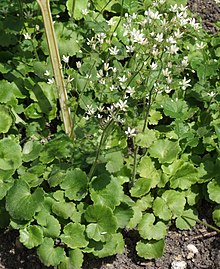
Saxifrages are typical inhabitants of Arctic–alpine ecosystems, and are hardly ever found outside the temperate parts of the Northern Hemisphere; most members of this genus are found in subarctic climates. A good number of species grow in glacial habitats, such as S. biflora which can be found some 4,000 m (13,000 ft) above sea level in the Alps, or the East Greenland saxifrage (S. nathorstii). The genus is also abundant in the Eastern and Western Himalayan alpine shrub and meadows. Though the archetypal saxifrage is a small plant huddling between rocks high up on a mountain, many species do not occur in such a habitat and are larger (though still rather delicate) plants found on wet meadows.
Various Saxifraga species are used as food plants by the caterpillars of some butterflies and moths, such as the Phoebus Apollo (Parnassius phoebus).[18]
Charles Darwin – erroneously believing Saxifraga to be allied to the sundew family (Droseraceae) – suspected the sticky-leaved round-leaved saxifrage (S. rotundifolia), rue-leaved saxifrage (S. tridactylites) and Pyrenean saxifrage (S. umbrosa) to be protocarnivorous plants, and conducted some experiments whose results supported his observations,[19] but the matter has apparently not been studied since his time.
Cultivation
[edit]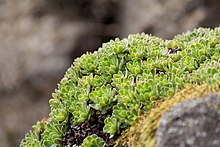
Numerous species and cultivars of saxifrage are cultivated as ornamental garden plants, valued particularly as groundcover or as cushion plants in rock gardens and alpine gardens. Many require alkaline or neutral soil to thrive.[7]
S. × urbium (London pride), a hybrid between Pyrenean saxifrage (S. umbrosa) and St. Patrick's cabbage (S. spathularis), is commonly grown as an ornamental plant.[2] Another horticultural hybrid is Robertsoniana saxifrage (S. × geum), derived from kidney saxifrage (S. hirsuta) and Pyrenean saxifrage.[citation needed] Some wild species are also used in gardening. Cambridge University Botanic Garden hosts the United Kingdom's national collection of saxifrages.[2]
Award of Garden Merit
[edit]The following species and cultivars have gained the Royal Horticultural Society's Award of Garden Merit:-[20]
- 'Angelina Johnson' (fortunei)[21]
- 'Blackberry and Apple Pie' (fortunei)[22]
- S. callosa (limestone saxifrage)[23]
- 'Conwy Snow' (fortunei)[24]
- 'Coolock Kate'[25]
- 'Cumulus'[26]
- S. fortunei[27]
- 'Gregor Mendel' (× apiculata)[28]
- 'Lagraveana' (paniculata)[29]
- 'Lutea'[30]
- 'Minor'[31]
- 'Moe' (fortunei)[32]
- 'Monarch'[33]
- 'Mount Nachi' (fortunei)[34]
- 'Peach Melba'[35]
- 'Reginald Farrer' (Silver Farreri Group)[36]
- 'Rokujo' (fortunei)[37]
- 'Rosea'[38]
- 'Shiranami' (fortunei)[39]
- 'Slack's Ruby Southside' (Southside Seedling Group)[40]
- 'Snowflake' (Silver Farreri Group)[41]
- 'Southside Star' (Southside Seedling Group)[42]
- S. stolonifera (strawberry saxifrage)[43]
- 'Sue Drew' (fortunei)[44]
- Sugar Plum Fairy='Toujya' (fortunei)[45]
- 'Theoden'[46]
- 'Tumbling Waters' [47]
- S. × urbium (London pride)[48]
- 'Venetia' (paniculata)[49]
- 'Whitehill'[50]
Uses
[edit]The leaves of some saxifrage species, such as creeping saxifrage (S. stolonifera) and S. pensylvanica,[51] are edible. The former is a food in Korea[52] and Japan.[citation needed] The flowers of purple saxifrage (S. oppositifolia) are eaten in Nunavut, Canada and the leaves and stems brewed as a tea.[53]
Species are also used in traditional medicine, such as creeping saxifrage in East Asia[54] and round-leaved saxifrage (S. rotundifolia) in Europe.[55]
Two species—purple saxifrage and creeping saxifrage—are popular floral emblems. They are official flowers for:
- Nunavut, Canada - purple saxifrage[56]
- County Londonderry, Northern Ireland - purple saxifrage[57]
- Tsukuba, Japan - creeping saxifrage, "hoshizaki" form (S. stolonifera Curtis f. aptera)[58]
-
 Pyrenean saxifrage (S. umbrosa), ancestor to horticultural hybrid saxifrages
 -
 Saxifraga caesia
 -
 Lesser London pride (Saxifraga cuneifolia)
 -
 Saxifraga decipiens
 -
 Irish saxifrage (Saxifraga rosacea)
 -
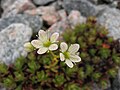 Prickly saxifrage (Saxifraga tricuspidata) flowers
References
[edit]- ^ a b c "Saxifraga Tourn. ex L." Plants of the World Online. Royal Botanic Gardens, Kew. Retrieved 13 April 2024.
- ^ a b c d "Saxifraga". National Plant Collections. Cambridge University Botanic Garden. Retrieved October 3, 2011.
- ^ Roger Spencer, ed. Horticultural Flora of South-Eastern Australia. UNSW Press, 2002. p. 81. ISBN 9780868401676
- ^ D. A. Webb & R. J. Gornall (1989). Saxifrages of Europe. Christopher Helm. p. 19. ISBN 0-7470-3407-9.
- ^ a b c Gornall 2011.
- ^ a b c Brouillet & Elvander 2008.
- ^ a b RHS A-Z encyclopedia of garden plants. United Kingdom: Dorling Kindersley. 2008. p. 1136. ISBN 978-1405332965.
- ^ Jintang et al 2004.
- ^ Deng et al 2015.
- ^ "Saxifraga L." Germplasm Resources Information Network. United States Department of Agriculture. February 9, 2005. Retrieved January 20, 2009.
- ^ Gornall 1987.
- ^ Soltis et al 1996.
- ^ Flora of China
- ^ Tkach et al 2015.
- ^ a b c d e f g h i j k l m n o p q r s t u v w x Umberto Quattrocchi. CRC World Dictionary of Plant Names: Common Names, Scientific Names, Eponyms. Synonyms, and Etymology. CRC Press, 1999. p.2395-2396. ISBN 9780849326738
- ^ Knaben, G. (1934). "Saxifraga osloensis n. sp., a tetraploid species of the Tridactylites section". Nytt Magasin for Botanikk: 117–138.
- ^ Reader's Digest Nature Lover's Library Wild Flowers of Britain, page 192, published 1988
- ^ Ivo Novák (1980). A Field Guide in Colour to Butterflies and Moths. Octopus Books. ISBN 0-7064-1293-1.
- ^ Charles Darwin (1875). "Drosophyllum – Roridula – Byblis – glandular hairs of other plants – concluding remarks on the Droseraceae". Insectivorous Plants (1st ed.). London: J. Murray. pp. 332–367.
- ^ "AGM Plants - Ornamental" (PDF). Royal Horticultural Society. July 2017. p. 95. Retrieved 1 November 2018.
- ^ "RHS Plantfinder - Saxifraga 'Angelina Johnson'". Retrieved 1 November 2018.
- ^ "RHS Plantfinder - Saxifraga 'Blackberry and Apple Pie'". Retrieved 1 November 2018.
- ^ "RHS Plant Selector - Saxifraga callosa". Retrieved 5 March 2021.
- ^ "RHS Plantfinder - Saxifraga 'Conwy Snow'". Retrieved 1 November 2018.
- ^ "RHS Plantfinder - Saxifraga 'Coolock Kate'". Retrieved 1 November 2018.
- ^ "RHS Plantfinder - Saxifraga 'Cumulus'". Retrieved 1 November 2018.
- ^ "RHS Plant Selector - Saxifraga fortunei". Retrieved 5 March 2021.
- ^ "RHS Plantfinder - Saxifraga 'Gregor Mendel' (× fortunei)". Retrieved 1 November 2018.
- ^ "RHS Plantfinder - Saxifraga 'Lagraveana'". Retrieved 1 November 2018.
- ^ "RHS Plant Selector - Saxifraga 'Lutea'". Retrieved 2 June 2013.
- ^ "RHS Plant Selector - Saxifraga 'Minor'". Retrieved 5 March 2021.
- ^ "RHS Plantfinder - Saxifraga 'Moe'". Retrieved 1 November 2018.
- ^ "RHS Plantfinder - Saxifraga 'Monarch'". Retrieved 1 November 2018.
- ^ "RHS Plantfinder - Saxifraga 'Mount Nachi'". Retrieved 1 November 2018.
- ^ "RHS Plantfinder - Saxifraga 'Peach Melba'". Retrieved 1 November 2018.
- ^ "RHS Plantfinder - Saxifraga (Silver Farreri Group) 'Reginald Farrer'". Retrieved 1 November 2018.
- ^ "RHS Plantfinder - Saxifraga 'Rokujo' (fortunei)". Retrieved 1 November 2018.
- ^ "RHS Plant Selector - Saxifraga 'Rosea'". Retrieved 5 March 2021.
- ^ "RHS Plantfinder - Saxifraga 'Shiranami'". Retrieved 1 November 2018.
- ^ "RHS Plantfinder - Saxifraga (Southside Seedling Group) 'Slack's Ruby Southside'". Retrieved 1 November 2018.
- ^ "RHS Plantfinder - Saxifraga (Silver Farreri Group) 'Snowflake'". Retrieved 1 November 2018.
- ^ "RHS Plantfinder - (Southside seedling Group) 'Southside Star'". Retrieved 1 November 2018.
- ^ "RHS Plant Selector - Saxifraga stolonifera". Retrieved 5 March 2021.
- ^ "RHS Plantfinder - Saxifraga 'Sue Drew'". Retrieved 1 November 2018.
- ^ "RHS Plantfinder - Saxifraga Sugar Plum Fairy='Toujya'". Retrieved 1 November 2018.
- ^ "RHS Plant Selector - Saxifraga 'Theoden'". Retrieved 5 March 2021.
- ^ "RHS Plant Selector - Saxifraga 'Tumbling Waters'". Retrieved 5 March 2021.
- ^ "RHS Plant Selector - Saxifraga × urbium". Retrieved 8 March 2021.
- ^ "RHS Plantfinder - Saxifraga 'Venetia' (paniculata)". Retrieved 1 November 2018.
- ^ "RHS Plantfinder - Saxifraga 'Whitehill'". Retrieved 1 November 2018.
- ^ Niering, William A.; Olmstead, Nancy C. (1985) [1979]. The Audubon Society Field Guide to North American Wildflowers, Eastern Region. Knopf. p. 780. ISBN 0-394-50432-1.
- ^ Chon, Sang-Uk; Heo, Buk-Gu; Park, Yong-Seo; Cho, Ja-Yong; Gorinstein, Shela (2008). "Characteristics of the leaf parts of some traditional Korean salad plants used for food". Journal of the Science of Food and Agriculture. 88 (11): 1963–1968. Bibcode:2008JSFA...88.1963C. doi:10.1002/jsfa.3304. ISSN 1097-0010.
- ^ Ji-xian Guo, Ki Sung Chung, Paul Pui-hay But, Takeatsu Kimura (1996). International Collation Of Traditional And Folk Medicine, Vol 2: Northeast Asia Part 2. World Scientific Publishing Company. p. 65.
{{cite book}}: CS1 maint: multiple names: authors list (link) - ^ Pieroni, Andrea; Quave, Cassandra L., eds. (2014). Ethnobotany and Biocultural Diversities in the Balkans. New York: Springer.
- ^ "The Official Flower of Nunavut: Purple Saxifrage". Legislative Assembly of Nunavut. 2011. Retrieved July 31, 2011.
- ^ County flowers in Britain Archived 14 February 2006 at the Wayback Machine www.plantlife.org.uk
- ^ "City flower, bird and tree" (in Japanese). City of Tsukuba. Retrieved 17 June 2021.
Bibliography
[edit]- Books
- Gornall, RJ (2011) [1984]. "Saxifraga". In Cullen, James; Knees, Sabina G.; Cubey, H. Suzanne (eds.). The European Garden Flora Flowering Plants: A Manual for the Identification of Plants Cultivated in Europe, Both Out-of-Doors and Under Glass. Vol. III Angoiospermae - Dicotyledons (Resedaceae - Cyrillaceae) (2nd ed.). Cambridge University Press. pp. 102–131. ISBN 978-0-521-76155-0.
- Soltis, D E (2007). "Saxifragaceae". In Kubitzki, Klaus (ed.). Flowering Plants. Eudicots: Berberidopsidales, Buxales, Crossosomatales, Fabales p.p., Geraniales, Gunnerales, Myrtales p.p., Proteales, Saxifragales, Vitales, Zygophyllales, Clusiaceae Alliance, Passifloraceae Alliance, Dilleniaceae, Huaceae, Picramniaceae, Sabiaceae. The Families and Genera of Vascular Plants. Vol. IX. Springer. pp. 418–435. ISBN 978-3-540-32219-1.
- Articles
- Chisholm, Hugh, ed. (1911). . Encyclopædia Britannica. Vol. 24 (11th ed.). Cambridge University Press. p. 264.
- Deng, Jia-bin; Drew, Bryan T.; Mavrodiev, Evgeny V.; Gitzendanner, Matthew A.; Soltis, Pamela S.; Soltis, Douglas E. (February 2015). "Phylogeny, divergence times, and historical biogeography of the angiosperm family Saxifragaceae". Molecular Phylogenetics and Evolution. 83: 86–98. Bibcode:2015MolPE..83...86D. doi:10.1016/j.ympev.2014.11.011. PMID 25479063.
- Gornall, Richard J. (December 1987). "An outline of a revised classification of Saxifraga L.". Botanical Journal of the Linnean Society. 95 (4): 273–292. doi:10.1111/j.1095-8339.1987.tb01860.x.
- Gornall, Richard J.; Ohba, Hideaki; Jintang, Pan (2000). "New Taxa, Names, and Combinations in the Saxifraga (Saxifragaceae) for the Flora of China". Novon. 10 (4): 375–377. doi:10.2307/3392990. JSTOR 3392990.
- Soltis, Douglas E.; Kuzoff, Robert K.; Conti, Elena; Gornall, Richard; Ferguson, Keith (March 1996). "matK and rbcL Gene Sequence Data Indicate that Saxifraga (Saxifragaceae) is Polyphyletic". American Journal of Botany. 83 (3): 371. doi:10.2307/2446171. JSTOR 2446171.
- Tkach, Natalia; Röser, Martin; Miehe, Georg; Muellner-Riehl, Alexandra N.; Ebersbach, Jana; Favre, Adrien; Hoffmann, Matthias H. (31 December 2015). "Molecular phylogenetics, morphology and a revised classification of the complex genus Saxifraga (Saxifragaceae)". Taxon. 64 (6): 1159–1187. doi:10.12705/646.4.
- Websites
- POWO (2019). "Saxifraga Tourn. ex L." Plants of the World Online. Royal Botanic Gardens, Kew. Retrieved 1 December 2019.
- WFO (2020). "Saxifraga L." World Flora Online. Retrieved 9 January 2020.
- "The Saxifrage Society". 2020. Retrieved 9 January 2020.
- Floras
- Jintang, Pan; Gornall, Richard; Ohba, Hideaki (2004). "Saxifraga Linnaeus, Sp. Pl. 1: 398. 1753 (虎耳草属hu er cao shu)". p. 280. Retrieved 9 January 2020., in Flora of China online vol. 8 see also PDF
- Brouillet, Luc; Elvander, Patrick E. (2008). "Saxifraga Linnaeus, Sp. Pl. 1: 398. 1753; Gen. Pl. ed. 5, 189. 1754". Flora of North America vol. 8. New York: Oxford University Press. pp. 43–146. Retrieved 9 January 2020.
External links
[edit]

| Authority control databases: National |
|---|

Original source: https://en.wikipedia.org/wiki/Saxifraga
Status: article is cached
 EncycloReader
is supported by the
EncycloReader
is supported by the  KSF
KSF