Categories
Shizuoka (city)
 From Wikipedia - Reading time: 29 min
Shizuoka
静岡市 | |||||||||
|---|---|---|---|---|---|---|---|---|---|
Designated city | |||||||||
| City of Shizuoka[1] | |||||||||
| |||||||||
 Flag  Emblem | |||||||||
 | |||||||||
 Location of Shizuoka in Shizuoka Prefecture | |||||||||
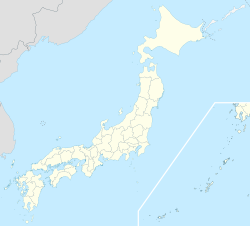  Shizuoka | |||||||||
| Coordinates: 34°58′32″N 138°22′58″E / 34.97556°N 138.38278°E | |||||||||
| Country | Japan | ||||||||
| Region | Chūbu (Tōkai) | ||||||||
| Prefecture | Shizuoka Prefecture | ||||||||
| First official record | 663 AD | ||||||||
| City Status | 1 April 1889 | ||||||||
| Government | |||||||||
| • Mayor | Takashi Namba | ||||||||
| Area | |||||||||
• Total | 1,411.90 km2 (545.14 sq mi) | ||||||||
| Population (September 1, 2023) | |||||||||
• Total | 677,867 | ||||||||
| • Density | 480/km2 (1,200/sq mi) | ||||||||
| Time zone | UTC+9 (Japan Standard Time) | ||||||||
| Symbols | |||||||||
| • Tree | Flowering dogwood | ||||||||
| • Flower | Hollyhock | ||||||||
| • Bird | Common kingfisher | ||||||||
| Phone number | 054-254-2111 | ||||||||
| Address | 5-1 Ōtemachi, Aoi-ku, Shizuoka-shi, Shizuoka-ken 420-8602 | ||||||||
| Website | Official website | ||||||||


Shizuoka (静岡市, Shizuoka-shi; Japanese pronunciation: [ɕi.(d)zɯꜜ.o.ka, ɕi.(d)zɯ.o.kaꜜ.ɕi][2]) is the capital city of Shizuoka Prefecture, Japan, and the prefecture's second-largest city in both population and area. It has been populated since prehistoric times. As of 1 September 2023,[update] the city had an estimated population of 677,867 in 106,087 households,[3] and a population density of 480 inhabitants per square kilometre (1,200/sq mi).
Overview
[edit]The city's name is made up of two kanji, 静 shizu, meaning "still" or "calm"; and 岡 oka, meaning "hill(s)".[4] In 1869, Shizuoka Domain was first created out of the older Sunpu Domain, and that name was retained when the city was incorporated in 1885. In 2003, Shizuoka absorbed neighboring Shimizu City (now Shimizu Ward) to create the new and expanded city of Shizuoka, briefly becoming the largest city by land area in Japan. In 2005, it became one of Japan's "designated cities".
Cityscapes
[edit]- Gallery
-
 Sunpu Castle (2014)
 -
 CBD of Shizuoka City (2020)
 -
 Skyline of Shizuoka City (2021)
 -
 Downtown of Shichikenchō (2021)
 -
 Konyachō (2021)
 -
 Ryōgaechō (2021)
 -
 Port of Shimizu (2020)
 -
 Sunrise of Shizuoka City (2020)
Geography
[edit]Shizuoka City lies in central Shizuoka Prefecture, about halfway between Tokyo and Nagoya along the Tōkaidō Corridor, between Suruga Bay to the south and the Minami Alps in the north. Shizuoka had the largest area of any municipality in Japan after merging with Shimizu City in April 2003, until February 2005, when Takayama in Gifu Prefecture superseded it by merging with nine surrounding municipalities.
The total area of the city is 1,411.90 km2 (545.14 sq mi).[5] Shizuoka is the 5th largest city in Japan in terms of geographic area after Takayama, Hamamatsu, Nikkō, and Kitami. It is also the 2nd largest city in Shizuoka Prefecture in terms of both geographic area and population after Hamamatsu, but ranks higher as an Urban Employment Area,[6] and leads as a metropolitan area and business region.
The fan-like shape of the Shizuoka Plain and Miho Peninsula were formed over the ages by the fast-flowing Abe River, carrying along collapsed sand and earth. These areas form the foundations of the city today.[7]: 242 The isolated Mount Kunō separates the Suruga coastline from the Shimizu coastline.
Basic data
[edit]- Area of densely populated region
- 103.99 km2 (40.15 sq mi)
- Urban planning area
- 234.80 km2 (90.66 sq mi)
- Area zoned for urbanization
- 104.0 km2 (40.2 sq mi)
Nature
[edit]

Mountains
[edit]- Mount Aino (間ノ岳, Aino-dake)
- Mount Shiomi (塩見岳, Shiomi-dake)
- Mount Warusawa (悪沢岳(荒川岳), Warusawa-dake (Arakawa-dake))
- Mount Akaishi (赤石岳, Akaishi-dake)
- Mount Hijiri (聖岳, Hijiri-dake)
- Mount Tekari (光岳, Tekari-dake)
- Mount Yanbushi (山伏, Yanbushi)
- Mount Daimugen (大無間山, Daimugen-zan)
- Mankan Pass (満観峠, Mankan-tōge)
- Mount Mafuji (真富士山, Mafuji-san)
- Mount Jūmai (十枚山, Jūmai-san)
- Mount Ryūsō (竜爪山, Ryūsō-zan)
- Mount Shizuhata (賤機山, Shizuhata-yama)
- Mount Yatsu (谷津山, Yatsu-yama)
- Mount Yahata (八幡山, Yahata-san)
- Mount Udo (Nihondaira) (有度山(日本平), Udo-san (Nihondaira))
- Mount Kajiwara (梶原山, Kajiwara-yama)
- Mount Satta (Satta Pass) (薩埵山(薩埵峠), Satta-yama (Satta-tōge))
- Mount Hamaishi (浜石岳, Hamaishi-dake)
- Mount Ōmaru (大丸山, Ōmaru-yama)
- Mount Ōhira (大平山, Ōhira-yama)
Rivers
[edit]- Ōi River (大井川, Ōi-gawa) (upstream)
- Abe River (安倍川)
- Warashina River (藁科川, Warashina-gawa)
- Mariko River (丸子川, Mariko-gawa)
- Tomoe River (巴川, Tomoe-gawa)
- Ōya River Drainage Ditch (大谷川放水路, Ōya-gawa Hōsui-ro)
- Nagao River (長尾川, Nagao-gawa)
- Fuji River (富士川, Fuji-kawa)
- Okitsu River (興津川, Okitsu-gawa)
- Ōzawa River (大沢川, Ōzawa-gawa)
- Ihara River (庵原川, Ihara-gawa)
- Yamakiri River (山切川, Yamakiri-gawa)
- Nakagōchi River (中河内川, Nakagōchi-gawa)
- Ōhashi River (大橋川, Ōhashi-gawa)
- Kogōchi River (小河内川(興津川支流), Kogōchi-gawa)
Lakes
[edit]- Lake Ikawa (井川湖, Ikawa-ko) (Ikawa Dam)
- Lake Hatanagi (畑薙湖, Hatanagi-ko) (Hatanagi-I Dam)
- Asahata Marsh (Asahata Anti-flood Pond) (麻機沼(麻機遊水地), Asahata-numa (Asahata Yūsuichi))
- Kujira Pond (鯨ヶ池, Kujira-ike)
- Udosaka Pond (有東坂池, Udosaka-ike)
- Futatsu Pond (Oshika Pond) (二ツ池(小鹿池), Futatsu-ike (Oshika-ike))
- Funakoshi Dike (船越堤, Funakoshi-tsutsumi)
Climate
[edit]On the south-central Pacific coast Shizuoka has a humid subtropical climate (Köppen climate classification Cfa), which is hot and humid in the summer, and rarely snows in the winter.[8] It is close to the warm Kuroshio Current and is wet even by Japanese standards with only slightly less precipitation than Kanazawa on the opposite side of Honshū, but it is paradoxically the sunniest of Japan's major cities owing to the absence of summer fog and its sheltered location from the northwesterly winds off the Sea of Japan. Further north, the mountainous Ikawa area is part of the Japanese snow country, where there are ski areas.
| Climate data for Shizuoka (1991−2020 normals, extremes 1940−present) | |||||||||||||
|---|---|---|---|---|---|---|---|---|---|---|---|---|---|
| Month | Jan | Feb | Mar | Apr | May | Jun | Jul | Aug | Sep | Oct | Nov | Dec | Year |
| Record high °C (°F) | 25.7 (78.3) |
26.2 (79.2) |
28.0 (82.4) |
33.3 (91.9) |
33.9 (93.0) |
38.3 (100.9) |
40.0 (104.0) |
41.4 (106.5) |
39.2 (102.6) |
33.9 (93.0) |
28.0 (82.4) |
24.5 (76.1) |
41.4 (106.5) |
| Mean daily maximum °C (°F) | 11.7 (53.1) |
12.6 (54.7) |
15.5 (59.9) |
19.8 (67.6) |
23.5 (74.3) |
26.1 (79.0) |
29.9 (85.8) |
31.3 (88.3) |
28.4 (83.1) |
23.6 (74.5) |
18.8 (65.8) |
14.1 (57.4) |
21.3 (70.3) |
| Daily mean °C (°F) | 6.9 (44.4) |
7.7 (45.9) |
10.7 (51.3) |
15.2 (59.4) |
19.2 (66.6) |
22.4 (72.3) |
26.1 (79.0) |
27.4 (81.3) |
24.5 (76.1) |
19.4 (66.9) |
14.3 (57.7) |
9.3 (48.7) |
16.9 (62.4) |
| Mean daily minimum °C (°F) | 2.1 (35.8) |
2.9 (37.2) |
6.0 (42.8) |
10.6 (51.1) |
15.1 (59.2) |
19.2 (66.6) |
23.1 (73.6) |
24.2 (75.6) |
21.1 (70.0) |
15.6 (60.1) |
9.9 (49.8) |
4.6 (40.3) |
12.9 (55.2) |
| Record low °C (°F) | −6.8 (19.8) |
−5.8 (21.6) |
−4.6 (23.7) |
−1.4 (29.5) |
5.1 (41.2) |
12.5 (54.5) |
15.4 (59.7) |
16.9 (62.4) |
10.6 (51.1) |
3.9 (39.0) |
−1.7 (28.9) |
−5.1 (22.8) |
−6.8 (19.8) |
| Average precipitation mm (inches) | 79.6 (3.13) |
105.3 (4.15) |
207.1 (8.15) |
222.2 (8.75) |
215.3 (8.48) |
268.9 (10.59) |
296.6 (11.68) |
186.5 (7.34) |
280.6 (11.05) |
250.3 (9.85) |
134.2 (5.28) |
80.7 (3.18) |
2,327.3 (91.63) |
| Average snowfall cm (inches) | 0 (0) |
0 (0) |
0 (0) |
0 (0) |
0 (0) |
0 (0) |
0 (0) |
0 (0) |
0 (0) |
0 (0) |
0 (0) |
0 (0) |
0 (0) |
| Average precipitation days (≥ 0.5 mm) | 5.8 | 6.5 | 10.2 | 10.5 | 10.9 | 13.6 | 12.9 | 10.6 | 12.8 | 10.9 | 7.6 | 6.1 | 118.3 |
| Average relative humidity (%) | 57 | 57 | 62 | 65 | 71 | 77 | 79 | 76 | 75 | 71 | 67 | 60 | 68 |
| Mean monthly sunshine hours | 207.9 | 187.5 | 189.9 | 189.7 | 192.0 | 135.9 | 157.9 | 201.8 | 157.3 | 157.7 | 173.3 | 200.5 | 2,151.5 |
| Source: Japan Meteorological Agency[9] | |||||||||||||
Area
[edit]
Wards
[edit]- Aoi Ward (葵区, Aoi-ku)
- Administrative center, made up of the former Shizuoka north of the Tōkaidō Main Line excluding Osada district
- Suruga Ward (駿河区, Suruga-ku)
- Former Shizuoka south of the Tōkaidō Main Line and Osada district
- Shimizu Ward (清水区, Shimizu-ku)
- Former city of Shimizu and towns of Kanbara and Yui.
Administrative district "image colours"
[edit]On 22 December 2006, colours and logos were established for each of the wards.[10]
| Aoi Ward | ■ Aoi Ward Green |
|---|---|
| Suruga Ward | ■ Suruga Ward Red |
| Shimizu Ward | ■ Shimizu Ward Blue |
Demographics
[edit]As of August 2019,[update] the city had an estimated population of 704,989 in 286,013 households[3] and a population density of 507 inhabitants per square kilometre (1,310/sq mi).

| Demographic | Population | As of |
|---|---|---|
| Male | 343,339 | August 2019[3] |
| Female | 361,651 | |
| Households | 286,013[3] | |
| Foreign | 9,389 | May 2019[3] |
| Total | 704,989 | August 2019[3] |
Historic population
[edit]Per Japanese census data,[11] the population of Shizuoka has been declining slowly since 1990.
| Year | Pop. | ±% |
|---|---|---|
| 1940 | 395,189 | — |
| 1950 | 467,782 | +18.4% |
| 1960 | 576,482 | +23.2% |
| 1970 | 681,797 | +18.3% |
| 1980 | 727,260 | +6.7% |
| 1990 | 739,300 | +1.7% |
| 2000 | 729,980 | −1.3% |
| 2010 | 716,328 | −1.9% |
| 2020 | 693,389 | −3.2% |
Bordering municipalities
[edit]
|
|
|


History
[edit]


Ancient history
[edit]The area that is now the city of Shizuoka has been inhabited since prehistoric times. Numerous kofun have been found within the city limits, and the Toro archaeological site indicates that a major Yayoi period (circa 400 BC–300 AD) settlement existed in what is now part of the central city area.
Suruga was established as a province of Japan in the early Nara period. At some point between the year 701 and 710, the provincial capital was relocated from what is now Numazu, to a more central location on the banks of the Abe River at a location named Sunpu (駿府) (a contraction of "Suruga no Kokufu" (駿河の国府)) or alternatively "Fuchū" (府中).
Pre-modern Shizuoka
[edit]During the Muromachi period, Sunpu was the capital of the Imagawa clan. The Imagawa were defeated at the Battle of Okehazama, and Sunpu was subsequently ruled by Takeda Shingen, followed by Tokugawa Ieyasu. However, Toyotomi Hideyoshi relocated Ieyasu, and installed Nakamura Kazutada to rule Sunpu. After the Toyotomi were defeated in the Battle of Sekigahara, Ieyasu recovered Sunpu, reassigning it to his own retainer, Naitō Nobunari in 1601. This marked the start of Sunpu Domain.
In April 1606, Ieyasu officially retired from the post of shōgun, and retired to Sunpu, where he established a secondary court, from which he could influence Shōgun Tokugawa Hidetada from behind the scenes. Subsequently, aside for brief periods, Sunpu was tenryō (territory under direct administration by the Shogunate), ruled by the Sunpu jōdai (駿府城代), an appointed official based in Sunpu.
From the Meiji period to World War II
[edit]In 1869, after the fall of the Tokugawa shogunate, the former shogunal line, headed by Tokugawa Iesato was sent to Sunpu and assigned the short-lived Sunpu Domain. The same year, Sunpu was renamed "Shizuoka". Shizuoka Domain became Shizuoka Prefecture with the abolition of the han system in 1871, which was expanded in 1876 through merger with the former Hamamatsu Prefecture and western portions of Ashigaru Prefecture in 1876. Shizuoka Station on the Tōkaidō Main Line was opened on 1 February 1889. The same day, a fire burned down most of downtown Shizuoka.
The modern city was founded on 1 April 1889. At the time, the population was 37,681, and Shizuoka was one of the first 31 cities established in Japan.
An electric tram service began in 1911. In 1914, due to heavy rains caused by a typhoon, the Abe River flooded, inundating the downtown area.[12] In the national census of 1920, the population of Shizuoka was 74,093. The area of the city continued to expand through the 1920s and 1930s through merger with outlying towns and villages. In 1935, the city was struck by a 6.4 magnitude earthquake, resulting in much damage. Although soon rebuilt, a large fire in 1940 again destroyed much of the center of the city.
During World War II, Shizuoka lacked targets of major military significance, and was initially only lightly bombed during several American air raids. However, in a major firebombing raid of 19 June 1945, the city suffered an extreme amount of damage with high civilian casualties.
Post-war Shizuoka
[edit]The area of the city continued to expand through the 1950s and 1960s through merger with outlying towns and villages. On 1 October 1964, the Tōkaidō Shinkansen began services to Shizuoka, and on 25 April 1969 the city was connected to the Tōmei Expressway. On 7 July 1974, the Abe River flooded, and landslides occurred during heavy rains, killing 23 people.[citation needed] On 16 August 1980, a major gas leak in an underground shopping center near Shizuoka Station resulted in an explosion, killing 15 people and seriously injuring 233 others. The Shizuoka City Hall moved to new premises in 1986. On 1 April 1992, Shizuoka was designated a core city by the central government, giving it increased autonomy.[13]
The 1 April 2003 merger with Shimizu City (current Shimizu Ward) greatly expanded the area and population of Shizuoka,[14] which then became a designated city on 1 April 2005,[15] and was divided into three wards. [citation needed]
Despite being somewhat geographically isolated from the rest of the city, the town of Kanbara (from Ihara District) was merged into Shizuoka on 31 March 2006,[16] becoming part of Shimizu-ku. On 1 November 2008, the town of Yui (also from Ihara District) was also merged into Shimizu-ku, resulting in the dissolution of Ihara District.[17]
Government
[edit]

Shizuoka has a mayor-council form of government with a directly elected mayor and a unicameral city legislature of 48 members. The city contributes 13 members to the Shizuoka Prefectural Assembly. In terms of national politics, the city is divided between Shizuoka 1st district and Shizuoka 4th district in the lower house of the Japanese Diet.
Mayors
[edit]Former Shizuoka city from 1889 to 2003
[edit]
|
|
|
Former Shimizu city from 1924 to 2003
[edit]
|
Since 2003 merger
[edit]| Term | Name | Start | Finish |
|---|---|---|---|
| 1–2 | Zenkichi Kojima | 14 April 2003 | 12 April 2011 |
| 3–6 | Nobuhiro Tanabe | 13 April 2011 | 12 April 2023 |
| 7 | Takashi Namba | 13 April 2023 | current |
Administration
[edit]Ward offices
[edit]- Shizuoka City Office/Aoi Ward Office:
5-1 Ōtemachi, Aoi-ku, Shizuoka-shi 420-8602- Aoi Ward Ikawa Branch Office:
656-2 Ikawa, Aoi-ku, Shizuoka-shi 428-0504
- Aoi Ward Ikawa Branch Office:
- Suruga Ward Office:
10-40 Minamiyahata-chō, Suruga-ku, Shizuoka-shi 422-8550- Suruga Ward Osada Branch Office:
13-1 Kami-Kawahara Suruga-ku, Shizuoka-shi 421-0132
- Suruga Ward Osada Branch Office:
- Shimizu City Office/Shimizu Ward Office:
6-9 Asahi-chō, Shimizu-ku, Shizuoka-shi 424-8701- Shimizu Ward Kanbara Branch Office:
1-21-1 Kanbara Shinden, Shimizu-ku, Shizuoka-shi 421-3211
- Shimizu Ward Kanbara Branch Office:
Sister cities
[edit]Shizuoka has twin and friendship relationships with several cities.[18][19]
International
[edit]- Sister cities
| City | Country | State | since |
|---|---|---|---|
| Stockton |  United States United States
|
California | October 16, 1959 |
| Omaha | United States
|
Nebraska | April 1, 1965 |
| Shelbyville | United States
|
Indiana | November 3, 1989 |
| Cannes |  France France
|
Provence-Alpes-Côte d'Azur | November 5, 1991[20] |
- Friendship cities
| City | Country | State | since |
|---|---|---|---|
| Huế |  Vietnam Vietnam
|
Thừa Thiên Huế province | April 12, 2005 |
National
[edit]- Sister cities
| City | Prefecture | region | since |
|---|---|---|---|
| Muroran |  Iburi Iburi
|
Hokkaidō region | December 24,1976 |
| Jōetsu |  Niigata Niigata
|
Chūbu region | October 12, 1995 |
- Friendship cities
| City | Prefecture | region | since |
|---|---|---|---|
| Saku |  Nagano Nagano
|
Chūbu region | October 12, 1989 |
Economy
[edit]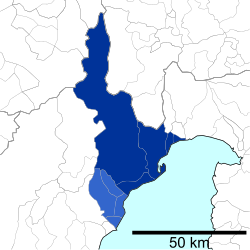


Shizuoka has 35,579 businesses as of 2012.[5]
Employment by industry: Agriculture 0.1%, Manufacturing: 26.9%, Service 73.0%
Greater Shizuoka, Shizuoka Metropolitan Employment Area, has a GDP of US$45.8 billion as of 2010.[21][22]
Shizuoka's GDP per capita (PPP) 2014 was US$41,472.[23]
Fuji Dream Airlines is headquartered in Aoi-ku, Shizuoka.[24]
Agriculture
[edit]- Green tea
- Varieties such as Motoyama and Yabukita are grown in all corners of the city, and the varieties grown especially in the Warashina area in Aoi Ward and the Ryōgōchi area of Shimizu Ward are known for their high quality
- Strawberries
- "Stonewall strawberries" (石垣いちご, ishigaki ichigo) are strawberries that grow in holes on inclined stone walls, grown especially along an 8 km (5 mi) stretch of Kunō Kaidō (route 150), also known as "Strawberry Road", along the coast of Suruga Bay.[25]
- Wasabi
- especially in areas such as Utōgi in Aoi Ward
- Mandarin orange and other citrus fruits
- especially Satsuma, a seedless and easy-peeling citrus mutant, known as mikan (みかん) or formally unshū mikan (ウンシュウミカン)[26][27][28][29]
- Lotus roots
- especially in the Asahata area of Aoi Ward
- Roses
- especially in the Ihara and Okitsu areas in Shimizu Ward
- Peaches
- especially in the Osada area:::
- Potatoes
- Especially the Sebago potato. Originally exported to Crookwell
Fishery
[edit]Shimizu Port boasts the largest haul of tuna in all Japan.[citation needed] Kanbara Harbour enjoys a prosperous haul of sakura ebi, and Mochimune Harbour enjoys a prosperous haul of shirasu sardines.
Products
[edit]Abekawa Mochi is a type of rice cake (or mochi) made with kinako soy flour that is a specialty of Shizuoka.
Shizuoka has a long history of being involved in the craft industries going back over 400 years ago, using trees, including hinoki cypress. The model industry goes back to the late 1920s when wood was used to produce model toys, using sashimono woodworking joinery techniques, purely for educational purposes. Craftsmen later moved on to lighter woods including balsa, but following the war, with the importation of US built scale models, many companies either turned to plastic models to compete or went under.[30][31]
The town has since become internationally notable for its plastic scale model kits[32] and is resident to long-established companies such as Aoshima, Fujimi, Hasegawa, and Tamiya. Another model brand, Bandai, produces its Gundam models exclusively at its Bandai Hobby Center plant in the city.[33] The city hosts the long-running Shizuoka Hobby Show annually in May at Twin Messe Shizuoka.[34]
Media
[edit]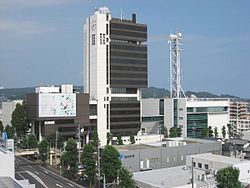
Print media
[edit]The Shizuoka Shimbun is the area's primary newspaper.
The book trilogy “Paper Gods” by Amanda Sun takes place in this city.
Broadcast media
[edit]Television
[edit]- NHK Shizuoka (Analogue Channel 9; Digital Channel 1)
- NHK Shizuoka Educational Channel (Analogue Channel 2; Digital Channel 2)
- Shizuoka Broadcasting System (SBS) (Analogue Channel 11; Digital Channel 6)
- TV Shizuoka (Analogue Channel 35; Digital Channel 8)
- Shizuoka Daiichi Television (Analogue Channel 31; Digital Channel 4)
- Shizuoka Asahi Television (Analogue Channel 33; Digital Channel 5)
Cable television
[edit]Shizuoka Cable Television (Dream Wave Shizuoka)
Radio
[edit]- NHK1 882 kHz
- NHK2 639 kHz
- NHK-FM 88.8 MHz
- SBS 1404 kHz / 93.9 MHz
- K-MIX 79.2 MHz
- FM-Hi!76.9 MHz
- Marine Pal (FM Shimizu) 76.3 MHz
- Guzen Media Japan—A podcast and vidcast based in Shizuoka, Japan[35]
Education
[edit]

Colleges and universities
[edit]- Shizuoka University
- National university, founded 1949. Main campus in Suruga Ward. Abbreviated to 静大 (Shizudai).
- University of Shizuoka (Shizuoka Prefectural University)
- Public university whose main campus is in Suruga Ward, close to Kusanagi Station.
- Tokai University
- Shimizu campus of the Tokyo-based private university
- Tokoha Gakuen University
- Private university founded in 1946
- Shizuoka Eiwa Gakuin University
- Co-educational private university in Suruga Ward, founded by missionaries from the Methodist Church of Canada with the support of the Shizuoka prefectural government. First institution in Shizuoka Prefecture to offer secondary education for girls, it became a four-year coeducational university in 2002.
- University of Shizuoka Junior College
- Junior college in Suruga Ward, affiliated with University of Shizuoka.
- Tokai University Junior College
- Junior college in Aoi Ward, affiliated with Tokai University.
- Tokoha Gakuen Junior College
- Junior college in Aoi Ward, affiliated with Tokoha Gakuen University.
Primary and secondary education
[edit]Shizuoka has 91 elementary schools, 57 middle schools and 27 high schools. In addition there are 29 vocations schools and 12 public libraries.
Transportation
[edit]


Airways
[edit]Airports
[edit]The nearest airport is Shizuoka Airport, situated between Makinohara and Shimada.
Railways
[edit]Shizuoka lies on the Tōkaidō Main Line, the JR Central main railway line from Tokyo to Osaka, and is well-served by the Tōkaidō Shinkansen, limited express and regional trains. The central station of Shizuoka is in the city centre. Shizuoka also has an LRT line, the Shizuoka Railway, administered by the Shizuoka Railway Co., Ltd. at Shizuoka Station. The under construction Chūō Shinkansen will pass through the mountainous area in the northern tip of the city. However, the line is not planned to have a station in Shizuoka.
High-Speed Rail
[edit] Central Japan Railway Company (JR Tōkai)
- Tōkaidō Shinkansen: - Shizuoka -
Conventional lines
[edit]- Central Japan Railway Company (JR Tōkai)
- Tōkaidō Main Line: - Shin-Kambara • Kambara • Yui • Okitsu • Shimizu • Kusanagi • Higashi-Shizuoka • Shizuoka • Abekawa • Mochimune • -
 Shizuoka Railway (Shizutetsu)
- Shizuoka Railway Shizuoka-Shimizu Line: Shin-Shizuoka – Hiyoshichō – Otowachō – Kasugachō – Yunoki – Naganuma – Furushō – Ken-Sōgō Undōjō – Kenritsu Bijutsukanmae – Kusanagi – Mikadodai – Kitsunegasaki – Sakurabashi – Irieoka – Shin-Shimizu
 Ōigawa Railway (Daitetsu)
- Ōigawa Railway Ikawa Line: - Kanzō – Ikawa -
Buses
[edit]Bus terminal
[edit]- Shin-Shizuoka Cenova
Roads
[edit]Expressway
[edit] Tōmei Expressway
 Shin-Tōmei Expressway
 Chūbu-Ōdan Expressway
Japan National Route
[edit] National Route 1
 National Route 52
 National Route 149
 National Route 150
 National Route 362
Seaways
[edit]Sea port
[edit]The Port of Shimizu-ku, in Shimizu City (now Shimizu Ward), is a long established mid-size sea port, catering to container ships, dry bulk ships and cruise ships.[36]
It is well located, being in between the two major port areas of Japan, i.e. the Tokyo Bay ports of Tokyo, Kawasaki and Yokohama (Keihin ports) and the Osaka Bay ports of Osaka and Kobe (Hanshin ports). The Port of Shimizu has a water depth of about 12 metres (39 ft); its attractiveness has been enhanced over the past years by the construction of new road and rail links which contribute to expanding its commercial hinterland.
In tonnage, imports (about 6.5 million tonnes (6,400,000 long tons; 7,200,000 short tons)) are close to twice export volumes, but in trade value exports are twice as valuable as imports.
The Port of Shimizu container traffic is about balanced, with over 250,000 TEU in each direction, with auto parts and chemicals amongst the main cargo types. Major international container lines provide weekly services on major trade routes, including North America, Europe and Asia, with about 110 calls per months on 28 trade routes.
The port of Shimizu also includes a terminal to receive LNG tankers and store imported Liquefied natural gas; it is operated by Shimizu LNG, a subsidiary of Shizuoka Gas (Japan is the world's largest importer of LNG).
The Port of Shimizu is also connected to other Japan ports. In particular, it is served by a Roll-on/roll-off service serving the port of Ōita, on the north-east coast of the southern island of Kyushu. This service, which sails three times a week and has a transit time of 20 hours, has enabled a modal shift of freight trucks from road to sea, thereby contributing to decreasing congestion and pollution on roads.
Tourism
[edit]


Local attractions
[edit]Museums
[edit]- Shizuoka Prefectural Museum of Art
- Shizuoka City Tokaido Hiroshige Museum of Art
- Museum of Natural and Environmental History, Shizuoka
Major attractions
[edit]- Nihondaira
- Miho no Matsubara
Historic spots
[edit]In Aoi Ward
[edit]- Shizuoka Sengen Shrine
- A collection of Shinto shrines that was patronised by powerful warrior clans since ancient times, most notably the Tokugawa clan.
- Sunpu Park/Sunpu Castle ruins
- The castle of the Imagawa and Tokugawa clans, originally built in 1599, was destroyed in 1869. Today, only the moats remain. The rest was turned into a park, and is now a popular place for hanami.
In Suruga Ward
[edit]- Toro
- Late Yayoi archaeological site notable as the first archaeological site excavated in Japan in which remains of a 1st-century AD Yayoi-era wet-rice Paddy fields were found.
- Kunōzan Tōshō-gū
- Shinto shrine that was the original burial place of Shōgun Tokugawa Ieyasu, and the oldest of the Tōshō-gū shrines in Japan. The main festival of the shrine is held annually on 17 April, although its spring festival from 17–18 February is a larger event.[37]
- Mariko-juku
- Twentieth of the fifty-three stations of the old Tōkaidō road, an old travel route during the Edo period.
In Shimizu Ward
[edit]- Miho Peninsula
- Famous for the scenic Miho no Matsubara (三保の松原, Miho Pine Grove), renowned as a seashore with beautiful green pine trees and white sands spanning over seven kilometers, designated as one of New Three Views of Japan (新日本三景, Shin Nihon Sankei). Also known as the scene of the legend of Hagoromo, which is based on the traditional swan maiden motif.
Culture
[edit]Festivals
[edit]- Daidogei World Cup (大道芸ワールドカップ, Daigougei Waarudo kappu)
- The Daidogei World Cup is an annual international street performers' festival, held over various locations around the city in November over four days. It was first held in 1992.[38]
- Shizuoka Festival (静岡まつり, Shizuoka Matsuri)
- The festival, which begun in 1957 but whose origins date back to traditions hundreds of years old, takes place in April, during the high point of the year for cherry blossoms. A flower-viewing procession echoes the shōgun Tokugawa Ieyasu's custom of taking daimyōs (feudal lords) to Sengen Shrine to view the cherry blossoms in the 17th century.[39]
- Abekawa Fireworks (安倍川花火, Abekawa Hanabi)
- A gigantic fireworks display held upstream on Shizuoka's Abekawa River in late July. It was first held 1953, to remember those who died during World War II and to pray for a national revival. Today, around 15,000 fireworks are .[40]
Cuisine
[edit]- Oden
- a Japanese dish consisting of several ingredients such as boiled eggs, daikon radish, konnyaku, and processed fish cakes stewed in a light, soy-flavoured dashi broth. Oden in Shizuoka uses a dark coloured broth flavoured with beef stock and dark soy sauce. All ingredients are skewered. Dried, ground fish (sardine, mackerel, or katsuobushi) and aonori powder (edible seaweed) are sprinkled on top before eating.
- Gyoza
- Soba noodles
- Seafood
- Zōni soup
- rice cakes in a broth cooked with vegetables, popular at New Year
- Tororo-jiru
- A grated yam soup. Chojiya, a tororo-jiru restaurant founded in 1598 in Mariko-juku area of Shizuoka, west of the Abe River, was made famous by Hiroshige when he depicted it in his series of ukiyo-e prints of the 53 stops along the Tōkaidō.
Shizuoka Performing Arts Center
[edit]The Shizuoka Performing Arts Center (SPAC) was founded in 1995 by the Shizuoka Prefecture.[41] The building was designed by architect Arata Isozaki[42] and was opened in 1999 for the second Theatre Olympics.[43]
The arts center is the first publicly funded cultural organization in Japan to have its own troupe of actors and other staff to manage its own venues and facilities for artistic purposes. Suzuki Tadashi was the first Artistic Director, appointed in 1997 and staying in the position until March 2007, after which Miyagi Satoshi took up the appointment.[41] SPAC has organised the World Theatre Festival Shizuoka each year since 2011,[44] as well as creating its own theatre productions (some of which tour abroad), having students to learn at the center, and other theatrical activities.[41]
The World Theatre Festival Shizuoka was formerly called the Shizuoka Spring Festival (2000-2010[44]), being changed to "World Theater Festival Shizuoka under Mt. Fuji" in 2012 by the artistic director of the centre, Miyagi Satoshi. His intention was "to connect Shizuoka to the world through theater", to have performances from every corner of the world, for "people to see that the world isn't a set and finished quantity and there is still plenty of room for change. I wanted to communicate that theater is a window to the world".[42] The festival includes stage plays, puppetry, film, dance and other performance arts.[44]
In 2020, due to the COVID-19 pandemic, it was announced on 3 April that the festival, scheduled to begin from 25 April to 6 May, would be cancelled. Instead, Miyagi staged an online version of the festival.[45]
Sport
[edit]With the Shimizu merger, Shimizu S-Pulse became the major football club in the city. Recently, however, a new rival club, Fujieda MYFC (from nearby Fujieda), has been rising in the regional league ranks as a contender for a place in the Japan Football League. The city hosted the official Asian Basketball Championship for Women in 1995 and 1999.
| Club | Sport | League | Venue | Established |
|---|---|---|---|---|
| Chanson V-Magic | Basketball | W.League | Konohana Arena | 1961 |
| Seikō | Softball | Japan Softball League(JSL) | Kusanagi Stadium | 1980 |
| Shimizu S-Pulse | Football | J.League | IAI Stadium Nihondaira | 1991 |
| Veltex Shizuoka | Basketball | B.League | Shizuoka City Central Gymnasium | 2018 |
| Shizuoka Jade | Table tennis | T.League | Shizuoka City Central Gymnasium | 2022 |
| Kufu HAYATE Ventures Shizuoka | Baseball | NPB (Western League) | Shizuoka City Shimizu Ihara Stadium | 2024 |
-
 Kusanagi Stadium
 -
 Shizuoka City Shimizu Ihara Stadium
 -
 IAI Stadium Nihondaira
 -
 Konohana Arena
Notable people
[edit] | This section does not cite any sources. (July 2012) |
- Princess Akishino – princess in the Japanese Imperial Family
- Yoshitaka Amano – illustrator and animator, designed the characters for the early Final Fantasy video game series
- Shoji Endo (George Masa) - Japananese American baseball player and photographer
- Kenta Hasegawa – professional football manager and former player, currently managing Nagoya Grampus
- Kazuyoshi Hoshino – racecar driver
- Daisuke Ichikawa – professional football player
- Shohei Ikeda – professional football player
- Toru Irie – professional football player
- Teruyoshi Ito – professional football player
- Yahiro Kazama – professional football player
- Naoya Kikuchi – professional football player
- Hiroki Kobayashi – professional football player
- Tomoaki Kuno – professional football player
- Hidetaka Miyazaki – video game director, creator of the Dark Souls series[46]
- Fumitake Miura – professional football player
- Kazuyoshi Miura – professional football player
- Yasutoshi Miura – professional football player
- Koki Mizuno – professional football player
- Hisashi Mizutori – Olympic gold medal gymnast
- Kazuyori Mochizuki – professional football player
- Shigeyoshi Mochizuki – professional football player
- Riyo Mori – Miss Universe Japan 2007, Miss Universe 2007
- Yusuke Mori – professional football player
- Ushiomaru Motoyasu – sumo wrestler
- Jun Muramatsu – professional football player
- Fuma Murata - Member and sub-leader of J-pop group &Team
- Go Oiwa – professional football manager and former player, currently manager of Japan national under-23 football team
- Katsumi Oenoki – professional football player
- Takeshi Oki – professional football player
- Ryota Oshima – professional football player
- Keisuke Ota – professional football player
- Toshihide Saito – professional football player
- Momoko Sakura – cartoonist, creator of Chibi Maruko-chan
- Yuya Sano – professional football player
- Masanori Sekiya – racecar driver
- Hideaki Sena – novelist and pharmacologist
- Keisuke Serizawa – textile designer
- Masatoshi Shima – inventor of the microprocessor
- Kotobuki Shiriagari – Manga artist
- Tadashi Suzuki – Stage director
- Yūichi Suzumoto – novelist
- Toranosuke Takagi – racecar driver
- Nobuhiro Tanabe – politician
- Yoshito Usui – creator of Crayon Shin-chan comics
- Takahiro Yamazaki – professional baseball player
- Kaito Yamamoto – professional football player
- Takahiro Yamanishi – professional football player
- Kotaro Yamazaki – professional football player
- Takuya Yokoyama – professional football player
- Kiyoe Yoshioka – singer, vocalist of Ikimono-gakari
City song
[edit]Watashi no Machi, Shizuoka (わたしの街 静岡)[47]
- Written: 13 April 2005
- Lyrics: Citizen competition entry
- Music, additions: Kei Ogura
- Arranged: Shin Kawabe
- Eri Itō sang on the CD release
References
[edit]- ^ "Foreign Languages". City of Shizuoka (in Japanese, English, Chinese, Korean, Spanish, and Portuguese). Public Relations Section, Mayor's Office, General Affairs Bureau. 10 September 2019. Archived from the original on 18 October 2020. Retrieved 30 October 2020.
- ^ NHK Broadcasting Culture Research Institute, ed. (24 May 2016). NHK日本語発音アクセント新辞典 (in Japanese). NHK Publishing.
- ^ a b c d e f "Tsukibetsu jinkō dēta(Shizuoka shi no jinkō setaisū" 月別人口データ(静岡市の人口・世帯数 [Monthly population data (population and number of households in Shizuoka City)]. City of Shizuoka (in Japanese). Shizuoka City Planning Bureau, Planning Division, Statistics Section. 10 October 2020. Archived from the original on 30 October 2020. Retrieved 30 October 2020.
- ^ Room, Adrian (25 February 2015). Placenames of the World: Origins and Meanings of the Names for 6,600 Countries, Cities, Territories, Natural Features and Historic Sites (2nd ed.). McFarland & Company. pp. 344–345. ISBN 978-0-7864-2248-7. LCCN 2005017522. OCLC 1194921674. OL 3402578M.
- ^ a b "Shizuoka statistics" (PDF). Archived from the original (PDF) on 4 March 2016. Retrieved 5 January 2016.
- ^ Kanemoto, Yoshitsugu. "Urban Employment Area Population Data, Metropolitan Employment Area (MEA) (2015 Standards)" (CSV). Center for Spatial Information Science (in Japanese and English). University of Tokyo. Archived from the original on 22 March 2019. Retrieved 30 October 2010.
- ^ Yamaguchi, Noriko (20 June 2008). "Abe River: The Crystal Waters that Gave Rise to a City for the Ages". The Proceedings of the 1st Asia-Pacific Water Summit: Water Security: Leadership and Commitment. Beppu City, Ōita Prefecture, Japan: World Scientific. ISBN 978-981-283-327-3. LCCN 2008339415. OCLC 836957213. OL 23934454M.
- ^ "Monthly total of snowfall depth (cm)". Japan Meteorological Agency. 2020. Archived from the original on 4 March 2016. Retrieved 30 October 2020.
- ^ 気象庁 / 平年値(年・月ごとの値). Japan Meteorological Agency. Archived from the original on 21 May 2021. Retrieved 19 May 2021.
- ^ District Image Colours and Logo Marks Archived 28 September 2011 at the Wayback Machine
- ^ "Shizuoka population statistics". Archived from the original on 3 February 2020. Retrieved 7 September 2019.
- ^ Inoue, Kimio; Kanbara, Junichi; Motohashi, Kazushi; Watanabe, Yasuhiro (15 July 2008). 安倍川中流・蕨野地区の西側山腹崩壊で生じた河道閉塞と1914年の水害 [The landslide dam and outburst floods at Warabino area of the Abe River in 1914]. Journal of the Japan Society of Erosion Control Engineering (in Japanese and English). 61 (2). Japan Society of Erosion Control Engineering: 30–35. doi:10.11475/sabo.61.2_30.
- ^ https://web.archive.org/web/20130629153438/http://www.soumu.go.jp/main_content/000215647.pdf List of Core Cities, Ministry of Internal Affairs and Communications
- ^ "Shizuoka city home page, Shimizu merger documents". Archived from the original on 4 March 2016. Retrieved 5 January 2016.
- ^ Hook, Glenn D. (2011). Decoding Boundaries in Contemporary Japan. Taylor & Francis. p. 148. ISBN 978-0-415-60044-6.
- ^ City mergers seen tailing off as the initial excitement fades | The Japan Times
- ^ http://www.city.shizuoka.jp.e.qv.hp.transer.com/000_001670.html Shizuoka city home page, Yui merger documents
- ^ International Sister Cities & Friendship Cities ‐ 静岡市 Archived 12 June 2008 at the Wayback Machine Shizuoka website retrieved 8 July 2008
- ^ Domestic Sister Cities & Friendship Cities ‐ 静岡市 Archived 17 March 2009 at the Wayback Machine Shizuoka website retrieved 8 July 2008
- ^ "International Exchange". List of Affiliation Partners within Prefectures. Council of Local Authorities for International Relations (CLAIR). Archived from the original on 13 January 2016. Retrieved 21 November 2015.
- ^ Yoshitsugu Kanemoto. "Metropolitan Employment Area (MEA) Data". Center for Spatial Information Science, The University of Tokyo. Archived from the original on 2 May 2019. Retrieved 29 September 2016.
- ^ Conversion rates - Exchange rates Archived 1 February 2018 at the Wayback Machine - OECD Data
- ^ "Global Metro Monitor". 30 November 2001. Archived from the original on 7 January 2019. Retrieved 5 September 2018.
- ^ "会社概要 Archived 27 March 2012 at the Wayback Machine." Fuji Dream Airlines. Retrieved on 20 May 2009.
- ^ What is cool and hot in this season – Strawberry Picking around Kuno Archived 27 August 2011 at the Wayback Machine
- ^ Hanelt, Peter (11 May 2001). Mansfeld's Encyclopedia of Agricultural and Horticultural Crops: Except Ornamentals. Illustrated by R. Kilian. Springer. p. 1033. ISBN 978-3540410171. OCLC 925011140. OL 12774481M. Archived from the original on 4 October 2023. Retrieved 20 October 2020.
- ^ Wiersema, John H.; León, Blanca (26 February 1999). World Economic Plants: A Standard Reference (1st ed.). CRC Press. p. 136. ISBN 978-0849321191. OCLC 317789267. OL 8259509M.
- ^ "Plant Name Details: Rutaceae Citrus unshiu Marcow". International Plant Names Index. Archived from the original on 5 June 2011. Retrieved 9 May 2011.
- ^ "Citrus unshiu". Germplasm Resources Information Network. Agricultural Research Service, United States Department of Agriculture. Retrieved 11 December 2017.
- ^ "Amazon.co.uk: Master Modeler: Creating the Tamiya Style: Shunsaku Tamiya, Giles Murray: Books". Amazon UK. Archived from the original on 4 September 2024. Retrieved 11 September 2017.
- ^ 田宮模型の仕事: Creating the Tamiya Style By Shunsaku Tamiya
- ^ "Business & Industry". Archived from the original on 10 February 2021. Retrieved 8 February 2008.
- ^ "Tour of Gundam Model Factory "Bandai Hobby Center" in Shizuoka - GIGAZINE". Archived from the original on 9 February 2021. Retrieved 24 February 2012.
- ^ "Record of Past International Conferences". Archived from the original on 16 February 2008. Retrieved 8 February 2008.
- ^ "Home". guzenmediajapan.com. Archived from the original on 24 January 2013. Retrieved 21 January 2008.
- ^ "Port of Shimizu". Shimizu Port Authority. Archived from the original on 24 October 2020. Retrieved 30 October 2020.
- ^ Plutschow, Herbe (17 October 1996). Matsuri: The Festivals of Japan (1st ed.). Curzon. ISBN 978-1873410639. OCLC 924886456. OL 8653650M.
- ^ "Daidogei World Cup 2022". JapanTravel. 4 June 2019. Archived from the original on 14 December 2021. Retrieved 14 December 2021.
- ^ "Origin of the Shizuoka Festival". Shizuoka Festival. Archived from the original on 4 September 2024. Retrieved 14 December 2021.
- ^ "Abekawa River Fireworks Festival Details". Japan Travel by Navitime. 13 December 2021. Archived from the original on 14 December 2021. Retrieved 14 December 2021.
- ^ a b c "What's SPAC". SPAC. 5 March 2019. Retrieved 14 December 2021.
- ^ a b Miyagi, Satoshi (29 October 2012). "Artist Interview: Satoshi Miyagi (Artistic Director of Shizuoka Performing Arts Center)". Performing Arts Network Japan (Interview). Interviewed by Yamaguchi, Hiroko. Retrieved 14 December 2021.
- ^ Kennedy, Gilles (16 June 1999). "A Triumphant 'Olympics' in Japan". The New York Times. Retrieved 14 December 2021.
- ^ a b c "World Theatre Festival Shizuoka". SPAC (in Latin). 19 March 2019. Retrieved 14 December 2021.
- ^ Tanaka, Nobuko (5 June 2020). "World Theatre Festival Shizuoka heads online in desperate times". The Japan Times. Retrieved 14 December 2021.
- ^ Parkin, Simon (31 March 2015). "Bloodborne creator Hidetaka Miyazaki: 'I didn't have a dream. I wasn't ambitious'". The Guardian. Archived from the original on 3 June 2015. Retrieved 8 May 2015.
- ^ 市歌 [City Song] (in Japanese). City of Shizuoka. 2007. Archived from the original on 9 June 2011. Retrieved 9 May 2011.
External links
[edit]
- Official website
- Daidogei World Cup in Shizuoka
- Know Shizuoka – The independent Guide (archived website)
 Geographic data related to Shizuoka (city) at OpenStreetMap
Places adjacent to Shizuoka (city) | ||||||||||||||||
|---|---|---|---|---|---|---|---|---|---|---|---|---|---|---|---|---|
| ||||||||||||||||


| |||||||||||||||||||||||||||||||||||||||||||||||||||


Authority control databases | |
|---|---|
| International | |
| National | |
| Geographic | |
| Academics | |
| Other | |

Original source: https://en.wikipedia.org/wiki/Shizuoka (city)
Status: article is cached
 EncycloReader
is supported by the
EncycloReader
is supported by the  KSF
KSF