Swedish Navy
 From Wikipedia - Reading time: 11 min
 | This article has multiple issues. Please help improve it or discuss these issues on the talk page. (Learn how and when to remove these messages)
|

| Swedish Navy | |
|---|---|
| Svenska marinen | |
 Coat of arms of the Swedish Navy. | |
| Founded | 7 June 1522 (503 years, 2 months) |
| Country |  Sweden Sweden |
| Type | Navy |
| Size | 2,100[1] |
| Part of | Swedish Armed Forces |
| Garrison/HQ | Muskö[2] |
| March | "Kungliga Flottans paradmarsch" (Wagner) |
| Anniversaries | 9 July (Battle of Svensksund) |
| Equipment | List of equipment |
| Engagements | See list
|
| Commanders | |
| Chief of Navy | RAdm Johan Norlén |
| Deputy Chief of Navy | BGen Patrik Gardesten |
| Chief of the Naval Staff | Capt Håkan Nilsson |
| Insignia | |
| Naval ensign and jack |  |
The Swedish Navy (Swedish: Svenska marinen) is the maritime service branch of the Swedish Armed Forces.[3] It is composed of surface and submarine naval units – the Fleet (Flottan), formally sometimes referred to as the Royal Navy (Kungliga Flottan) – as well as marine units, the Amphibious Corps (Amfibiekåren).
Founded under King Gustav Vasa in 1522, the Swedish navy is one of the oldest continuously serving navies in the world, celebrating its 500th anniversary in 2022.
History
[edit] | You can help expand this section with text translated from the corresponding article in Swedish. (January 2023) Click [show] for important translation instructions.
|
Early Swedish kings (c. 9th–14th centuries) organised a Swedish Navy along the coastline through ledungen. This involved combined rowing and sailing ships (without artillery). This system became obsolete with the development of society and changes in military technology. No later than in the 14th century, the duty to serve in ledungen was replaced by a tax. In 1427, when Sweden was part of the Kalmar Union (with Denmark and Norway), Swedish warships did however participate in the naval battle of Öresund against the Hanseatic League. It is unclear how this force was organised and exactly on what basis.
On 7 June 1522, one year after the separation of Sweden from the Kalmar Union, Gustav Vasa purchased a number of ships from the Hanseatic town of Lübeck. Official Swedish histories since the 19th century have often recorded this day as the birth of the current Swedish Navy. The museum ship Vasa in Stockholm was a 17th-century ship of the Royal Swedish Navy (Kungliga flottan).

The Amphibious Corps dates back to 1 January 1902, when a separate "Coastal Artillery" (Kustartilleriet) was established, and Marinen came into use as the name of the service as a whole. The last decade of the 20th century saw the abandonment of the coastal fortifications and the force became a more regular[citation needed] marine corps, renamed Amphibious Corps (Amfibiekåren) in 2000.
For most of the twentieth century, the Swedish Navy focused on the threat of a full-scale invasion of Sweden via the Baltic Sea and on protecting commercial shipping. Sweden's location on the Scandinavian peninsula makes it highly dependent of maritime trade: 90% imports and exports enter or leave Sweden through the Baltic. In 1972, the government decreed that non-military measures should be used to protect merchant shipping. The resolution led to the decommissioning of all the navy's destroyers and frigates, though the non-military measures the government intended to use to protect shipping have never been specified.
The navy first participated in a UN-mandate international operation in Kosovo through KFOR, KS04 in 2001 by the amphibious corps. The fleet participated in its first UN operation UN-led peacekeeping mission in October 2006 when the corvette HSwMS Gävle[a] began performing coastal surveillance duties for the United Nations Mission in Lebanon. HSwMS Gävle was relieved by HSwMS Sundsvall, which returned to Sweden in September 2007.
HSwMS Malmö, HSwMS Stockholm, and HSwMS Trossö took part in the EU-led EUNAVFOR operation (2008– ) off the coast of the Horn of Africa. In 2010, HSwMS Carlskrona was the EUNAVFOR flagship, housing the fleet headquarters led by RAdm (LH) Jan Thörnqvist.[5]
Ensign and Jack
[edit]-
 Naval ensign and jack since 1905
 -
 Naval ensign 1844–1905
 -
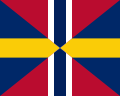 Naval jack 1844-1905
 -
 Naval ensign 1815–1844
Organization
[edit]Until recently, the Navy was led by the Chief of the Navy, who was typically a vice admiral. This office has been eliminated, and the highest officer of the Navy is now the Chief of Navy, Rear Admiral Johan Norlén, who is the senior representative of the Swedish Navy's combat forces.
The Marine units use the same system of rank as the Army.
Naval units
[edit]- 1st Submarine Flotilla (1. ubflj) located in Karlskrona
- 3rd Naval Warfare Flotilla (3. sjöstridsflj) located in Karlskrona
- 4th Naval Warfare Flotilla (4. sjöstridsflj) located at Berga
Amphibious units
[edit]- 1st Marine Regiment (Amf 1) located in Berga
- 4th Marine Regiment (Amf 4) located in Gothenburg
Bases
[edit]- Muskö Naval Base, located at Muskö island in the Stockholm archipelago. The base serves as the headquarters of the Swedish Navy since September 2019.
- Karlskrona Naval Base (MarinB), located at Karlskrona with detachments at Berga, Gothenburg and Skredsvik.
Training units
[edit]- Swedish Naval Warfare Centre (SSS) located in Karlskrona
Equipment
[edit]The equipment of the Swedish Navy can be found on the following pages:
- Active equipment / fleet and future equipment:
- List of active Swedish Navy ships
- List of equipment of the Swedish Navy
- Former equipment / fleet:
- List of ships of the Swedish Navy
- List of coastal defence ships of the Swedish Navy
Commanders
[edit]Ranks
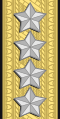
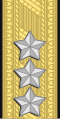
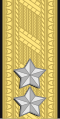
[edit]- Commissioned officer ranks
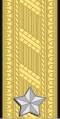
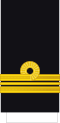
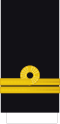
The rank insignia of commissioned officers.
| NATO code | OF-10 | OF-9 | OF-8 | OF-7 | OF-6 | OF-5 | OF-4 | OF-3 | OF-2 | OF-1 | ||||||||||||||
|---|---|---|---|---|---|---|---|---|---|---|---|---|---|---|---|---|---|---|---|---|---|---|---|---|
 Swedish Navy[6] Swedish Navy[6] |
|

|
|

|
|

|
|

|

|

|
|
|

|

| ||||||||||
| Amiral | Viceamiral | Konteramiral | Flottiljamiral | Kommendör | Kommendörkapten | Örlogskapten | Kapten | Löjtnant | Fänrik | |||||||||||||||
- Other ranks
The rank insignia of non-commissioned officers and enlisted personnel.
| NATO code | OR-9 | OR-8 | OR-7 | OR-6 | OR-5 | OR-4 | OR-3 | OR-2 | OR-1 | |||||||||||||||||||||||||||
|---|---|---|---|---|---|---|---|---|---|---|---|---|---|---|---|---|---|---|---|---|---|---|---|---|---|---|---|---|---|---|---|---|---|---|---|---|
| Swedish Navy[6] |

|

|

|

|

|

|

|

|

|

|

|

|

|

|

| |||||||||||||||||||||
| Flottiljförvaltare | Förvaltare | Överfanjunkare | Fanjunkare | Översergeant | Sergeant | Överfurir | Furir | Korpral | Vicekorpral | Menig 4 | Menig 3 | Menig 2 | Menig 1 | Menig | ||||||||||||||||||||||
See also
[edit]
- Royal Swedish Society of Naval Sciences
- Leidang
- List of Swedish wars
- List of admirals of Sweden
Notes
[edit]References
[edit]- ^ IISS (2022). The Military Balance 2022. Routledge. p. 151. ISBN 978-1-032-27900-8.
- ^ Birke, Sune; Braunstein, Christian (2011). Sveriges marina förband och skolor under 1900-talet. Skrift / Statens försvarshistoriska museer, 1101-7023 ; 13 (in Swedish). Stockholm: Statens försvarshistoriska museer. pp. 8–13. SELIBR 12638815.
- ^ "The Navy". Swedish Armed Forces. Retrieved 2 September 2020.
- ^ Allied Command Operations. "A Day Aboard HSwMS Kullen". NATO. Archived from the original on 20 October 2014. Retrieved 19 October 2014.
- ^ "90 000 ton humanitär hjälp säkrades under svensk ledning" [90,000 tonnes of humanitarian aid was secured under Swedish leadership]. Swedish Armed Forces (in Swedish). 16 August 2010. Archived from the original on 27 August 2010.
- ^ a b "Försvarsmaktens Gradbeteckningar" (PDF). Försvarsmakten (in Swedish). Swedish Armed Forces. 2 January 2014. Retrieved 13 March 2024.
External links
[edit]- Official website (in English)
- Official website (in Swedish)
- Göran Frilund – The Swedish Navy 1788–1809
Swedish Armed Forces | ||
|---|---|---|
|  | |


Original source: https://en.wikipedia.org/wiki/Swedish Navy
Status: article is cached
 EncycloReader
is supported by the
EncycloReader
is supported by the  KSF
KSF