TEX55
 From Wikipedia - Reading time: 6 min
| TEX55 | |||||||||||||||||||||||||||||||||||||||||||||||||||
|---|---|---|---|---|---|---|---|---|---|---|---|---|---|---|---|---|---|---|---|---|---|---|---|---|---|---|---|---|---|---|---|---|---|---|---|---|---|---|---|---|---|---|---|---|---|---|---|---|---|---|---|
| Identifiers | |||||||||||||||||||||||||||||||||||||||||||||||||||
| Aliases | TEX55, TSCPA, chromosome 3 open reading frame 30, testis expressed 55, C3orf30 | ||||||||||||||||||||||||||||||||||||||||||||||||||
| External IDs | MGI: 1921913 HomoloGene: 17614 GeneCards: TEX55 | ||||||||||||||||||||||||||||||||||||||||||||||||||
| |||||||||||||||||||||||||||||||||||||||||||||||||||
| |||||||||||||||||||||||||||||||||||||||||||||||||||
| |||||||||||||||||||||||||||||||||||||||||||||||||||
| |||||||||||||||||||||||||||||||||||||||||||||||||||
| Wikidata | |||||||||||||||||||||||||||||||||||||||||||||||||||
| |||||||||||||||||||||||||||||||||||||||||||||||||||
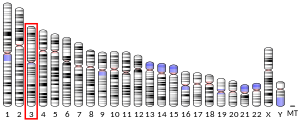


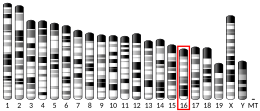

Testis expressed 55 (TEX55) is a human protein that is encoded by the C3orf30 gene located on the forward strand of human chromosome three, open reading frame 30 (3q13.32).[5][6] TEX55 (accession number: NM_152539.3) is also known as Testis-specific conserved, cAMP-dependent type II PK anchoring protein (TSCPA), and uncharacterized protein C3orf30.[6]
Gene[edit]
The TEX55 gene is 13,893 bp and spans from base pair 119,146,151 to 119,160,042.[6] This gene is flanked by immunoglobulin superfamily member 11 and Uroplakin1B.[5]
Promoter[edit]
The promoter region of TEX55 has multiple SRY box-6 and SOX/SRY-sex/testis determining and related HMG box transcription factor binding sites, as well as an X-linked zinc finger binding site. This indicates that the sex chromosomes may play a role in post-translational modification and expression.[7]
Homology[edit]
Paralogs[edit]
The TEX55 protein has no known human paralogs.[8]
Orthologs[edit]
TEX55 has orthologs in many mammals including, bats, dolphins, and even aardvarks.[8] According to BLAST the TEX55 protein cannot be found outside of clade Mammalia.[8] The most distant ortholog, found using BLAST, was in the aardvark, which is thought to have diverged an estimated 105 MYA.[9] However, according to GeneCard, distant orthologs have also been found in chickens, lizards (Anolis carolinensis), and zebrafish.[6]
mRNA[edit]
The mRNA of TEX55 is 1800 base pairs long and has three exons.[6] According to GeneCard, the TEX55 mRNA has 3 theoretical splice forms, but only the one containing all three exons have been studied and characterized.[6] The 5’ UTR of the mRNA has an RFX1 binding site, which binds to a stem-loop structure just upstream of the start codon, used to activate transcription.[7][10]
Protein[edit]
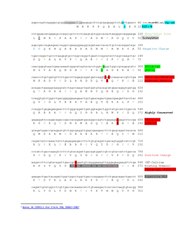
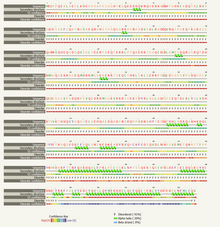
The translated protein of the TEX 55 mRNA is 536 AA, a predicted molecular weight of 60 kD, had an isoelectric point of 5.51, and is highly conserved at the C-terminus.[11] Tex55 has a slightly high amount of Glutamine and a slightly low amount of Leucine, which compared to the protein database swp23s.q.[11] Multiple sequence alignment of TEX55 and 20 mammalian orthologs show that there are 28 residues, concentrated in the C-terminus, that are conserved between all proteins.[8][12] The highly conserved residues are outlined in the conceptual translation and multiple sequence analysis. Through function-region analysis, researchers found that this protein may act as an anchoring protein of cAMP-dependent type-II PK, and might be an A-kinase anchoring proteins.[13][14]


Post-Translational Modifications[edit]
Analysis of the sumoylation sites indicate that Lys 14 has a high probability of being sumoylated.[17] The TEX55 protein has a high number of potential phosphorylation/O-glycosylation sites.[18][19]
Secondary Structure[edit]
All secondary structure prediction analysis indicate that the C-terminus of Tex 55 has a high probability of being an alpha-helix, and indicate that there is little to no amount of beta-sheets. Secondary structure analysis tools predict that the majority of the Tex 55 protein is coiled domains, and alpha-helices.
Tertiary Structure[edit]
Tertiary structures of TEX55 was generated using Phyre2. The C-terminus, which is highly conserved, was calculated to have a 30 residue alpha-helix that has relatively high confidence (82.3%). The highly conserved, high-confidence, alpha-helix is colored in red in the 3D structure image of TEX55 to the above. The overall tertiary structure of TEX55 is globular.
Motifs[edit]
Tex55 has two motifs according to GeneCard: EF-Hand Calcium Binding Domain 10 and Uroplakin 1B, both of which are found in the middle of the protein.[6] Uroplakin 1B is known to regulate cell development, activation, growth, and motility.[20] This could indicate why abnormalities in TEX55 expression leads to sperm with altered morphology.[13][21]
Protein Localization[edit]
Analysis the cellular localization probability of Tex55 and its orthologs indicate that it is most likely located in the nucleus of the cell. Below is a list of orthologs and the probability of finding that protein in the specified cellular location.[22]
| Organism | Nucleus | Cytoplasm | Cytoskeletal | Golgi | Mitochondria | Plasma Membrane |
|---|---|---|---|---|---|---|
| Human | 43.5% | 34.8% | 13.0% | 0% | 8.7% | 0% |
| Vampire Bat | 60.9% | 17.4% | 13.0% | 4.3% | 0% | 4.3% |
| Tree Shrew | 82.6% | 17.4% | 0% | 0% | 8.7% | 0% |
| Cat | 73.9% | 17.4% | 0% | 0% | 8.7% | 0% |
| Southern White Rhino | 65.2% | 17.4% | 4.3% | 0% | 8.7% | 4.3% |
| Lemur | 56.5% | 30.4% | 13.0% | 0% | 0% | 0% |
| Beluga Whale | 52.2% | 26.1% | 13.0% | 0% | 4.3% | 4.3% |
Expression[edit]
Expression of TEX55 mRNA can be found in most tissues in the human body, from the brain to the prostate.[5] However, the protein produced by this mRNA has been shown to be produced mainly in the testis of mammals, according to NCBI.[5] Analysis done by the Human Protein Atlas indicates that the TEX55 protein can be found not only in the testis, but also the bronchus, fallopian tubes, and endometrium.[23]
Clinical significance[edit]
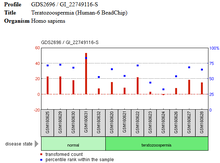
Being produced mainly in the testis of mammals, researchers believe that the protein product of TEX55 plays a role in spermatogenesis.[13] It has been shown that individuals with Cryptorchidism and Sertoli-cell-only syndrome, which are both associated with sterility, do not produce this protein in their testis.[13] Microarray analysis of individuals with Teratozoospermia, a condition that is characterized by ~96% of sperm morphology being altered, indicates that TEX55 expression is reduced by ~20%.[21][24] In clinical research, the TEX55 protein products have been detected in mice starting at 38 days old, then up regulated for at least 6 month.[13]
References[edit]
- ^ a b c GRCh38: Ensembl release 89: ENSG00000163424 - Ensembl, May 2017
- ^ a b c GRCm38: Ensembl release 89: ENSMUSG00000022798 - Ensembl, May 2017
- ^ "Human PubMed Reference:". National Center for Biotechnology Information, U.S. National Library of Medicine.
- ^ "Mouse PubMed Reference:". National Center for Biotechnology Information, U.S. National Library of Medicine.
- ^ a b c d "TEX55 testis expressed 55 [Homo sapiens (human)] - Gene - NCBI". www.ncbi.nlm.nih.gov. Retrieved 2019-04-22.
- ^ a b c d e f g "GeneCard". www.genecards.org. Retrieved 2019-04-22.
- ^ a b "Genomatix: Login Page". www.genomatix.de. Retrieved 2019-05-02.
- ^ a b c d "BLAST: Basic Local Alignment Search Tool". blast.ncbi.nlm.nih.gov. Retrieved 2019-05-01.
- ^ "TimeTree :: The Timescale of Life". www.timetree.org. Retrieved 2019-05-06.
- ^ "Sfold - Software for Statistical Folding and Studies of Regulatory RNAs". sfold.wadsworth.org. Retrieved 2019-05-06.
- ^ a b "SAPS Results". www.ebi.ac.uk. Retrieved 2019-05-02.
- ^ "Clustal Omega < Multiple Sequence Alignment < EMBL-EBI". www.ebi.ac.uk. Retrieved 2019-05-06.
- ^ a b c d e Yu Z, Wu B, Tang A, Chen J, Guo X, Qin J, Gui Y, Cai Z (October 2009). "Expression profile of a novel germ cell-specific gene, TSCPA, in mice and human". Journal of Huazhong University of Science and Technology Medical Sciences. 29 (5): 535–9. doi:10.1016/j.fertnstert.2009.07.1478. PMID 19821082.
- ^ a b c "Phyre 2 Results for Tex55____". www.sbg.bio.ic.ac.uk. Retrieved 2019-05-02.
- ^ "TEX55 rendering by EzMol". www.sbg.bio.ic.ac.uk. Retrieved 2019-05-06.
- ^ "PROSITE". prosite.expasy.org. Retrieved 2019-05-02.
- ^ "GPS-SUMO: Prediction of SUMOylation Sites & SUMO-interaction Motifs". sumosp.biocuckoo.org. Archived from the original on 2018-05-06. Retrieved 2019-05-02.
- ^ "NetOGlyc". www.cbs.dtu.dk. Retrieved 2019-05-06.
- ^ "NetPhos 3.1 Server". www.cbs.dtu.dk. Retrieved 2019-05-06.
- ^ "UPK1B". www.genecards.org. Retrieved 2019-05-05.
- ^ a b c "Home - GEO Profiles - NCBI". www.ncbi.nlm.nih.gov. Retrieved 2019-05-02.
- ^ "PSORT II Prediction". psort.hgc.jp. Retrieved 2019-05-05.
- ^ "Tissue expression of C3orf30 - Summary - The Human Protein Atlas". www.proteinatlas.org. Retrieved 2019-05-02.
- ^ "Teratozoospermia and male infertility". Forum Instituto Bernabeu. 2016-11-25. Retrieved 2019-05-06.
Original source: https://en.wikipedia.org/wiki/TEX55
Status: article is cached
 EncycloReader
is supported by the
EncycloReader
is supported by the  KSF
KSF