Categories
The Man-Machine
 From Wikipedia - Reading time: 9 min
| The Man-Machine | ||||
|---|---|---|---|---|
 | ||||
| Studio album by Kraftwerk | ||||
| Released | May 1978 | |||
| Recorded | 1977–1978 | |||
| Studio | Kling Klang (Düsseldorf, West Germany) | |||
| Genre | ||||
| Length | 36:10 | |||
| Label |
| |||
| Producer |
| |||
| Kraftwerk chronology | ||||
| ||||
| 2009 Edition | ||||
 2009 remastered edition cover | ||||
| Singles from The Man-Machine | ||||
| ||||
The Man-Machine (German: Die Mensch-Maschine) is the seventh studio album by German electronic music band Kraftwerk. It was released on May 1978 by Kling Klang in Germany and by Capitol Records elsewhere. A further refinement of their mechanical style, the album saw the group incorporate more danceable rhythms. The album has a satirical bent to it. It is thought to address a wide-range of themes from the Cold War, Germany's fascination with manufacturing, and humankind's increasingly symbiotic relationship with machines.[3] It includes the singles "The Model" and "The Robots".
Although the album was initially unsuccessful on the UK Albums Chart, it reached a new peak position of number nine in February 1982,[4] becoming the band's second highest-peaking album in the United Kingdom after Autobahn (1974).[5]
Artwork[edit]
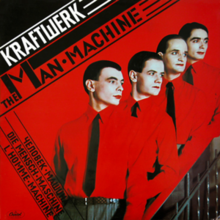
The artwork for the cover was produced by Karl Klefisch,[6] based on the work of the Russian suprematist El Lissitzky – the words "Inspired by El Lissitzky" are noted on the cover.[7] The back cover image is an adaptation of a graphic from Lissitzky's book for children About Two Squares: A Suprematist Tale of Two Squares in Six Constructions.[8]
Release[edit]
The Man-Machine was released in May, 1978.[9] The Man-Machine was certified gold by the British Phonographic Industry (BPI) on 15 February 1982[10] In October 2009, a remastered edition of the album was released on CD, Vinyl and digital formats by Mute Records, and Astralwerks.[11][12]
Critical reception[edit]
| Review scores | |
|---|---|
| Source | Rating |
| AllMusic |   [13] [13] |
| Christgau's Record Guide | B+[14] |
| The Guardian | [15] |
| The Irish Times |  [12] [12] |
| Mojo | [16] |
| Q | [17] |
| The Rolling Stone Album Guide | [18] |
| Select | 5/5[19] |
| Spin Alternative Record Guide | 8/10[20] |
| Uncut | [21] |
Reviewing the album in 1978, Andy Gill of NME stated that "The Man-Machine stands as one of the pinnacles of 70's rock music", adding that "the sparsity of the lyrics leaves the emphasis squarely on those robot rhythms, chilling tones and exquisite melodies".[22] Village Voice critic Robert Christgau also reviewed the album that year, saying: "Only a curmudgeon could reject a group that synthesizes the innovations of Environments and David Seville & the Chipmunks, not to mention that it's better make-out music."[23] Mitchell Schneider from Rolling Stone found that the "chilling restraint and relentless sameness" of the lyrics and music are tempered by Kraftwerk's sense of humour and "sheer audacity", which makes for a listening experience that is "strangely pleasant in an otherworldly way".[24]
Tony Clayton wrote in The Irish Times which "they constitute the resilient framework of electro-pop and electronica we hear today. And if there are more simple, warm and beautiful pieces of electronic music out there than 'Ohm Sweet Ohm', 'Neon Lights', 'Europe Endless' and the title track of Autobahn, then this geezer has yet to hear them."[12] Uncut critic David Cavanagh called "The Model" a "wry pop satire" and wrote that "the sparse lyrics lend themselves to considerable interpretation".[21]
In a retrospective review for AllMusic, Steve Huey wrote that the album is "less minimalistic in its arrangements and more complex and danceable in its underlying rhythms" than the group's previous works, and noted its "tremendous impact" on subsequent synth-pop artists. He also described it as "closer to the sound and style that would define early new wave electro-pop", and noted its "feel of a divided concept album", with some songs (such as the title track and "The Robots") exploring "the science fiction-esque links between humans and technology", and others (such as "Neon Lights" and "Metropolis") celebrating "the glamour of urbanization".[13] NME ranked The Man-Machine as the 57th greatest album of all time in 2013, citing it as Kraftwerk's "definitive" album and the catalyst for the synth-pop "revolution" that followed its release.[25] Paste ranked it the 11th best album of 1978.[26]
Track listing[edit]
All lyrics are written by Ralf Hütter except "The Model", lyrics by Hütter and Emil Schult
| No. | Title | Music | Length |
|---|---|---|---|
| 1. | "The Robots" ("Die Roboter") |
| 6:10 |
| 2. | "Spacelab" |
| 5:50 |
| 3. | "Metropolis" |
| 6:01 |
| No. | Title | Music | Length |
|---|---|---|---|
| 4. | "The Model" ("Das Model") |
| 3:38 |
| 5. | "Neon Lights" ("Neonlicht") |
| 9:03 |
| 6. | "The Man-Machine" ("Die Mensch-Maschine") |
| 5:28 |
| Total length: | 36:10 | ||
Personnel[edit]
Credits adapted from the liner notes of the 2009 remastered edition of The Man-Machine.[27]
Kraftwerk[edit]
- Ralf Hütter – album concept, artwork reconstruction (2009 remaster), cover, electronics, keyboards, Orchestron, production, Synthanorma Sequenzer, synthesiser, vocoder, voice
- Florian Schneider – album concept, electronics, production, synthesiser, vocoder, Votrax
- Karl Bartos – electronic drums
- Wolfgang Flür – electronic drums
Additional personnel[edit]
- Günther Fröhling – photography
- Leanard Jackson – engineering
- Karl Klefisch – artwork
- Joschko Rudas – engineering
- Henning Schmitz – engineering assistance
- Johann Zambryski – artwork reconstruction (2009 remaster)
Studios[edit]
- Recorded at Kling Klang Studio in Düsseldorf, Germany
- Mixed at Studio Rudas in Düsseldorf, Germany
Charts[edit]
Weekly charts[edit]
|
Year-end charts[edit]
|
Certifications and sales[edit]
| Region | Certification | Certified units/sales |
|---|---|---|
| Germany | — | 150,000[37] |
| United Kingdom (BPI)[10] | Gold | 100,000^ |
|
^ Shipments figures based on certification alone. | ||
References[edit]
- ^ International Review of the Aesthetics and Sociology of Music (34 ed.). Institute of Musicology, Zagreb Academy of Music. 2003. p. 170. Retrieved 3 October 2022.
- ^ Piazza, James (29 June 2022). The Ghost of Madame Curie: Writings from Innerspace Labs. James Piazza. p. 744. Retrieved 3 October 2022.
- ^ Wiser, Danny (31 July 2020). "GERMANY: The Man-Machine - Kraftwerk". 200worldalbums.com. Retrieved 25 October 2023.
- ^ a b "Official Albums Chart Top 100". Official Charts Company. Retrieved 22 January 2017.
- ^ "Kraftwerk" (select "Albums" tab). Official Charts Company. Retrieved 1 June 2018.
- ^ "Kraftwerk stoppt Schau zu eigenen Ehren". Westdeutsche Zeitung (in German). 17 April 2018. Retrieved 3 October 2022.
- ^ Smolko, Tim; Smolko, Joanna (11 May 2021). Atomic Tunes: The Cold War in American and British Popular Music. Indiana University Press. p. 253. ISBN 978-0-253-05617-7. Retrieved 3 October 2022.
- ^ "El Lissitzky. Suprematic tale about two squares". Ukrainian Art Library. Retrieved 3 October 2022.
- ^ Schütte, Uwe (27 February 2020). Kraftwerk: Future Music from Germany. Penguin UK. p. 72. ISBN 978-0-241-32055-6. Retrieved 2 October 2022.
- ^ a b "British album certifications – Kraftwerk – The Man-Machine". British Phonographic Industry. 15 February 1982.Select albums in the Format field. Select Gold in the Certification field. Type The Man-Machine in the "Search BPI Awards" field and then press Enter.
- ^ "Kraftwerk begin MoMA run TONIGHT, new limited edition boxset now available". BrooklynVegan. 10 April 2012. Retrieved 3 October 2022.
- ^ a b c Clayton-Lea, Tony (30 October 2009). "Kraftwerk: Autobahn (1974), Radio-Activity (1975), Trans Europe Express (1977), The Man-Machine (1978) (Mute/EMI)". The Irish Times. Dublin. ISSN 0791-5144. Retrieved 18 March 2017.
- ^ a b Huey, Steve. "The Man-Machine – Kraftwerk". AllMusic. Retrieved 29 March 2014.
- ^ Christgau, Robert (1981). "K". Christgau's Record Guide: Rock Albums of the Seventies. Ticknor and Fields. ISBN 0-89919-026-X. Retrieved 28 February 2019 – via robertchristgau.com.
- ^ Sweeting, Adam (14 April 1995). "CDs of the week: Kraftwerk reissues". The Guardian. London. ISSN 0261-3077.
- ^ Snow, Mat (November 2009). "Gut Vibrations". Mojo. No. 192. London. p. 110. ISSN 1351-0193.
- ^ "Kraftwerk: The Man-Machine". Q. London. 2009. p. 116. ISSN 0955-4955.
As evidenced by the mesmeric groove of 'Spacelab,' their influence on the more electronic end of disco was feeding back into their own art ...
- ^ Coleman, Mark; Randall, Mac (2004). "Kraftwerk". In Brackett, Nathan; Hoard, Christian (eds.). The New Rolling Stone Album Guide (4th ed.). Simon & Schuster. pp. 468–69. ISBN 0-7432-0169-8.
- ^ Harrison, Andrew (June 1995). "Kraftwerk: Radio Activity / Man Machine / Computer World / The Mix". Select. No. 60. London. ISSN 0959-8367.
- ^ Reynolds, Simon (1995). "Kraftwerk". In Weisbard, Eric; Marks, Craig (eds.). Spin Alternative Record Guide. Vintage Books. pp. 215–16. ISBN 0-679-75574-8.
- ^ a b Cavanagh, David (16 October 2009). "Uncut reviews: Kraftwerk – Reissues". Uncut. London. ISSN 1368-0722. Archived from the original on 5 December 2010. Retrieved 1 May 2014.
- ^ Gill, Andy (29 April 1978). "Mind Machine Music". NME. ISSN 0028-6362.
- ^ Christgau, Robert (4 September 1978). "Christgau's Consumer Guide". The Village Voice. New York. ISSN 0042-6180. Retrieved 29 April 2013 – via robertchristgau.com.
- ^ Schneider, Mitchell (18 May 1978). "The Man-Machine". Rolling Stone. ISSN 0035-791X. Retrieved 19 October 2020.
- ^ "The 500 Greatest Albums Of All Time: 100–1". NME. London. 25 October 2013. ISSN 0028-6362. Retrieved 19 October 2020.
- ^ "The 30 Best Albums of 1978". Paste. 23 February 2018. Retrieved 21 July 2022.
- ^ Die Mensch-Maschine (remastered CD liner notes). Kraftwerk. Kling Klang. 2009. 50999 6 99589 2 2.
{{cite AV media notes}}: CS1 maint: others in cite AV media (notes) (link) - ^ Kent, David (1993). Australian Chart Book 1970–1992 (illustrated ed.). St Ives, N.S.W.: Australian Chart Book. p. 170. ISBN 0-646-11917-6.
- ^ "Austriancharts.at – Kraftwerk – Die Mensch-Maschine" (in German). Hung Medien. Retrieved 1 June 2018.
- ^ "Dutchcharts.nl – Kraftwerk – The Man·Machine" (in Dutch). Hung Medien. Retrieved 1 June 2018.
- ^ "Le Détail des Albums de chaque Artiste". InfoDisc (in French). Retrieved 1 June 2018. Select "KRAFTWERK" from the drop-down menu and then press "OK".
- ^ "Offiziellecharts.de – Kraftwerk – Die Mensch-Maschine" (in German). GfK Entertainment Charts. Retrieved 1 June 2018.
- ^ "Swedishcharts.com – Kraftwerk – The Man·Machine". Hung Medien. Retrieved 1 June 2018.
- ^ "Kraftwerk Chart History (Billboard 200)". Billboard. Retrieved 22 January 2017.
- ^ "Italiancharts.com – Kraftwerk – Die Mensch-Maschine". Hung Medien. Retrieved 22 January 2017.
- ^ "Top 100 Album-Jahrescharts – 1978" (in German). GfK Entertainment. Retrieved 1 June 2018.
- ^ "EMI Electrola" (PDF). Billboard. Vol. 90, no. 50. New York. 16 December 1978. p. WG-12. ISSN 0006-2510. Retrieved 5 October 2020 – via World Radio History.
External links[edit]
- The Man-Machine at Discogs (list of releases)
Kraftwerk | |||||
|---|---|---|---|---|---|
| |||||
| Studio albums |
| ||||
| Live albums |
| ||||
| Compilations |
| ||||
| Box sets |
| ||||
| Singles |
| ||||
| Videography |
| ||||
| Related |
| ||||
| |||||

| Authority control databases |
|---|

Original source: https://en.wikipedia.org/wiki/The Man-Machine
Status: article is cached
 EncycloReader
is supported by the
EncycloReader
is supported by the  KSF
KSF