Cuan Chen of the Cuanman gains control over Yunnan[9]
6th century
[edit]
Year
Date
Event
570
Cuan Zan splits his realm into the Wuman/Black Mywa, ruled by his son Cuan Zhen, in the east and the Baiman/White Mywa, ruled by his eldest son Cuan Wan, in the west
Nanzhao retreats from Qianzhong Circuit in modern Guizhou[18]
10th century
[edit]
Year
Date
Event
902
Zheng Maisi murders the king of Nanzhao and sets up his own Dachanghe regime[9]
928
Zhao Shanzhen kills the king of Dachanghe and sets up Datianxing[9]
929
Yang Hefeng removes Zhao Shanzhen and sets up Dayining[9]
937
Duan Siping defeats Dayining and creates the Dali Kingdom[9]
967
Long Yanyao of Nanning, the Yang clan of Bo Prefecture, and the Tian clan of Si Prefecture submit to the Song dynasty in return for their autonomy[19]
Song dynasty recognizes the Bole of the Luodian kingdom, the Mangbu of the Badedian kingdom, and the Awangren of the Yushi kingdom[20]
975
Emperor Taizu of Song tries to convince Pugui of the Mu'ege Kingdom situated in northwest, central, east, and southeast Guizhou to acquiesce to Song overlordship[21]
976
Song dynasty and aboriginal allies in Guizhou attack the Mu'ege Kingdom, forcing them to retreat to Dafang County[22]
980
Long Yanyao's grandson Long Qiongju presents tribute to the Emperor Taizong of Song[19]
995
Long Hanyao of Nanning presents tribute to the Song court[19]
998
Long Hanyao of Nanning presents tribute to the Song court[19]
11th century
[edit]
Year
Date
Event
1042
Song dynasty appoints Degai of the Mu'ege Kingdom as regional inspector[22]
Möngke Khan places Kublai Khan in charge of the invasion of the Dali Kingdom[25]
1253
September
Kublai Khan's forces set up headquarters on the Jinsha River in western Yunnan and march on Dali in three columns[25]
1254
January
The Dali Kingdom is conquered, although its dynasty remains in power, and the king, Duan Xingzhi, is later invested with the title of Maharajah by Möngke Khan; so ends the Dali Kingdom[26]
winter
Kublai Khan returns to Mongolia and leaves Subutai's son Uryankhadai in charge of campaigns against local Yi tribes[26]
1257
Uriyangkhadai, son of Subutai, pacifies Yunnan and returns to Gansu[26]
winter
Mongol invasions of Vietnam: Uriyangkhadai returns to Yunnan and invades the Trần dynasty of Đại Việt[26]
14th century
[edit]
Year
Date
Event
1332
March
War of the Two Capitals: Loyalist rebels in Yunnan are defeated[27]
Ming–Mong Mao War: Si Lunfa surrenders to the Ming dynasty[33]
1397
December
Ming–Mong Mao Intervention: Si Lunfa is deposed and requests Ming aid in restoring him to power[34]
1398
January
Ming–Mong Mao Intervention: Si Lunfa is restored to power[35]
15th century
[edit]
Year
Date
Event
1438
8 December
Luchuan–Pingmian campaigns: Ming carries out a punitive expedition against Si Renfa of Mong Mao for attacking neighboring tusi, but fails to defeat him[36]
1441
27 February
Luchuan–Pingmian campaigns: Ming forces attack Mong Mao[37]
1442
January
Luchuan–Pingmian campaigns: Mong Mao is defeated but Si Renfa escapes to Ava[38]
1443
March
Luchuan–Pingmian campaigns: Ming forces defeat Si Jifa but fail to capture him[39]
1445
August
Luchuan–Pingmian campaigns: Ava hands over Si Renfa to Ming in return for their support in attacking Hsenwi[40]
1446
January
Luchuan–Pingmian campaigns: Si Renfa is executed[40]
1449
March
Luchuan–Pingmian campaigns: Ming forces invade Mong Yang for harboring Si Jifa, but he manages to escape again[41]
1450
Miao rebellions under the Ming dynasty: Yao and Miao people rebel in Guizhou and Huguang[42]
1452
Miao rebellions under the Ming dynasty: Yao and Miao rebels are suppressed[42]
1456
Miao rebellions under the Ming dynasty: Miao people in Huguang rebel and are suppressed[42]
Andrade, Tonio (2016), The Gunpowder Age: China, Military Innovation, and the Rise of the West in World History, Princeton University Press, ISBN 978-0-691-13597-7.
Beckwith, Christopher I (1987), The Tibetan Empire in Central Asia: A History of the Struggle for Great Power among Tibetans, Turks, Arabs, and Chinese during the Early Middle Ages, Princeton University Press
Crespigny, Rafe (2007), A Biographical Dictionary of Later Han to the Three Kingdoms (23-220 AD), Brill
Dardess, John (2012), Ming China 1368-1644 A Concise History of A Resilient Empire, Rowman & Littlefield Publishers, Inc.
Fernquest, John (2006), Crucible of War: Burma and the Ming in the Tai Frontier Zone (1382-1454)
Graff, David Andrew (2016), The Eurasian Way of War Military Practice in Seventh-Century China and Byzantium, Routledge, ISBN 978-0-415-46034-7.
Herman, John E. (2007), Amid the Clouds and Mist China's Colonization of Guizhou, 1200–1700, Harvard University Asia Center, ISBN 978-0-674-02591-2
Lewis, James (2015), The East Asian War, 1592-1598: International Relations, Violence and Memory, Routledge
Liew, Foon Ming (1996), The Luchuan-Pingmian Campaigns (1436-1449) in the Light of Official Chinese Historiography
Mote, F. W. (2003), Imperial China: 900–1800, Harvard University Press, ISBN 978-0674012127
Swope, Kenneth M. (2009), A Dragon's Head and a Serpent's Tail: Ming China and the First Great East Asian War, 1592-1598, University of Oklahoma Press.
Swope, Kenneth (2014), The Military Collapse of China's Ming Dynasty, Routledge
Taylor, K.W. (2013), A History of the Vietnamese, Cambridge University Press
Twitchett, Denis (1994), The Cambridge History of China, Volume 6, Alien Regime and Border States, 907-1368, Cambridge: Cambridge University Press, ISBN 0521243319
Twitchett, Denis (1998), The Cambridge History of China Volume 7 The Ming Dynasty, 1368—1644, Part I, Cambridge University Press
Twitchett, Denis (1998b), The Cambridge History of China Volume 8 The Ming Dynasty, 1368—1644, Part 2, Cambridge University Press
Twitchett, Denis (2008), The Cambridge History of China 1, Cambridge University Press
Twitchett, Denis (2009), The Cambridge History of China Volume 5 The Sung dynasty and its Predecessors, 907-1279, Cambridge University Press
Wang, Zhenping (2013), Tang China in Multi-Polar Asia: A History of Diplomacy and War, University of Hawaii Press
Watson, Burton (1993), Records of the Grand Historian by Sima Qian: Han Dynasty II (Revised Edition, Columbia University Press
Xiong, Victor Cunrui (2009), Historical Dictionary of Medieval China, United States of America: Scarecrow Press, Inc., ISBN 978-0810860537
Yang, Bin (2008b), "Chapter 4: Rule Based on Native Customs", Between Winds and Clouds: The Making of Yunnan (Second Century BCE to Twentieth Century CE), Columbia University Press
 From Wikipedia - Reading time: 11 min
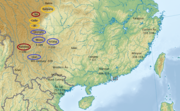 Ancient southern China
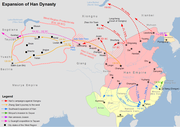 Han conquest of Dian, 109 BC
 Nanzhao, 879
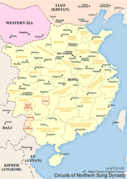 Song dynasty, 1111
 Dali Kingdom, late 12th century
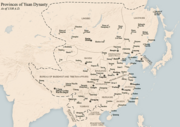 Yuan dynasty, 1330
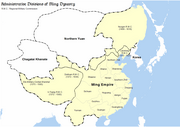 Ming dynasty
 Qing dynasty, 1820
 EncycloReader
is supported by the
EncycloReader
is supported by the  KSF
KSF