Table of Contents Categories
Trapiche
 From Wikipedia - Reading time: 6 min
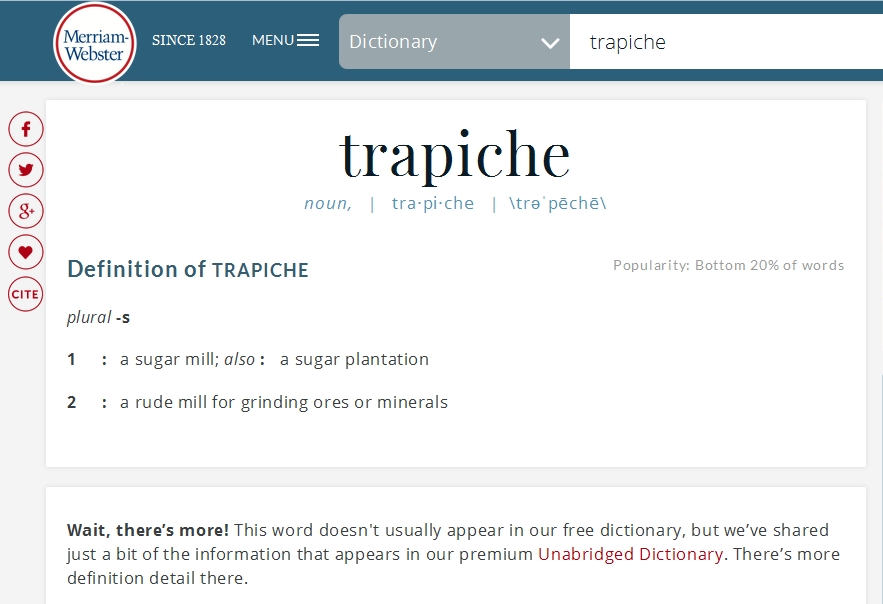
A trapiche is a mill made of wooden rollers used to extract juice from fruit, originally olives, and since the Middle Ages, sugar cane as well. By extension the word is also sometimes applied to the location of the mill, whether the workshop or the entire plantation.[1]
Etymology[edit]
The word has its origin in the Latin trapetum that means oil mill.[2] From the Sicilian language trappitu[3] the term, crossing the Mozarab Valencia, with its typical change of termination to «-ig» via the Catalan language (trapig -Gandía, 1536-, trapitz de canyamel -Mallorca, 1466-)[4] has arrived to the other languages of the Iberian peninsula as trapiche.[5] In the documents of the Duke of Gandía from the beginning of the fifteen century, one can see the term «trapig de canyamel», as a synecdoche to indicate the whole village engenho.[3][6] According to Herrera: "..es de notar que antiguamente no auuia azucar,ſino en Valencia" ("note that in the old days there was no sugar except in Valencia").[7]
Caribbean[edit]
Canarian precedents[edit]
In the late 15th century, the horizontal two-roller engenho or trapiche transferred seamlessly from the Portuguese in the Madeira Islands to the Canary Islands just as the Castilians (not yet known as Spanish), still struggled to control the Guanches, the rebellious indigenous Canarians. They were, in fact, the first coerced workers of the fledgling sugar industry on these islands. As the Iberians colonized the archipelagos off the coast of West Africa they relocated here most of the Mediterranean agricultural industry making of these islands the center of technological advancement in the Atlantic World. And in a matter of two decades after Christopher Columbus touched down on the Bahamas, just across the ocean, the trapiche followed European colonists to the Caribbean.[8] The first stop was the island of Hispaniola.
Hispaniola (Santo Domingo)[edit]
The trapiche's arrival to the Caribbean coincided with three crucial events in the early history of the Americas. They were the dramatic decline of the indigenous population, the arrival of the first enslaved Africans to the Americas and the sudden drop in the production of gold. While large numbers of colonists sought to escape the ensuing desolation and migrated to settle and desolate in turn other territories, those who stayed on Hispaniola turned to the sugar industry hustled at first by a mixture of enslaved indigenous people and Africans (ladinos and bozales). In a few more years, as the indigenous population retrieved, enslaved Blacks made up the bulk if not all of the coerced workers. With the promise of personal wealth implied in the system of slavery and with the advice of Canarian experts colonists began establishing some types of engenhos as early as 1514.[9] According to Cronistas de Indias (Chroniclers of the Indies), Bartolomé de las Casas and Gonzalo Fernández de Oviedo y Valdés, it was Gonzales de Veloso (also, Gonzalez Veloso and Gonzalo de Vellosa) who built in what today is San Cristobal the first two-roller trapiche pulled by horses on Hispaniola.[10][11] From there, it turned up on the Island of San Juan Bautista (Puerto Rico) and later in Cuba.[12]
Three rollers[edit]
Though most current examples of trapiches in the Spanish Caribbean are of the three-rollers, according to scholar Anthony R. Stevens-Acevedo, the horizontal two-roller trapiche was the type used in the Caribbean throughout the end of the 16th century. As this piece of technology moved south to Tierra Firme (South America), the trapiche not only acquired a new roller, but it also erected all three of them to become a more efficient instrument of the expanding sugar industry. In this more elaborate shape, it soon returned to the Caribbean as the backbone of the sugar engenho.[9]
South America[edit]
Sugar cane industry[edit]

Nowadays, the majority of the ingenios in Argentina or (engenhos in Brazil), use a trapiche to grind the sugarcane and extract its juice. They used water vapor as a driving force for mechanisms. In Latin America one can see small and transportable "street trapiches" handled by just one person. They can be installed almost anywhere to produce fresh cane juice. Its manufacture is artisanal, having even wooden gears.[13]
Mining environment[edit]
In Argentina, Bolivia and Chile the term also applies to a type of mill used to reduce different kinds of minerals to dust.[14][15] In the seventeenth century, these facilities and the raw material (ore, wages, the lease of the site and water, buildings ...) needed a considerable investment, the major part of it held by wealthy colonial elite.[14]
Among the general mechanisms by which the Chilean economic life developed in the Colony, the trapiches were a highly profitable investment. On the other hand, the perception of metals as means of payment for its use, offered a source of profitability, as they were connected to the commercial circuit of gold but outside the margins of local production centers.
Outside South America this type of mill might be known as Chilean mill.
References[edit]
- ^ Merriam-Webster: trapiche
- ^ «trapetum», Pons Latein-Deutsches Wörterbuch
- ^ a b Charles Verlinden & Eberhard Schmitt, Die mittelalterlichen Ursprünge der europäischen Expansion, tom I de Dokumente zur Geschichte der europäischen Expansion, Wiesbaden, Otto Harrassowitz Verlag, 1986, pàgina 169, ISBN 9783406303722
- ^ Corominas: trapig en Gandía, 1536, y trapitz de canyamel en Mallorca, 1466
- ^ «trapig ».
- ^ Hug de Cardona editat per Frederic Aparisi Romero, III: Col·lecció diplomàtica (1407-1482) Fonts Històriques Valencianes, València, Universitat de València, 2011, pàgina 1058 ss., ISBN 9788437083025
- ^ Antonio de Herrera y Tordesillas (1601). Historia General De Los Hechos De Los Castellanos En Las Islas Itierra Firme Del Mar Oceano: Decada Segvnda. Por Juan Flamenco. pp. 105–.
- ^ Viera y Clavijo, José de (1991). Historia de Canarias T. 2. Las Palmas de Gran Canaria: Islas Canarias: Viceconsejería de Cultura y Deportes, Gobierno de Canarias. p. 420. ISBN 8487137962.
- ^ a b R. Stevens-Acevedo, Anthony (January 2013). "The Machines That Milled the Sugar-Canes: The Horizontal Double Roller Mills in the First Sugar Plantations of the Americas": 81.
{{cite journal}}: Cite journal requires|journal=(help) - ^ Casas, Bartolomé de las (1876). Historia de las Indias escrita. Madrid: M. Ginesta. p. 28.
- ^ Valdés, Gonzalo Fernández de Oviedo y, Francisco de Solano, and Fermín del Pino (1982). América y la España del siglo XVI: homenaje a Gonzalo Fernández de Oviedo cronista de Indias en el V centenario de su nacimento. (Madrid, 1478). Editorial CSIC - CSIC Press, 1982. ISBN 9788400051532.
{{cite book}}: CS1 maint: multiple names: authors list (link) - ^ Daniels, Christian, Joseph Needham, and Nicholas K. Menzies (1996). Science and Civilisation in China: Volume 6, Biology and Biological Technology, Part 3, Agro-Industries and Forestry. Cambridge, UK: Cambridge University Press. p. 317. ISBN 0521419999.
{{cite book}}: CS1 maint: multiple names: authors list (link) - ^ Wooden trapiches in Colombia
- ^ a b Paola Raquel Figueroa, «Trapiches i ingenios mineros en la Mendoza colonial - Argentina segles XVI, XVII i XVIII)»(castellà), Tiempo y Espacio,, any 17, Vol 20, 2008, pàgines 84-97, ISSN 0716-9671
- ^ «trapiche» Diccionario de la lengua española, 22a edició, 2001
Bibliography[edit]
- Francisco Pons Moncho, Trapig: La producción de azucar en la Safor (siglos XIV-XVIII), Publicaciones del Instituto Duque Real Alonso el Viejo, Ajuntament de Gandia, 1979, 127 pàgines, ISBN 978-8450034769
- Fernando Nuez Viñals, La herencia árabe en la agricultura y el bienestar de occidente,(in Spanish) València, Universitat Politècnica de València, 2002, 445 pàgines,
- Miquel Barceló, El feudalisme comptat i debatut: Formació i expansió del feudalisme català, València, Universitat de València, 2003, ISBN 9788437056715
- Sucre & Borja. La canyamel dels Ducs. Del trapig a la taula Catàleg de l'Exposició, Gandia. Casa de la Cultura "Marqués de González de Quirós", 2000
External links[edit]
 |
Wikimedia Commons has media related to Category:Trapiche. |
Original source: https://en.wikipedia.org/wiki/Trapiche
Status: article is cached
 EncycloReader
is supported by the
EncycloReader
is supported by the  KSF
KSF