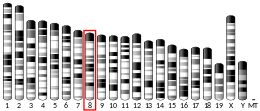
Ubiquitin specific peptidase 10, also known as USP10, is an enzyme which in humans is encoded by the USP10 gene.[5]
Function
[edit]
Ubiquitin is a highly conserved protein that is covalently linked to other proteins to regulate their function and degradation. This gene encodes a member of the ubiquitin-specific protease family of cysteine proteases. The enzyme specifically cleaves ubiquitin from ubiquitin-conjugated protein substrates. The protein is found in the nucleus and cytoplasm. It functions as a co-factor of the DNA-bound androgen receptor complex, and is inhibited by a protein in the Ras-GTPase pathway. The human genome contains several pseudogenes similar to this gene.[5]
Interactions
[edit]
USP10 has been shown to interact with G3BP1.[6]
In the endothelium, USP10 regulates Notch signaling by slowing down the degradation of the intracellular domain of NOTCH1. [7]
D'Andrea A, Pellman D (1999). "Deubiquitinating enzymes: a new class of biological regulators". Crit. Rev. Biochem. Mol. Biol. 33 (5): 337–52. doi:10.1080/10409239891204251. PMID 9827704.
Puente XS, Sánchez LM, Overall CM, López-Otín C (2003). "Human and mouse proteases: a comparative genomic approach". Nat. Rev. Genet. 4 (7): 544–58. doi:10.1038/nrg1111. PMID 12838346. S2CID 2856065.
Rual JF, Venkatesan K, Hao T, Hirozane-Kishikawa T, Dricot A, Li N, Berriz GF, Gibbons FD, Dreze M, Ayivi-Guedehoussou N, Klitgord N, Simon C, Boxem M, Milstein S, Rosenberg J, Goldberg DS, Zhang LV, Wong SL, Franklin G, Li S, Albala JS, Lim J, Fraughton C, Llamosas E, Cevik S, Bex C, Lamesch P, Sikorski RS, Vandenhaute J, Zoghbi HY, Smolyar A, Bosak S, Sequerra R, Doucette-Stamm L, Cusick ME, Hill DE, Roth FP, Vidal M (2005). "Towards a proteome-scale map of the human protein-protein interaction network". Nature. 437 (7062): 1173–8. Bibcode:2005Natur.437.1173R. doi:10.1038/nature04209. PMID 16189514. S2CID 4427026.
Faus H, Meyer HA, Huber M, Bahr I, Haendler B (2006). "The ubiquitin-specific protease USP10 modulates androgen receptor function". Mol. Cell. Endocrinol. 245 (1–2): 138–46. doi:10.1016/j.mce.2005.11.011. PMID 16368182. S2CID 24365493.
Grunda JM, Nabors LB, Palmer CA, Chhieng DC, Steg A, Mikkelsen T, Diasio RB, Zhang K, Allison D, Grizzle WE, Wang W, Gillespie GY, Johnson MR (2007). "Increased expression of thymidylate synthetase (TS), ubiquitin specific protease 10 (USP10) and survivin is associated with poor survival in glioblastoma multiforme (GBM)". J. Neurooncol. 80 (3): 261–74. doi:10.1007/s11060-006-9191-4. PMID 16773218. S2CID 42007677.
Beausoleil SA, Villén J, Gerber SA, Rush J, Gygi SP (2006). "A probability-based approach for high-throughput protein phosphorylation analysis and site localization". Nat. Biotechnol. 24 (10): 1285–92. doi:10.1038/nbt1240. PMID 16964243. S2CID 14294292.
Deng S, Zhou H, Xiong R, Lu Y, Yan D, Xing T, Dong L, Tang E, Yang H (2007). "Over-expression of genes and proteins of ubiquitin specific peptidases (USPs) and proteasome subunits (PSs) in breast cancer tissue observed by the methods of RFDD-PCR and proteomics". Breast Cancer Res. Treat. 104 (1): 21–30. doi:10.1007/s10549-006-9393-7. PMID 17004105. S2CID 29643544.
 From Wikipedia - Reading time: 7 min






 EncycloReader
is supported by the
EncycloReader
is supported by the  KSF
KSF