Categories
Ukrainian Orthodox Church – Kyiv Patriarchate
 From Wikipedia - Reading time: 21 min
| Ukrainian Orthodox Church – Kyiv Patriarchate | |
|---|---|
  St Volodymyr's Cathedral in Kyiv | |
| Abbreviation | UOC-KP |
| Type | Eastern Orthodox |
| Classification | Independent Eastern Orthodox (1992–October 2018) previously canonical Eastern Orthodox (October–December 2018) Independent Eastern Orthodox (2019–Present) |
| Primate | Patriarch Filaret |
| Language | Ukrainian, Church Slavonic |
| Headquarters |  Kyiv, Ukraine Kyiv, Ukraine |
| Territory | Ukraine |
| Founder | Metropolitan Filaret (Denysenko) |
| Independence | 1992 |
| Separated from | Ukrainian Orthodox Church (Moscow Patriarchate) (1992) Orthodox Church of Ukraine (2019) |
| Merged into | Orthodox Church of Ukraine (2018) |
| Defunct | 15 December 2018 (Reneged and re-established since 2019) |
| Members | Reported as 25 percent of religious Ukrainian population by Razumkov Centre (2016); less than 100,000 (2019) |
| Official website | Ukrainian Orthodox Church |
The Ukrainian Orthodox Church – Kyiv Patriarchate (UOC-KP; Ukrainian: Украї́нська Правосла́вна Це́рква – Ки́ївський Патріарха́т (УПЦ-КП), romanized: Ukrainska Pravoslavna Tserkva — Kyivskyi Patriarkhat (UPTs-KP)) was an Orthodox church in Ukraine, in existence from 1992 to 2018. Its patriarchal cathedral was St Volodymyr's Cathedral in Kyiv.
After its unilateral declaration of autocephaly in 1992, the UOC-KP was not recognised by the other Eastern Orthodox churches, and was considered a "schismatic group" by the Moscow Patriarchate.[1][2] Patriarch Filaret (Denysenko) was enthroned in 1995 and excommunicated by the Russian Orthodox Church in 1997,[3][4] an action not recognized by the UOC-KP synod.[5] In 2018, the Ecumenical Patriarchate of Constantinople reinstated Filaret as a bishop and facilitated the convening of a unification council.[6][7][8][9][10] In December 2018, the unification council of the Eastern Orthodox churches of Ukraine decided to unite the UOC-KP with the Ukrainian Autocephalous Orthodox Church (UAOC), creating the Orthodox Church of Ukraine (OCU) which was subsequently granted autocephaly by the Ecumenical Patriarch of Constantinople in January 2019.
A conflict between Filaret and Epiphanius, the Metropolitan of the OCU following the December 2018 unification council, erupted and resulted in Filaret claiming continuation of the UOC-KP on 20 June 2019. That church, however, is not currently recognized by, or in communion with any of the mainstream Orthodox churches that are members of the Organization of the Eastern Orthodox Church.
History
[edit]The Kyiv Patriarchate considers itself an independent church,[11] a successor of the Metropolis of Kyiv and all Rus[11] which existed under the Ecumenical Patriarchate until 1686 (when it was incorporated into the Moscow Patriarchate of the Russian Orthodox Church). In January 1992, after Ukraine became an independent state during the dissolution of the Soviet Union, Metropolitan of Kyiv Filaret convened an assembly at the Kyiv Pechersk Lavra which submitted a request for Ukrainian autocephaly to the Moscow Patriarch.[12] The Moscow Patriarch did not comply.[12]
| Part of a series on the |
| Eastern Orthodox Church |
|---|
 |
| Overview |
|
The church was organised in June 1992. Its nominal primate was the émigré Mstyslav (Skrypnyk), primate of the Ukrainian Autocephalous Orthodox Church. Mstyslav never approved the union of the UAOC and UOC-KP.[13] Although Metropolitan Filaret had been the driving force of the Kyiv Patriarchate, it was not until the sudden death of Patriarch Volodymyr (Romaniuk) in July 1995 that he was elected the Patriarch of Kyiv and All Rus-Ukraine in October of that year. Filaret had been defrocked by the Moscow Patriarchate (in which he had been ordained and served as bishop from February 1962 to spring 1992), and was excommunicated in February 1997.[4]
After the 2014 Russian annexation of Crimea, 38 of the church's 46 parishes in Crimea ceased to exist; three churches were seized by Russian authorities.[14] The Kyiv Patriarchate is unrecognised by the Moscow Patriarchate (which considers it schismatic) and other Orthodox churches. In April 2018, the Ecumenical Patriarchate began to consider a request by the Ukrainian Parliament to grant canonical status to the UOC-KP in Ukraine.[15][6]
11 October 2018 Ecumenical Patriarchate decision
[edit]In early September 2018, Ecumenical Patriarch of Constantinople Bartholomew indicated that the Church of Constantinople did not recognise the Moscow Patriarchate's claim to ecclesiastical jurisdiction over "the region of today's Metropolis of Kyiv".[16] On 11 October 2018, after a synod, the Patriarchate of Constantinople renewed an earlier decision to move towards granting autocephaly to the Ukrainian Orthodox Church.[17][18][19] The synod also withdrew Constantinople's 332-year qualified acceptance of the Russian Orthodox Church's jurisdiction over the Ukrainian Church, contained in a 1686 letter.[18][19] It lifted the excommunications of Patriarch Filaret of the Ukrainian Orthodox Church – Kyiv Patriarchate (UOC-KP) and Metropolitan Makariy of the Ukrainian Autocephalous Orthodox Church (UAOC); both bishops were "canonically reinstated to their hierarchical or priestly rank, and their faithful ... restored to communion with the Church."[20][21][22]
The following day, the UOC-KP declared that the decision restored the canonical recognition of the episcopate and clergy of the Kyiv Patriarchate.[23][24] It was later clarified that the Ecumenical Patriarchate considered Filaret "the former metropolitan of Kyiv"[25][26][27][28] and Makariy "the former Archbishop of Lviv"[26][27] and, on 2 November 2018, the Ecumenical Patriarchate did not recognise the UAOC or the UOC-KP and their leaders.[29][30] The Ecumenical Patriarchate declared that it recognised sacraments performed by the UOC-KP and the UAOC as valid.[31][32]
On 20 October 2018, the UOC-KP changed the title of its leader to "His Holiness and Beatitude (name), Archbishop and Metropolitan of Kyiv – Mother of the Rus Cities and of Galicia, Patriarch of All Rus-Ukraine, Holy Archimandrite of the Holy Assumption Kyiv-Pechersk and Pochayiv Lavra".[33][34][35] The abridged form is "His Holiness (name), Patriarch of Kyiv and All Rus’-Ukraine", and the form for interchurch relations is "Archbishop, Metropolitan of Kyiv and All Rus'-Ukraine".[33][34][36][37][38][39] The full title and the interchurch-relations version's mention of "archbishop" and "metropolitan" and the abridged form's mention of "patriarch" have caused confusion.[34][35]
Dissolution and merger with the UAOC into the OCU
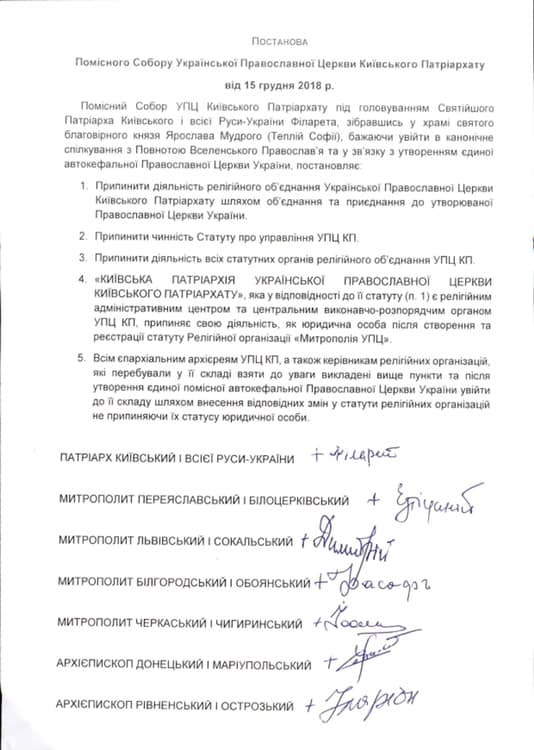
[edit]On 15 December 2018, the Ukrainian Autocephalous Orthodox Church and UOC-KP hierarchies decided to dissolve the churches. That day, the UAOC, the UOC–KP and some members of the Ukrainian Orthodox Church (Moscow Patriarchate) were going to merge to form the Orthodox Church of Ukraine after a unification council.[40]
According to Filaret, "the Kyiv Patriarchate has not been liquidated. It is not liquidated. They want to present the situation as if it was liquidated. The Kyiv Patriarchate can be liquidated by the one who created it".[41][42][43] The Ukrainian Ministry of Culture, "in response to a widely circulated statement by the media, alleging that the Ukrainian Orthodox Church of the Kyivan Patriarchate still exists or is being restored in Ukraine", published a report that the UOC-KP had "actually and legally ceased its activities".[44] Filaret said, "The Ukrainian Orthodox Church of the Kyiv Patriarchate (UOC-KP) remains registered with state bodies. In particular, the Kyiv Patriarchate remains registered. This means the Kyiv Patriarchate continues to legally exist."[45] According to the Ukrainian Ministry of Justice, the UOC-KP still existed.[46][47]
Separation from the OCU and reestablishment of the UOC–KP
[edit]The local council of the UOC-KP (convened by Filaret) decided to cancel the decisions of the unification council of the Orthodox churches of Ukraine on 20 June 2019,[48][49] during the conflict between Filaret and Epiphanius.
On 31 July 2019, the Ukrainian Ministry of Culture said the UOC-KP had ceased to exist.[50][51] However, on 4 September 2019, the District Administrative Court of Kyiv suspended the liquidation of the UOC-KP at the request of the UOC-KP.[52][53] On 11 September, another decision of the same court blocked "the Justice Ministry of Ukraine, the Culture Ministry of Ukraine, its structural sub-units, central-government and local authorities, and notaries public from performing any registration regarding the Kyiv Patriarchate, the Ukrainian Orthodox Church of the Kyiv Patriarchate [UOC-KP], and their assets"[54][55] On 11 November 2019, the Court of Appeal of the District Administrative Court of Kyiv confirmed legality of the process of liquidation of the UOC-KP.[56][57]
On 14 December 2019, after the meeting of the enlarged Bishops' Council, held on 14 December in Kyiv on the occasion of the anniversary of the creation of the OCU, Epiphanius declared that the procedure of liquidation of the UAOC as well as the UOC-KP had been completed the day before. He added: "Such structures no longer exist. In confirmation of that, in the State Register there is marked 'activity DISCONTINUED'".[58] In the same month, the UOC-KP stated it did not recognize the liquidation.[59]
In January 2020, the UOC-KP announced that Filaret had officially withdrawn his signature from 15 December 2018 act of dissolution of the UOC-KP.[60][61]
Statistics
[edit]The Kyiv Patriarchate has 44 percent of Orthodox Christians, compared to 12.8 percent for the UOC of the Moscow Patriarchate. Although the Russian Orthodox Church in Ukraine (UOC-MP) has twice as many parishes, the UOC-KP had three times as many members. The former had 38 percent of all Orthodox and 25 percent of the population in 2016, and the Russian Orthodox had 23 percent of the Orthodox and 15 percent of the population. The UOC-KP had 34 dioceses worldwide, and over 5,100 parishes in Ukraine. Its United States vicariate consisted of 15 parishes, with its main cathedral St. Andrew's in Bloomingdale, Illinois.[62] The church had six parishes in Australia, and over 40 in western Europe. The Russian government's reported negative influence on the Moscow Patriarchate and claims that it is using the patriarchate as a "tool of influence over Ukraine" led to a renewed April 2018 drive to recognise an independent Ukrainian Orthodox church which, according to Ukrainian President Petro Poroshenko, would help "eliminate internal strife and conflicts within the state."[15][63]
UOC-KP adherents in Ukraine, excluding Crimea and breakaway areas of Donbas:
| Date | Percentage | Source |
|---|---|---|
| May–June 2016 | 33 | [64] |
| June–July 2017 | 44 | [65] |
| May–June 2018 | 36 | [66] |
Primates
[edit]
In November 1991 the all-Ukrainian sobor of the Ukrainian Orthodox Church, called by Metropolitan Filaret Denysenko, issued a request to the patriarch of Moscow for the autocephaly of the Ukrainian church.[67] The sobor of the ROC held in April 1992 refused that request and decided to replace Metropolitan Filaret with Volodymyr Sabodan. In response to this, at the all-Ukrainian sobor in June 1992 one part of the Ukrainian Orthodox church, led by Metropolitan Filaret, decided to separate from the ROC and unite with the Ukrainian Autocephalous Orthodox Church (UAOC) to form the Ukrainian Orthodox Church-Kyiv Patriarchate under Patriarch Mstyslav.[67] Mstyslav never approved of the union of the UAOC and the UOC-KP.[67]
Patriarch Mstyslav (Stepan Ivanovych Skrypnyk) was Patriarch of Kyiv and all Rus’-Ukraine and primate of the Ukrainian Autocephalous Orthodox Church (UAOC) and Ukrainian Orthodox Church – Kyiv Patriarchate (UOC–KP) from 1991 to 1993. After Mstyslav's death in 1993, the temporary union ended and the Ukrainian Orthodox Church – Kyiv Patriarchate and the Ukrainian Autocephalous Orthodox Church separated. The primates of the Ukrainian Orthodox Church–Kyiv Patriarchate continued to hold the title of patriarch:
- Metropolitan Filaret (Filaret Denysenko) (1990–1992)
- Patriarch Mstyslav (Mstyslav Skrypnyk) (1992–1993)
- Patriarch Volodymyr (Volodomyr Romaniuk) (1993–1995)
- Patriarch Filaret (Filaret Denysenko), (1995–2018)
- Patriarch Filaret (Filaret Denysenko), (2019–present)
On 20 October 2018, the UOC-KP changed the title of its primate to "His Holiness and Beatitude (name), Archbishop and Metropolitan of Kyiv – Mother of the Rus Cities and of Galicia, Patriarch of All Rus-Ukraine, Holy Archimandrite of the Holy Assumption Kyiv-Pechersk and Pochayiv Lavra".[34][35][68] The abridged form is "His Holiness (name), Patriarch of Kyiv and All Russia-Ukraine", and the form for inter-church relations is "Archbishop, Metropolitan of Kyiv and All Rus'-Ukraine".[34][36][37][38][39][68] Metropolitan Hilarion called the bestowal of title a "farce".[2][69]
Administration
[edit] | The neutrality of this section is disputed. (April 2020) |
Before the first disestablishment:[70]
Dioceses
[edit]- Belgorod
- Bogorodsk
- Cherkasy[71]
- Chernihiv
- Chernivtsi[72]
- Crimea
- Dnipropetrovsk
- Donetsk
- Drohobych-Sambir
- Ivano-Frankivsk
- Kharkiv
- Kherson[73]
- Khmelnytskyi
- Kitsman
- Kolomyia
- Kropyvnytskyi
- Kyiv
- Luhansk
- Lviv
- Mykolaiv
- Odesa
- Pereiaslav
- Poltava
- Rivne
- Sumy
- Ternopil-Buchach[74]
- Ternopil-Terebovlya
- Vinnytsia
- Volyn
- Volodymyr-Volynskyi
- Zakarpattia Oblast
- Zaporizhzhia
- Zhytomyr
- Deanery of Germany[75]
- Eastern Moldavia
- Paris
Exarchates and vicariates
[edit]- Exarchate in Greece
- Ukrainian Orthodox Vicarate of the UOC-KP in the US and Canada[76]
- Vicariate in Australia
- European Exarchate
- Russian Exarchate
See also
[edit]- Bulgarian Alternative Synod
- Eastern Orthodox Church organization
- Montenegrin Orthodox Church
- Orthodox Church in America
- Orthodox Church in Italy
References
[edit]- ^ "РПЦ: вмешательство Константинополя в ситуацию на Украине может породить новые расколы". ТАСС (Interview with Metropolitan Hilarion (Alfeyev)). 1 September 2018. Retrieved 2 December 2018.
- ^ a b "Metropolitan Hilarion: Filaret Denisenko was and remains a schismatic". mospat.ru. 22 October 2018. Retrieved 29 October 2018.
- ^ "Акт об отлучении от Церкви монаха Филарета (Денисенко)". sobor-2008.ru. Archived from the original on 29 August 2014. Retrieved 1 December 2018.
- ^ a b "Official History of the Defrocking and Anathematization of Philaret Denisenko. Documents of the June 1992, 1994, and 1997 Bishops' Councils of the Russian Orthodox Church". OrthoChristian.Com. 17 October 2018. Retrieved 1 December 2018.
- ^ Патріархії, Прес-центр Київської. "X. The So-Called "Anathematization" Of Patriarch Filaret (part 2). - Ukrainian Orthodox Church – Kyiv Patriarchate (UOC-KP)". archive.cerkva.info. Retrieved 1 December 2018.
- ^ a b Ecumenical Patriarchate of Constantinople (11 October 2018). "Announcement (11/10/2018)". Retrieved 17 October 2018.
- ^ Petrasiuk, Oleg (14 October 2018). "Ukraine thanks Ecumenical Patriarchate for supporting independence of Ukrainian Orthodox Church". KyivPost. Retrieved 17 October 2018.
- ^ "The Ecumenical Synod lifted the anathema on the leaders of the UOC-KP and the UAOC | The Koz Times". koztimes.com. 11 October 2018. Archived from the original on 12 October 2018. Retrieved 12 October 2018.
- ^ "Announcement of the Ecumenical Patriarchate of Constantinople". Ecumenical Patriarchate. 11 October 2018. Retrieved 12 October 2018.
- ^ "Ecumenical Patriarchate To Recognize Ukrainian Church's Autocephaly Despite Moscow's Disagreement | Greek Reporter Europe". eu.greekreporter.com. 7 September 2018. Retrieved 16 October 2018.
- ^ a b СТАТУТ ПРО УПРАВЛІННЯ УКРАЇНСЬКОЇ ПРАВОСЛАВНОЇ ЦЕРКВИ КИЇВСЬКОГО ПАТРІАРХАТУ See Chapter I, § 1 and 7.
- ^ a b After autocephaly, The Ukrainian Week (26 October 2018)
(in Ukrainian) The Ecumenical Patriarchate unveiled documents in support of Ukrainian autocephaly, Gazeta.ua (14 September 2018) - ^ "Ukrainian Orthodox church". www.encyclopediaofukraine.com. Retrieved 9 January 2019.
- ^ Russia seeks to crush the Ukrainian Orthodox Church in Crimea for helping resist Russification, UNIAN (11 October 2018)
- ^ a b Coyle, James J. (24 April 2018). "Ukraine May Be Getting Its Own Church, but Not as Fast as Poroshenko Thinks". Atlantic Council. According to the Razumkov Center, among the 27.8 million Ukrainian members of Orthodox churches, allegiance to the Kyiv Patriarchate has grown from 12% in 2000 to 25% in 2016. Much of the growth has come from believers who previously did not associate with either patriarchate.
- ^ Synaxis of Hierarchs of The Ecumenical Patriarchate of Constantinople Ukrainian Orthodox Church of the USA
- ^ Polityuk, Pavel; Dikmen, Yesim (11 October 2018). "Ukraine wins approval for historic split from Russian church". Reuters. Retrieved 16 October 2018.
- ^ a b "Announcement (11/10/2018). - Announcements - The Ecumenical Patriarchate". www.patriarchate.org. Ecumenical Patriarchate. 11 October 2018. Retrieved 12 October 2018.
The Holy Synod discussed in particular and at length the ecclesiastical matter of Ukraine, in the presence of His Excellency Archbishop Daniel of Pamphilon and His Grace Bishop Hilarion of Edmonton, Patriarchal Exarchs to Ukraine, and following extensive deliberations decreed:
1) To renew the decision already made that the Ecumenical Patriarchate proceed to the granting of Autocephaly to the Church of Ukraine. [...]
4) To revoke the legal binding of the Synodal Letter of the year 1686 [...] - ^ a b Tomos ante portas: a short guide to Ukrainian church independence. Euromaidan Press. 14 October 2018. Retrieved 16 October 2018.
the Synod ... of the Ecumenical Patriarchate ... gave further confirmation that Ukraine is on the path to receiving church independence from Moscow. ... Although President Poroshenko triumphantly announced that as a result of the meeting Ukraine had received the long-awaited Tomos, or decree of Church independence – a claim circulated in Ukraine with great enthusiasm, this is not true ... Constantinople's decision will benefit other jurisdictions in Ukraine – the UOC KP and UAOC, which will have to effectively dismantle their own administrative structures and set up a new Church, which will receive the Tomos of autocephaly ... Right now it's unclear which part of the UOC MP will join the new Church. 10 out of 90 UOC MP bishops signed the appeal for autocephaly to the Ecumenical Patriarch – only 11%. But separate priests could join even if their bishops don't, says Zuiev.
- ^ "Announcement (11/10/2018). - Announcements - The Ecumenical Patriarchate". www.patriarchate.org. 11 October 2018. Retrieved 30 October 2018.
- ^ "Announcement (11/10/2018). - Announcements - The Ecumenical Patriarchate". www.patriarchate.org. Retrieved 27 October 2018.
3) To accept and review the petitions of appeal of Filaret Denisenko, Makariy Maletych and their followers, who found themselves in schism not for dogmatic reasons, in accordance with the canonical prerogatives of the Patriarch of Constantinople to receive such petitions by hierarchs and other clergy from all of the Autocephalous Churches. Thus, the above-mentioned have been canonically reinstated to their hierarchical or priestly rank, and their faithful have been restored to communion with the Church.
- ^ "Constantinople recognizes Kyiv Patriarch Filaret as church bishop". KyivPost. 11 October 2018. Retrieved 17 October 2018.
The Kyiv Patriarchate and the Ukrainian Autocephalous Orthodox Church are planning to merge with pro-independence bishops of the Moscow Patriarchate into an independent (autocephalous) Ukrainian church, which is expected to get a Tomos — a Synod decree recognizing the independence of the Ukrainian church from the Constantinople church. "This decision gives us the opportunity to unite with bishops of the Moscow Patriarchate who are willing (to join)," Filaret said on Oct. 11.
- ^ "Заява Прес-центру Київської Патріархії про рішення Священного Синоду Константинопольської Матері-Церкви та їхнє значення для Церкви в Україні". www.cerkva.info. 12 October 2018. Retrieved 1 December 2018.
- ^ "Kiev Patriarchate declines to implement the Phanar's decision on Filaret". spzh.news. 12 October 2018. Retrieved 1 December 2018.
- ^ "Phanar considers Filaret an ordinary bishop without an episcopal see". spzh.news. 14 October 2018. Retrieved 29 October 2018.
- ^ a b "ΑΠΟΚΛΕΙΣΤΙΚΟ | Βαρθολομαίος σε Ονούφριο: Δεν μπορείτε να έχετε πλέον τον τίτλο Κιέβου". ROMFEA (in Greek). 7 December 2018. Retrieved 8 December 2018.
- ^ a b "Patriarch Bartholomew explains Metropolitan Onufriy reasons for Ukraine church's autocephaly (Letter)". unian.info. 7 December 2018. Retrieved 29 December 2018.
- ^ "Kyiv Patriarchate does not exist, never existed - Patriarch Bartholomew". www.interfax-religion.com. 3 June 2019. Retrieved 3 June 2019.
- ^ "Константинополь: "Надеемся, Москва обратится к разуму". Подробности беседы". BBC News Русская служба. 2 November 2018. Retrieved 3 November 2018.
- ^ Cazabonne, Emma (6 November 2018). "BBC interview with Archbishop Job of Telmessos on the Ukrainian question". orthodoxie.com. Retrieved 7 November 2018.
- ^ "Exarch: Constantinople recognizes all clergy of KP and UAOC as canonical". spzh.news. 16 October 2018. Retrieved 18 December 2018.
- ^ "Constantinople recognized all clergy of KP and UAOC as canonical—Patriarchal Exarch". OrthoChristian.Com. 16 October 2018. Retrieved 22 December 2018.
- ^ a b "ЖУРНАЛ №17 ЗАСІДАННЯ СВЯЩЕННОГО СИНОДУ УКРАЇНСЬКОЇ ПРАВОСЛАВНОЇ ЦЕРКВИ КИЇВСЬКОГО ПАТРІАРХАТУ". www.cerkva.info. Українська Православна Церква Київський Патріархат (УПЦ КП). 20 October 2018. Retrieved 27 October 2018.
- ^ a b c d e ""Metropolitan" and "patriarch" rolled into one: KP changes its head's title". spzh.news. 20 October 2018. Retrieved 29 October 2018.
- ^ a b c "UOC KP Spokesman: Our Primate is archbishop, metropolitan, and patriarch". spzh.news. 27 October 2018. Retrieved 29 October 2018.
- ^ a b Wozniak, Hanna (26 October 2018). "Is the Ecumenical Patriarchate Fine with St. Andrew's Church in Kyiv?". moderndiplomacy.eu. Retrieved 27 October 2018.
On October 20, the UOC KP Synod changed the title of its head [Filaret]. Now the Church's Primate will also be called the Archimandrite of Kyiv-Pechersk and Pochayiv Lavras, which seemingly reflects Filaret's desire to get them at his disposal. At the moment both Lavras belong to the UOC MP [the Ukrainian Orthodox Church (Moscow Patriarchate)], so it looks like the "Archimandrite" doesn't want to comply with the fifth point of the Constantinople Synod decree in which the Patriarchate appeals to all sides involved that they avoid appropriation of Churches, Monasteries and other properties.
- ^ a b Укрінформ (26 October 2018), Українська церква на шляху утвердження автокефалії, archived from the original on 12 December 2021, retrieved 29 October 2018 (Press conference)
- ^ a b "UOC KP Spokesman: Our Primate is archbishop, metropolitan, and patriarch". spzh.news. 27 October 2018. Retrieved 29 October 2018.
Filaret is an "archbishop", a "metropolitan", and a "patriarch". This was announced on October 26 by Spokesman of the UOC KP Eustratiy Zoria during the press conference of Ukrinform "Ukrainian Church on the road to establishing autocephaly".
- ^ a b "Zoria explains why Filaret's title includes references to UOC Lavras". spzh.news. 22 October 2018. Retrieved 24 November 2018.
- ^ Киевский патриархат и УАПЦ самораспустились перед Собором. РБК-Украина (in Russian). 15 December 2018. Retrieved 16 December 2018.
- ^ "Split is looming in the newly formed Orthodox Church of Ukraine". risu.org.ua. 10 May 2019. Retrieved 12 May 2019.
- ^ ""Київський Патріархат не ліквідовано" — владика Філарет" [The Kyiv Patriarchate has not been liquidated — Bishop Filaret]. risu.org.ua. 9 May 2019. Retrieved 12 May 2019.
- ^ Cazabonne, Emma (10 May 2019). ""Patriarch" Filaret considers that the "Kyiv Patriarchate has never been liquidated"". Orthodoxie.com. Retrieved 11 May 2019.
- ^ "УПЦ КП "фактично й юридично припинила свою діяльність", — заява Міністерства культури". risu.org.ua. 11 May 2019. Retrieved 12 May 2019.
- ^ "Patriarch Filaret talks of split, schools Metropolitan Epifaniy". www.unian.info. 15 May 2019. Retrieved 15 May 2019.
- ^ "Filaret's "Kiev Patriarchate" still exists—Ukrainian Ministry of Justice". OrthoChristian.Com. 21 May 2019. Retrieved 21 May 2019.
- ^ "В Минюсте сообщили, что решение о роспуске УПЦ КП может принять только Поместный собор Киевского патриархата или суд". gordonua.com. Retrieved 21 May 2019.
- ^ "Filaret's 'Council' restores UOC-KP with all its structure, property and criticizes Tomos". RISU - Religious Information Service of Ukraine. 20 June 2019. Retrieved 20 June 2019.
- ^ ""Kyiv Patriarchate" cancels its dissolution". Interfax. 20 June 2019. Retrieved 21 June 2019.
- ^ "Ministry of Culture confirms liquidation of Kyiv Patriarchate". risu.org.ua. 31 July 2019. Retrieved 1 August 2019.
- ^ "Міністерство культури України :: Заява Міністерства культури України щодо особливостей державної реєстрації низки православних релігійних організацій після проведення Помісного Об'єднавчого Собору 15 грудня 2018 року". mincult.kmu.gov.ua. 31 July 2019. Retrieved 1 August 2019.
- ^ "УПЦ КП подала судовий позов щодо незаконності утворення ліквідаційної комісії Київської патріархії". Інформаційне агентство Українські Національні Новини (УНН). Всі онлайн новини дня в Україні за сьогодні - найсвіжіші, останні, головні. (in Ukrainian). 4 September 2019. Retrieved 6 September 2019.
- ^ "District Administrative Court suspends liquidation of UOC-KP". risu.org. 5 September 2019.
- ^ "Ukrainian court freezes "Kyiv Patriarchate" liquidation". www.interfax-religion.com. 12 September 2019. Retrieved 13 September 2019.
- ^ "Окружний суд заборонив ПЦУ розпоряджатись майном ліквідованого Київського патріархату". espreso.tv. 12 September 2019. Retrieved 15 September 2019.
- ^ "Суд в Киеве разрешил продолжить ликвидацию УПЦ-КП". www.interfax-religion.ru. 11 November 2019. Retrieved 12 November 2019.
- ^ "Court of Appeal allows liquidation of UOC-KP". risu.org.ua. 11 November 2019. Retrieved 12 November 2019.
- ^ "Митрополит Епіфаній оголосив про юридичне припинення існування УПЦ КП та УАПЦ". risu.org.ua. 14 December 2019. Retrieved 14 December 2019.
- ^ "Filaret's supporters plan to hold a forum in Brussels in defense of UOC-KP". risu.org.ua. 24 December 2019. Retrieved 26 December 2019.
- ^ "Filaret recalls signature under UOC-KP liquidation". www.interfax-religion.com. 13 January 2020. Retrieved 15 January 2020.
- ^ "Філарет відкликав свій підпис під постановою про ліквідацію УПЦ КП". risu.org.ua. 10 January 2020. Retrieved 10 January 2020.
- ^ "Home". en.standrewuoc.com. Retrieved 10 December 2018.
- ^ Daniel, McLaughlin (24 April 2018). "Ukraine seeks church independence to bolster stand against Russia". Irish Times.
"Ukrainian Lawmakers Back President's Move To Obtain Autocephalous Status For Orthodox Church". Radio Free Europe. 19 April 2018. - ^ "Public Opinion Survey: Residents of Ukraine May 28–June 14, 2016" (PDF). International Republican Institute. 8 July 2016. p. 62.
- ^ "Public Opinion Survey of Residents of Ukraine June 9 – July 7, 2017" (PDF). iri.org. 22 August 2017. p. 77. Archived from the original (PDF) on 22 August 2017.
- ^ "Public Opinion Survey: Residents of Ukraine May 26 – June 10, 2018" (PDF). International Republican Institute. 2018. p. 85.
- ^ a b c "Ukrainian Orthodox church". encyclopediaofukraine.com. Retrieved 9 January 2019.
- ^ a b "ЖУРНАЛ №17 ЗАСІДАННЯ СВЯЩЕННОГО СИНОДУ УКРАЇНСЬКОЇ ПРАВОСЛАВНОЇ ЦЕРКВИ КИЇВСЬКОГО ПАТРІАРХАТУ". www.cerkva.info. Українська Православна Церква Київський Патріархат (УПЦ КП). Retrieved 27 October 2018.
- ^ "Metropolitan Hilarion: Awarding new titles to Filaret is farce". spzh.news. 23 October 2018. Retrieved 29 October 2018.
- ^ "Resources- Links". Ukrainian Orthodox Church – Kyivan Patriarchate in the United States and Canada. Retrieved 8 December 2018.
- ^ "Культурно-просветительский центр "Cherkas". Христианство в искусстве: иконы, фрески, мозаики". cherkas.org.ua. Retrieved 8 December 2018.
- ^ "ГОЛОВНА — Чернігівські єпархіальні відомості". www.cerkva.in.ua. Retrieved 8 December 2018.
- ^ "pravoslav.tv". pravoslav.tv/. Retrieved 8 December 2018.
- ^ "cerkva.te.ua". Тернопільська єпархія Української Првославної Церкви Київського патріархату (in Ukrainian). Retrieved 8 December 2018.
- ^ "www.ukrainian-church.de/". Ukrainische Orthodoxe Kirche (in German). Retrieved 8 December 2018.
- ^ "Home". uockpusa.org. Retrieved 15 February 2021.
Further reading
[edit]- Goreev, Dmitry (23 January 2020). "Філарет та його новий Київський патріархат" [Filaret and his new Kyiv Patriarchate]. risu.org.ua. Retrieved 28 January 2020.
External links
[edit]- "Ukrainian Orthodox Church of the Kyivan Patriarchate". www.cerkva.info (in Ukrainian, Russian, and English).
- "The Canons of the Eastern Orthodox Church".
- Canonical status of the Ukrainian Orthodox Church – Kyiv Patriarchate
- Decision of the UOC-KP to dissolve itself (in Ukrainian)
External links
[edit] Media related to Ukrainian Orthodox Church – Kyiv Patriarchate at Wikimedia Commons
Patriarchates in Christianity | |||||||||||||||||||||
|---|---|---|---|---|---|---|---|---|---|---|---|---|---|---|---|---|---|---|---|---|---|
Traditional ecclesiastical jurisdictions of primates in Christianity, sorted according to earliest apostolic legacy and branched where multiple denominational claimants: bold blue = Catholic Church, light blue = Eastern Orthodox Church, bold/light green = Oriental Orthodoxy, italic blue = Nestorianism | |||||||||||||||||||||
| Early Christianity (Antiquity) (30–325/476) |
| ||||||||||||||||||||
| Middle Ages (476–1517) |
| ||||||||||||||||||||
| Early Modern era (1517–1789) |
| ||||||||||||||||||||
| Late Modern era (since 1789) |
| ||||||||||||||||||||
| Related |
| ||||||||||||||||||||
| |||||||||||||||||||||

Authority control databases | |
|---|---|
| International | |
| National | |

Original source: https://en.wikipedia.org/wiki/Ukrainian Orthodox Church – Kyiv Patriarchate
Status: article is cached
 EncycloReader
is supported by the
EncycloReader
is supported by the  KSF
KSF