WIPF1
 From Wikipedia - Reading time: 9 min
| WIPF1 | |||||||||||||||||||||||||||||||||||||||||||||||||||
|---|---|---|---|---|---|---|---|---|---|---|---|---|---|---|---|---|---|---|---|---|---|---|---|---|---|---|---|---|---|---|---|---|---|---|---|---|---|---|---|---|---|---|---|---|---|---|---|---|---|---|---|
 | |||||||||||||||||||||||||||||||||||||||||||||||||||
| Identifiers | |||||||||||||||||||||||||||||||||||||||||||||||||||
| Aliases | WIPF1, PRPL-2, WASPIP, WIP, WAS2, WAS/WASL interacting protein family member 1 | ||||||||||||||||||||||||||||||||||||||||||||||||||
| External IDs | OMIM: 602357; MGI: 2178801; HomoloGene: 86891; GeneCards: WIPF1; OMA:WIPF1 - orthologs | ||||||||||||||||||||||||||||||||||||||||||||||||||
| |||||||||||||||||||||||||||||||||||||||||||||||||||
| |||||||||||||||||||||||||||||||||||||||||||||||||||
| |||||||||||||||||||||||||||||||||||||||||||||||||||
| |||||||||||||||||||||||||||||||||||||||||||||||||||
| |||||||||||||||||||||||||||||||||||||||||||||||||||
| Wikidata | |||||||||||||||||||||||||||||||||||||||||||||||||||
| |||||||||||||||||||||||||||||||||||||||||||||||||||



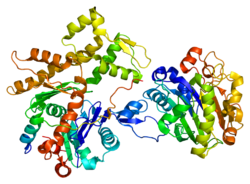
WAS/WASL-interacting protein (WIP) is a protein that in humans is encoded by the WIPF1 gene.[5][6]
Function
[edit]This gene encodes a protein that plays an important role in the organization of the actin cytoskeleton. Overexpression of WIP in mammalian cells has been shown to increase actin polymerization.[5] The encoded protein binds to a region of Wiskott–Aldrich syndrome protein that is frequently mutated in Wiskott–Aldrich syndrome, an X-linked recessive disorder. Impairment of the interaction between these two proteins may contribute to the disease. Two transcript variants encoding the same protein have been identified for this gene.[6] In patients lacking the WIPF1 gene WASp protein levels are depleted and WAS symptoms present.[7]
Interactions
[edit]WIP has been shown to interact with Wiskott–Aldrich syndrome protein,[5][8] N-WASp, Cortactin,[9] NCK1,[8] MYO1e[10] and ITSN1.[11] While Wiskott–Aldrich syndrome protein (WASp)is expressed only in haematopoetic cells, WIPF1 is expressed ubiquitously.[5] The majority of the mutations causing Wiskott Aldrich Syndrome are located in the WH1 domain of WASp.[12] These mutations affect WASp-WIPF1 binding.[13] WIPF1 has an N-terminal profilin binding domain, two actin binding WH2 domains, a central polyproline stretch, and a C-terminal WASp Binding Domain. WASp protein is degraded in the absence of WIP; but the ubiquitously expressed WASp ortholog N-WASp remains stable in the absence of WIP.
Work in yeast
[edit]WIPF1 functions and interactions have been studied in multiple fungal systems including Saccharomyces cerevisiae, Schizosaccharomyces pombe, Candida albicans,[14] and Magnaporthe grisea.[15]
Yeast Vrp1 is recruited to sites of endocytosis by WASp homologs. Here it interacts with myosin-1 and enhances myosin-1 mediated activation of the Arp2/3 complex.[16] In addition to a role in endocytosis, Saccharomyces cerevisiae Vrp1 functions in cytokinesis and cell polarization.[17]
In Schizosaccharomyces pombe, Vrp1 interaction with myosin-1 is believed to help position new actin branches near the membrane, enhancing the amount of force against the membrane. This interaction is disrupted by the yeast specific protein Bbc1/Mti1/SPAC23A1.17, which competes with Vrp1 for binding the Myo1e homolog.[18]
References
[edit]- ^ a b c GRCh38: Ensembl release 89: ENSG00000115935 – Ensembl, May 2017
- ^ a b c GRCm38: Ensembl release 89: ENSMUSG00000075284 – Ensembl, May 2017
- ^ "Human PubMed Reference:". National Center for Biotechnology Information, U.S. National Library of Medicine.
- ^ "Mouse PubMed Reference:". National Center for Biotechnology Information, U.S. National Library of Medicine.
- ^ a b c d Ramesh N, Antón IM, Hartwig JH, Geha RS (December 1997). "WIP, a protein associated with Wiskott–Aldrich syndrome protein, induces actin polymerization and redistribution in lymphoid cells". Proceedings of the National Academy of Sciences of the United States of America. 94 (26): 14671–6. Bibcode:1997PNAS...9414671R. doi:10.1073/pnas.94.26.14671. PMC 25088. PMID 9405671.
- ^ a b "Entrez Gene: WIPF1 WAS/WASL interacting protein family, member 1".
- ^ Lanzi G, Moratto D, Vairo D, Masneri S, Delmonte O, Paganini T, et al. (January 2012). "A novel primary human immunodeficiency due to deficiency in the WASP-interacting protein WIP". The Journal of Experimental Medicine. 209 (1): 29–34. doi:10.1084/JEM.20110896. hdl:11379/487873. PMC 3260865. PMID 22231303.
- ^ a b Antón IM, Lu W, Mayer BJ, Ramesh N, Geha RS (August 1998). "The Wiskott–Aldrich syndrome protein-interacting protein (WIP) binds to the adaptor protein Nck". The Journal of Biological Chemistry. 273 (33): 20992–5. doi:10.1074/jbc.273.33.20992. PMID 9694849.
- ^ Kinley AW, Weed SA, Weaver AM, Karginov AV, Bissonette E, Cooper JA, Parsons JT (March 2003). "Cortactin interacts with WIP in regulating Arp2/3 activation and membrane protrusion". Current Biology. 13 (5): 384–93. doi:10.1016/S0960-9822(03)00107-6. PMID 12620186. S2CID 17357571.
- ^ Cheng J, Grassart A, Drubin DG (August 2012). "Myosin 1E coordinates actin assembly and cargo trafficking during clathrin-mediated endocytosis". Molecular Biology of the Cell. 23 (15): 2891–904. doi:10.1091/mbc.e11-04-0383. PMC 3408416. PMID 22675027.
- ^ Gryaznova T, Kropyvko S, Burdyniuk M, Gubar O, Kryklyva V, Tsyba L, Rynditch A (July 2015). "Intersectin adaptor proteins are associated with actin-regulating protein WIP in invadopodia". Cellular Signalling. 27 (7): 1499–508. doi:10.1016/j.cellsig.2015.03.006. PMID 25797047.
- ^ Rajmohan R, Raodah A, Wong MH, Thanabalu T (December 2009). "Characterization of Wiskott–Aldrich syndrome (WAS) mutants using Saccharomyces cerevisiae". FEMS Yeast Research. 9 (8): 1226–35. doi:10.1111/j.1567-1364.2009.00581.x. PMID 19817875.
- ^ Rajmohan R, Meng L, Yu S, Thanabalu T (April 2006). "WASP suppresses the growth defect of Saccharomyces cerevisiae las17Delta strain in the presence of WIP". Biochemical and Biophysical Research Communications. 342 (2): 529–36. doi:10.1016/j.bbrc.2006.01.160. PMID 16488394.
- ^ Borth, Nicole (July 19, 2010). "Candida albicans Vrp1 is required for polarized morphogenesis and interacts with Wal1 and Myo5" (PDF). Microbiology. 156 (Pt 10): 2962–2969. doi:10.1099/mic.0.041707-0. PMID 20656786.
- ^ Huang, Lin (January 24, 2017). "MoVrp1, a putative verprolin protein, is required for asexual development and infection in the rice blast fungus Magnaporthe oryzae". Scientific Reports. 7: 41148. Bibcode:2017NatSR...741148H. doi:10.1038/srep41148. PMC 5259722. PMID 28117435.
- ^ Sirotkin, Vladimir; Beltzner, Christopher C.; Marchand, Jean-Baptiste; Pollard, Thomas D. (2005-08-15). "Interactions of WASp, myosin-I, and verprolin with Arp2/3 complex during actin patch assembly in fission yeast". The Journal of Cell Biology. 170 (4): 637–648. doi:10.1083/jcb.200502053. ISSN 0021-9525. PMC 2171502. PMID 16087707.
- ^ Munn, Alan L.; Thanabalu, Thirumaran (July 2009). "Verprolin: a cool set of actin-binding sites and some very HOT prolines". IUBMB Life. 61 (7): 707–712. doi:10.1002/iub.195. hdl:10072/30097. ISSN 1521-6551. PMID 19507265. S2CID 6788285.
- ^ MacQuarrie CD, Mangione MC, Carroll R, James M, Gould KL, Sirotkin V (September 2019). "S. pombe adaptor protein Bbc1 regulates localization of Wsp1 and Vrp1 during endocytic actin patch assembly". Journal of Cell Science. 132 (17): jcs233502. doi:10.1242/jcs.233502. PMC 6771142. PMID 31391237.
Further reading
[edit]- Ramesh N, Antón IM, Martínez-Quiles N, Geha RS (January 1999). "Waltzing with WASP". Trends in Cell Biology. 9 (1): 15–9. doi:10.1016/S0962-8924(98)01411-1. PMID 10087612.
- Antón IM, Lu W, Mayer BJ, Ramesh N, Geha RS (August 1998). "The Wiskott–Aldrich syndrome protein-interacting protein (WIP) binds to the adaptor protein Nck". The Journal of Biological Chemistry. 273 (33): 20992–5. doi:10.1074/jbc.273.33.20992. PMID 9694849.
- Stewart DM, Tian L, Nelson DL (April 1999). "Mutations that cause the Wiskott–Aldrich syndrome impair the interaction of Wiskott–Aldrich syndrome protein (WASP) with WASP interacting protein". Journal of Immunology. 162 (8): 5019–24. doi:10.4049/jimmunol.162.8.5019. PMID 10202051. S2CID 8959266.
- Vaduva G, Martinez-Quiles N, Anton IM, Martin NC, Geha RS, Hopper AK, Ramesh N (June 1999). "The human WASP-interacting protein, WIP, activates the cell polarity pathway in yeast". The Journal of Biological Chemistry. 274 (24): 17103–8. doi:10.1074/jbc.274.24.17103. PMID 10358064.
- Moreau V, Frischknecht F, Reckmann I, Vincentelli R, Rabut G, Stewart D, Way M (July 2000). "A complex of N-WASP and WIP integrates signalling cascades that lead to actin polymerization". Nature Cell Biology. 2 (7): 441–8. doi:10.1038/35017080. PMID 10878810. S2CID 40986646.
- Vetterkind S, Miki H, Takenawa T, Klawitz I, Scheidtmann KH, Preuss U (January 2002). "The rat homologue of Wiskott–Aldrich syndrome protein (WASP)-interacting protein (WIP) associates with actin filaments, recruits N-WASP from the nucleus, and mediates mobilization of actin from stress fibers in favor of filopodia formation". The Journal of Biological Chemistry. 277 (1): 87–95. doi:10.1074/jbc.M104555200. PMID 11687573.
- Antón IM, de la Fuente MA, Sims TN, Freeman S, Ramesh N, Hartwig JH, et al. (February 2002). "WIP deficiency reveals a differential role for WIP and the actin cytoskeleton in T and B cell activation". Immunity. 16 (2): 193–204. doi:10.1016/S1074-7613(02)00268-6. PMID 11869681.
- Scott MP, Zappacosta F, Kim EY, Annan RS, Miller WT (August 2002). "Identification of novel SH3 domain ligands for the Src family kinase Hck. Wiskott–Aldrich syndrome protein (WASP), WASP-interacting protein (WIP), and ELMO1". The Journal of Biological Chemistry. 277 (31): 28238–46. doi:10.1074/jbc.M202783200. PMID 12029088.
- Benesch S, Lommel S, Steffen A, Stradal TE, Scaplehorn N, Way M, et al. (October 2002). "Phosphatidylinositol 4,5-biphosphate (PIP2)-induced vesicle movement depends on N-WASP and involves Nck, WIP, and Grb2". The Journal of Biological Chemistry. 277 (40): 37771–6. doi:10.1074/jbc.M204145200. PMID 12147689.
- Zettl M, Way M (September 2002). "The WH1 and EVH1 domains of WASP and Ena/VASP family members bind distinct sequence motifs". Current Biology. 12 (18): 1617–22. doi:10.1016/S0960-9822(02)01112-0. PMID 12372256. S2CID 9396610.
- Volkman BF, Prehoda KE, Scott JA, Peterson FC, Lim WA (November 2002). "Structure of the N-WASP EVH1 domain-WIP complex: insight into the molecular basis of Wiskott–-Aldrich Syndrome". Cell. 111 (4): 565–76. doi:10.1016/S0092-8674(02)01076-0. PMID 12437929. S2CID 13997860.
- Sasahara Y, Rachid R, Byrne MJ, de la Fuente MA, Abraham RT, Ramesh N, Geha RS (December 2002). "Mechanism of recruitment of WASP to the immunological synapse and of its activation following TCR ligation". Molecular Cell. 10 (6): 1269–81. doi:10.1016/S1097-2765(02)00728-1. PMID 12504004.
- Luthi JN, Gandhi MJ, Drachman JG (February 2003). "X-linked thrombocytopenia caused by a mutation in the Wiskott–Aldrich syndrome (WAS) gene that disrupts interaction with the WAS protein (WASP)-interacting protein (WIP)". Experimental Hematology. 31 (2): 150–8. doi:10.1016/S0301-472X(02)01023-8. PMID 12591280.
- Kinley AW, Weed SA, Weaver AM, Karginov AV, Bissonette E, Cooper JA, Parsons JT (March 2003). "Cortactin interacts with WIP in regulating Arp2/3 activation and membrane protrusion". Current Biology. 13 (5): 384–93. doi:10.1016/S0960-9822(03)00107-6. PMID 12620186. S2CID 17357571.
- Kim MK, Kim ES, Kim DS, Choi IH, Moon T, Yoon CN, Shin JS (October 2004). "Two novel mutations of Wiskott–Aldrich syndrome: the molecular prediction of interaction between the mutated WASP L101P with WASP-interacting protein by molecular modeling". Biochimica et Biophysica Acta (BBA) - Molecular Basis of Disease. 1690 (2): 134–40. doi:10.1016/j.bbadis.2004.06.007. PMID 15469902.
External links
[edit]- Overview of all the structural information available in the PDB for UniProt: O43516 (WAS/WASL-interacting protein family member 1) at the PDBe-KB.
PDB gallery | |
|---|---|
|

Original source: https://en.wikipedia.org/wiki/WIPF1
Status: article is cached
 EncycloReader
is supported by the
EncycloReader
is supported by the  KSF
KSF