Categories
Waris Ali Shah
 From Wikipedia - Reading time: 8 min
Syed Waris Ali Shah(R.A) | |
|---|---|
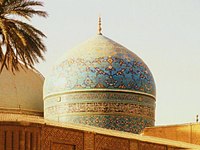
 Dargah of Haji Waris Ali Shah in Dewa Shareef, Barabanki, India. | |
| Title | Imam-ul-Aulia, Ashraful Alameen, Waris-e-Panjtan, Aalam Panaah Waris |
| Personal | |
| Born | Mitthan Miya.[1] 16 July 1817 AD / 1 Ramzan ul Mubarak, 1232 Hijri Dewa, Barabanki, India |
| Died | 7 April 1905 AD /1 safar, 1323 Hijri Dewa, Barabanki, India |
| Resting place | Dewa, Barabanki, India |
| Religion | Islam |
| Era | Early 19th century |
| Region | India |
| Denomination | Sunni |
| Jurisprudence | Hanafi |
| Tariqa | Qadri |
Waris Ali Shah (1817–1905) was a Sufi saint from Dewa, Barabanki, India, and the founder of the Warsi Sufi order. He traveled to many places specially Europe and the west and admitted people to his spiritual order. He belongs to the 26th generation of Hazrat Imam Hussain رضی اللہ عنہ[2] His shrine is at Dewa, India.[3][4]
Life[edit]
In the book "Islamic Review and Muslim India", (Kraus Reprint, 1971) it was mentioned that Waris Ali Shah had lived his life as the Christ lived.[5]
Father[edit]
His father name was Hazrat Qurban Ali Shah R.A, whose tomb is in Dewa.[6]
At an early age Shah showed an inclination for a religious life.[7]
Social engagements[edit]
He went to Makkah for pilgrimage many times.[8] During his travels in Europe, he visited the Sultan of Turkey[clarification needed] and Otto von Bismarck in Berlin.[2] He also traveled to England and had an audience with Queen Victoria.[8]
He was a friend of Abdul Bari.[9]
Death[edit]
He died on 5 April 1905 (29 Muharram 1323 AH).[10]
Sufi order[edit]
| Part of a series on Islam Sufism |
|---|
 |
 Islam portal Islam portal |
Waris Ali Shah belonged to the Qadiriyya order of Sufism.[11] He had a liberal view and permitted his followers to follow Sufism and names may not be changed in case of one has accepted Islam.[2]
As a boy, Shah attached himself to Khadim Ali Shah, a Dervish of Golaganj, Lucknow, in the state of Uttar Pradesh, India, and remained with the latter until his death in 1832–33 when Shah was 16 years old.[12]
His disciples[edit]
He had followers from several faiths.[13]
- Ghulam Muhammad (governor general of Pakistan)[14]
- Sultan Abdul Majed[15]
- Hakeem Safdar Ali Warisi (Mahajan Title given by Haji Saheb) writer of Jalwaye Waris[16] (Migrate from Gadia to Bahraich on Haji Saheb's order. His Grand Son Izhar Warsi is prominent poet of Urdu.[17])
- Thakur Pancham Singh.[18]
- Zamindar Dt. Mainpuri.
- Raja Udyat Narayan Sing (Suratgunj, Oudh).[19]
- Baboo Moti Misser (Bhagalpur).
- Thakur Grur Mohan Singh, Zamindar (Bhagalpur).
- Baba Sufi Syed Diwana Shah Warsi [20] first khalifa (roohani) and nephew (Jagatdal, West Bengal).
- Sadaf Jabbar Fazihat.
- Shah Abdul Ad Shah.
- Maulana Mohammad Shah.
- Mustaqim Shah.[13]
- Faizu Shah
- Rahim Shah
- Hafiz Pyaari
- Shakir Shah
- Avghat Shah[21]
- Maroof Shah
- Noorkarim Shah
- Siddiq Shah (Amethi Sultanpur U.P India
- Sai Baba of Shirdi[citation needed]
- Bangali Shah(Kolkata India)
- Sandal Shah (Kolkata India)
- Mushir Husain Qidwai of Gadia, a zamindar, barrister and pan-Islamist politician from Barabanki.[9]
- Badnam Shah
- Khuda Bakhsh Sheikh was a follower of Waris Ali Shah. He collected the sayings of his spiritual guide Malfūzāt-i-Hāji Wāris 'Ali Shāh.[3] His book, Tohmat-ul-Asfiya, is the biography of Waris Ali Shah.[22]
- Haseen Shah warsi
- Bekarar Shah Warsi[23]
- Warsi Ghulam Mohammad Mallah[citation needed]
Death anniversary[edit]
Shah's father's death anniversary, locally known as Dewa Mela, is observed in October–November and is attended by nearly a million Muslims and Hindus.[8][24][25][26]
Shah reportedly started this event in memory of his own father, Qurban Ali Shah. Another annual fair is held in Shah's tomb on 1 Safar.[27][28]
See also[edit]
- Islam in India
- Sufism in India
References[edit]
- ^ "पैदाइशी वली थे हजरत हाजी वारिस अली शाह". Dainik Jagran (in Hindi). Retrieved 24 September 2020.
- ^ a b c Hasan, Masoodul (2007). Sufism and English literature : Chaucer to the present age : echoes and images. New Delhi, India: Adam Publishers & Distributors. pp. 5, 183. ISBN 9788174355232.
- ^ a b Hadi, Nabi (1994). Dictionary of Indo-Persian literature. Janpath, New Delhi: Indira Gandhi National Centre for the Arts. p. 554. ISBN 9788170173113.
- ^ Prasad, Rajendra (2010). India divided. New Delhi: Penguin Books. p. 44. ISBN 9780143414155.
- ^ Islamic Review and Muslim India. Kraus Reprint. 1971.
- ^ All India Reporter, Volume 4, Part 5. D.V. Chitaley. 1917. pp. 81, 85, 87.
- ^ All India Reporter, Volume 4, Part 5. D.V. Chitaley. 1917. p. 81.
- ^ a b c Ehtisham, S. Akhtar (2008). A medical doctor examines life on three continents : a Pakistani view. New York: Algora Pub. p. 11. ISBN 9780875866345.
- ^ a b Qureshi, M. Naeem (1999). Pan-Islam in British Indian politics : a study of the Khilafat movement, 1918 – 1924. Leiden [u.a.]: Brill. pp. 92, 470, 539. ISBN 9789004113718.
- ^ Sharib, Zahurul Hassan (2006). The Sufi saints of the Indian subcontinent. Munshiram Manoharlal Publishers. p. 290. ISBN 9788121510523.
- ^ Mountain Path, Volume 19. Sri Ramanasramam. 1982. pp. 20, 21.
- ^ S. D., Chaudhri (1917). Indian Cases: Containing Full Reports of Decisions of the Privy Council, the High Courts of Allahabad, Bombay, Calcutta, Madras and Patna, the Chief Courts of Lower Burma and the Punjab, the Courts of the Judicial Commissioners of Central Provinces, Oudh, Sind and Upper Burma, Reported in ... 25 Legal Periodicals ... with a Large Number of Extra Rulings Not Reported Elsewhere, Volume 40. Great Britain Privy Council Judicial Committee, India Courts: The manager, at the "Law publishing press". p. 102.
- ^ a b "Waris ali shah, saint waris ali, hazrat waris ali, desciples sarkar waris, warsi family, generations waris ali shah, urs ceremony, warsi doctrine, waris, warsi, dewa sharif, dewa, dewamela, ehram, desciples, imams, imam ali, imam hussain, generations prophet muhammad". www.warispak.com.
- ^ Zaman, Muhammad Qasim (15 May 2018). Islam in Pakistan: A History. Princeton University Press. ISBN 978-1-4008-8974-7.
- ^ Sharib, Zahurul Hassan (2006). The Sufi Saints of the Indian Subcontinent. Munshiram Manoharlal Publishers. ISBN 9788121510523.
- ^ Hanif, N. (2002). Biographical Encyclopaedia of Sufis: Central Asia and Middle East. Sarup & Sons. ISBN 978-81-7625-266-9.
- ^ "Welcome to Uttar Pradesh Urdu Akademi : A U.P.Govt. Undertaking". www.upurduakademi.org. Retrieved 23 April 2021.
- ^ "इटावा के राजा ठाकुर पंचम सिंह ने दान की थी संपत्ति". Navbharat Times (in Hindi). Retrieved 23 April 2021.
- ^ "Melas & Festivals | District Barabanki, Government of Uttar Pradesh | India". Retrieved 16 September 2021.
- ^ "Online collection of Sufi Poetry & Sufi Shayari by famous Poets". Sufinama. Retrieved 20 November 2022.
- ^ Rekhta
- ^ "Personalities: Literary". The Official Website of Barabanki *Master Mahmood Alam At post Badgavan. MINISTRY OF COMMUNICATION & INFORMATION TECHNOLOGY; GOVERNMENT OF INDIA; BARABANKI-225001. Retrieved 20 July 2010.
- ^ "जिसने देखा हो गया सैदा तेरा वारिस पिया." Dainik Jagran (in Hindi). Retrieved 22 April 2021.
- ^ Kochhar, S. K. (1984). Teaching of history (2nd ed.). Sterling. p. 292. ISBN 9788120700253.
- ^ Kapoor, Subodh, ed. (2002). The Indian encyclopaedia : biographical, historical, religious, administrative, ethnological, commercial and scientific (1st ed.). New Delhi: Cosmo Publications. p. 1925. ISBN 9788177552577.
- ^ Hasan, Mushirul (2004). From pluralism to separatism : qasbas in colonial Awadh (1st. publ. ed.). New Delhi [u.a.]: Oxford Univ. Press. p. 129. ISBN 9780195666083.
- ^ Varma, Uma (1994). Uttar Pradesh State Gazetteer: Social services, culture, places of interest Gazetteer of India Volume 5 of Uttar Pradesh State Gazetteer, Uttar Pradesh (India). Dept. of District Gazetteers. Government of Uttar Pradesh, Department of District Gazetteers.
- ^ "This year, UP's Dewa mela to focus on 'One District, One Product'". Hindustan Times. 15 October 2019. Retrieved 24 September 2020.
Authority control | |
|---|---|
| International | |
| National | |

External links[edit]
Original source: https://en.wikipedia.org/wiki/Waris Ali Shah
Status: article is cached
 EncycloReader
is supported by the
EncycloReader
is supported by the  KSF
KSF