Categories
Warner Bros. Pictures
 From Wikipedia - Reading time: 25 min
 Logo used since December 2023 | |
| Formerly |
|
|---|---|
| Company type | Division |
| Industry | Film production |
| Predecessor | Warner Features Company |
| Founded | April 4, 1923 |
| Founders |
|
| Headquarters | 4000 Warner Boulevard, Burbank, California , United States |
Area served | Worldwide |
Key people |
|
| Products | Motion pictures |
| Services |
|
| Parent | Warner Bros. Motion Picture Group |
| Website | warnerbros.com |
| Footnotes / references [1][2] | |
Warner Bros. Pictures is an American film studio and distribution arm of the Warner Bros. Motion Picture Group division of Warner Bros., both of which are owned by Warner Bros. Discovery as part of its Streaming & Studios division. It is headquartered at the Warner Bros. Studios complex in Burbank, California. Animated films produced by Warner Bros. Pictures Animation are also released under the studio banner.[3]
The studio was founded on April 4, 1923, by the brothers Harry Warner, Albert Warner, Sam Warner, and Jack L. Warner. In addition to producing its own films, the studio handles filmmaking operations, theatrical distribution, marketing and promotion for films produced and released by other Warner Bros. labels. These labels include Warner Bros. Pictures Animation, New Line Cinema and Castle Rock Entertainment, as well as various third-party producers.
Warner Bros. Pictures is currently one of four live-action film studios within the Warner Bros. Motion Picture Group, the others being New Line Cinema, Castle Rock Entertainment, and Spyglass Media Group (with a minority stake). The most commercially successful film franchises from Warner Bros. include Harry Potter, DC Universe (formerly DC Extended Universe), Batman, The Lord of the Rings, and Monsterverse; Barbie is the studio's highest-grossing film worldwide with $1.4 billion in revenue.
History
[edit]The studio's predecessor (and modern Warner Bros. Entertainment as a whole) was founded in 1910 as the Warner Features Company in New Castle, Pennsylvania, by filmmaker Sam Warner and his business partners and brothers, Harry, Albert, and Jack.[4] They produced their first film, the Peril of the Plains[5] in 1912, which Sam directed for the St. Louis Motion Picture Company. In 1915, Sam and Jack moved to California to establish a production studio;[6] on July 8 of that year, Albert and Harry set up the New York–based Warner Brothers Distributing Corporation to release the films.[7][8][9] In 1918, during World War I, the four Warner brothers produced an adaptation of the book My Four Years in Germany by James W. Gerard as their first full-scale picture; the choice of subject was bold given the sensitivity of the content and the war.[10] The war film was a box office hit, and it helped the brothers to establish themselves as a prestige studio.[11]
On April 4, 1923, Warner Bros. Pictures, Inc. was officially established, as the brothers focussed entirely on the motion picture industry.[12] In 1927, Warner Bros. Pictures revolutionized the film industry by releasing its first sound film (or "talkie"), The Jazz Singer, starring Al Jolson. Studio co-founder Sam Warner died before the film's premiere, however.[13] When the company diversified during later years, it was eventually rebranded with the current umbrella name; nevertheless Warner Bros. Pictures continued to be used as the name of the company's film-production arm.
The studio has released twenty-five films that have been nominated for an Academy Award for Best Picture: Disraeli (1929), I Am a Fugitive from a Chain Gang (1932), 42nd Street (1933), Here Comes the Navy (1934), A Midsummer Night's Dream (1935), Anthony Adverse (1936), The Life of Emile Zola (1937), The Adventures of Robin Hood (1938), Four Daughters (1938), Jezebel (1938), and Dark Victory (1939), as well as later nominees.
In the aftermath of the 1948 antitrust suit, uncertain times led Warner Bros. to sell most of its pre-1950[14][15][16] films and cartoons to Associated Artists Productions (a.a.p.) in 1956. In addition, a.a.p. also obtained the Fleischer Studios and Famous Studios Popeye cartoons, originally from Paramount Pictures. Two years later, a.a.p. was sold to United Artists (UA), which owned the company until 1981, when Metro-Goldwyn-Mayer (MGM) acquired UA.[17][18]
In November 1966, Jack L. Warner acknowledged advancing age and changing times, selling 32% of control of the studio and music business to Seven Arts Productions for $32 million.[19] (Seven Arts Productions was run by Canadian investors Elliot and Kenneth Hyman.) Eventually the company, including the studio, was renamed Warner Bros.-Seven Arts on July 14, 1967.[20]
In 1982, during their independent years, Turner Broadcasting System acquired Brut Productions; this was the film production arm of the France-based, personal-care company Faberge Inc., which was struggling at the time.[21]
In 1986, Turner Broadcasting System acquired MGM. Finding itself in debt, Turner kept the pre-May 1986 MGM film and television libraries and a small portion of the UA library, while spinning off the rest of MGM.[22] (The properties retained by Turner included the a.a.p. library and North American rights to the RKO Radio Pictures library.)
In 1989, Warner Communications acquired Lorimar-Telepictures Corporation and merged with Time Inc. to form Time Warner (now known as Warner Bros. Discovery).[23][24] Lorimar's catalogue included the post-1974 library of Rankin/Bass Productions, as well as the post-1947 library of Monogram Pictures/Allied Artists Pictures Corporation.
In 1991, Turner Broadcasting System acquired animation studio Hanna-Barbera and the Ruby-Spears library from Great American Broadcasting. Years later, Turner Broadcasting System also acquired Castle Rock Entertainment on December 22, 1993,[25][26] and New Line Cinema on January 28, 1994.[27][28] On October 10, 1996, Time Warner Entertainment acquired Turner Broadcasting System, thus bringing Warner Bros.'s pre-1950 library home. In addition, Warner Bros. owns only Castle Rock Entertainment's post-1994 library.
Warner Bros. Pictures
[edit]
The studio division was incorporated as Warner Bros. Pictures on March 3, 2003, to diversify film subjects and expand audiences for their film releases.[29] The company became part of the Warner Bros. Pictures Group, which was established in 2008, and Jeff Robinov was appointed the first president of the company.[30] In 2017, longtime New Line executive Toby Emmerich joined as president.[31] In January 2018, he was promoted to chairman.[32][33] On October 23, 2018, it was announced that Lynne Frank, President of Warner Bros. Pictures Group, would be leaving the company to pursue new opportunities.[34] In June 2019, Warner Bros. Pictures signed an agreement with SF Studios to have their films distributed in Sweden, Denmark, Norway, and Finland.[35]

Like most other film distributors, Warner Bros. Pictures struggled with releasing films during the 2020 COVID-19 pandemic because of restrictions on opening theaters. After postponing several films planned for 2020 into 2021, Warner Bros. announced in December 2020 that they would take an unusual approach: planning their full slate of 2021 films for both theatrical release and simultaneous one-month availability on the HBO Max streaming service. This approach was similar to the studio's release of Wonder Woman 1984 that month.
After one month, these films would still be shown in theaters and would later become available via home media on typical release schedules.[36] The inclusion of streaming, dubbed "Project Popcorn", was criticized by production companies, directors, and actors. The criticism arose because Warner Bros. Pictures announced the streaming plan without informing these groups in advance, and because of concerns about lower payouts due to streaming options.[37] These criticisms led Warner Bros. Pictures to alter compensation rates for the affected films by January 2021, in order to provide larger payouts to their casts and crews.[38]
In March 2021, Warner Bros. announced that they would discontinue the model of same-day HBO Max and theatrical release in 2022; instead, they would use a 45-day theatrical exclusivity window.[39] This change is part of an agreement the studio reached with Cineworld (who operates Regal Cinemas).[40]

Warner Bros. Discovery (WBD) is the company formerly known as Discovery, Inc. before its acquisition of WarnerMedia in April 2022. On June 1, 2022, WBD announced several changes:
- Toby Emmerich would step down as head of the Warner Bros. Pictures Group after a transition period.
- The company would be divided into three units: Warner Bros. Pictures/New Line Cinema, DC Films, and Warner Animation Group.
- Former MGM executives Michael De Luca and Pamela Abdy would serve as co-chairs of Warner Bros. Pictures. They would also temporarily oversee the other two divisions until new executives were hired.
- Emmerich would start his own production company; he would also enter into a five-year distribution and funding agreement with Warner Bros. Pictures.[42][43]
On June 8, COO Carolyn Blackwood announced that she was stepping down as well.[44]
Steve Spira returned as president of business affairs for Warner Bros. in June 2022; De Luca and Abdy took over from Emmerich in July 2022. Former president Alan Horn was appointed as a consultant for WBD President David Zaslav, working with De Luca and Abdy.[45]
In August 2022, Warner Bros. Pictures entered into a multi-year contract to distribute MGM films outside the United States, including on home entertainment. This contract included joint participation by both companies in marketing, advertising, publicity, film distribution, and relationship with exhibitors for future MGM titles.[46] That same month, the studio's plans for film distribution were revised, with increased reliance on theatrical releases rather than releases on HBO Max only.[47]
Walter Hamada, the president of DC Films, stepped down on October 19, 2022.[48] President of Production & Development Courtenay Valenti departed on October 28 and was replaced by Jesse Ehrman.[49][50] On June 9, 2023, the Warner Bros. Pictures Group was renamed as the Warner Bros. Motion Picture Group.[51]
Film library
[edit]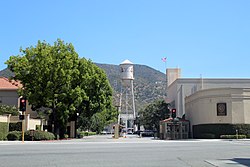
Mergers and acquisitions have helped Warner Bros. to accumulate a diverse collection of films, cartoons and television programs. As of 2022, Warner Bros. owned more than 145,000 hours of programming, including 12,500 feature films and 2,400 television programs comprising more than 150,000 individual episodes.[52]
Shared universes
[edit]Warner Bros. owns several shared universes. Some of these are based on books and comics, including some of the highest grossing intellectual properties in the movie industry.
| IP | No. Films | Notes |
|---|---|---|
| DC Extended Universe | 15 | Movies based on DC Comics. DCEU was Warner Bros.'s first iteration of a shared universe. |
| DC Universe | 1 | Soft-reboot of the DC Extended Universe, led by James Gunn and Peter Safran. First movie, was released in 2025. |
| Wizarding World | 11 | Film rights sold by J. K. Rowling for 2 million $ and a net % of the profits. This shared universe became the 4th highest grossing IP in movie history. This universe includes 8 movies based on the Harry Potter books and 3 movies based on Fantastic Beasts and Where to Find Them. |
| The Conjuring Universe | 8 | Dramatized horror movies based on real-life cases of paranormal investigators Ed and Lorraine Warren. This shared universe includes movies like Annabelle, The Nun and The Curse of La Llorona. |
| Monsterverse | 5 | Shared Universe based on monster movie characters like Godzilla and King Kong, in addition to other kaiju characters created by Toho, including Mothra, Rodan and King Ghidorah. Made in co-production with Legendary Entertainment. |
| Middle-earth | 6 | Movie series based on the books written by J. R. R. Tolkien, directed by Peter Jackson. |
| The Lego Movie | 4 | Warner Bros owned the rights to Lego films up until the end of 2019. More Lego movies were planned, but were cancelled after Universal Pictures bought the Lego film rights. Cancelled sequels include a sequel to The Lego Batman Movie, called Lego Superfriends.[53][54] |
Film series
[edit]| Title | Release date | No. Films | Notes |
|---|---|---|---|
| Gold Diggers | 1923–51 | 7 | |
| Looney Tunes/Merrie Melodies | 1930–present | 8 | 1030+ theatrical shorts |
| Penrod and Sam | 1931–38 | 2 | |
| Perry Mason | 1934–37 | 6 | |
| Philo Vance | 1934–40 | 5 | |
| Torchy Blane | 1937–39 | 9 | |
| Four Daughters | 1938–41 | 4 | |
| Nancy Drew | 1938–2019 | 6 | |
| Secret Service | 1939–40 | 4 | |
| A Star Is Born | 1954–2018 | 3 | Acquired from Selznick International Pictures; co-production with Transcona Enterprises (1954), First Artists, Barwood Films (both 1976), Metro-Goldwyn-Mayer, Live Nation Productions, Gerber Pictures, Joint Effort and Gerber Pictures (all 2018) |
| Ocean's | 1960–present | 5 | co-production with Village Roadshow Pictures (2001–present) |
| Dirty Harry | 1971–88 | ||
| The Exorcist | 1973–2005 | 4 | co-production with Morgan Creek (3–4) |
| Oh, God! | 1977–84 | 3 | |
| Every Which Way but Loose | 1978–80 | 2 | |
| Superman | 1978–2006 | 5 | co-production with Legendary Pictures (2006); Except for Supergirl, which was distributed by Tri-Star Pictures |
| Mad Max | 1979–present | 5 | co-production with Village Roadshow Pictures |
| Poseidon | 1979–2006 | 2 | |
| Friday the 13th | 1980–2009 | co-production with Paramount Pictures and New Line Cinema | |
| The Shining | 1980–2019 | ||
| Arthur | 1981–2011 | 3 | |
| Blade Runner | 1982–2017 | 2 | co-production with Alcon Entertainment and Columbia Pictures (2017) |
| National Lampoon's Vacation | 1983–2015 | 5 | |
| Gremlins | 1984–90 | 2 | co-production with Amblin Entertainment |
| Police Academy | 1984–94 | 7 | |
| Sesame Street | 1985–present | 2 | co-production with Sesame Workshop |
| The Color Purple | 1985–2023 | co-production with Amblin Entertainment (1984–2023), The Guber-Peters Company (1984), OW Films, SGS Pictures, Quincy Jones Productions and Domain Entertainment (all 2023) | |
| Lethal Weapon | 1987–98 | 4 | |
| The Lost Boys | 1987–2010 | 3 | |
| Beetlejuice | 1988–present | 2 | |
| Batman | 1989–97 | 4 | co-production with Polygram Pictures (1989–95) |
| Pure Country | 1992–2017 | 3 | |
| Under Siege | 1992–95 | 2 | co-production with Regency Enterprises |
| Unforgiven | 1992–2013 | ||
| Grumpy Old Men | 1993–95 | ||
| The Fugitive | 1993–98 | ||
| Free Willy | 1993–2010 | 4 | co-production with Regency Enterprises |
| Major League | 1994–98 | 2 | distribution only; produced by Morgan Creek |
| Ace Ventura | 1994–2009 | 3 | |
| Eraser | 1996–2022 | 2 | |
| Twister | 1996–2024 | co-production with Universal Pictures, Amblin Entertainment (both 1996–2024), The Kennedy/Marshall Company and Domain Entertainment (both 2024) | |
| The Dukes of Hazzard | 1997–2007 | 4 | co-production with Kudzu Productions (both 1997–2000) and Gerber Pictures (both 2005–2007) |
| The Matrix | 1999–present | co-production with Village Roadshow Pictures | |
| Analyze | 1999–2002 | 2 | co-production with Village Roadshow Pictures and TriBeCa Productions |
| Pokémon | 1999–2019 | 4 | US distribution only; co-production with The Pokémon Company |
| Deep Blue Sea | 1999–2020 | 3 | co-production with Village Roadshow Pictures |
| The Whole Yards | 2000–04 | 2 | distribution only; co-production with Morgan Creek (2000) and Franchise Pictures |
| Miss Congeniality | 2000–05 | co-production with Castle Rock Entertainment and Village Roadshow Pictures | |
| Tom and Jerry | 2001–present | 16 | co-production with Turner Entertainment |
| Cats & Dogs | 2001–20 | 3 | co-production with Village Roadshow Pictures (1–2) |
| Wizarding World | 2001–present | 11 | |
| Scooby-Doo | 2002–present | 6 | |
| Kangaroo Jack | 2003–04 | 2 | co-production with Jerry Bruckheimer Films |
| Terminator | 2003–09 | US distribution only; co-production with Columbia Pictures | |
| A Cinderella Story | 2004–present | 6 | |
| Laura's Star | 2004–21 | co-production with Rothkirch Cartoon-Film | |
| The Sisterhood of the Traveling Pants | 2005–08 | 2 | co-production with Alloy Entertainment |
| The Dark Knight trilogy | 2005–12 | 3 | co-production with Legendary Pictures |
| Willy Wonka | 2005–present | 2 | co-production with Village Roadshow Pictures |
| Happy Feet | 2006–11 | ||
| 300 | 2006–present | co-production with Legendary Pictures | |
| The Hangover | 2009–13 | 3 | |
| Final Destination | 2009–present | 2 | co-production with New Line Cinema and Practical Pictures |
| Sherlock Holmes | co-production with Village Roadshow Pictures | ||
| Watchmen | 2009–24 | 3 | US distribution only; co-production with Paramount Pictures, DC Films (both 2009–24) and Legendary Pictures (2009) |
| Top Cat | 2011–15 | 2 | International distribution only; co-production with Anima Estudios, Illusion Studios (2011), Discreet Art Productions and Prana Studios (both 2015) |
| Dolphin Tale | 2011–14 | co-production with Alcon Entertainment | |
| The Hobbit | 2012–14 | 3 | co-production with Metro-Goldwyn-Mayer, New Line Cinema and WingNut Films; Co-owned with Metro-Goldwyn-Mayer |
| Magic Mike | 2012–23 | ||
| DC Extended Universe | 2013–23 | 15 | co-production with DC Entertainment (2013–16), DC Films (2016–23) and RatPac Entertainment (2016–17) |
| The Conjuring Universe | 2013–present | 7 | co-production with Atomic Monster, The Safran Company and New Line Cinema |
| The Lego Movie | 2014–19 | 4 | co-production with Warner Bros. Pictures Animation, Village Roadshow Pictures (2014) and Lego System A/S |
| Monsterverse | 2014–present | 5 | co-production with Legendary Pictures |
| Creed | 2015–present | 3 | co-production with Metro-Goldwyn-Mayer and New Line Cinema (1–2) |
| The Meg | 2018–present | 2 | |
| It | 2017–19 | distribution only; produced by New Line Cinema | |
| Detective Pikachu | 2019–present | 1 | co-production with Legendary Pictures, The Pokémon Company and Toho |
| Joker | 2019–24 | 2 | co-production with Village Roadshow Pictures, DC Films (1) Bron Creative and Joint Effort. |
| Dune | 2021–present | co-production with Legendary Pictures | |
| The Batman | 2022–present | 1 | distribution only; produced by DC Films (1), 6th & Idaho and Dylan Clark productions and DC Studios. |
| A Minecraft Movie | 2025–present | co-production with Legendary Pictures, Mojang studios, Vertigo Entertainment and On the Roam. | |
| DC Universe | distribution only; produced by DC Studios |
Highest-grossing films
[edit]- † Indicates films currently in theatrical release in the week commencing 25 July 2025.
|
|
‡ — Includes theatrical reissue(s)
Notes
[edit]- ^ co-owned by New Line Cinema and Metro-Goldwyn-Mayer Pictures (the film's producers)
References
[edit]- ^ "Company history". Warnerbros.com. Archived from the original on October 16, 2015. Retrieved April 9, 2014.
- ^ "Warner Bros Pictures, Inc". OpenCorporates. April 4, 1923. Retrieved August 29, 2023.
- ^ "1. The Chaplin Effect: Ghosts in the Machine and Animated Gags", Funny Pictures, University of California Press, pp. 15–28, December 31, 2019, doi:10.1525/9780520950122-003, ISBN 9780520950122, S2CID 226722604, retrieved October 30, 2023
- ^ "Harry, Albert, Sam and Jack Warner: the most famous Hollywood family, creators the Warner Bros". Russian-American Heritage Museum. Retrieved December 23, 2021.
- ^ "IMDb – Peril of the Plains (1912)". IMDb. Retrieved December 23, 2021.
- ^ Pawlak, Debra Ann (January 12, 2012). Bringing Up Oscar. Simon and Schuster. ISBN 9781605982168. Retrieved December 23, 2021.
- ^ "Business Entity Detail: Warner Bros. Distributing Corporation (search on Entity Number: C0080357)". California Business Search. California Secretary of State. Retrieved June 19, 2019.
- ^ "Warner Brothers Get Mutt And Jeff". Moving Picture World. September 1, 1917. Retrieved May 8, 2022.
- ^ "Warners Have New Policy". The New York Clipper. May 1, 1917. Retrieved May 8, 2022.
- ^ Jacobson, Lara. The Warner Brothers Prove Their Patriotism.
- ^ "Warner's First Feature Film Turns 100". WarnerBros.com. March 9, 2018. Retrieved May 8, 2022.
- ^ Maas, Jennifer (March 23, 2022). "Warner Bros. Reveals 100th Anniversary Logo, Teases Rollout of Commemorative Content, Products and Events". Variety. Retrieved May 8, 2022.
- ^ "Warner, Movie Magnate, Dies: Sam Warner, Former Youngstown Man, Rose from Obscurity to Leader in Field". The Youngstown Daily Vindicator. October 5, 1927.
- ^ Schickel, Richard (2008). You must remember this : the Warner Bros. story. George Perry. Philadelphia, Pa.: Running Press. ISBN 978-0-7624-3418-3. OCLC 191926490.
- ^ WB retained a pair of features from 1949 that they merely distributed, and all short subjects released on or after September 1, 1948; in addition to all cartoons released in August 1948
- ^ "Media History Digital Library". archive.org. Archived from the original on March 25, 2019. Retrieved September 17, 2019.
- ^ Hoyt, Eric (July 3, 2014). Hollywood Vault: Film Libraries Before Home Video. Univ of California Press. ISBN 978-0-520-95857-9.
- ^ Cole, Robert J. (May 16, 1981). "M-G-M Is Reported Purchasing United Artists for $350 million". The New York Times. ISSN 0362-4331. Archived from the original on September 8, 2016. Retrieved October 26, 2016.
- ^ Sloane, Leonard (November 15, 1966). "Jack L. Warner, President, Agrees to Sell His Interest In a $32-Million Deal; 7 ARTS IS BUYING 33% OF WARNER". The New York Times. Archived from the original on March 11, 2018.
- ^ "Warner Meeting Scheduled". The New York Times. June 18, 1967.
- ^ "Faberge Sells Brut's Assets". The New York Times. January 1982. Archived from the original on July 1, 2017. Retrieved November 27, 2014.
- ^ "Turner Sells Fabled MGM but Keeps a Lion's Share". Los Angeles Times. December 20, 1985. Archived from the original on August 1, 2017. Retrieved February 2, 2018.
- ^ "Crash Landing Merv Adelson—TV mogul, multimillionaire, and friend of the famous—lived a show-business fantasy. His bankruptcy has shocked Hollywood. – November 10, 2003". CNN. Archived from the original on January 26, 2013. Retrieved September 2, 2015.
- ^ "Warner Completes Merger With Lorimar Telepictures". The Los Angeles Times. Archived from the original on November 3, 2012. Retrieved October 23, 2010.
- ^ "Turner Broadcasting Company Report". sec.gov. Securities and Exchange Commission. Archived from the original on July 10, 2017. Retrieved November 8, 2017.
- ^ "Done deal: Turner Broadcasting System Inc. said it closed..." Chicage Tribune. Archived from the original on March 2, 2016. Retrieved September 2, 2015.
- ^ "New Line to Join Ted Turner Empire Today : Film: With more money, the company is likely to add a few big movies to its annual production schedule". Los Angeles Times. January 28, 1994. Archived from the original on March 25, 2019. Retrieved October 30, 2019.
- ^ "New Line Cinema". ethicalbusinessbureau.com. Archived from the original on March 2, 2016. Retrieved October 30, 2019.
- ^ "Business Entity Detail: Warner Bros. Pictures (search on Entity Number: C2502930)". California Business Search. California Secretary of State. Retrieved June 19, 2019.
- ^ Halbfinger, David (November 27, 2007). "Warner's Production Chief to Also Oversee Distribution". The New York Times. Archived from the original on December 19, 2019.
- ^ "WarnerBros.com | Toby Emmerich Named President and Chief Content Officer, Warner Bros. Pictures Group | Press Releases". www.warnerbros.com. Retrieved December 14, 2022.
- ^ Lang, Brent (January 9, 2018). "Warner Bros. Shake-Up: Toby Emmerich Named Film Chairman, Sue Kroll Out". Variety. Retrieved February 7, 2020.
- ^ "Warner Bros. Shake-Up: Toby Emmerich Named Film Chairman, Sue Kroll Out". Variety. January 9, 2018.
- ^ "Warner Bros International Marketing President Lynne Frank To Exit". Deadline. October 23, 2018.
- ^ "Warner Bros, SF Studios Expand Distribution Deal Across Scandinavia". Variety. June 25, 2019.
- ^ Rubin, Rebecca; Donnelly, Matt (December 3, 2020). "Warner Bros. to Debut Entire 2021 Film Slate, Including 'Dune' and 'Matrix 4,' Both on HBO Max and In Theaters". Variety. Retrieved December 3, 2020.
- ^ Barnes, Brooks; Sperling, Nicole (December 7, 2020). "Trading Box Office for Streaming, but Stars Still Want Their Money". The New York Times. Retrieved January 18, 2021.
- ^ Shaw, Lucas; Gilbolm, Kelly (January 9, 2021). "Warner Bros. Guarantees Filmmakers a Payday for HBO Max Movies". Bloomberg News. Retrieved January 18, 2021.
- ^ McClintock, Pamela (October 27, 2021). ""Project Popcorn": WarnerMedia's Box Office-HBO Max Experiment Gets Mixed Results". The Hollywood Reporter. Retrieved December 22, 2021.
- ^ D'Alessandro, Anthony; Tartaglione, Nancy (March 23, 2021). "Regal Cinemas To Reopen In April; Parent Cineworld & Warner Bros Reach Multi-Year Deal To Show WB Films In U.S. & UK". Deadline. Retrieved March 24, 2021.
- ^ "Warner Bros. Pictures | Warner Bros. Discovery Brand Guide".
- ^ "Toby Emmerich Out As Warner Bros Motion Picture Group Chairman; Michael De Luca & Pam Abdy To Lead Studio". Deadline. June 1, 2022. Retrieved June 2, 2022.
- ^ D'Alessandro, Anthony (June 1, 2022). "David Zaslav "Thrilled" Toby Emmerich Remaining Part Of Warner Bros Discovery Family, Outlines New Structure; De Luca & Abdy Made Official". Deadline. Retrieved June 2, 2022.
- ^ Kit, Borys (June 8, 2022). "Carolyn Blackwood Exits Warner Bros. Amid Ongoing Shake-Up". The Hollywood Reporter. Retrieved June 12, 2022.
- ^ Kim Masters (July 28, 2022). "Alan Horn on Rejoining Warner Bros.: "I See Myself as a Consigliere"". The Hollywood Reporter. Retrieved July 29, 2022.
- ^ D'Alessandro, Anthony (August 14, 2022). "Warner Bros Forms Multi-Year Pact To Distribute MGM Movies Overseas Beginning With 'Bones And All', 'Creed III'; How Bond Will Be Handled". Deadline Hollywood. Retrieved September 14, 2022.
- ^ D'Alessandro, Anthony (August 24, 2022). "'Aquaman 2' Heads To Christmas 2023, 'Shazam: Fury Of The Gods' Goes To March; HBO Max Pics 'House Party' & 'Evil Dead Rise' Going Theatrical – Warner Bros. Release Date Changes". Deadline. Retrieved March 6, 2023.
- ^ D'Alessandro, Anthony (October 19, 2022). "DC Films Boss Walter Hamada Has Departed Studio As Warner Bros Discovery Finalizes Exit: The Dish". Deadline Hollywood. Retrieved October 19, 2022.
- ^ Donnelly, Matt (October 20, 2022). "Warner Bros. Pictures Names Jesse Ehrman President of Production and Development; Ups Three to Senior VP (EXCLUSIVE)". Variety. Retrieved October 21, 2022.
- ^ D'Alessandro, Anthony (October 27, 2022). "As Courtenay Valenti Exits Warner Bros, Production Boss Won't Be Idle For Long: The Dish". Deadline Hollywood. Retrieved November 2, 2022.
- ^ "Warner Bros. Motion Picture Group Taps Animation Visionary Bill Damaschke to Lead Its Newly Rebranded Feature Animation Division, Warner Bros. Pictures Animation". Business Wire. June 9, 2023. Retrieved July 6, 2023.
- ^ "WarnerBros.com | Warner Bros. Unveils Centennial Logo in Advance of the Iconic Studio's 100th Anniversary | Press Releases". www.warnerbros.com. Retrieved July 13, 2022.
- ^ "'LEGO Batman Movie 2' in the Works". DC. Retrieved July 4, 2023.
- ^ Yates, Jack (June 10, 2021). "Cancelled The LEGO Batman Movie sequel plot revealed". Retrieved July 4, 2023.
- ^ "About". Warner Bros. Retrieved September 16, 2020.
- ^ Masters, Kim (June 21, 2017). "Warner Bros. Eyes Slimmed-Down Movie Budgets Under Toby Emmerich". The Hollywood Reporter. Retrieved September 16, 2020.
- ^ "Box Office by Studio – Warner Bros. All Time". Box Office Mojo. Archived from the original on August 16, 2017. Retrieved August 15, 2017.
- ^ Fabro, Rocio (August 30, 2023). "'Barbie' Surpasses 'Harry Potter' as Warner Bros. Best Grossing Movie Ever". Archived from the original on August 30, 2023.
External links
[edit]Warner Bros. | ||||
|---|---|---|---|---|
| Motion Picture Group |
|  | ||
| Television Group |
| |||
| Other properties |
| |||
| Former/defunct |
| |||
| Key people |
| |||
| Related |
| |||
| ||||

Original source: https://en.wikipedia.org/wiki/Warner Bros. Pictures
Status: article is cached
 EncycloReader
is supported by the
EncycloReader
is supported by the  KSF
KSF