Woman
 From Wikipedia - Reading time: 48 min

| Part of a series on |
| Women in society |
|---|
 |
| Part of a series on |
| Feminism |
|---|
|
 Feminism portal Feminism portal |
A woman is an adult female human.[a][2][3] Before adulthood, a female child or adolescent is referred to as a girl.[4]
Typically, women are of the female sex and inherit a pair of X chromosomes, one from each parent, and women with functional uteruses are capable of pregnancy and giving birth from puberty until menopause. More generally, sex differentiation of the female fetus is governed by the lack of a present, or functioning, SRY gene on either one of the respective sex chromosomes.[5] Female anatomy is distinguished from male anatomy by the female reproductive system, which includes the ovaries, fallopian tubes, uterus, vagina, and vulva. An adult woman generally has a wider pelvis, broader hips, and larger breasts than an adult man. These characteristics facilitate childbirth and breastfeeding. Women typically have less facial and other body hair, have a higher body fat composition, and are on average shorter and less muscular than men.
Throughout human history, traditional gender roles within patriarchal societies have often defined and limited women's activities and opportunities, resulting in gender inequality; many religious doctrines and legal systems stipulate certain rules for women. With restrictions loosening during the 20th century in many societies, women have gained wider access to careers and the ability to pursue higher education. Violence against women, whether within families or in communities, has a long history and is primarily committed by men. Some women are denied reproductive rights. The movements and ideologies of feminism have a shared goal of achieving gender equality.
Some women are transgender, meaning they were assigned male at birth,[6][7] while some women are intersex, meaning they have sex characteristics that do not fit typical notions of female biology.[8][9]
Etymology
[edit]The spelling of woman in English has progressed over the past millennium from wīfmann[10] to wīmmann to wumman, and finally, the modern spelling woman.[11] In Old English, mann had the gender-neutral meaning of 'human', akin to the Modern 'person' or 'someone'. The word for 'woman' was wīf or wīfmann (lit. 'woman-person') whereas 'man' was wer or wǣpnedmann (from wǣpn 'weapon; penis'). However, following the Norman Conquest, man began to mean 'male human', and by the late 13th century it had largely replaced wer.[12] The consonants /f/ and /m/ in wīfmann coalesced into the modern woman, while wīf narrowed to specifically mean a married woman ('wife').
It is a popular misconception that the term "woman" is etymologically connected to "womb".[13] "Womb" derives from the Old English word wamb meaning 'belly, uterus'[14] (cognate to the modern German colloquial term "Wamme" from Old High German wamba for 'belly, paunch, lap').[15][16]
Terminology
[edit]
The word woman can be used generally, to mean any female human, or specifically, to mean an adult female human as contrasted with girl. The word girl originally meant "young person of either sex" in English;[17] it was only around the beginning of the 16th century that it came to mean specifically a female child.[18] The term girl is sometimes used colloquially to refer to a young or unmarried woman; however, during the early 1970s, feminists challenged such use because the use of the word to refer to a fully grown woman may cause offense. In particular, previously common terms such as office girl are no longer widely used. Conversely, in certain cultures which link family honor with female virginity, the word girl (or its equivalent in other languages) is still used to refer to a never-married woman; in this sense it is used in a fashion roughly analogous to the more-or-less obsolete English maid or maiden.
The social sciences' views on what it means to be a woman have changed significantly since the early 20th century as women gained more rights and greater representation in the workforce, with scholarship in the 1970s moving toward a focus on the sex–gender distinction and social construction of gender.[19][20] There are various words used to refer to the quality of being a woman. The term "womanhood" merely means the state of being a woman; "femininity" is used to refer to a set of typical female qualities associated with a certain attitude to gender roles; "womanliness" is like "femininity", but is usually associated with a different view of gender roles.[citation needed]
Different countries have different laws, but age 18 is frequently considered the age of majority (the age at which a person is legally considered an adult).[21] Menarche, the onset of menstruation, occurs on average at age 12–13. Many cultures have rites of passage to symbolize a girl's coming of age, such as confirmation in some branches of Christianity,[22] bat mitzvah in Judaism, or a custom of a special celebration for a certain birthday (generally between 12 and 21), like the quinceañera of Latin America.
Biology
[edit]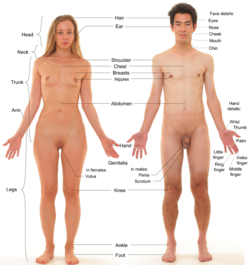
Male and female bodies have some differences. Some differences, such as the external sex organs, are visible, while other differences, such as internal anatomy and genetic characteristics, are not visible.
Genetic characteristics
[edit]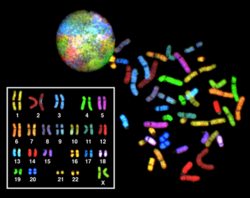
Typically, the cells of female humans contain two X chromosomes, while the cells of male humans have an X and a Y chromosome.[23] During early fetal development, all embryos have phenotypically female genitalia up until week 6 or 7, when a male embryo's gonads differentiate into testes due to the action of the SRY gene on the Y chromosome.[24] Sex differentiation proceeds in female humans in a way that is independent of gonadal hormones.[24] Because humans inherit mitochondrial DNA only from the mother's ovum, genealogical researchers can trace maternal lineage far back in time.
Hormonal characteristics, menstruation and menopause
[edit]Female puberty triggers bodily changes that enable sexual reproduction via fertilization. In response to chemical signals from the pituitary gland, the ovaries secrete hormones that stimulate maturation of the body, including increased height and weight, body hair growth, breast development and menarche (the onset of menstruation).[25]

Most girls go through menarche between ages 12–13,[26][27] and are then capable of becoming pregnant and bearing children. Pregnancy generally requires internal fertilization of the eggs with sperm, via either sexual intercourse or artificial insemination, though in vitro fertilization allows fertilization to occur outside the human body.[28] Humans are similar to other large mammals in that they usually give birth to a single offspring per pregnancy, but are unusual in being altricial compared to most other large mammals, meaning young are undeveloped at time of birth and require the aid of their parents or guardians to fully mature.[29] Sometimes humans have multiple births, most commonly twins.[30]
Usually between ages 49–52, a woman reaches menopause, the time when menstrual periods stop permanently, and they are no longer able to bear children.[31][32][33] Unlike most other mammals, the human lifespan usually extends many years after menopause.[34] Many women become grandmothers and contribute to the care of grandchildren and other family members.[35] Many biologists believe that the extended human lifespan is evolutionarily driven by kin selection, though other theories have also been proposed.[36][37][38][39]
Morphological and physiological characteristics
[edit]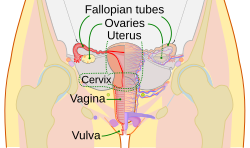
In terms of biology, the female sex organs are involved in the reproductive system, whereas the secondary sex characteristics are involved in breastfeeding children and attracting a mate.[40] Humans are placental mammals, which means the mother carries the fetus in the uterus and the placenta facilitates the exchange of nutrients and waste between the mother and fetus.[41][42]

The internal female genitalia consist of the ovaries, gonads that produce female gametes called ova, the fallopian tubes, tubular structures that transport the egg cells, the uterus, an organ with tissue to protect and nurture the developing fetus and its cervix to expel it, the accessory glands (Bartholin's and Skene's), two pairs of glands that help lubricate during intercourse, and the vagina, an organ used in copulating and birthing.
The vulva (external female genitalia)[43] consists of the clitoris, labia majora, labia minora and vestibule. The vestibule is where the vaginal and urethral openings are located.
The mammary glands are hypothesized to have evolved from apocrine-like glands to produce milk, a nutritious secretion that is the most distinctive characteristic of mammals, along with live birth.[44] In mature women, the breast is generally more prominent than in most other mammals; this prominence, not necessary for milk production, is thought to be at least partially the result of sexual selection.[40]
Estrogens, which are primary female sex hormones, have a significant impact on a female's body shape. They are produced in both men and women, but their levels are significantly higher in women, especially in those of reproductive age. Besides other functions, estrogens promote the development of female secondary sexual characteristics, such as breasts and hips.[45][46][47] As a result of estrogens, during puberty, girls develop breasts and their hips widen. Working against estrogen, the presence of testosterone in a pubescent female inhibits breast development and promotes muscle and facial hair development.[48]
Circulatory system
[edit]Women have lower hematocrit (the volume percentage of red blood cells in blood) than men; this is due to lower testosterone, which stimulates the production of erythropoietin by the kidney. The normal hematocrit level for a woman is 36% to 48% (for men, 41% to 50%). The normal level of hemoglobin (an oxygen-transport protein found in red blood cells) for women is 12.0 to 15.5 g/dL (for men, 13.5 to 17.5 g/dL).[49][50][51]
Women's hearts have finer-grained textures in the muscle compared to men's hearts, and the heart muscle's overall shape and surface area also differs to men's when controlling for body size and age.[52][53] In addition, women's hearts age more slowly compared to men's hearts.[54]
Sex distribution
[edit]Girls are born slightly less frequently than boys (the ratio is around 1:1.05). Out of the total human population in 2015, there were 1018 men for every 1000 women.[55]
Intersex women
[edit]Intersex women have an intersex condition, usually defined as those born with ambiguous genitalia. Most individuals with ambiguous genitalia are assigned female at birth, and most intersex women are cisgender. The medical practices to assign binary female to intersex youth is often controversial.[56] Some intersex conditions are associated with typical rates of female gender identity, while others are associated with substantially higher rates of identifying as LGBT compared to the general population.[57][58][59][60]
Sexuality and gender
[edit]

Sexual orientation
[edit]Female sexuality and attraction are variable, and a woman's sexual behavior can be affected by many factors, including evolved predispositions, personality, upbringing, and culture. While most women are heterosexual, significant minorities are lesbian or bisexual.[63]
Most cultures use a gender binary by which women are of one of two genders, the others being men; other cultures have a third gender.[64][65][66] Femininity (also called womanliness or girlishness) is a set of attributes, behaviors, and roles generally associated with women and girls. Although femininity is socially constructed,[67] some behaviors considered feminine are biologically influenced.[67][68][69][70] The extent to which femininity is biologically or socially influenced is subject to debate.[69][68][70] It is distinct from the definition of the biological female sex,[71][72] as both men and women can exhibit feminine traits.
Gender
[edit]Most women are cisgender, meaning their female sex assignment at birth corresponds with their female gender identity. Some women are transgender, meaning they were assigned male at birth.[7] Trans women may experience gender dysphoria, the distress brought upon by the discrepancy between a person's gender identity and their sex assigned at birth.[73] Gender dysphoria may be treated with gender-affirming care, which may include social or medical transition. Social transition may involve changes such as adopting a new name, hairstyle, clothing, and pronoun associated with the individual's affirmed female gender identity.[74] A major component of medical transition for trans women is feminizing hormone therapy, which causes the development of female secondary sex characteristics (such as breasts, redistribution of body fat, and lower waist–hip ratio). Medical transition may also involve gender-affirming surgery, and a trans woman may undergo one or more feminizing procedures which result in anatomy that is typically gendered female.[75][76] Like cisgender women, trans women may have any sexual orientation.
Health
[edit]Factors that specifically affect the health of women in comparison with men are most evident in those related to reproduction, but sex differences have been identified from the molecular to the behavioral scale. Some of these differences are subtle and difficult to explain, partly due to the fact that it is difficult to separate the health effects of inherent biological factors from the effects of the surrounding environment they exist in. Sex chromosomes and hormones, as well as sex-specific lifestyles, metabolism, immune system function, and sensitivity to environmental factors are believed to contribute to sex differences in health at the levels of physiology, perception, and cognition. Women can have distinct responses to drugs and thresholds for diagnostic parameters.[77][page needed]
Some diseases primarily affect or are exclusively found in women, such as lupus, breast cancer, cervical cancer, or ovarian cancer.[78] The medical practice dealing with female reproduction and reproductive organs is called gynaecology ("science of women").[79][80]
Maternal mortality
[edit]Maternal mortality or maternal death is defined by WHO as "the death of a woman while pregnant or within 42 days of termination of pregnancy, irrespective of the duration and site of the pregnancy, from any cause related to or aggravated by the pregnancy or its management but not from accidental or incidental causes."[81] In 2008, noting that each year more than 500,000 women die of complications of pregnancy and childbirth and at least seven million experience serious health problems while 50 million more have adverse health consequences after childbirth, the World Health Organization urged midwife training to strengthen maternal and newborn health services. To support the upgrading of midwifery skills the WHO established a midwife training program, Action for Safe Motherhood.[82]
In 2017, 94% of maternal deaths occur in low and lower middle-income countries. Approximately 86% of maternal deaths occur in sub-Saharan Africa and South Asia, with sub-Saharan Africa accounting for around 66% and Southern Asia accounting for around 20%. The main causes of maternal mortality include pre-eclampsia and eclampsia, unsafe abortion, pregnancy complications from malaria and HIV/AIDS, and severe bleeding and infections following childbirth.[83] Most European countries, Australia, Japan, and Singapore are very safe in regard to childbirth.[84][improper synthesis][better source needed]
Life expectancy
[edit]
The life expectancy for women is generally longer than men's. This advantage begins from birth, with newborn girls more likely to survive the first year than boys. Worldwide, women live six to eight years longer than men.[86] However, this varies by place and situation. For example, discrimination against women has lowered female life expectancy in some parts of Asia so that men there live longer than women.[86]
The difference in life expectancy are believed to be partly due to biological advantages and partly due to gendered behavioral differences between men and women.[86][87] For example, women are less likely to engage in unhealthy behaviors like smoking and reckless driving, and consequently have fewer preventable premature deaths from such causes.[86]
In some developed countries, the life expectancy is evening out. This is believed to caused both by worse health behaviors among women, especially an increased rate of smoking tobacco by women, and improved health among men, such as less cardiovascular disease.[86] The World Health Organization (WHO) writes that it is "important to note that the extra years of life for women are not always lived in good health."[86]
Reproductive rights
[edit]
Reproductive rights are legal rights and freedoms relating to reproduction and reproductive health. The International Federation of Gynecology and Obstetrics has stated that:[88]
- ... the human rights of women include their right to have control over and decide freely and responsibly on matters related to their sexuality, including sexual and reproductive health, free of coercion, discrimination and violence. Equal relationships between women and men in matters of sexual relations and reproduction, including full respect for the integrity of the person, require mutual respect, consent and shared responsibility for sexual behavior and its consequences.
The World Health Organization reports that based on data from 2010 to 2014, 56 million induced abortions occurred worldwide each year (25% of all pregnancies). Of those, about 25 million were considered as unsafe. The WHO reports that in developed regions about 30 women die for every 100,000 unsafe abortions and that number rises to 220 deaths per 100,000 unsafe abortions in developing regions and 520 deaths per 100,000 unsafe abortions in sub-Saharan Africa. The WHO ascribes these deaths to:
- restrictive laws
- poor availability of services
- high cost
- stigma
- conscientious objection of health-care providers
- unnecessary requirements, such as mandatory waiting periods, mandatory counseling, provision of misleading information, third-party authorization, and medically unnecessary tests that delay care.[89]
History
[edit]The earliest women whose names are known include:
- Neithhotep (c. 3200 BCE), the wife of Narmer and the first queen of ancient Egypt.[90][91]
- Merneith (c. 3000 BCE), consort and regent of ancient Egypt during the first dynasty. She may have been ruler of Egypt in her own right.[92][93]
- Peseshet (c. 2600 BCE), a physician in Ancient Egypt.[94][95]
- Puabi (c. 2600 BCE), or Shubad – queen of Ur whose tomb was discovered with many expensive artifacts. Other known pre-Sargonic queens of Ur (royal wives) include Ashusikildigir, Ninbanda, and Gansamannu.[96]
- Kugbau (c. 2500 BCE), a taverness from Kish chosen by the Nippur priesthood to become hegemonic ruler of Sumer, and in later ages deified as "Kubaba".
- Tashlultum (c. 2400 BCE), Akkadian queen, wife of Sargon of Akkad and mother of Enheduanna.[97][98]
- Baranamtarra (c. 2384 BCE), prominent and influential queen of Lugalanda of Lagash. Other known pre-Sargonic queens of the first Lagash dynasty include Menbara-abzu, Ashume'eren, Ninkhilisug, Dimtur, and Shagshag, and the names of several princesses are also known.
- Enheduanna (c. 2285 BCE),[99][100] the high priestess of the temple of the Moon God in the Sumerian city-state of Ur and possibly the first known poet and first named author of either gender.[101]
- Shibtu (c. 1775 BCE), king Zimrilim's consort and queen of the Syrian city-state of Mari. During her husband's absence, she ruled as regent of Mari and enjoyed extensive administrative powers as queen.[102]
The glyph (♀) for the planet and Roman goddess Venus, or Aphrodite in Greek, is the symbol used to represent the female sex.[103][104][105] In ancient alchemy, the Venus symbol stood for copper and was associated with femininity.[105]
Culture and gender roles
[edit]In recent history, gender roles have changed greatly. At some earlier points in history, children's occupational aspirations starting at a young age differed according to gender.[106] Traditionally, middle class women were involved in domestic tasks emphasizing child care. For poorer women, economic necessity compelled them to seek employment outside the home even if individual poor women may have preferred domestic tasks. Many of the occupations that were available to them were lower in pay than those available to men.[107]


As changes in the labor market for women came about, availability of employment changed from only "dirty", long hour factory jobs to "cleaner", more respectable office jobs where more education was demanded. Married women's participation in the U.S. labor force rose from 5.6–6% in 1900 to 23.8% in 1923.[108][109] These shifts in the labor force led to changes in the attitudes towards women at work, allowing for the revolution which resulted in women becoming career and education oriented.[citation needed]
In the 1970s, many female academics, including scientists, avoided having children. Throughout the 1980s, institutions tried to equalize conditions for men and women in the workplace. Even so, the inequalities at home hampered women's opportunities: professional women were still generally considered responsible for domestic labor and child care, which limited the time and energy they could devote to their careers. Until the early 20th century, U.S. women's colleges required their women faculty members to remain single, on the grounds that a woman could not carry on two full-time professions at once. According to Schiebinger, "Being a scientist and a wife and a mother is a burden in society that expects women more often than men to put family ahead of career." (p. 93).[110]
Movements advocate equality of opportunity for both sexes and equal rights irrespective of gender. Through a combination of economic changes and the efforts of the feminist movement, in recent decades women in many societies have gained access to careers beyond the traditional homemaker. Despite these advances, modern women in Western society still face challenges in the workplace as well as with the topics of education, violence, health care, politics, and motherhood, and others. Sexism can be a main concern and barrier for women almost anywhere, though its forms, perception, and gravity vary between societies and social classes.
The Gender Parity Index in school enrollment varies by country.[111] The gender gaps in mathematics and reading show girls tend to have higher reading skills. The gender pay gap varies between countries and age groups.[112]
Religion
[edit]Particular religious doctrines have specific stipulations relating to gender roles, the spiritual authority of women, social and private interaction between the sexes, appropriate dressing attire for women, and various other issues affecting women and their position in society.
In many countries, these religious teachings influence the criminal law, or the family law of those jurisdictions (see Sharia law, for example).
The relation between religion, law and gender equality has been discussed by international organizations.[113]
Violence against women
[edit]
The UN Declaration on the Elimination of Violence against Women defines "violence against women" as:[114]
...any act of gender-based violence that results in, or is likely to result in, physical, sexual or mental harm or suffering to women, including threats of such acts, coercion or arbitrary deprivation of liberty, whether occurring in public or in private life.
It identifies three forms of such violence: that which occurs in the family, that which occurs within the general community, and that which is perpetrated or condoned by the State. It also states that "violence against women is a manifestation of historically unequal power relations between men and women".[115]
Violence against women remains a widespread problem, fueled, especially outside the West, by patriarchal social values, lack of adequate laws, and lack of enforcement of existing laws. Social norms that exist in many parts of the world hinder progress towards protecting women from violence. For example, according to surveys by UNICEF, the percentage of women aged 15–49 who think that a husband is justified in hitting or beating his wife under certain circumstances is as high as 90% in Afghanistan and Jordan, 87% in Mali, 86% in Guinea and Timor-Leste, 81% in Laos, and 80% in the Central African Republic.[116] A 2010 survey conducted by the Pew Research Center found that stoning as a punishment for adultery was supported by 82% of respondents in Egypt and Pakistan, 70% in Jordan, 56% Nigeria, and 42% in Indonesia.[117]
Specific forms of violence that affect women include female genital mutilation, sex trafficking, forced prostitution, forced marriage, rape, sexual harassment, honor killings, acid throwing, and dowry related violence. Laws and policies on violence against women vary by jurisdiction. In the European Union, sexual harassment and human trafficking are subject to directives.[118][119] Governments can be complicit in violence against women, such as when stoning is used as a legal punishment, mostly for women accused of adultery.[120]
There have also been many forms of violence against women which have been prevalent historically, notably the burning of witches, the sacrifice of widows (such as sati) and foot binding. The prosecution of women accused of witchcraft has a long tradition; for example, during the early modern period (between the 15th and 18th centuries), witch trials were common in Europe and in the European colonies in North America. Today, there remain regions of the world (such as parts of Sub-Saharan Africa, rural North India, and Papua New Guinea) where belief in witchcraft is held by many people, and women accused of being witches are subjected to serious violence.[121][122][123] In addition, there are also countries which have criminal legislation against the practice of witchcraft. In Saudi Arabia, witchcraft remains a crime punishable by death, and in 2011 the country beheaded a woman for 'witchcraft and sorcery'.[124][125]
It is also the case that certain forms of violence against women have been recognized as criminal offences only during recent decades, and are not universally prohibited, in that many countries continue to allow them. This is especially the case with marital rape.[126][127] In the Western World, there has been a trend towards ensuring gender equality within marriage and prosecuting domestic violence, but in many parts of the world women still lose significant legal rights when entering a marriage.[128]
Sexual violence against women greatly increases during times of war and armed conflict, during military occupation, or ethnic conflicts; most often in the form of war rape and sexual slavery. Contemporary examples of sexual violence during war include rape during the Armenian Genocide, rape during the Bangladesh Liberation War, rape in the Bosnian War, rape during the Rwandan genocide, and rape during Second Congo War. In Colombia, the armed conflict has also resulted in increased sexual violence against women.[129] The most recent case was the sexual jihad done by ISIL where 5000–7000 Yazidi and Christian girls and children were sold into sexual slavery during the genocide and rape of Yazidi and Christian women, some of whom jumped to their death from Mount Sinjar, as described in a witness statement.[130]
Clothing, fashion and dress codes
[edit]

Women in different parts of the world dress in different ways, with their choices of clothing being influenced by local culture, religious tenets, traditions, social norms, and fashion trends, among other factors. Different societies have different ideas about modesty.
In many jurisdictions, laws limit what women may or may not wear. This is especially the case in regard to Islamic dress. While certain jurisdictions legally mandate such clothing (the wearing of the headscarf), other countries forbid or restrict the wearing of certain hijab attire (such as burqa/covering the face) in public places (one such country is France – see French ban on face covering). These laws – both those mandating and those prohibiting certain articles of dress – are highly controversial.[131]
Fertility and family life
[edit]
The total fertility rate (TFR) – the average number of children born to a woman over her lifetime – differs significantly between different regions of the world. In 2016, the highest estimated TFR was in Niger (6.62 children born per woman) and the lowest in Singapore (0.82 children/woman).[133] While most Sub-Saharan African countries have a high TFR, which creates problems due to lack of resources and contributes to overpopulation, most Western countries currently experience a sub replacement fertility rate which may lead to population ageing and population decline.
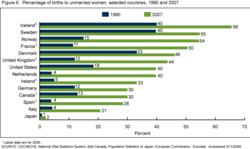
In many parts of the world, there has been a change in family structure over the past few decades. For instance, in the West, there has been a trend of moving away from living arrangements that include the extended family to those which only consist of the nuclear family. There has also been a trend to move from marital fertility to non-marital fertility. Children born outside marriage may be born to cohabiting couples or to single women. While births outside marriage are common and fully accepted in some parts of the world, in other places they are highly stigmatized, with unmarried mothers facing ostracism, including violence from family members, and in extreme cases even honor killings.[134][135] In addition, sex outside marriage remains illegal in many countries (such as Saudi Arabia, Pakistan,[136] Afghanistan,[137][138] Iran,[138] Kuwait,[139] Maldives,[140] Morocco,[141] Oman,[142] Mauritania,[143] United Arab Emirates,[144][145] Sudan,[146] and Yemen[147]).
The social role of the mother differs between cultures. In many parts of the world, women with dependent children are expected to stay at home and dedicate all their energy to child raising, while in other places mothers most often return to paid work (see working mother and stay-at-home mother).
Education
[edit]
Single-sex education has traditionally been dominant and is still highly relevant. Universal education, meaning state-provided primary and secondary education independent of gender, is not yet a global norm, even if it is assumed in most developed countries. In some Western countries, women have surpassed men at many levels of education. For example, in the United States in 2005/2006, women earned 62% of associate degrees, 58% of bachelor's degrees, 60% of master's degrees, and 50% of doctorates.[148][149]
In 2020, 87% of the world's women were literate, compared to 90% of men; at the same time, only 59% of women in sub-Saharan Africa were literate.[150] The educational gender gap in Organisation for Economic Co-operation and Development (OECD) countries has been reduced over the last 30 years. Younger women today are far more likely to have completed a tertiary qualification: in 19 of the 30 OECD countries, more than twice as many women aged 25 to 34 have completed tertiary education than have women aged 55 to 64. In 21 of 27 OECD countries with comparable data, the number of women graduating from university-level programmes is equal to or exceeds that of men. 15-year-old girls tend to show much higher expectations for their careers than boys of the same age.[151] While women account for more than half of university graduates in several OECD countries, they receive only 30% of tertiary degrees granted in science and engineering fields, and women account for only 25% to 35% of researchers in most OECD countries.[152]
Research shows that while women are studying at prestigious universities at the same rate as men they are not being given the same chance to join the faculty. Sociologist Harriet Zuckerman has observed that the more prestigious an institute is, the more difficult and time-consuming it will be for women to obtain a faculty position there. In 1989, Harvard University tenured its first woman in chemistry, Cynthia Friend, and in 1992 its first woman in physics, Melissa Franklin. She also observed that women were more likely to hold their first professional positions as instructors and lecturers while men are more likely to work first in tenure positions. According to Smith and Tang, as of 1989, 65% of men and only 40% of women held tenured positions and only 29% of all scientists and engineers employed as assistant professors in four-year colleges and universities were women.[153] In the Soviet Union, 40% of chemistry PhDs went to women in the 1960s.[154]
In 1992, women earned 9% of the PhDs awarded in engineering, but only one percent of those women became professors. In 1995, 11% of professors in science and engineering were women. In relation, only 311 deans of engineering schools were women, which is less than 1% of the total. Even in psychology, a degree in which women earn the majority of PhDs, they hold a significant amount of fewer tenured positions, roughly 19% in 1994.[155]
Government and politics
[edit]
Women are underrepresented in government in most countries. In January 2019, the global average of women in national assemblies was 24.3%.[156]

Suffrage is the civil right to vote, and women's suffrage movements have a long historic timeline. For example, women's suffrage in the United States was achieved gradually, first at state and local levels in the late 19th and early 20th centuries, then in 1920 when women in the US received universal suffrage with the passage of the Nineteenth Amendment to the United States Constitution. Some Western countries were slow to allow women to vote, notably Switzerland, where women gained the right to vote in federal elections in 1971, and in the canton of Appenzell Innerrhoden women were granted the right to vote on local issues only in 1991, when the canton was forced to do so by the Federal Supreme Court of Switzerland;[157][158] and Liechtenstein, in 1984, through a women's suffrage referendum.
Science, literature and art
[edit]Science and medicine
[edit]
One area where women have been permitted most access historically was that of obstetrics and gynecology (prior to the 18th century, caring for pregnant women in Europe was undertaken by women; from the mid-18th century onwards, medical monitoring of pregnant women started to require rigorous formal education, to which women did not generally have access, and thus the practice was largely transferred to men).[160][161]
Literature
[edit]Writing was generally also considered acceptable for upper-class women, although achieving success as a female writer in a male-dominated world could be very difficult; as a result of several women writers adopted a male pen name (e.g. George Sand, George Eliot).[162]
Music
[edit]Women have been composers, songwriters, instrumental performers, singers, conductors, music scholars, music educators, music critics/music journalists and other musical professions. There are music movements,[clarification needed] events and genres related to women, women's issues and feminism.[citation needed] In the 2010s, while women comprise a significant proportion of popular music and classical music singers, and a significant proportion of songwriters (many of them being singer-songwriters), there are few women record producers, rock critics and rock instrumentalists. Although there have been a huge number of women composers in classical music, from the Medieval period to the present day, women composers are significantly underrepresented in the commonly performed classical music repertoire, music history textbooks and music encyclopedias; for example, in the Concise Oxford History of Music, Clara Schumann is one of the only female composers who is mentioned.
Women comprise a significant proportion of instrumental soloists in classical music and the percentage of women in orchestras is increasing. A 2015 article on concerto soloists in major Canadian orchestras, however, indicated that 84% of the soloists with the Montreal Symphony Orchestra were men. In 2012, women still made up just 6% of the top-ranked Vienna Philharmonic orchestra. Women are less common as instrumental players in popular music genres such as rock and heavy metal, although there have been a number of notable female instrumentalists and all-female bands. Women are particularly underrepresented in extreme metal genres.[163] Women are also underrepresented in orchestral conducting, music criticism/music journalism, music producing, and sound engineering. While women were discouraged from composing in the 19th century, and there are few women musicologists, women became involved in music education "... to such a degree that women dominated [this field] during the later half of the 19th century and well into the 20th century."[164]

According to Jessica Duchen, a music writer for London's The Independent, women musicians in classical music are "... too often judged for their appearances, rather than their talent" and they face pressure "... to look sexy onstage and in photos."[165] Duchen states that while "[t]here are women musicians who refuse to play on their looks, ... the ones who do tend to be more materially successful."[165]
According to the UK's Radio 3 editor, Edwina Wolstencroft, the classical music industry has long been open to having women in performance or entertainment roles, but women are much less likely to have positions of authority, such as being the leader of an orchestra.[166] In popular music, while there are many women singers recording songs, there are very few women behind the audio console acting as music producers, the individuals who direct and manage the recording process.[167]
See also
[edit]- Lists of women
- UN Women
Sociological:
- Women's studies
Notes
[edit]References
[edit]- ^ "female". Merriam-Webster.com Dictionary. Merriam-Webster.
- ^ "woman". Mosby's Pocket Dictionary of Medicine, Nursing & Health Professions. Elsevier Health Sciences. 2009. p. 1453. ISBN 978-0-323-06604-4.
- ^ Venes, Donald (2017). "woman". Taber's Cyclopedic Medical Dictionary. F.A. Davis. p. 2539. ISBN 978-0-8036-5940-7.
- ^ "Definition of girl noun". Oxford learner's Dictionary.
- ^ Passarge, Eberhard (2017). Color Atlas of Genetics. New York. p. 362. ISBN 978-3-13-241440-2.
- ^ "trans woman". Merriam-Webster.com Dictionary. Merriam-Webster.
- ^ a b "Understanding transgender people, gender identity and gender expression". American Psychological Association. 9 March 2023. Retrieved 14 June 2023.
- ^ "Intersex people". OHCHR.
- ^ United Nations Office of the High Commissioner for Human Rights (2015). "Free & Equal Campaign Fact Sheet: Intersex" (PDF).
- ^ "wīfmann": Bosworth & Toller, Anglo-Saxon Dictionary (Oxford, 1898–1921) p. 1219. The spelling "wifman" also occurs: C.T. Onions, Oxford Dictionary of English Etymology (Oxford, 1966) p. 1011
- ^ Webster's New World Dictionary, Second College Edition, entry for "woman".
- ^ man – definition Dictionary.reference.com
- ^ Stanton, Elizabeth Cady (2002). "The Book of Genesis, Chapter II". The Woman's Bible: A Classic Feminist Perspective. Mineola, New York: Dover Publications. pp. 21–22. ISBN 978-0486424910.
Next comes the naming of the mother of the race. "She shall be called Woman", in the ancient form of the word Womb-man. She was man and more than man because of her maternity.
(Originally published in two volumes, 1895 and 1898, by The European Publishing Company.) - ^ "womb (n.)". Online Etymology Dictionary. Retrieved 29 August 2019.
- ^ S. Starostin. "Germanic etymology". The Tower of Babel.
- ^ Kluge, Friedrich (1891). An Etymological Dictionary of the German Language. London: George Bell & Sons. p. 384. Archived from the original on 1 November 2007.
Translated by John Francis Davis, D.Litl, M.A.
- ^ Used in Middle English from c. 1300, meaning 'a child of either sex, a young person'. Its derivation is uncertain, perhaps from an Old English word which has not survived: another theory is that it developed from Old English 'gyrela', meaning 'dress, apparel': or was a diminutive form of a borrowing from another West Germanic Language. (Middle Low German has Gör, Göre, meaning 'girl or small child'.) "girl, n.". OED Online. September 2013. Oxford University Press. 13 September 2013
- ^ By late 14th century a distinction was arising between female children, often called 'gay girls' – and male, or 'knave girls' -: a1375 William of Palerne (1867) l. 816 ' Whan þe gaye gerles were in-to þe gardin come, Faire floures þei founde.' ('When the gay girls came into the garden, Fair flowers they found.') By the 16th century, the unsupported word had begun to mean specifically a female: 1546 J. Heywood Dialogue Prouerbes Eng. Tongue i. x. sig. D, 'The boy thy husbande, and thou the gyrle his wyfe.' The usage meaning 'child of either sex' survived much longer in Irish English. "girl, n.". OED Online. September 2013. Oxford University Press. 13 September 2013
- ^ Poeschl, Gabrielle (7 June 2021). "A hundred years of debates on sex differences: Developing research for social change". Journal of Social and Political Psychology. 9 (1): 221–235. doi:10.5964/jspp.6399. hdl:10216/134531.
- ^ Haig, David (April 2004). "The inexorable rise of gender and the decline of sex: social change in academic titles, 1945-2001". Archives of Sexual Behavior. 33 (2): 87–96. doi:10.1023/b:aseb.0000014323.56281.0d. PMID 15146141.
- ^ "age of majority". LII / Legal Information Institute. Retrieved 20 December 2023.
- ^ "Confirmation". BBC Religion. 23 June 2009. Archived from the original on 18 February 2022. Retrieved 4 February 2017.
- ^ Hake, Laura; O'Connor, Clare (2008). "Genetic Mechanisms of Sex Determination". Nature Education. 1 (1): 25.
- ^ a b Institute of Medicine (US) Committee on Understanding the Biology of Sex and Gender Differences; Wizemann, Theresa M.; Pardue, Mary-Lou (2001). "Sex Begins in the Womb". Exploring the Biological Contributions to Human Health. National Academies Press (US). doi:10.17226/10028. ISBN 978-0-309-07281-6. PMID 25057540.
All human individuals – whether they have an XX, an XY, or an atypical sex chromosome combination – begin development from the same starting point. During early development the gonads of the fetus remain undifferentiated; that is, all fetal genitalia are the same and are phenotypically female. After approximately 6 to 7 weeks of gestation, however, the expression of a gene on the Y chromosome induces changes that result in the development of the testes.
- ^ Hamilton-Fairley, Diana (2009). Lecture notes. Obstetrics and gynaecology. Chichester, UK: Wiley-Blackwell. ISBN 978-1-4051-7801-3. OCLC 230193908.
- ^ Al-Sahab B, Ardern CI, Hamadeh MJ, Tamim H (2010). "Age at menarche in Canada: results from the National Longitudinal Survey of Children & Youth". BMC Public Health. 10: 736. doi:10.1186/1471-2458-10-736. PMC 3001737. PMID 21110899.
- ^ Anderson SE, Dallal GE, Must A (April 2003). "Relative weight and race influence average age at menarche: results from two nationally representative surveys of US girls studied 25 years apart". Pediatrics. 111 (4 Pt 1): 844–850. doi:10.1542/peds.111.4.844. PMID 12671122.
- ^ "What is Assisted Reproductive Technology? | Reproductive Health". CDC. 14 November 2014. Archived from the original on 1 November 2017.
- ^ "Overview of Multiple Pregnancy". Stanford Medicine Children’s Health.
- ^ "Twins, Triplets, Multiple Births". medlineplus.gov. Retrieved 25 July 2022.
- ^ "Menopause: Overview". Eunice Kennedy Shriver National Institute of Child Health and Human Development. 28 June 2013. Archived from the original on 2 April 2015. Retrieved 8 March 2015.
- ^ "Menopause: Overview". PubMedHealth. 29 August 2013. Archived from the original on 10 September 2017. Retrieved 8 March 2015.
- ^ Takahashi TA, Johnson KM (May 2015). "Menopause". The Medical Clinics of North America. 99 (3): 521–34. doi:10.1016/j.mcna.2015.01.006. PMID 25841598.
- ^ Hawkes, K.; O’Connell, J. F.; Jones, N. G. Blurton; Alvarez, H.; Charnov, E. L. (3 February 1998). "Grandmothering, menopause, and the evolution of human life histories". Proceedings of the National Academy of Sciences. 95 (3): 1336–1339. Bibcode:1998PNAS...95.1336H. doi:10.1073/pnas.95.3.1336. PMC 18762. PMID 9448332.
- ^ "Increasingly Indispensable Grandparents | YaleGlobal Online". archive-yaleglobal.yale.edu. Retrieved 28 July 2022.
- ^ Kaptijn, Ralf; Thomese, Fleur; van Tilburg, Theo G.; Liefbroer, Aart C. (December 2010). "How Grandparents Matter: Support for the Cooperative Breeding Hypothesis in a Contemporary Dutch Population". Human Nature. 21 (4): 393–405. doi:10.1007/s12110-010-9098-9. PMC 2995872. PMID 21212819.
- ^ Peccei, Jocelyn Scott (2001). "Menopause: Adaptation or epiphenomenon?". Evolutionary Anthropology: Issues, News, and Reviews. 10 (2): 43–57. doi:10.1002/evan.1013.
- ^ Kyriazis, Marios (2020). "Ageing Throughout History: The Evolution of Human Lifespan". Journal of Molecular Evolution. 88 (1): 57–65. Bibcode:2020JMolE..88...57K. doi:10.1007/s00239-019-09896-2. PMID 31197416.
- ^ Blell, Mwenza (2018). "Grandmother Hypothesis, Grandmother Effect, and Residence Patterns". The International Encyclopedia of Anthropology. pp. 1–5. doi:10.1002/9781118924396.wbiea2162. ISBN 978-0-470-65722-5.
- ^ a b Buss, David M. (2019). "Evolved Standards of Physical Beauty". Evolutionary Psychology. pp. 283–288. doi:10.4324/9780429061417. ISBN 978-0-429-06141-7.
- ^ "placental mammal | Characteristics & Facts | Britannica". www.britannica.com. Retrieved 25 July 2022.
- ^ "Placental Mammals". ucmp.berkeley.edu. Retrieved 25 July 2022.
- ^ Ash, Mildred (1980). "The Misnamed Female Sex Organ". Women's Sexual Development. pp. 171–179. doi:10.1007/978-1-4684-3656-3_9. ISBN 978-1-4684-3658-7.
- ^ Oftedal, Olav T. (2002). "The mammary gland and its origin during synapsid evolution". Journal of Mammary Gland Biology and Neoplasia. 7 (3): 225–252. doi:10.1023/a:1022896515287. PMID 12751889.
- ^ Hess, R. A.; Bunick, D; Lee, K. H.; Bahr, J; Taylor, J. A.; Korach, K. S.; Lubahn, D. B. (1997). "A role for estrogens in the male reproductive system". Nature. 390 (6659): 447–448. Bibcode:1997Natur.390..509H. doi:10.1038/37352. PMC 5719867. PMID 9393999.
- ^ Raloff, J (6 December 1997). "Estrogen's Emerging Manly Alter Ego". Science News. 152 (23): 356. doi:10.2307/3980827. JSTOR 3980827.
- ^ "Science Blog – Estrogen Linked To Sperm Count, Male Fertility". Science Blog. Archived from the original on 7 May 2007. Retrieved 4 March 2008.
- ^ "Normal Testosterone and Estrogen Levels in Women". Website. WebMD. Retrieved 28 October 2015.
- ^ "Hematocrit". www.redcrossblood.org.
- ^ Grau, M.; Cremer, J. M.; Schmeichel, S.; Kunkel, M.; Bloch, W. (2018). "Comparisons of Blood Parameters, Red Blood Cell Deformability and Circulating Nitric Oxide Between Males and Females Considering Hormonal Contraception: A Longitudinal Gender Study - PMC". Frontiers in Physiology. 9: 1835. doi:10.3389/fphys.2018.01835. PMC 6305760. PMID 30618840.
- ^ "High red blood cell count". Mayo Clinic.
- ^ "Architecture of the heart different between women and men and with age". www.bhf.org.uk.
- ^ "Differences Between Men's and Women's Hearts". Lahey Health. 21 February 2019.
- ^ "Male and Female Hearts Don't Grow Old the Same Way - 10/20/2015". www.hopkinsmedicine.org.
- ^ United Nations (2016). 2015 Demographic Yearbook (PDF) (in English and French). New York: United Nations Publication. p. 60. ISBN 978-9210511094. OCLC 1028121211. Archived (PDF) from the original on 22 February 2021. Retrieved 29 July 2022.
- ^ Dreger, Alice D.; Herndon, April M. (2009). "Progress and Politics in the Intersex Rights Movement: Feminist Theory in Action". GLQ. 15 (2): 199–224. doi:10.1215/10642684-2008-134. Project MUSE 261479.
- ^ Hines, Melissa; Ahmed, S. Faisal; Hughes, Ieuan A. (2003). "Psychological Outcomes and Gender-Related Development in Complete Androgen Insensitivity Syndrome". Archives of Sexual Behavior. 32 (2): 93–101. doi:10.1023/A:1022492106974. PMID 12710824.
- ^ Cohen-Kettenis, PT (August 2005). "Gender change in 46,XY persons with 5alpha-reductase-2 deficiency and 17beta-hydroxysteroid dehydrogenase-3 deficiency". Archives of Sexual Behavior. 34 (4): 399–410. doi:10.1007/s10508-005-4339-4. PMID 16010463.
- ^ Furtado, Paulo Sampaio; Moraes, Felipe; Lago, Renata; Barros, Luciana Oliveira; Toralles, Maria Betânia; Barroso, Ubirajara (November 2012). "Gender dysphoria associated with disorders of sex development". Nature Reviews Urology. 9 (11): 620–627. doi:10.1038/nrurol.2012.182. PMID 23045263.
- ^ "The Mental Health and Well-being of LGBTQ Youth who are Intersex" (PDF). The Trevor Project. 2021.
- ^ Manifestations of Venus: art and sexuality pg 93 By Katie Scott, Caroline Arscott pg 93-"...began its consideration of Venus by describing her as .... who presided over all feminine charms, for..."
- ^ The Pacific muse pg 49 By Patty O'Brien "The young beautiful Venus wringing water from her tresses was a configuration of exotic femininity that was…
- ^ Bailey, J. Michael; Vasey, Paul; Diamond, Lisa; Breedlove, S. Marc; Vilain, Eric; Epprecht, Marc (2016). "Sexual Orientation, Controversy, and Science". Psychological Science in the Public Interest. 17 (2): 45–101. doi:10.1177/1529100616637616. PMID 27113562. Archived from the original on 2 December 2019. Retrieved 21 December 2019.
- ^ Kevin L. Nadal, The Sage Encyclopedia of Psychology and Gender (2017, ISBN 978-1-4833-8427-6), p. 401: "Most cultures currently construct their societies based on the understanding of gender binary—the two gender categorizations (male and female). Such societies divide their population based on biological sex assigned to individuals at birth to begin the process of gender socialization."
- ^ Sigelman, Carol K.; Rider, Elizabeth A. (2017). Life-Span Human Development. Cengage Learning. p. 385. ISBN 978-1-337-51606-8. Archived from the original on 21 July 2023. Retrieved 4 August 2021.
- ^ Maddux, James E.; Winstead, Barbara A. (2019). Psychopathology: Foundations for a Contemporary Understanding. Routledge. ISBN 978-0-429-64787-1. Archived from the original on 21 July 2023. Retrieved 4 August 2021.
- ^ a b Shehan, Constance L. (2018). Gale Researcher Guide for: The Continuing Significance of Gender. Gale, Cengage Learning. ISBN 978-1535861175.
- ^ a b Lippa, Richard A. (2005). Gender, Nature, and Nurture. Routledge. ISBN 978-1135604257.
- ^ a b Masculinity and Femininity in the MMPI-2 and MMPI-A. U of Minnesota Press. 2010. ISBN 978-1452900032.
- ^ a b Wharton, Amy S. (2009). The Sociology of Gender: An Introduction to Theory and Research. John Wiley & Sons. ISBN 978-1405143431.
- ^ "Gender, Equity and Human Rights". Archived from the original on 23 September 2014.
- ^ Ferrante, Joan (January 2010). Sociology: A Global Perspective (7th ed.). Belmont, CA: Thomson Wadsworth. pp. 269–272. ISBN 978-0-8400-3204-1.
- ^ "Standards of Care for the Health of Transsexual, Transgender, and Gender Nonconforming People (version 7)" (PDF). The World Professional Association for Transgender Health. p. 96. Archived from the original (PDF) on 24 September 2014.
- ^ Sherer, Ilana (1 March 2016). "Social Transition: Supporting Our Youngest Transgender Children". Pediatrics. 137 (3): e20154358. doi:10.1542/peds.2015-4358. PMID 26921284.
- ^ Beidel, Deborah C; Frueh, B. Christopher; Hersen, Michel (30 June 2014). Adult Psychopathology and Diagnosis (7th ed.). New York: Wiley. p. 618. ISBN 978-1-118-92791-5. OCLC 956674391. Archived from the original on 30 March 2019. Retrieved 12 December 2017.
- ^ Köllen, Thomas (25 April 2016). Sexual Orientation and Transgender Issues in Organizations: Global Perspectives on LGBT Workforce Diversity. Springer. p. 138. ISBN 978-3-319-29623-4. OCLC 933722553. Archived from the original on 30 March 2019. Retrieved 12 December 2017.
- ^ Institute of Medicine (US) Committee on Understanding the Biology of Sex Gender Differences; Wizemann, T. M.; Pardue, M. L. (2001). Exploring the Biological Contributions to Human Health: Does Sex Matter?. The National Academies Collection: Reports funded by National Institutes of Health. Washington, D.C.: National Academies Press (US). ISBN 978-0-309-07281-6. PMID 25057540.
- ^ "Advancing the case for gender-based medicine". Horizon 2020. European Commission. 30 October 2015. Archived from the original on 9 November 2015. Retrieved 29 July 2022.
- ^ "gynaecology". Lexico. Archived from the original on 18 February 2022. Retrieved 29 July 2022.
- ^ Moscucci, Ornella (2005). The science of woman: gynaecology and gender in England 1800 - 1929. Cambridge history of medicine (1. paberpack ed., transf. to digital print ed.). Cambridge: Cambridge Univ. Press. ISBN 978-0-521-44795-9.
- ^ "Maternal mortality ratio (per 100 000 live births)". World Health Organization. Archived from the original on 7 May 2013. Retrieved 19 April 2014.
- ^ Education material for teachers of midwifery : midwifery education modules. World Health Organization. 2008. p. 3. hdl:10665/44145. ISBN 978-600-7257-12-8.
- ^ "Maternal mortality". World Health Organization. 19 September 2019. Archived from the original on 8 February 2022. Retrieved 29 July 2022.
- ^ "The World Factbook". Cia.gov. Archived from the original on 18 April 2015. Retrieved 19 April 2014.
- ^ PELE, Laurent. "How long will I live? Estimate remaining life expectancy for all countries in the world".
- ^ a b c d e f "Female Life Expectancy". World Health Organization. Archived from the original on 25 July 2019. Retrieved 24 August 2019.
- ^ "Why is life expectancy longer for women than it is for men?". Scientific American. 30 August 2004. Archived from the original on 15 April 2021. Retrieved 17 October 2009.
- ^ "Resolution on Reproductive and Sexual Health | International Federation of Gynecology and Obstetrics". Figo.org. Archived from the original on 23 February 2014. Retrieved 19 April 2014.
- ^ "Preventing unsafe abortion". World Health Organization. Retrieved 24 August 2019.
- ^ Aidan Dodson & Dyan Hilton (2004). The Complete Royal Families of Ancient Egypt. Thames & Hudson. ISBN 0-500-05128-3.
- ^ J. Tyldesley, Chronicle of the Queens of Egypt, 2006, Thames & Hudson.
- ^ Wilkinson, Toby A.H. (2001). Early dynastic Egypt. Routledge. p. 74. ISBN 978-0-415-26011-4.[permanent dead link]
- ^ Aidan Dodson & Dyan Hilton (2004). The Complete Royal Families of Ancient Egypt. p. 140. Thames & Hudson. ISBN 0-500-05128-3.
- ^ Plinio Prioreschi, A History of Medicine, Horatius Press 1996, p. 334.
- ^ Lois N. Magner, A History of Medicine, Marcel Dekker 1992, p. 28.
- ^ Elisabeth Meier Tetlow (2004). Women, Crime, and Punishment in Ancient Law and Society: The ancient Near East. Continuum International Publishing Group. p. 221. ISBN 978-0-8264-1628-5. Retrieved 29 July 2011.
- ^ Elisabeth Meier Tetlow (2004). Women, Crime, and Punishment in Ancient Law and Society: The ancient Near East. Continuum International Publishing Group. ISBN 978-0-8264-1628-5. Retrieved 29 July 2011.
- ^ Michael Roaf (1992). Mesopotamia and the ancient Near East. Stonehenge Press. ISBN 978-0-86706-681-4. Retrieved 29 July 2011.
- ^ Samuel Kurinsky. "Jewish Women Through The Ages – The Proto-Jewess En Hedu'Anna, Priestess, Poet, Scientist". Hebrew History Federation.
- ^ Jennifer Bergman (19 July 2001). "Windows to the Universe". www.nestanet.org. National Earth Science Teachers Association.
- ^ Adovasio, J.M.; Soffer, Olga; Page, Jake (2007). The Invisible Sex: Uncovering the True Roles of Women in Prehistory. Smithsonian Books & Collins (Harper Collins Publishers) Smithsonian Books. pp. 278–279. ISBN 978-0-06-117091-1.
- ^ Elisabeth Meier Tetlow (2004). Women, Crime, and Punishment in Ancient Law and Society: The ancient Near East. Continuum International Publishing Group. p. 84. ISBN 978-0-8264-1628-5.
- ^ Fadu, Jose A., ed. (2014). Encyclopedia of Theory & Practice in Psychotherapy & Counseling. LuLu Press. p. 337. ISBN 978-1312078369.
- ^ Stearn, William T. (May 1962). "The Origin of the Male and Female Symbols of Biology". Taxon. 11 (4): 109–113. doi:10.2307/1217734. JSTOR 1217734.
- ^ a b Schott, GD (December 2005). "Sex symbols ancient and modern: their origins and iconography on the pedigree". The BMJ. 331 (7531): 1509–10. doi:10.1136/bmj.331.7531.1509. PMC 1322246. PMID 16373733.
- ^ Sharpe, S. (1976). Just like a Girl. London: Penguin. ISBN 978-0140219531.
- ^ Hartmann, Heidi I. (1976). "Women's Work in the United States". Current History. 70 (416): 215–229. JSTOR 45313850.
- ^ "The First Measured Century: Book: Section 2.8". www.pbs.org. Retrieved 20 December 2023.
- ^ Fosu, Augustin Kwasi (1990). "Labor Force Participation by Married Women: Recent Intercity Evidence". Eastern Economic Journal. 16 (3): 229–238. JSTOR 40326204.
- ^ Schiebinger, Londa (1999). Has Feminism Changed Science? : Science and Private Life. Cambridge, Massachusetts: Harvard University Press. pp. 92–103.
- ^ "School enrollment, gender parity index". World Bank Gender Data Portal. Retrieved 22 June 2023.
- ^ "Gender pay gap statistics". Eurostat. Retrieved 30 March 2025.
- ^ "Harmful practices against women and girls can never be justified by religion – UN expert". UN News. 29 October 2013. Retrieved 12 May 2023.
- ^ "A/RES/48/104. Declaration on the Elimination of Violence against Women". Un.org. Retrieved 19 April 2014.
- ^ United Nations General Assembly. "A/RES/48/104 – Declaration on the Elimination of Violence against Women – UN Documents: Gathering a body of global agreements". UN Documents. Retrieved 19 April 2014.
- ^ "Statistics by Area – Attitudes towards wife-beating – Statistical table". Childinfo.org. Archived from the original on 4 July 2014. Retrieved 19 April 2014.
- ^ "Muslim Publics Divided on Hamas and Hezbollah". Pew Research Center's Global Attitudes Project. Pewglobal.org. 2 December 2010. Retrieved 19 April 2014.
- ^ Directive 2002/73/EC – equal treatment of 23 September 2002 amending Council Directive 76/207/EEC on the implementation of the principle of equal treatment for men and women as regards access to employment, vocational training and promotion, and working conditions [1]
- ^ "Directive 2011/36/EU of the European Parliament and of the Council of 5 April 2011 on preventing and combating trafficking in human beings and protecting its victims, and replacing Council Framework Decision 2002/629/JH".
- ^ Batha, Emma (28 September 2013). "Special report: The punishment was death by stoning. The crime? Having a mobile phone". The Independent. Retrieved 13 May 2021.
- ^ Diwan, Mohammed A. (2004). "Conflict Between State Legal Norms and Norms Underlying Popular Beliefs: Witchcraft In Africa As A Case Study*". Duke Journal of Comparative & International Law. 14: 351–387. Retrieved 11 August 2021.
- ^ Ally, Yaseen (June 2009). "Witch hunts in modern South Africa: an under-represented facet of gender-based violence" (PDF). South African Medical Research Council. Archived from the original (PDF) on 6 May 2017. Retrieved 8 January 2014.
- ^ "Woman burned alive for 'sorcery' in Papua New Guinea". BBC News. 7 February 2013.
- ^ "Saudi Arabia: Beheading for 'sorcery' shocking | Amnesty International". Amnesty.org. Retrieved 19 April 2014.
- ^ "Saudi woman beheaded for 'witchcraft and sorcery'". CNN.com. 14 December 2011.
- ^ In 2006, the UN Secretary-General's In-depth study on all forms of violence against women found that (p. 113): "Marital rape may be prosecuted in at least 104 States. Of these, 32 have made marital rape a specific criminal offence, while the remaining 74 do not exempt marital rape from general rape provisions. Marital rape is not a prosecutable offence in at least 53 States. Four States criminalize marital rape only when the spouses are judicially separated. Four States are considering legislation that would allow marital rape to be prosecuted."[2]
- ^ In England and Wales, marital rape was made illegal in 1991. The views of Sir Matthew Hale, a 17th-century jurist, published in The History of the Pleas of the Crown (1736), stated that a husband cannot be guilty of the rape of his wife because the wife "hath given up herself in this kind to her husband, which she cannot retract"; in England and Wales this would remain law for more than 250 years, until it was abolished by the Appellate Committee of the House of Lords, in the case of R v R in 1991.
- ^ For example, in Yemen, marriage regulations state that a wife must obey her husband and must not leave home without his permission.[3] In Iraq husbands have a legal right to "punish" their wives. The criminal code states at Paragraph 41 that there is no crime if an act is committed while exercising a legal right; examples of legal rights include: "The punishment of a wife by her husband, the disciplining by parents and teachers of children under their authority within certain limits prescribed by law or by custom"."The Penal Code – With Amendments" (PDF). Iraqi Ministry of Justice. Archived from the original (PDF) on 21 October 2012. Retrieved 21 October 2012. In the Democratic Republic of Congo the Family Code states that the husband is the head of the household; the wife owes her obedience to her husband; a wife has to live with her husband wherever he chooses to live; and wives must have their husbands' authorization to bring a case in court or to initiate other legal proceedings.[4]
- ^ "Colombian authorities fail to stop or punish sexual violence against women | Amnesty International". Amnesty.org. Retrieved 19 April 2014.
- ^ Ahmed, Havidar (14 August 2014). "The Yezidi Exodus, Girls Raped by ISIS Jump to their Death on Mount Shingal". Rudaw Media Network. Retrieved 26 August 2014.
- ^ "Women's right to choose their dress, free of coercion". Amnesty International. 4 March 2011. Archived from the original on 27 September 2013. Retrieved 8 January 2014.
- ^ "Changing Patterns of Nonmarital Childbearing in the United States". CDC/National Center for Health Statistics. 13 May 2009. Retrieved 24 September 2011.
- ^ "The World Factbook – Central Intelligence Agency". Archived from the original on 28 October 2009. Retrieved 8 January 2014.
- ^ "RRT Research Response". Refugee Review Tribunal Australia. 1 May 2013. Archived from the original on 1 May 2013. Retrieved 28 June 2019.
- ^ "Turkey condemns 'honour killings'". BBC News. 1 March 2004.
- ^ "Human Rights Voices – Pakistan, August 21, 2008". Eyeontheun.org. Archived from the original on 21 January 2013.
- ^ "Home". AIDSPortal. Archived from the original on 26 October 2008.
- ^ a b "Iran". Travel.state.gov. Archived from the original on 1 August 2013.
- ^ "United Nations Human Rights Website – Treaty Bodies Database – Document – Summary Record – Kuwait". Unhchr.ch.
- ^ Sathuendrakumar, Rajasundram (21 June 2022). "Maldives – Countries and Their Cultures". Encyclopedia.com. Retrieved 21 July 2022.
- ^ Fakim, Nora (9 August 2012). "BBC News – Morocco: Should pre-marital sex be legal?". BBC.
- ^ "Legislation of Interpol member states on sexual offences against children – Oman" (PDF). Interpol. Archived from the original (PDF) on 15 December 2007.
- ^ "2010 Human Rights Report: Mauritania". State.gov. 8 April 2011.
- ^ Dubai FAQs. "Education in Dubai". Dubaifaqs.com.
- ^ Judd, Terri (10 July 2008). "Briton faces jail for sex on Dubai beach – Middle East – World". The Independent. London.
- ^ "Sudan must rewrite rape laws to protect victims". Reuters. 28 June 2007. Archived from the original on 9 December 2012.
- ^ United Nations High Commissioner for Refugees. "Refworld | Women's Rights in the Middle East and North Africa – Yemen". UNHCR.
- ^ "Historical summary of faculty, students, degrees, and finances in degree-granting institutions: Selected years, 1869–70 through 2005–06". National Center for Education Statistics. Retrieved 22 August 2014.
- ^ Eisenhart, A. Margaret; Finkel, Elizabeth (2001). Women (Still) Need Not Apply:The Gender and Science Reader. New York: Routledge. pp. 13–23.
- ^ "This is how much global literacy has changed over 200 years". World Economic Forum. 12 September 2022. Retrieved 10 March 2023.
- ^ Education Levels Rising in OECD Countries but Low Attainment Still Hampers Some, Organisation for Economic Co-operation and Development, Publication Date: 14 September 2004. Retrieved December 2006.
- ^ Women in Scientific Careers: Unleashing the Potential, Organisation for Economic Co-operation and Development Archived 2007-02-10 at the Wayback Machine, ISBN 92-64-02537-5, 2006. Retrieved December 2006.
- ^ Brainard, Suzanne G.; Carlin, Linda (October 1998). "A Six-Year Longitudinal Study of Undergraduate Women in Engineering and Science". Journal of Engineering Education. 87 (4): 369–375. doi:10.1002/j.2168-9830.1998.tb00367.x. ProQuest 217940422.
- ^ Magazine, Smithsonian; Eveleth, Rose. "Soviet Russia Had a Better Record of Training Women in STEM Than America Does Today". Smithsonian Magazine. Retrieved 17 January 2025.
- ^ Schiebinger, Londa (1999). "Meters of Equity". Has Feminism Changed Science?. Harvard University Press. pp. 33–53. doi:10.2307/j.ctv1msswnm.6. ISBN 978-0-674-38113-1. JSTOR j.ctv1msswnm.6.
- ^ "Women in Parliaments: World and Regional Averages". Ipu.org. 14 February 2011. Retrieved 19 April 2014.
- ^ "The Long Way to Women's Right to Vote in Switzerland: a Chronology". History-switzerland.geschichte-schweiz.ch. Retrieved 19 April 2014.
- ^ "Experts In Women'S Anti-Discrimination Committee Raise Questions Concerning Reports Of Switzerland On Compliance With Convention". Un.org. Retrieved 19 April 2014.
- ^ "Marie Curie". AWIS. 16 April 2021. Archived from the original on 1 December 2021. Retrieved 1 December 2021.
- ^ Gelis, Jacues. History of Childbirth. Boston: Northern University Press, 1991: 96–98
- ^ Bynum, W.F., & Porter, Roy, eds. Companion Encyclopedia of the History of Medicine. London and New York: Routledge, 1993: 1051–1052.
- ^ Jung, Daun (December 2017). "Critical Names Matter: 'Currer Bell,' 'George Eliot,' and 'Mrs. Gaskell'". Victorian Literature and Culture. 45 (4): 763–781. doi:10.1017/S1060150317000201.
- ^ Julian Schaap and Pauwke Berkers. "Grunting Alone? Online Gender Inequality in Extreme Metal Music" in IASPM Journal. Vol. 4, no. 1 (2014) p. 103
- ^ "Women Composers In American Popular Song". Parlorsongs.com. 25 March 1911. p. 1. Retrieved 20 January 2016.
- ^ a b "CBC Music". Archived from the original on 1 March 2016.
- ^ Jessica Duchen. "Why the male domination of classical music might be coming to an end | Music". The Guardian. Retrieved 20 January 2016.
- ^ Ncube, Rosina (September 2013). "Sounding Off: Why So Few Women In Audio?". Sound on Sound.
Further reading
[edit]- Chafe, William H. Archived 2009-01-13 at the Wayback Machine, The American Woman: Her Changing Social, Economic, And Political Roles, 1920–1970, Oxford University Press, 1972. ISBN 0-19-501785-4
- Rosalie Maggio, ed. (1996). The New Beacon Book of Quotations by Women. Boston: Beacon Press. ISBN 0-8070-6783-0.
- Routledge International Encyclopedia of Women, 4 vls., ed. by Cheris Kramarae and Dale Spender, Routledge 2000
- Women in World History : a biographical encyclopedia, 17 vls., ed. by Anne Commire, Waterford, Conn. [etc.] : Yorkin Publ. [etc.], 1999–2002
- Woman In all ages and in all countries in 10 volumes. Illustrated edition deluxe limited to 1,000 numbered copies with an index by Rénald Lévesque
External links
[edit]


Women in Asia | |
|---|---|
| Sovereign states |
|
| States with limited recognition |
|
| Dependencies and other territories |
|
| |


Feminism | |||||||
|---|---|---|---|---|---|---|---|
| History |
| ||||||
| Movements and ideologies |
| ||||||
| Concepts |
| ||||||
| Theory |
| ||||||
| By country |
| ||||||
| Lists |
| ||||||
| |||||||


Original source: https://en.wikipedia.org/wiki/Woman
Status: article is cached
 EncycloReader
is supported by the
EncycloReader
is supported by the  KSF
KSF