Table of Contents Categories
XigmaNAS
 From Wikipedia - Reading time: 8 min
 | This article needs additional citations for verification. (November 2022) |
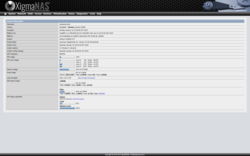 Screenshot of XigmaNAS WebGUI | |
| Developer(s) |
|
|---|---|
| Stable release | 12.3.0.4 (9073)
/ 7 June 2022 |
| Preview release | 13.1.0.5 (9284)
/ 4 August 2022 |
| Operating system | FreeBSD |
| Platform | x64 |
| Available in |
|
| Type | Computer storage |
| License | BSD license |
| Website | www |
XigmaNAS is network-attached storage (NAS) server software with a dedicated management web interface (written in PHP). It is free software under the terms of the Simplified BSD license.[1]
XigmaNAS is a continuation of the original FreeNAS code, which was developed between 2005 and late 2011. It was released under the name NAS4Free on 22 March 2012.[2][3] The name was changed to XigmaNAS in July 2018. On SourceForge, it was elected “'Community Choice' Project of the Month” twice, in August 2015 and March 2017.[4]
Technology[edit]
XigmaNAS is an embedded open-source NAS software distribution based on the latest release of FreeBSD.[5][4] It developed from original FreeNAS 7 code and updated to work with the current latest FreeBSD releases.[2] However, "XigmaNAS preserves FreeNAS’s original m0n0wall/PHP architecture and introduces experimental support for the ARM architecture."[6]
XigmaNAS supports sharing across Windows, Apple, and UNIX-like systems. It includes ZFS v5000, Software RAID (0,1,5), disk encryption, S.M.A.R.T. and email reports etc., with the following protocols: SMB, Samba Active Directory Domain Controller AD, FTP, NFS, TFTP, AFP, rsync, Unison (file synchronizer), iSCSI (initiator and target), HAST, CARP, Bridge, UPnP, and BitTorrent. All of this is configurable by its web interface.[citation needed]
Features[edit]
 | This section contains content that is written like an advertisement. (November 2022) |
- All XigmaNAS versions
- Hard drive and volume management
- Software RAID
- Disk encryption (using cryptographic accelerator card if present)
- Partition
- MBR, GPT
- iSCSI initiator
- Filesystems
- ZFS v5000, UFS
- Ext2, Ext3
- FAT, NTFS
- Networking
- 802.1q VLAN tagging
- Wireless
- Network link aggregation
- Wake On Lan
- Network Bridge
- CARP (Common Address Redundancy Protocol)
- HAST (Highly Available Storage)
- Network Protocols
- Server Message Block (SMB, one never used version was known as CIFS) (Samba)
- Active Directory Domain controller (Samba)
- Apple Filing Protocol (AFP) (Netatalk)
- Network File System (NFS)
- FTP (ProFTPD)
- TFTP (tftp-hpa)
- rsync (client/server)
- Unison
- SCP (SSH)
- iSCSI target
- Extra services
- UPnP server (FUPPES)
- UPnP server (MiniDLNA)
- iTunes/DAAP server (Firefly)
- Lighttpd (Webserver)
- Iperf Iperf3 Network Bandwidth measure
- Syncthing File synchronization application
- Transmission BitTorrent client
- VirtualBox Virtualbox included and managed by phpVirtualBox and noVNC on GUI
- Monitoring
- S.M.A.R.T. (smartmontools)
- Alert by E-mail
- SNMP
- Syslog
- UPS (NUT)
Installation[edit]
XigmaNAS is installable on almost any boot medium including LiveCD optionally with a small USB flash drive for config storage if necessary, both for x86-64 and x86-32 computer platforms up to version 10.3.[9] As of version 11.0, XigmaNAS no longer supports x86-32, but version 10.3 is still getting updates.[10] XigmaNAS can be installed on Compact Flash, USB flash drive, SSD, hard drive or other bootable devices, and supports advanced formatted drives using 4 kB sectors. The software distribution is currently distributed as in ISO image (.iso, ~370 MB) or USB flash drive image (.img, ~320 MB) format, and in source form.[citation needed]
Preferred embedded installation[edit]
A special small footprint embedded image is also available (.img, ~150 MB).[10] The preferred method is the embedded installation onto a USB stick, Compact Flash card (CF), or HDD/SSD, for which XigmaNAS was designed. The XigmaNAS OS will load into system memory, eliminating system writes to a drive except for configuration changes written to an archive. Flash devices are more energy efficient, and the updating process can be done by WebGUI in the browser, downloading and installing a new firmware image.[citation needed]
History[edit]
The original FreeNAS project derives from m0n0wall.[11]
The FreeNAS 0.7 branch was end-of-life'd in late 2011 after the FreeNAS name was legally acquired by iXsystems, Inc. Starting with version 8.x, new iXsystems developers rewrote FreeNAS and legacy FreeNAS 0.7 was no longer available for download.
The legacy FreeNAS 0.7 code was unable to be developed any longer under the same name, and a name change was necessary. The founder of FreeNAS (Olivier Cochard-Labbé) donated the original FreeNAS source code to the NAS4Free project. With the support of the former developers, namely Daisuke Aoyama and Michael Zoon, it carries on the original FreeNAS code base. FreeNAS 8.x.y and up is a software fork of the original FreeNAS with a new rewritten code-base, continuing the old branded name.[2] In 2018, the project applied for the XigmaNAS trademark in order to protect the brand[12] prior to the release of v11.2.
Awards[edit]
- SourceForge.net — Project of the Month, March 2017[13]
- SourceForge.net — Project of the Month, August 2015[14]
- SourceForge.net — Project of the Week, May 2015[15]
The awards listed below are legacy FreeNAS ones.
- VMware — "Ultimate Virtual Appliance Challenge, Consumer" (2008)[16]
- SourceForge.net — Project of the Month, January 2007[17]
- InfoWorld — Best of open source in storage (2008)[18]
See also[edit]
- OpenMediaVault
- Nexenta
- Openfiler
- FreeNAS
- Zentyal
- List of NAS manufacturers
- Comparison of iSCSI targets
- File area network
- Disk enclosure
- OpenWRT
References[edit]
- ^ "LICENSE". NAS4Free Documentation. The NAS4Free Project 2013. Retrieved 13 May 2013.
- ^ a b c "NAS4Free - The Free Network Attached Storage Project". The NAS4Free Project 2013. Retrieved 13 May 2013.
- ^ "NAS4Free as your cross-platform network filehub". podcasts. knightwise 2012. Retrieved 13 May 2013.
- ^ a b "March 2017, "Community Choice" Project of the Month – NAS4Free". sourceforge. Slashdot Media. March 2017. Retrieved 8 June 2017.
- ^ "General Information". NAS4Free. The NAS4Free Project 2013. Retrieved 13 May 2013.
- ^ "FreeNAS vs NAS4Free - High Level Comparison". freenas.org. iXsystems, Inc. Retrieved 8 June 2017.
- ^ As of 3/7/18, no i386 downloads are being offered any longer
- ^ As of September 18[when?], no ARM release was available
- ^ "nas4free [NAS4Free]". wiki.nas4free.org. Archived from the original on 8 May 2013.[user-generated source]
- ^ a b "Download NAS4Free 11.0". SourceForge & NAS4Free. Retrieved 30 November 2016.
- ^ "The Ars NAS distribution shootout: FreeNAS vs NAS4Free". 19 June 2014.
- ^ "Project is changed into XigmaNAS! - XigmaNAS". www.xigmanas.com. Archived from the original on 26 June 2019.
- ^ "Project of the Month, March 2017". SourceForge, Inc. March 2017. Retrieved 1 March 2017.
- ^ "Project of the Month, August 2015". SourceForge, Inc. August 2015. Retrieved 2 August 2015.
- ^ "Project of the Week May 2015". SourceForge, Inc. 18 May 2015. Retrieved 18 May 2015.
- ^ "FreeNAS is a Network-Attached Storage (NAS) server". VMware, Inc. Archived from the original on 5 May 2008. Retrieved 28 February 2008.
- ^ "Project of the Month January 2007". SourceForge, Inc. Archived from the original on 13 March 2008. Retrieved 28 February 2008.
- ^ "Best of open source in storage - 2007". InfoWorld. Retrieved 28 February 2008.
Further reading[edit]
Further readings prior to 2012 are referring to the legacy FreeNAS .07 precursor branch.
- "FreeNAS: A Simple Data Storage Solution". Radio World. 11 August 2009.
- "Network-Attached Storage on the Cheap". PC World. Washington Post. 27 August 2008.
- "Videotutorial with German Translator Falk". 079 – FreeNAS entfesselt. sysops.tv. 5 November 2010.
External links[edit]

Original source: https://en.wikipedia.org/wiki/XigmaNAS
Status: article is cached
 EncycloReader
is supported by the
EncycloReader
is supported by the  KSF
KSF