Complex square root
 From Wikiversity - Reading time: 4 min
Introduction[edit | edit source]
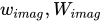
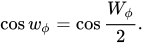
 Origin at point . parallel to axis. parallel to axis. By cosine double angle formula: Let complex numbers and Let
Similarly, are the corresponding components of are given.
and
|
























![{\displaystyle W_{mod}={\sqrt[{2}]{a^{2}+b^{2}}}}](https://wikimedia.org/api/rest_v1/media/math/render/svg/747cd6864432d237b6e52bc1c3edb8347afabb6c)
![{\displaystyle w_{mod}={\sqrt[{2}]{W_{mod}}}}](https://wikimedia.org/api/rest_v1/media/math/render/svg/76e2b2caab59537437f15dad5e7c950fc231dc2f)


Implementation[edit | edit source]
In the python programming language a complex square root is available for floating point numbers with a precision of 15.
# python code:
>>> (5.27 + 3.36*1j) ** 0.5
(2.4+0.7000000000000001j)
>>>
>>> (-18j) ** .5
(3-2.9999999999999996j)
>>>
Function cmath.sqrt() provides clean output:
# python code:
>>> import cmath
>>> cmath.sqrt (5.27 + 3.36*1j)
(2.4+0.7j)
>>> cmath.sqrt (-18j)
(3-3j)
>>>
If it is desired to calculate complex square root with precision greater than that available for python's floating point math,
the following code using python's decimal module will do the job. The following code also shows how complex square root
is calculated.
# python code:
import decimal

dD = decimal.Decimal
dgt = decimal.getcontext()
Precision = dgt.prec = 100   # Adjust as necessary.

def ComplexSquareRoot (v1, v2 = None) :
    '''
p,q = ComplexSquareRoot (a,b) or
p,q = ComplexSquareRoot ((a,b))
a,b are the real and imaginary parts of complex number W = (a+bi)
p,q are the real and imaginary parts of complex number w = (p+qi)
where W = w ** 2
This function preserves +/- 0 as calculated by python function cmath.sqrt().
'''
    thisName = 'ComplexSquareRoot (v1, v2 = None) :'
    if v2 == None : a,b = v1
    else : a,b = v1,v2

    dgt.prec += 3
    a,b = [ dD(str(v)) for v in (a,b) ]

    if b == 0 :
        if a == 0 : p,q = dD(0),b
        else :
            root = abs(a).sqrt()
            if a > 0: p,q = root, b
            else : p,q = dD(0), root.copy_sign(b)
    elif a == 0 :
        root = abs(b/2).sqrt()
        if b > 0 : p,q = root, root
        else : p,q = root, -root
    else :
        Wmod = (a**2 + b**2).sqrt()
        wmod = Wmod.sqrt()
        cosWφ = a/Wmod
#             2
# cos2A = 2cos A - 1
        coswφ = ((cosWφ + 1) / 2).sqrt()
        p = wmod * coswφ
        q = b /(2*p)

    dgt.prec -= 3
    return [ s.normalize() for s in (p,q) ]
Examples[edit | edit source]
# python code:

import cmath
sqrt = cmath.sqrt

for (a,b) in (
        (0.,0.), (0.,-0.), (-0.,0.), (-0.,-0.),
        (4,0.),  (4,-0.),  (-4,0.),  (-4,-0.),
        (0.,50), (0.,-50), (-0.,50), (-0.,-50),
        (-394200411798404114010884279663511687236816, 157994206778295991363266285626991662856270),
):
    result1 = ComplexSquareRoot (a,b)
    result2 = sqrt (complex(a,b))
    str1 = 'result1, result2' ; print (str1, eval(str1))
result1, result2 ([Decimal('0'), Decimal('0')], 0j)
result1, result2 ([Decimal('0'), Decimal('-0')], -0j)
result1, result2 ([Decimal('0'), Decimal('0')], 0j)
result1, result2 ([Decimal('0'), Decimal('-0')], -0j)

result1, result2 ([Decimal('2'), Decimal('0')], (2+0j))
result1, result2 ([Decimal('2'), Decimal('-0')], (2-0j))
result1, result2 ([Decimal('0'), Decimal('2')], 2j)
result1, result2 ([Decimal('0'), Decimal('-2')], -2j)

result1, result2 ([Decimal('5'), Decimal('5')], (5+5j))
result1, result2 ([Decimal('5'), Decimal('-5')], (5-5j))
result1, result2 ([Decimal('5'), Decimal('5')], (5+5j))
result1, result2 ([Decimal('5'), Decimal('-5')], (5-5j))

# Function ComplexSquareRoot() preserves precision of large numbers:
result1, result2 ([Decimal('123456789012345678935'), Decimal('639876543210987654321')], (1.2345678901234568e+20+6.398765432109876e+20j))
This article is licensed under CC BY-SA 3.0.
Original source: https://en.wikiversity.org/wiki/Complex square root
Status: article is cached
Original source: https://en.wikiversity.org/wiki/Complex square root
Status: article is cached
 EncycloReader
is supported by the
EncycloReader
is supported by the  KSF
KSF