The word "line" is open to many different interpretations, as in:
"That horse is descended from a great line of thoroughbreds." or
"Toe the line, or else!"
The concept of "line" in geometry is so basic that a definition may not be necessary. It might be better to say that a definition may not be possible (or adequate.)
Here are some possible definitions:
A line has length but no breadth. This "line" could not be seen under the most powerful microscope.
A line is the shortest possible distance between two fixed points. In astronomy the shortest possible distance between two fixed points might be curved. Some wit might argue that there is no such thing as a fixed point. After all every point on the surface of the earth is always moving.
A line is the locus of a point that moves from one fixed point to a second fixed point so that the distance traveled is the minimum possible. With current technology
the minimum possible distance between New York City and Rome follows the curvature of the earth.
The word "point" has been mentioned but not defined. Can we define a point?
If you draw a "line" on a piece of paper and then crumple the paper, what does this do to the line?
In this page the "line" is described in the context of Cartesian geometry in exactly two dimensions.
Figure 1. Cartesian plane illustrating many different lines.
How many lines do you see in Figure 1? The answer takes us into a mixture of philosophy and geometry.
One answer might be: "None. I see many images, each with the appearance of a rectangle and each containing a line such as
or ."
"You can't see the whole line . At best all you can see is a segment of the line between "
"Are the limits included or excluded?"
"Do you see the red line?"
"I see a red image with the appearance of a rectangle (or trapezoid, I can't be sure), probably representing the line ,
but it could represent the line ."
A second answer might be: "Too many for the current discussion. After all, the character contains 5 lines."
Let's go back to the original question: "How many lines do you see in Figure 1?"
While I see many more than 3, it seems that there are 3 of interest to this discussion and I answer: "Three."
"Describe them."
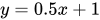
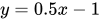
"A red line with equation , a blue line with equation and a green line with equation "
Despite the possibility of endless limitations and diversions such as those mentioned above, we accept this answer as satisfactory for the current discussion.
The line defined.
In figure 1, the blue line may be defined as just that: "the blue line." However, if we are to answer profound questions about the blue line, such as "How far is the blue line from the red?" or "Where do the blue and green lines intersect?" we need to define the blue line in algebraic terms.
The blue line is the line that passes through points and it has equation .
Calculate the values of :
and the equation of the blue line becomes: . This equation has the form where:
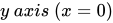
slope of blue line and the , the value of at the point where the line and the intersect.
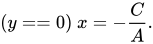
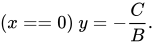
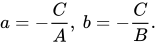
The red and green lines both intersect the at the point . The intercept is .
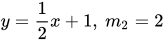
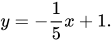
The red line has equation The green line has equation
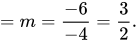
Slope of line
Figure 2. Slope of line illustrated. When increases by units, increases by units. Slope of oblique line When decreases by units, decreases by units. Slope of oblique line
See Figure 2. The oblique line passes through points
The oblique line has equation and it passes through the point
The intercept is and:
Oblique line has equation
Back to Figure 1. By inspection, and the red line has equation and
the green line has equation
Parallel lines
Figure 3. Parallel lines in the Cartesian plane. The 3 colored lines all have slope . Each colored line has equation: The 3 colored lines are parallel.
See Figure 3. The three colored lines are parallel because they all have the same slope
Remember that the lines are all parallel, as are the lines
Lines with same intercept
Figure 4. Lines with same intercept. The 3 colored lines all pass through point . They have the same intercept. Each colored line has equation:
See Figure 4. The colored lines represent the family of lines that pass through the point . There is one exception. The line
passes through the point but it cannot be represented by the equation
Note the red line. As increases, decreases, and the line goes down from left to right. Slope of the line is
and line has equation
Figure 1. Line as locus of point equidistant from 2 fixed points. Any point on line is equidistant from points
In this section the line is defined as the locus of a point that is always equidistant from two fixed points. In Figure 1 the two fixed points are
and the length is non-zero. By definition length = length
Let points have coordinates
Length
Length
Therefore:
Expand and the result is:
This equation has the form: where:
In Figure 1 the line through points has equation
If defined as the locus of a point equidistant from points the calculation of produces
the equation
If defined as the locus of a point equidistant from points the calculation of produces
the equation
Distance from point to line
Length .
Length is non-zero. Therefore, at least one of must be non-zero.
Length distance from point to line.
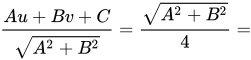
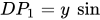
Consider the expression and substitute for
We show that or
If you make the substitutions and expand, you will see that the equality is valid.
Therefore distance from point to line.
Similarly we can show that distance from point to line.
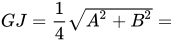
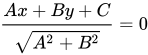
If the equation of the line has form: then
coefficient of coefficient of
If the equation of the line has
the distance from point to the line is
the distance from point to the line is and
Length and length have the same absolute value with opposite signs.
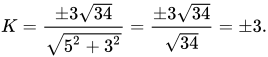
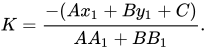
Use of multiplier K
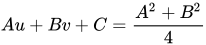
Consider the equation If this doesn't make sense.
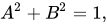
To make sense of the relationship introduce a multiplier become and the relationship is:
If
Consider the line and the point
If the equation of the line is expressed as
the equation makes sense, but the doesn't change.
the distance from point to the line as calculated above
with equation
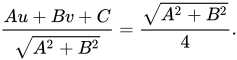
Calculation of the equation of the line equidistant from points initially produces:
Calculation of the equation of the line equidistant from points initially produces:
Figure 1. Graph illustrating normal form of straight line. ω. ω ω At point
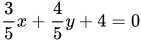
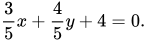
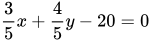
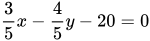
See Figure 1. The green line through point has equation or
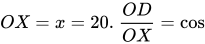
The normal to the line from the origin has length
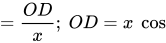
Let ω ω ω
The normal to the line is in the quadrant where cosine is negative and sine is positive.
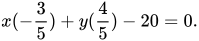
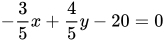
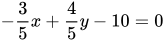
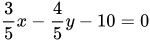
The normal form of the equation is ω ω or
This puts the origin on the negative side of the line.
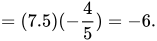
Directed distance from line to origin Directed distance from origin to line
Components of the normal form
Figure 2. Composition of normal form with point on line. ω; ω.
See Figure 2. This example shows line with point on the line.
The normal to the line is in the quadrant where cosine is positive and sine is positive.
ω
ω ω is the normal with length
Point has coordinates
ω ω
ω ω
The point is on the line.
Figure 3. Composition of normal form with point not on line. ω; ω. Points are from green line through
See Figure 3. This example shows line with point not on the line.
The normal to the line is in the quadrant where cosine is positive and sine is negative.
ω.
ω ω is the normal with length
Point has coordinates
ω ω
ω The negative value for establishes direction towards the origin.
The points are from the line indicating units toward the origin.
Normal form in practice
Figure 4. Three lines in normal form.
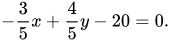
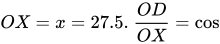
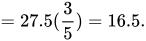
See Figure 4. The green line has equation and point is on the line.
The brown line has equation and point is on the line.
The brown and green lines are in the quadrant where cosine is negative and sine is positive.
Distance from brown line to origin
Distance from green line to origin
Distance from green line to point toward the origin.
Distance from brown line to point away from the origin.
Distance from green line to brown line toward the origin.
Distance from brown line to green line away from the origin.
The purple line has equation and point is on the line.
The purple line is in the quadrant where cosine is positive and sine is negative.
The purple and brown lines are parallel, but in opposite quadrants.
Distance from brown line to point toward the origin.
Distance from purple line to point toward the origin.
When calculating distance between brown and purple lines, it is important to see that they are in opposite quadrants. If direction is not important, you can say that the brown line has equation and the distance between them is
Figure 1. Direction numbers. Both sets of direction numbers are equivalent to
See Figure 1.
The red line has intercept and intercept
Slope of red line
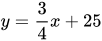
Red line has equation
When increases by increases by The line has
where represents a change in
and represents a corresponding change in
This section shows that the line may be defined using known
points and
Consider the points The value of at is the value of
at The change in between is represented by arrow with length
The value of at is the value of
at The change in between is represented by arrow with length
are the direction numbers of the red line at point
The red line passes through point with direction numbers
Consider the points
The red line passes through point with direction numbers
The direction numbers for the red line are consistent because they represent a ratio, the slope of the line.
Given the point and direction numbers the red line can be defined
as and the equation of the red line is
Given the point and direction numbers the red line can be defined
as and the equation of the red line is
the same as that calculated above.
For convenience, both sets of direction numbers can be expressed as
The equation of the red line is given as: hence direction numbers
Direction numbers are valid only if the distance between the two points of reference is non-zero. Therefore, at least one of must be non-zero.
Using direction numbers
1. Format of any point.
Given a line defined as any point on the line has format:
For example, if the red line in Figure 1 is defined as
any point on the line is If the point is or point
2. Normal to the line.
Refer to the section "Line as locus of a point" above. If the line has equation the
normal to the line has direction numbers
3. Point at specified distance.
Given a line defined as calculate the two points on the line at distance
from
Let one point at distance from have coordinates
Then
For example, given a line defined as calculate the two points on the line at
distance
from
The points are: or
4. Point at intersection of two lines.
Let one line have equation and let the other be defined as
Any point on the second line has format The point
satisfies the first equation. Therefore:
If the lines are parallel.
5. Angle between two lines.
Figure 2. Angle of intersection using direction numbers. Line has direction numbers Line has direction numbers
See Figure 2.
Line has direction numbers
Line has direction numbers
The aim is to calculate the angle between the two lines,
Figure 1. Angle of intersection using direction cosines. All values are direction cosines.
When a set of direction numbers has the direction numbers are direction cosines.
In Figure 1 All values are direction
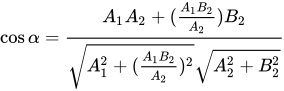
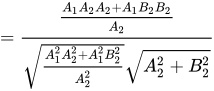
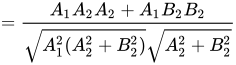
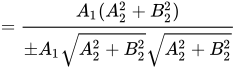
cosines. From 5 above, This statement is equivalent to:
or
For example, two lines have direction numbers Calculate the angle between them.
Convert to direction cosines:
°.
If ° or °, and the lines are parallel.
If ° or °, and the lines are perpendicular.
1. using direction cosines
Figure 2. Cos(2α) using direction cosines.
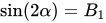
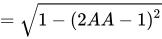
In Figure 2 line has direction numbers line has direction numbers
and The values are direction cosines.
This statement is equivalent to:
or
2. using direction cosines
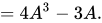
Figure 3. cos(3α) using direction cosines. All values are direction cosines
See Figure 3.
Lines are defined as respectively.
therefore:
3. using direction cosines
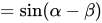
Figure 4. sin(α-β) using direction cosines. All values are direction cosines
See Figure 4.
Lines are defined as respectively.
Line has equation
Point has coordinates
Length
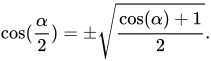
4. Bisect angle between lines using direction cosines
Figure 5. Bisect an angle using direction cosines. Line bisects Line has direction numbers
See Figure 5.
The aim is to produce line the bisector of
Lines are defined as
and respectively.
Ensure that all values are direction cosines.
At least one of and one of are non-zero.
Let line have direction numbers
Slope of line
Let line have direction numbers
if equals
if equals
Both lines are parallel and in same direction.
Three lines are colinear.
else :equals
The axis.
elifequalsequals
The axis.
elifequals
The lines are parallel and in opposite directions.
 From Wikiversity - Reading time: 27 min









































































































































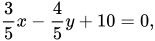


![{\displaystyle [A_{1},B_{1}]=[15,9].}](https://wikimedia.org/api/rest_v1/media/math/render/svg/b83a9408ee1f34f93f364d274ebbbf32c40cc7be)
![{\displaystyle [A_{2},B_{2}]=[-45,-27].}](https://wikimedia.org/api/rest_v1/media/math/render/svg/68c2d944b5269b88ce639c2399b3b268035acc37)
![{\displaystyle [5,3].}](https://wikimedia.org/api/rest_v1/media/math/render/svg/a78e0b7b751a5b2d9d919bdbb8d98f0781875afe)


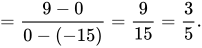


![{\displaystyle direction\ numbers\ [A,B]=[1,{\frac {3}{5}}]}](https://wikimedia.org/api/rest_v1/media/math/render/svg/ccfeae3e6581d4513f1dd2911c6b62aeef69bb1e)












![{\displaystyle [15,9],[-45,-27]}](https://wikimedia.org/api/rest_v1/media/math/render/svg/f55569cd608f15e4e919a4a7796ab4c634b9b786)

![{\displaystyle [A_{1},B_{1}]=[15,9],}](https://wikimedia.org/api/rest_v1/media/math/render/svg/49870a3a7d485fe6b2967edbcf396a3bcaaa062c)
![{\displaystyle (5,12),[15,9]}](https://wikimedia.org/api/rest_v1/media/math/render/svg/edb0a5f87f03e03cded893494411767b3d147548)

![{\displaystyle [A_{2},B_{2}]=[-45,-27],}](https://wikimedia.org/api/rest_v1/media/math/render/svg/ec6e7297e3352f4c25e003f6c014f40c5b26d852)
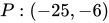
![{\displaystyle (-25,-6),[-45,-27]}](https://wikimedia.org/api/rest_v1/media/math/render/svg/46d8bcb5295d7e0f202a40afd2566d14b1efe090)


![{\displaystyle [A_{3},B_{3}]=[1,{\frac {3}{5}}]=[5,3].}](https://wikimedia.org/api/rest_v1/media/math/render/svg/88e5ac5b0caa17e3e3d4e26c3759693ea7b23a87)
![{\displaystyle [A,B]}](https://wikimedia.org/api/rest_v1/media/math/render/svg/1993067bb075f2ebfa02e78959b7c5bed68e06f4)
![{\displaystyle (x_{1},y_{1}),[A_{1},B_{1}]}](https://wikimedia.org/api/rest_v1/media/math/render/svg/2a198fc6d4b72d0a1e89eb778dc313c4d544e3c1)

![{\displaystyle (5,12),[5,3],}](https://wikimedia.org/api/rest_v1/media/math/render/svg/7f41cf867d5f1faea4e95181d046316c133c3a74)




![{\displaystyle [A,B].}](https://wikimedia.org/api/rest_v1/media/math/render/svg/f45c17782d9bcf79842f0650f6fa847a627dc032)




![{\displaystyle (-15,0),[5,3]}](https://wikimedia.org/api/rest_v1/media/math/render/svg/186726a68f99837247128944fcc76382b5543e7f)




![{\displaystyle (x_{1},y_{1}),[A_{1},B_{1}].}](https://wikimedia.org/api/rest_v1/media/math/render/svg/00977021f42082dd8809ddee05df7c9177bfcf87)







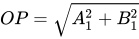
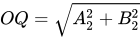
![{\displaystyle [A_{1},B_{1}].}](https://wikimedia.org/api/rest_v1/media/math/render/svg/70791a88c7279c0eebf3f507d89fb81c0028ca41)

![{\displaystyle [A_{2},B_{2}].}](https://wikimedia.org/api/rest_v1/media/math/render/svg/ca800d3e42d43607626760eb6171d2a5e0941f72)








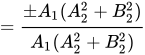


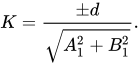
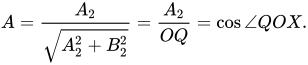
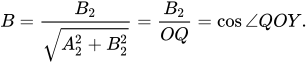
![{\displaystyle [A,B]=[{\frac {A_{2}}{\sqrt {A_{2}^{2}+B_{2}^{2}}}},{\frac {B_{2}}{\sqrt {A_{2}^{2}+B_{2}^{2}}}}].}](https://wikimedia.org/api/rest_v1/media/math/render/svg/c81cc543d36fd2647bc1f2735588f5952af4b068)



![{\displaystyle [A_{1},B_{1}],\ [A_{2},B_{2}]}](https://wikimedia.org/api/rest_v1/media/math/render/svg/478386015336815d969093c469059aca2f985b89)







![{\displaystyle [1,1],\ [{\sqrt {3}},1].}](https://wikimedia.org/api/rest_v1/media/math/render/svg/32866f825597d0b71e0ed715547881d72a761449)
![{\displaystyle [{\frac {\sqrt {2}}{2}},{\frac {\sqrt {2}}{2}}],\ [{\frac {\sqrt {3}}{2}},{\frac {1}{2}}].}](https://wikimedia.org/api/rest_v1/media/math/render/svg/23df4390f8f290177d06087e7f52344d6feb6b2e)






_using_direction_cosines_01.png)



![{\displaystyle [A,B],}](https://wikimedia.org/api/rest_v1/media/math/render/svg/c10ade1cc555c33ddd8041d68ea07eb9b7fb6dae)
![{\displaystyle [A,-B]}](https://wikimedia.org/api/rest_v1/media/math/render/svg/aa3b5b8f1cfa07bfef2ad4aa168e5ae37212250f)










_using_direction_cosines_00.png)

![{\displaystyle [A_{1},B_{1}],\ [A,B]}](https://wikimedia.org/api/rest_v1/media/math/render/svg/6e9e2502e373d03561d07a6635059051c3273cd1)


![{\displaystyle (0,0),[A_{1},B_{1}];}](https://wikimedia.org/api/rest_v1/media/math/render/svg/1e02ca744138fa64407d6ed180f54760b39394b3)
![{\displaystyle (0,0),[A,B];}](https://wikimedia.org/api/rest_v1/media/math/render/svg/c3e30b1629e47bb3ac49cade09a7cd4098632d88)
![{\displaystyle (0,0),[A,-B]}](https://wikimedia.org/api/rest_v1/media/math/render/svg/457d8e53fdc18033147e7986855ea89e2ef1194d)















_using_direction_cosines_00.png)


![{\displaystyle (0,0),[A_{2},B_{2}]}](https://wikimedia.org/api/rest_v1/media/math/render/svg/606974fcdfda240a55b618ba9d4660dca1606420)









![{\displaystyle [B_{2}-B_{1},A_{1}-A_{2}].}](https://wikimedia.org/api/rest_v1/media/math/render/svg/29b9f33ae7010c18f6b677d4a8076acb470c7deb)


![{\displaystyle (0,0),[A_{1},B_{1}]}](https://wikimedia.org/api/rest_v1/media/math/render/svg/944a6ce66c8486f81d9541c4de8d856437ebded2)





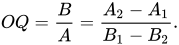
![{\displaystyle [A,B]=[B_{1}-B_{2},\ A_{2}-A_{1}].}](https://wikimedia.org/api/rest_v1/media/math/render/svg/3e17bb055c6c865305529117cf5d5f6a96477145)



![{\displaystyle \ \ \ \ \ \ \ \ \ \ \ \ \ \ \ \ [A,\ B]\ =\ [A_{1},\ B_{1}]}](https://wikimedia.org/api/rest_v1/media/math/render/svg/009d9da43f10973a44b518597d7a060ee9bc4995)


![{\displaystyle \ \ \ \ \ \ \ \ \ \ \ \ \ \ \ \ [A,\ B]\ =\ [0,\ 1]\ \#}](https://wikimedia.org/api/rest_v1/media/math/render/svg/c72b8074baf04967af738c98725a834e56757cd3)


![{\displaystyle \ \ \ \ \ \ \ \ [A,\ B]\ =\ [1,\ 0]\ \#}](https://wikimedia.org/api/rest_v1/media/math/render/svg/2b7628ed88aa52beea9bafbc2465c39787990b58)




![{\displaystyle \ \ \ \ \ \ \ \#\ [A,\ B]\ =\ [B_{1}-(-B_{1}),\ -A_{1}-A_{1}]\ =\ [2B_{1},\ -2A_{1}]}](https://wikimedia.org/api/rest_v1/media/math/render/svg/9ad19de6aa5e494096e8ab2a53df4a5b629c5e22)
![{\displaystyle \ \ \ \ \ \ \ \ [A,\ B]\ =\ [B_{1},\ -A_{1}]\ \#}](https://wikimedia.org/api/rest_v1/media/math/render/svg/5dd553158b85d3d1e6867627b0203637215448d8)






_using_direction_cosines_00.png)







![{\displaystyle (A_{1}A_{2},B_{1}A_{2}),[-B_{1},A_{1}].}](https://wikimedia.org/api/rest_v1/media/math/render/svg/34cc55bfccc29138b8cc6c3e3452445fec7c5ba1)





























 EncycloReader
is supported by the
EncycloReader
is supported by the  KSF
KSF