Lip
 From Wikidoc - Reading time: 6 min
Editor-In-Chief: C. Michael Gibson, M.S., M.D. [1]
Overview
[edit | edit source]|
WikiDoc Resources for Lip |
|
Articles |
|---|
|
Media |
|
Evidence Based Medicine |
|
Clinical Trials |
|
Ongoing Trials on Lip at Clinical Trials.gov Clinical Trials on Lip at Google
|
|
Guidelines / Policies / Govt |
|
US National Guidelines Clearinghouse on Lip
|
|
Books |
|
News |
|
Commentary |
|
Definitions |
|
Patient Resources / Community |
|
Directions to Hospitals Treating Lip Risk calculators and risk factors for Lip
|
|
Healthcare Provider Resources |
|
Continuing Medical Education (CME) |
|
International |
|
|
|
Business |
|
Experimental / Informatics |
Lips are a visible organ at the mouth of humans and many animals. Both lips are soft, protruding, movable, and serve primarily for food intake, as a tactile sensory organ, and in articulation of speech.
Anatomical basics of the human lip
[edit | edit source]One differentiates between the Upper (Labium superioris) and lower lip (Labium inferioris). The lower lip is usually somewhat larger. The border between the lips and the surrounding skin is referred to as the vermilion border, or simply the vermilion. The vertical groove on the upper lip is known as the philtrum. The entire skin between the upper lip and the nose is referred to as the "ergotrid".
The skin of the lip, with three to five cellular layers, is very thin compared to typical face skin, having up to 16 layers. With light skin color, the lip skin contains no melanocyte (pigment cells, which give skin its color). Because of this, the blood vessels appear through the skin of the lips, which leads to their notable red coloring. With darker skin color this effect is less prominent, as in this case the skin of the lips contains more melanin and thus is visually thicker.
The lip skin is not hairy and does not have sweat glands or sebaceous glands. Therefore, it does not have the usual protection layer of sweat and body oils which keep the skin smooth, kill pathogens, and regulate warmth. For these reasons, the lips dry out faster and become chapped more easily.
Anatomy in detail
[edit | edit source]The skin of the lips is stratified squamous epithelium. The mucous membrane is represented by a large area in the sensory cortex and is therefore highly sensitive. The Frenulum Labii Inferioris is the frenulum of the lower lip. The Frenulum Labii Superioris is the frenulum of the upper lip.
Sensory nerve supply
[edit | edit source]- Trigeminal nerve
- The infraorbital nerve is a branch of the maxillary branch. It supplies not only the upper lip, but much of the skin of the face between the upper lip and the lower eyelid, except for the bridge of the nose.
- The mental nerve is a branch of the mandibular branch ( via the inferior alveolar nerve). It supplies the skin and mucous membrane of the lower lip and labial gingiva (gum) anteriorly.
Blood supply
[edit | edit source]The facial artery is one of the six non-terminal branches of the external carotid artery. It supplies the lips by its superior and inferior labial branches, each of which bifurcate and anastomose with their companion artery from the other side.
Muscles acting on the lips
[edit | edit source]The muscles acting on the lips are considered part of the muscles of facial expression. All muscles of facial expression are derived from the mesoderm of the second pharyngeal arch, and are therefore supplied (motor supply) by the nerve of the second pharyngeal arch, the facial nerve (7th cranial nerve). The muscles of facial expression are all specialised members of the paniculus carnosus, which attach to the dermis and so wrinkle or dimple the overlying skin. Functionally, the muscles of facial expression are arranged in groups around the orbits, nose and mouth.
The muscles acting on the lips:
- sphincters of the oral orifice
- anchor point for several muscles
- modiolus
- lip elevation
- lip depression
Functions of the lips
[edit | edit source]Food intake
[edit | edit source]Because they have their own muscles and bordering muscles, the lips are very movable. Lips are used for eating functions, like holding food or to get it in the mouth. In addition, lips serve to close the mouth airtight shut, and to hold food and drink inside, and to keep out unwanted objects. Through making a narrow funnel with the lips, the suction of the mouth is increased. This suction is essential for babies to breast feed.
Tactile organ
[edit | edit source]The lip has many nerve endings and reacts as part of the tactile (touch) senses. Lips are very sensitive to touch, warmth, and cold. It is therefore an important aide for exploring unknown objects for babies and toddlers.
Articulation
[edit | edit source]The lips serve for creating different sounds - mainly the labial, bilabial and labiodental consonant sounds - and thus create an important part of the speech apparatus. The lips enable whistling and the performing of wind instruments like the trumpet, clarinet, and flute.
Facial expressions
[edit | edit source]See Full Article: facial expression. The lips visibly express emotions.
Erogenous zone
[edit | edit source]Because of its high amounts of nerve endings, the lips make an erogenous zone. Lips play a crucial role in kissing and other acts of intimacy.
Lips are a visible expression of fertility. It has been shown that the more estrogen a woman has the fuller her lips and that full lips are considered attractive.([2]Indeed lipstick "tricks" men into thinking that a women has more estrogen than she actually has and thus finding her more attractive.[3]
Symbolic meaning
[edit | edit source]Lips are often viewed as a symbol for sensuality. This has many origins; above all that they are very sensitive as a tactile organ and feel pleasantly soft. It has been suggested that female lips are seen as sexually attractive because they mimic the appearance and sexual swelling of the labia of the vulva, and that the lips are therefore a secondary sex characteristic. [4] Additionally, they are a part of the mouth and so are associated with its symbolic connections (see for example oral stage of the psychology according to Sigmund Freud).
Changes to the lip
[edit | edit source]- One of the most frequent changes of the lips is a blue coloring due to cyanosis; the blood contains less oxygen and thus has a dark red to blue color, which shows through the thin skin. Cyanosis is the reason why corpses always have blue lips. In cold weather cyanosis can appear, so especially in the winter blue lips may not be an uncommon sight.
- Lips can (temporarily) swell. The reasons for this are varied and can be from sexual stimulation, injuries and side effects of medications or misallignment of teeth.
- Cracks or splits in the angles of the lips could be the result of an inflammation of the lips, Angular cheilitis.
Diseases
[edit | edit source]As an organ of the body, the lip can be a focus of disease or show symptoms of a disease:
- Lip herpes (technically Herpes labialis, a form of herpes simplex) is a viral infection which appears in the formation of painful blisters at the lip.
- Carcinoma at the lips is caused predominantly by using tobacco and overexposure of sunlight. To a lesser extent, it could also come from lack of oral hygiene or poor fitting dentures. Alcohol appears to increase the carcinoma risk of tobacco use.
- Infections from lip rings.
References
[edit | edit source]Scientific Sources:
- Nozomi Tomiyama, DDS; Toshimichi Ichida, DDS, PhD; Kazunori Yamaguchi, DDS, PhD: Electromyographic Activity of Lower Lip Muscles When Chewing with the Lips in Contact and Apart. The Angle Orthodontist, Vol. 74, No. 1, pp. 31–36. February 2003
- Marcus Bisson, BMed Sci, BM, BS, MRCS; Adriaan Grobbelaar, MBChB, MMed(Plast), FCS(SA), FRCS(Plast): The Aesthetic Properties of Lips: A Comparison of Models and Nonmodels. The Angle Orthodontist, Vol. 74, No. 2, pp. 162–166. June 2003
- McMinn, RMH (Ed) (1994) Last's Anatomy: Regional and applied (9th Ed). London: Churchill Livingstone. ISBN 0-443-04662-X
Additional images
[edit | edit source]-
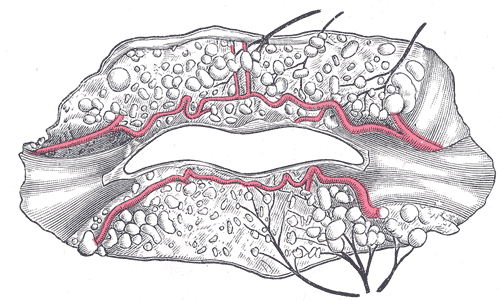 The labial coronary arteries, etc.

External links
[edit | edit source]
Template:Head and neck general
Template:Oral pathology
ar:شفة
ast:Llabiu
de:Lippe
eo:Lipo
ko:입술
it:Labbro
he:שפתיים
la:Labia oris
nl:Lip
nn:Lippe
sq:Buza
simple:Lip
fi:Huulet
sv:Läpp
yi:ליפן
 EncycloReader
is supported by the
EncycloReader
is supported by the  KSF
KSF