Categories
Measles physical examination
 From Wikidoc - Reading time: 3 min
|
Measles Microchapters |
|
Diagnosis |
|---|
|
Treatment |
|
Case Studies |
|
Measles physical examination On the Web |
|
American Roentgen Ray Society Images of Measles physical examination |
|
Risk calculators and risk factors for Measles physical examination |
Editor-In-Chief: C. Michael Gibson, M.S., M.D. [1]Vidit Bhargava, M.B.B.S [2]
Overview
[edit | edit source]Measles is a condition, that is best diagnosed clinically based on a constellation of signs and symptoms. Fever, rash and conjunctivitis are 3 major physical findings that must be looked out for, while making the diagnosis of measles.[1][2]
Physical Examination
[edit | edit source]Vitals
[edit | edit source]Temperature
[edit | edit source]- A high fever is always present, it could be as high as 105°F.
Pulse
[edit | edit source]- Tachycardia may be present, specially with the onset of fever.
Respiratory Rate
[edit | edit source]Skin
[edit | edit source]Rash
[edit | edit source]- Three to five days after the start of symptoms, a red or reddish-brown itchy rash appears.
- The rash usually begins on a person’s face at the hairline and spreads downward to the neck, trunk, arms, legs, and feet.
- It also regresses in the same manner as it appeared in about 5-7 days.
- The rash is blanching, maculopapular in nature to begin with but may coalesce later to become plaques and patches.
- When the rash appears, a person’s fever may spike to more than 104°F.
- Shown below are images depicting the characteristic rash of measles.
Images obtained from the Public Health Image Library[3]
-
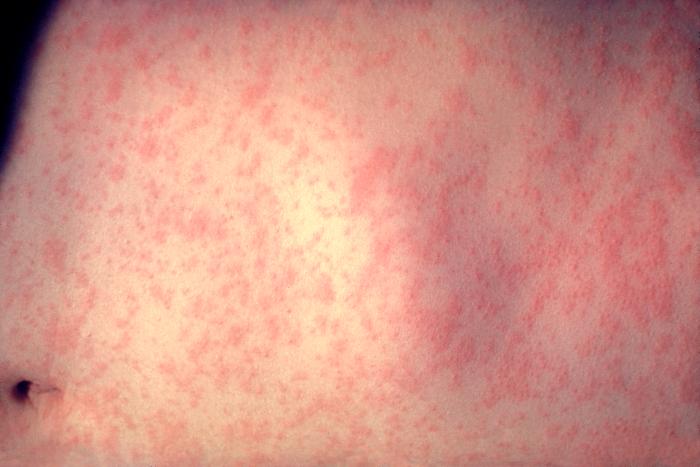 Image showing measles rash on day 3.
 -
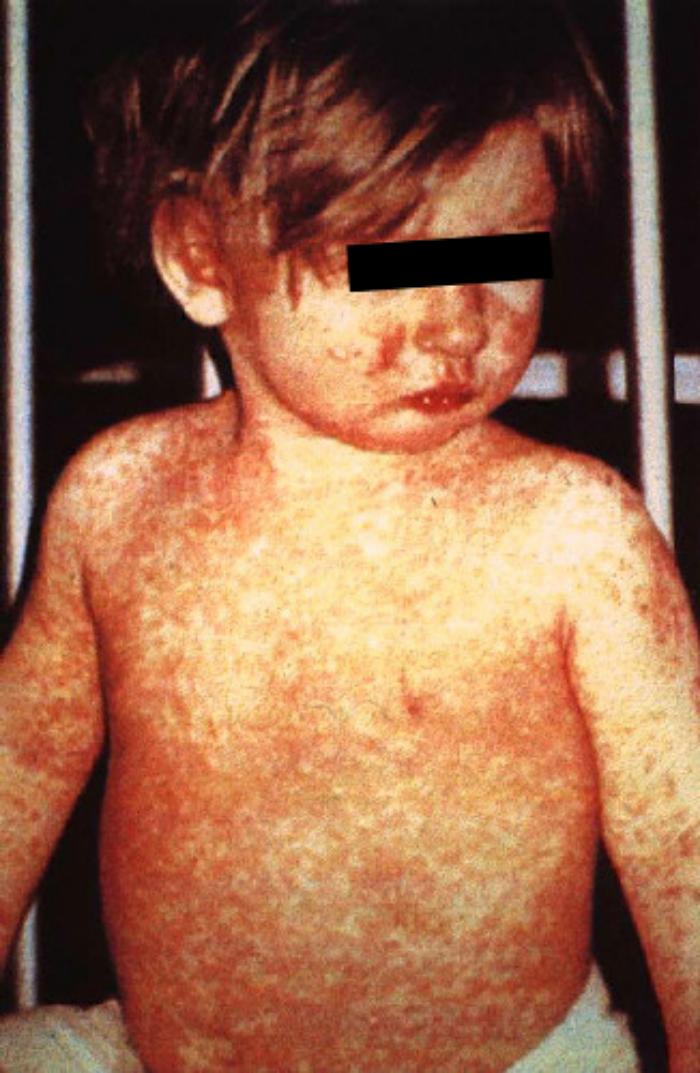 Image showing characteristic day 4 appearance of measles rash.
 -
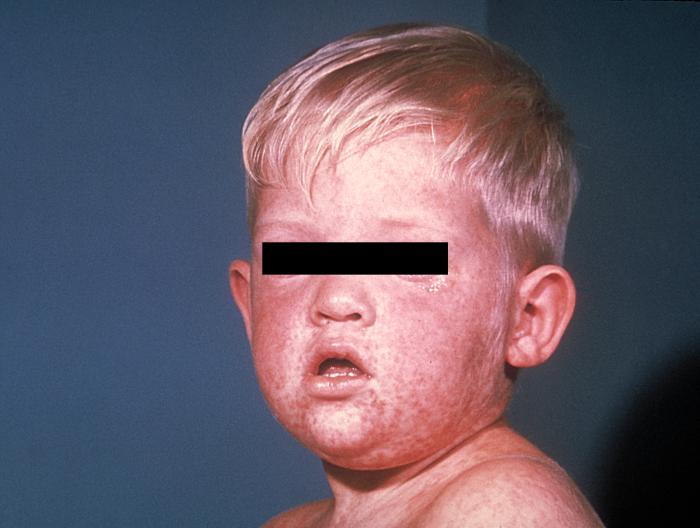 Typical appearance of rash on day 3, measles.
 -
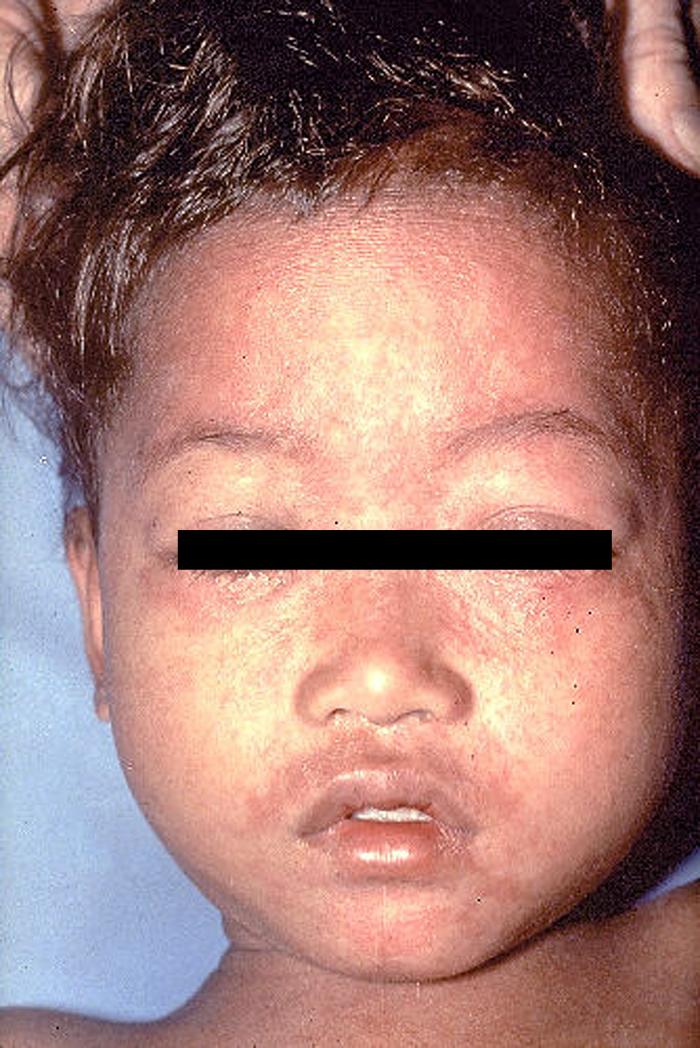 Face of child with measles.
 -
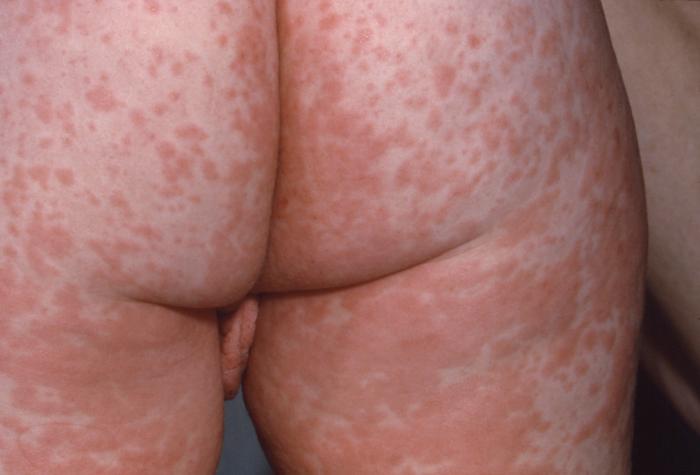 Characteristic red blotchy pattern on his buttocks during 3rd day of the rash.


Eyes
[edit | edit source]Conjunctivitis
[edit | edit source]- Conjuntivitis, also known as pink eye, is one of the 3 'C' 's in the classical 3 'C' presentation of measles (other 2 being cough and coryza).
- Shown below is an image illustrating pink eye in a child with measles:
Images obtained from the Public Health Image Library[3]
-
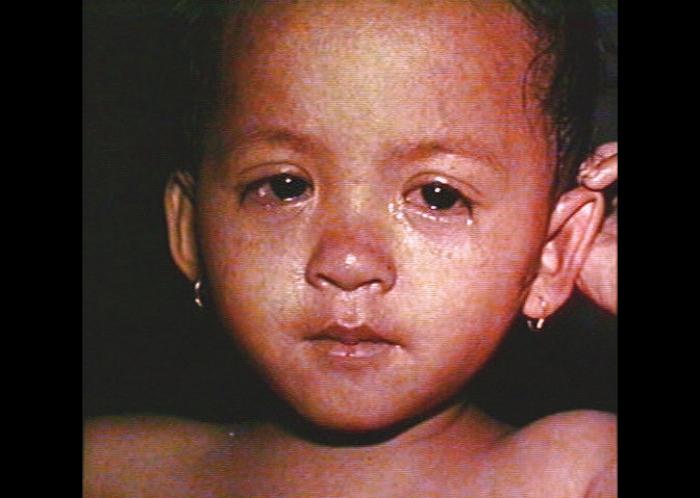 Conjunctivitis (pink eye) in a child with measles

Throat
[edit | edit source]Koplik's spots
[edit | edit source]- Koplik's spots are tiny white spots with erythematous base and bluish-white centers found inside the mouth at the base of second molars.
- These appear usually 2-3 days after initial prodrome and may or may not persist until the rash disappears.
- Although they are pathognomic, Koplik's spots are not present in all the cases.
- Its absence does not exclude the diagnosis of measles.
Images obtained from the Public Health Image Library[3]
-
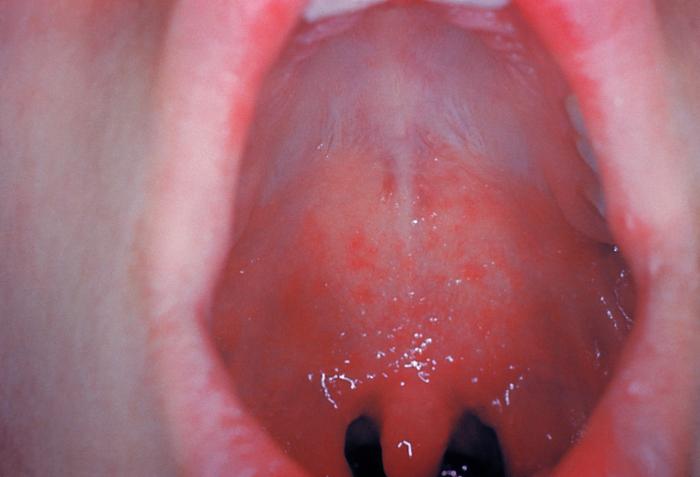 Image showing bluish-grey spots on an erythematous base known as Koplik's spots
 -
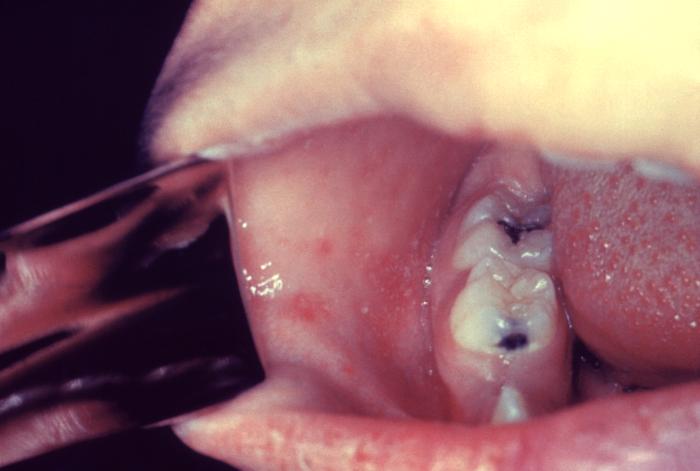 Image showing Koplik's spots opposite the base of second molars.


References
[edit | edit source]Licensed under CC BY-SA 3.0 | Source: https://www.wikidoc.org/index.php/Measles_physical_examination6 views | ↧ Download this article as ZWI file
 EncycloReader
is supported by the
EncycloReader
is supported by the  KSF
KSF