Categories
Annona foetida
 From Wikipedia - Reading time: 5 min
| Annona foetida | |
|---|---|
Scientific classification 
| |
| Kingdom: | Plantae |
| Clade: | Tracheophytes |
| Clade: | Angiosperms |
| Clade: | Magnoliids |
| Order: | Magnoliales |
| Family: | Annonaceae |
| Genus: | Annona |
| Species: | A. foetida
|
| Binomial name | |
| Annona foetida | |
| Synonyms | |
|
Annona trunciflora R.E.Fr. | |
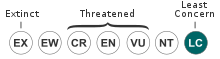
Annona foetida is a species of plant in the family Annonaceae. It is native to Bolivia, Brazil, Colombia, French Guiana, Peru and Suriname.[2] Carl Friedrich Philipp von Martius, the German botanist who first formally described the species, named it after its foul-smelling (fetidus in Latin) odor.[3][4]
Description[edit]
It is a shrub or a tree reaching 3.3-3.9 meters in height. Its dark gray-brown bark is tough and flexible. Its leaves are 10.8-21.6 by 4.1-8.1 centimeters and come to an abrupt point at their tips. Its petioles are 6.8 millimeters long. Its fruit are reddish-brown and the size of a goose egg. Its seeds are flat, yellowish, ovals, 9 millimeters in length. Its bark and unripe fruit have a remarkably foul odor.[4]
Reproductive biology[edit]
The pollen of Annona foetida is shed as permanent tetrads.[5] It is pollinated by the scarab beetle Cyciocephala undata.[6]
Habitat and distribution[edit]
It grows in forest habitats. Its fruit mature in December.[4]
Uses[edit]
Bioactive compounds extracted from leaves, bark and branches have been reported to have antimicrobial, antileishmanial and antitrypanosomal activities.[7][8][9]
References[edit]
- ^ Verspagen, N.; Erkens, R.H.J. (2021). "Annona foetida". IUCN Red List of Threatened Species. 2021: e.T142424385A142424391. doi:10.2305/IUCN.UK.2021-1.RLTS.T142424385A142424391.en. Retrieved 20 Jun 2022.
- ^ "Annona foetida Mart". Plants of the World Online. The Trustees of the Royal Botanic Gardens, Kew. n.d. Retrieved January 2, 2019..
- ^ Stearn, William (2004). Botanical Latin. Portland, Ore. Newton Abbot: Timber Press David & Charles. ISBN 9780881926279.
- ^ a b c Martius, Karl Friedrich Philipp von; Eichler, August Wilhelm (1841). Flora Brasiliensis, enumeratio plantarum in Brasilia hactenus detectarum (in Latin). Vol. 13. Munich & Leipzig: R. Oldenbourg. doi:10.5962/bhl.title.454.
- ^ Walker, James W. (1971). "Pollen Morphology, Phytogeography, and Phylogeny of the Annonaceae". Contributions from the Gray Herbarium of Harvard University. 202 (202): 1–130. JSTOR 41764703.
- ^ Küchmeister, Heike; Webber, Antonio C.; Silberbauer-Gottsberger, Ilse; Gottsberger, Gerhard (1998). "A polinização e sua relação com a termogênese em espécies de Arecaceae e Annonaceae da Amazônia Central" [Pollination and its relation with thermogenesis in Arecaceae and Annonaceae species of Central Amazonia]. Acta Amazonica (in Portuguese). 28 (3): 217. doi:10.1590/1809-43921998283245. ISSN 0044-5967.
- ^ Costa, Emmanoel Vilaça; Pinheiro, Maria Lúcia Belém; Silva, Jefferson Rocha de Andrade; Maia, Beatriz Helena Lameiro de Noronha S; Duarte, Marta Cristina Teixeira; Amaral, Ana Cláudia Fernandes; Machado, Gérzia Maria de Carvalho; Leon, Leonor Laura (2009). "Antimicrobial and antileishmanial activity of essential oil from the leaves of Annona foetida (Annonaceae)". Química Nova. 32 (1): 78–81. doi:10.1590/S0100-40422009000100015. ISSN 0100-4042.
- ^ Costa, Emmanoel V.; Pinheiro, Maria Lúcia B.; Xavier, Clahildek M.; Silva, Jefferson R. A.; Amaral, Ana Cláudia F.; Souza, Afonso D. L.; Barison, Andersson; Campos, Francinete R.; Ferreira, Antonio G.; Machado, Gérzia M. C.; Leon, Leonor L. P. (2006). "A Pyrimidine-β-carboline and Other Alkaloids fromAnnonafoetidawith Antileishmanial Activity" (PDF). Journal of Natural Products. 69 (2): 292–294. doi:10.1021/np050422s. ISSN 0163-3864. PMID 16499336.
- ^ Costa, Emmanoel Vilaça; Pinheiro, Maria Lúcia Belém; Souza, Afonso Duarte Leão de; Barison, Andersson; Campos, Francinete Ramos; Valdez, Rodrigo Hinojosa; Ueda-Nakamura, Tânia; Filho, Benedito Prado Dias; Nakamura, Celso Vataru (2011). "Trypanocidal Activity of Oxoaporphine and Pyrimidine-β-Carboline Alkaloids from the Branches of Annona foetida Mart. (Annonaceae)". Molecules. 16 (11): 9714–9720. doi:10.3390/molecules16119714. ISSN 1420-3049. PMC 6264547. PMID 22113579.
External links[edit]
.jpg) | This Annonaceae article is a stub. You can help Wikipedia by expanding it. |
 EncycloReader
is supported by the
EncycloReader
is supported by the  KSF
KSF